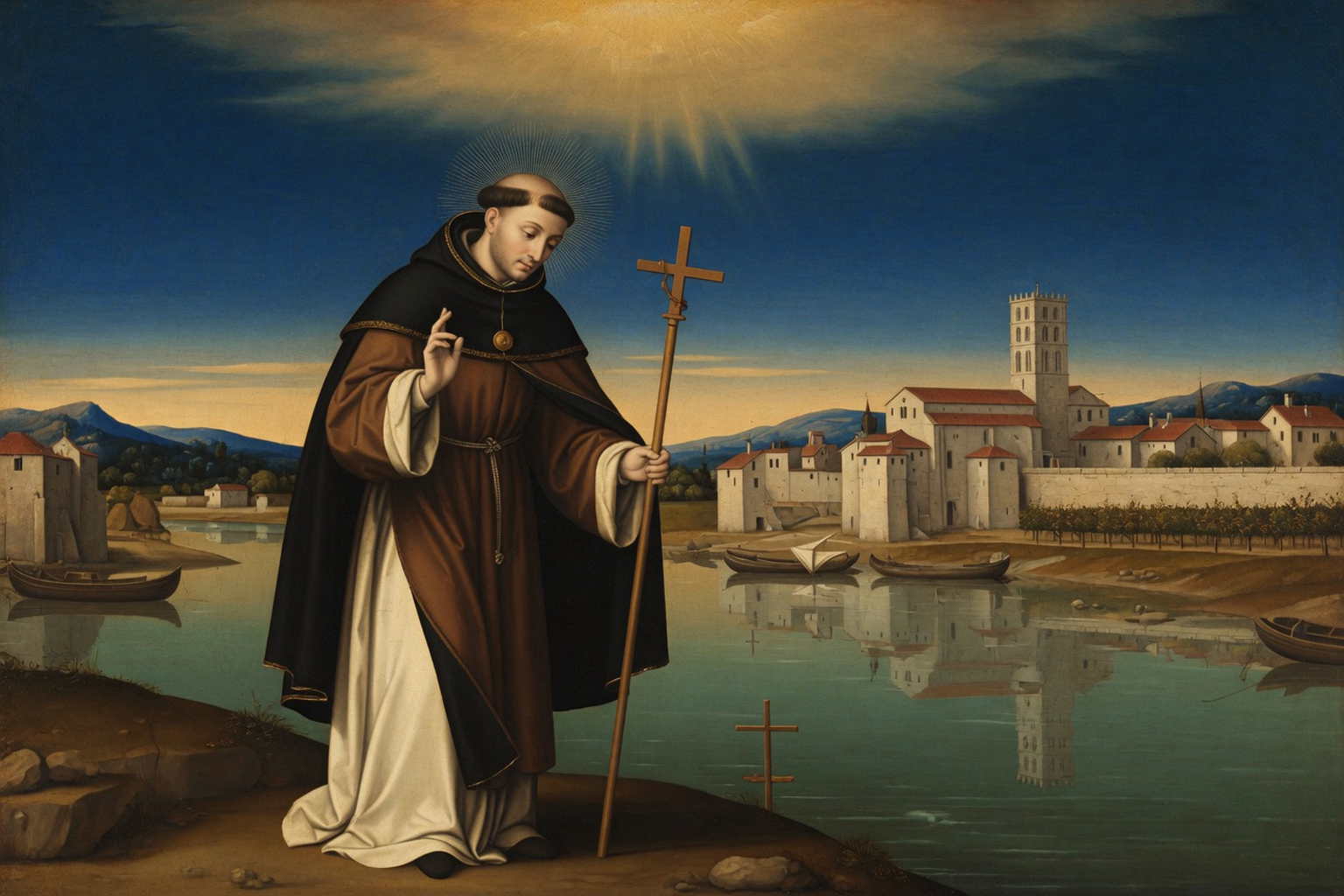
Saint Clair was a 7th-century abbot in Vienne, recognized for his early piety and his leadership of the monasteries of Sainte-Blandine and Saint-Marcel. Renowned for his miracles, notably on the Rhône, he prophesied future invasions before dying around 660. His cult remains active in the Dauphiné and Savoy regions, particularly for eye ailments.
Guided reading
8 reading sections
SAINT CLAIR, ABBOT.
Origins and Pious Education
Born near Vienne, Clair is raised in piety by his widowed mother, assiduously frequenting the churches of the martyrs.
Died circa 660. — Pope, Vitalian. — King of France, Clotaire III.
"I have chosen thee to adorn the holy place." Jest., cx. 13.
The lif e of Saint Clair (Cl Saint Clair (Clarus) Priest and martyr of English origin, hermit in the Vexin. arus) was written by a very ancient author, whose name is unknown, but who displays great accuracy and faithfulness. This Saint was born in the vicinity of Vienne , in a Vienne Episcopal see and principal city of the saint's activity. village situated on the banks of the Rhô ne wh Rhône River into which the bodies of the martyrs were thrown. ich today bears his name. He lost his father while still a child; his mother, a very virtuous woman, took great care of his education; she trained him early in Christian virtues and the practices of true piety. She often took him to the churches of the holy Martyrs in Vienne, for she lived in a suburb of the city called Beauchamp; and as she spent several hours in prayer before the tombs of the Saints, she so accustomed her child to this exercise that, young as he was, he soon became a man of prayer. One day when they had gone together to the church of Saint Ferréol, martyr, which was on the other side of the Rhône, their Saint-Ferréol Brother of Tarcisius and Bishop of Uzès. hearts were so softened by feelings of sweet compunction that, forgetting all else, they remained there almost until nightfall. Evening having come, they boarded a boat to cross the water and return to their home; but such a great wind and furious storm arose that the boatmen themselves despaired of ever being able to reach the shore. The blessed child, stretching his hands toward the church of Saint Ferréol, and shedding many tears, made this prayer to God:
The Miracle of the Storm
As a child, Clarus calms a violent storm on the Rhône through his prayer while returning from the church of Saint-Ferréol.
"O God! for whose name the glorious martyr Saint Ferréol endured death, deliver us from this peril." Sa prayer was immediately answered, for at the same time the storm ceased, the waves calmed, and the boat reached the shore on the side of Vienne imperceptibly. This miracle filled those who were crossing the water with him with astonishment, and they could not help, while thanking God, but also exalt the virtue and power of His servant.
Monastic Ascension in Vienne
Clair entered the monastery of Saint-Ferréol before directing that of Sainte-Blandine, then becoming abbot of Saint-Marcel.
There were, at that time, partly in Vienne and partly around Vienne, eight great monasteries, where no fewer than fourteen hundred religious persons lived, both men and women; and Saint Cadold, archbishop saint Cadold Archbishop of Vienne who appointed Clair to his duties. of this see, watched over all with great care, to lead them in the ways of holiness. Among these monasteries were that of Saint-Ferréol, of which we have just spoken, which was also called the monastery of the Grinnicians, and which nourished, by itself, four hundred religious; and another, of Sainte-Blandine, intended for widows who wished to spend the rest of their lives in continence. The mother of our Saint retired to the latter, where, after a holy life, she happily ended her days. As for her son, he was received into the former, where he gave, in time, so many marks of perfect prudence and consummate virtue, that the blessed archbishop judged him capable of taking the government of the widows of the monastery of Sainte-Blandine, where his mother had died. This dignity was only a step to climb higher. For, as he showed, in the conduct of this community, the admirable treasures of grace and wisdom with which God had enriched him, he was soon made abbot of another of these eight monasteries, called Saint-Marcel. It was there that, discharging his office with Saint-Marcel Monastery of which Clair was the abbot. extreme diligence and solicitude, and making himself a perfect model of all the virtues that one can desire in the father of a monastic family, he became illustrious by the purity of his morals and by his glorious actions. He did not, however, cease to watch over the monastery of the widows that had been entrusted to him; for he had such great breadth of heart that nothing could limit his zeal and his charity.
Miracles and the struggle against the demon
The abbot multiplies healings, protects the harvests, and victoriously confronts demonic manifestations.
God, who takes pleasure in honoring His friends, made him illustrious through several miracles. One day, the superior of the convent of Sainte-Blandine was so ill that only her death was expected. The Saint, full of faith, approached her bed and, touching her hand in the presence of the entire community, immediately restored her to perfect health. Another time, he healed one of his disciples who was tormented by a cruel colic, by anointing him only with the holy oils. Going to a village with some of his religious, he met a poor man covered in ulcers; he commanded one of his companions to go wash him in a stream that was nearby, and scarcely had he entered it when the wounds closed and his skin became perfectly healthy and rosy. The convent's vineyard having been so severely hailed upon that almost no grape clusters remained, the servant of God spent the night there in prayer; and, the next day, it appeared so beautiful and so laden that it did not seem as though it had received the slightest damage. As the brothers were fishing one day in the Rhône, which was then extremely swollen, one of them fell into the water and was in great danger of drowning; but the holy abbot, who was present, having made the sign of the cross, the religious was brought toward the shore by the waters, which returned him safe and sound to his brothers. This holy man was no less powerful in dissipating the efforts of Satan than in healing illnesses. One night, as he was walking around the monastery of Sainte-Blandine, saying his prayers as usual, this infernal monster came before him in a human form of prodigious size and with a terrifying gaze. The Saint was not frightened at the sight of this phantom; but, full of courage and faith, he asked him who he was and what he intended. "I have come," replied the demon, "to drive you from this place; for, without you, I would have long since made myself its master." — "Go, Satan," the Saint replied to him; "it is my Lord Jesus Christ to whom the whole earth belongs, and not I, who prevents you from having enjoyment of it." In saying this, he made the sign of the cross against him and made him vanish. But as this cruel enemy went to throw himself upon one of the servants outside this monastery and was tormenting her horribly, the man of God ran there, and, putting his fingers into her mouth, he prayed and delivered her at that very hour from her possession. He performed many other miracles during his life; but these suffice to show his admirable virtue and the great credit he had with God.
Prophecy of the Saracen invasions
Clair predicts the ruin of Vienne by the infidels, announcing the Saracen invasions later halted by Charles Martel.
Having learned by revelation that his death was near, he warned his children that the city of Vienne would still enjoy peace during the reign of six bishops; but that under the seventh, infidels would seize it and put everything to fire and sword. And this is what has been seen since: about 72 years after this prophecy, the Vandals and the Saracens, descending from Spain, filled the provinces of Languedoc, Provence, Dauphiné, and Burgundy with fire and murder, and sacked their best cities: they would have done the same in the rest of France if Charles Martel had not stopped this flood b y the signal v Charles-Martel Mayor of the palace, possible ancestor of the saint. ictory he won over them, on the day of Saint-Martin-le-Beau, where the old chroniclers say that three hundred and seventy-five thousand of them remained on the spot. (732.) A violent illness having forced our Saint to take to his bed, he had a marvelous vision three days before his death; he saw the sky open and a multitude of blessed spirits coming toward him; in their midst was Saint Marcel, bishop of Die, patron of his monastery, and Saint Blandina. As he expressed a great desire to go in their company, Saint Blandina replied that, in three days, at five o'clock, Saint Marcel and she would come to fetch him, and that this great army of Saints would be with him to defend him against the assaults of the demons. He therefore had himself carried to the church and laid on a hairshirt, where he remained for those three days praying continually, and singing without ceasing the praises of God; at the end of this time, his religious, finishing the Psalter, and having arrived at these last words: "Let every spirit praise the Lord," the edifice was suddenly filled with a celestial light and a marvelous odor; and, at the same time, this blessed abbot rendered his soul to God. It was around the year 660, the first day of January. His body was carried to the church of Saint-Blandina, as he had ordered, and was buried there before the high altar. The odor, which had been felt at his death, always followed this holy body into the tomb. On the way, he healed a paralytic who was brought near his coffin; and, since then, he has performed several other miracles. Later his relics were carried to the church of Saint-Pierre; but they were scattered in the sixteenth century by the Huguenots. To satisfy public devotion, the feast of Saint Clair was transfer red to Ja Huguenots Group that desecrated the saint's relics in 1567. nuary 2, because of the Circumcision of Our Lord which did not allow it to be celebrated in such a special way, then to the 4th of the same month in the proper offices of the diocese of Grenoble, recently approved in Rome.
Death and heavenly glorification
Warned of his end, he died in 660 surrounded by visions of saints and celestial lights, and was then buried at Sainte-Blandine.
Among the Benedictine houses under the jurisdiction of Saint Marcel, the diocese of Geneva, a suffragan of Vienne, included that of the Cluse de Saint-Clair, near Dingy. It wa Annecy Central city of his episcopal ministry. s reached from Annecy by a Roman road carved into the rock. The illustrious family of Saint Bernard of Menthon provided several priors to this place of pilgrimage. Saint Clair is held in great veneration for eye ailments in the dioceses of Tarentaise, Annecy, and Valence.
Cult, relics, and patronage
His relics were dispersed by the Huguenots in the 16th century; he remains invoked for eye ailments in several dioceses.
Saint Clair is depicted calming the swollen waters of the Rhône.
Sources and documentation
The biography is based on ancient authors such as Surius and documents provided by the archives of Grenoble and Annecy.
His life, written by an author whose name is unknown, almost contemporary and very sincere, is reported by Surius and by Hollandus, on the first of January. The Martyrology of France, by André du Saussay, also makes mention of him. Molanas added this Saint to the Martyrology of Uegard, and Benoît Genon gave an abridgment of his life in the collection of those of the Fathers of the West. It is from there, and from the notes sent to us by M. Anvergne, canon secretary of the bishopric of Grenoble, and M. the Abbé Ducis, archivist of the department of Haute-Savoie, in Annecy, that we have drawn this abridgment.
Annexes & related entities
Structured data for exploration: events, miracles, quotes, places, attributes, patronages, and important entities cited in the text.
Key Events
- Born near Vienne on the banks of the Rhône
- Pious upbringing by his mother in Beauchamp
- Miracle of the calmed storm on the Rhône during childhood
- Entered the monastery of Saint-Ferréol (Grinniciens)
- Governor of the Sainte-Blandine monastery for widows
- Elected abbot of the monastery of Saint-Marcel
- Prophecy regarding the invasion of Vienne by the infidels
- Vision of Saint Marcellus of Die and Saint Blandina before his death
Miracles
- Calming of a storm on the Rhône through prayer
- Instant healing of the superior of Sainte-Blandine through touch
- Healing of colic through the anointing with holy oils
- Healing of a leper/ulcerous person in a stream
- Restoration of a hail-damaged vineyard after a night of prayer
- Saving a monk from drowning with a sign of the cross
- Exorcism of a giant demon and a possessed servant
- Healing of a paralytic as his coffin passed by
Quotes
-
I have chosen you to adorn the holy place.
Jest., ch. 13 (cited as an epigraph) -
Go, Satan; it is my Lord Jesus Christ to whom the whole earth belongs, and not I, who prevents you from enjoying it.
Words of Saint Clair to the demon