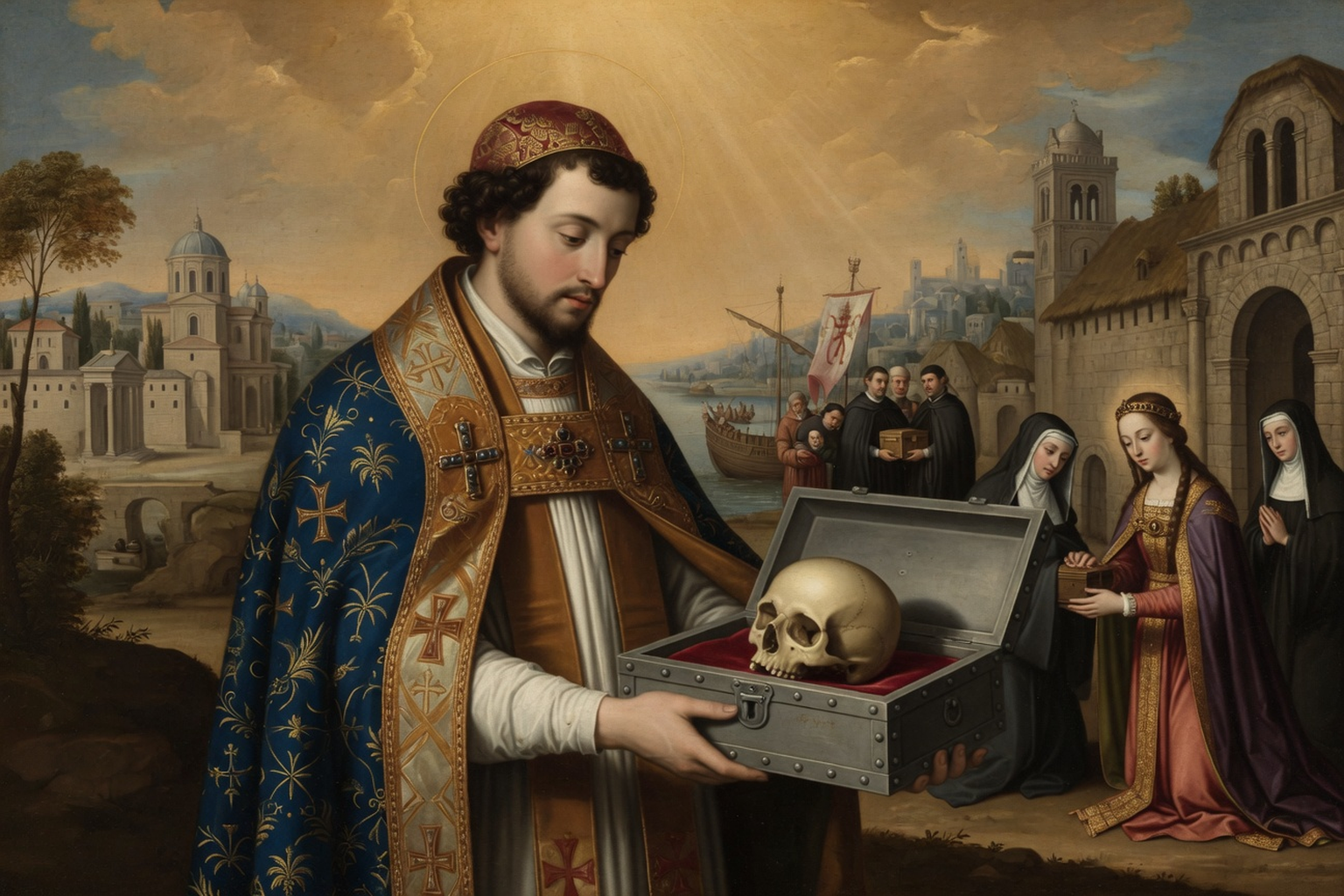
Saint Julian, martyr of Antioch, saw his relics (notably his skull) brought from the East to Paris during the reign of Gregory the Great. Queen Brunhilda donated them to an abbey near Étampes. In 1648, a casket containing his remains was rediscovered at Morigny before disappearing, possibly transferred to Sens.
Guided reading
4 reading sections
RELICS OF SAINT JULIAN AND THE ABBEY OF MORIGNY.
Origin and distribution of the relics
The skull of Saint Julian, brought from the East under Gregory the Great, was entrusted by Queen Brunhild to nuns near Étampes, then divided between Morigny and Paris.
It is said that the sku ll of Saint saint Julien Martyr of Antioch whose relics were transported to Gaul. Julian was brought from the East to Paris, in the time of Saint Greg ory the Great. Que La reine Brunehaut Queen of Austrasia and Burgundy, principal political opponent of Columbanus. en Brunhild, to whom it was given, presented it to the nuns she had established near Étampes. A part of this skull was found at M origny, Morigny Primary location where a portion of the saint's skull is preserved. near Étampes, and the other in Paris, in the church of the regular canonesses of Saint-Basile.
Greatness and decline of the abbey of Morigny
Founded thanks to popular charity on land donated by Anseau, the abbey declined from the 16th century onwards before being ruined by the Revolution of 1793.
We requested information on this subject from M. Bonvoisin, honorary canon, parish priest of Notre-Dame, in Étampes. Here is his reply:
T he abbey of Morigny L'abbaye de Morigny Primary location where a portion of the saint's skull is preserved. , as well as the church, was built on land donated by a man named Anseau, through the generosity of the people of Étampes. *Mirore qui legis hæc... antiqui nostri omnia quæ hic cernis ex pauperum eleemosynis construxerunt. Non rex, non comes, non aliquis magnatum, aliquid instituit.*
Everything has disappeared. Already at the beginning of the 16th century, the invasion of commendatory abbots had caused it to lose its former splendor. *L'Histoire des antiquités d'Étampes*, 1650, notes abbots who let the building fall into decay, and when the turmoil of '93 arrived, there were no more religious. The abbey buildings were rented out and occupied by all comers; they were ruins; of the church, only the choir remains.
The last abbot (de Tressan) did not reside there; a Franciscan friar from Étampes would go to say mass every Sunday at the abbey.
Today, the parish church having been demolished, the choir of the abbey church, the sole survivor, has become the parish church; it is a beautiful and good remnant of the 13th or 14th century.
As for the buildings, they have disappeared; but it is thought that a part of the new château, enclosed within more modern constructions, comes from the old buildings: it is impossible to know otherwise; the whole has been covered with plaster and nothing indicates ancient constructions.
Fortuitous discovery of the relics in 1648
During construction work in 1648, a lead casket was discovered containing bones of Saint Julian and an inscription authenticating their origin from Antioch.
As for the skull of Saint Julian:
There was formerly near the tower of Brunehaut, in the parish of Morigny, an abbey of nuns of which only the chapel of Saint Julian, martyr of An tioch, remained in 1680, and it saint Julien, martyr d'Antioche Martyr of Antioch whose relics were transported to Gaul. is believed that Queen Brunehaut had caused this abbey to be built.
Workers who were working on the high altar of this chapel in 1648 found a lead casket which was opened in the presence of the Abbot of Morigny, by Jean Bochereau, Dean of Notre-Dame d'Étampes, assisted by Nicolas Tyrouin, priest of Saint-Basile, and there were found the posterior part of a skull, an arm bone in three pieces, a vertebra, several bone powders, and an antique piece on which were engraved the following words:
*Hic jacet exput S. Juliani, martyri s, quod Se S. Juliani Martyr of Antioch whose relics were transported to Gaul. verinus attulit de Antiochia civitate, temporibus Brunegidiæ Reginæ.*
And on the reverse:
*Ex ossibus S. Christophori. — Brachium S. Gomaliolis.*
These relics were deposited, according to the orders of the Archbishop of Sens, in the sacristy of the abbey, as is stated in the official report drawn up by the said Dean of Notre-Dame.
This is summarized from the *Antiquités d'Étampes*, by D om Fleuveau, Dom Fleuveau Author of the Antiquités d'Étampes (1680) and source of the narrative. 1680.
Disappearance and hagiographic uncertainties
The relics have disappeared today, possibly transferred to Sens, while the martyrology distinguishes several martyr saints named Julian.
There is now, nowhere, any trace of the relics of Saint Julian, neither at Étampes, nor at Morigny. Perhaps they were transferred to Sens, w hich Sens Diocese to which Morigny belonged and a possible site for the transfer of relics. had and still has an illustrious collection.
Morigny belonged to that diocese.
The Martyrology indicates two Saint Julians, martyrs, among others, Saint Julian of Constantinople, June 9; Saint Julian of Antioch, and his wife, January 9.
THE BLESSED PHILIPPE BERRUYER.
Annexes & related entities
Structured data for exploration: events, miracles, quotes, places, attributes, patronages, and important entities cited in the text.
Key Events
- Martyrdom in Antioch
- Translation of the skull from the Orient to Paris under Gregory the Great
- Gift of relics by Queen Brunhilda to the nuns of Étampes
- Discovery of a lead casket in 1648 during work on the high altar
Quotes
-
Hic jacet exput S. Juliani, martyris, quod Severinus attulit de Antiochia civitate, temporibus Brunegidiæ Reginæ.
Inscription on an antique piece found in the reliquary