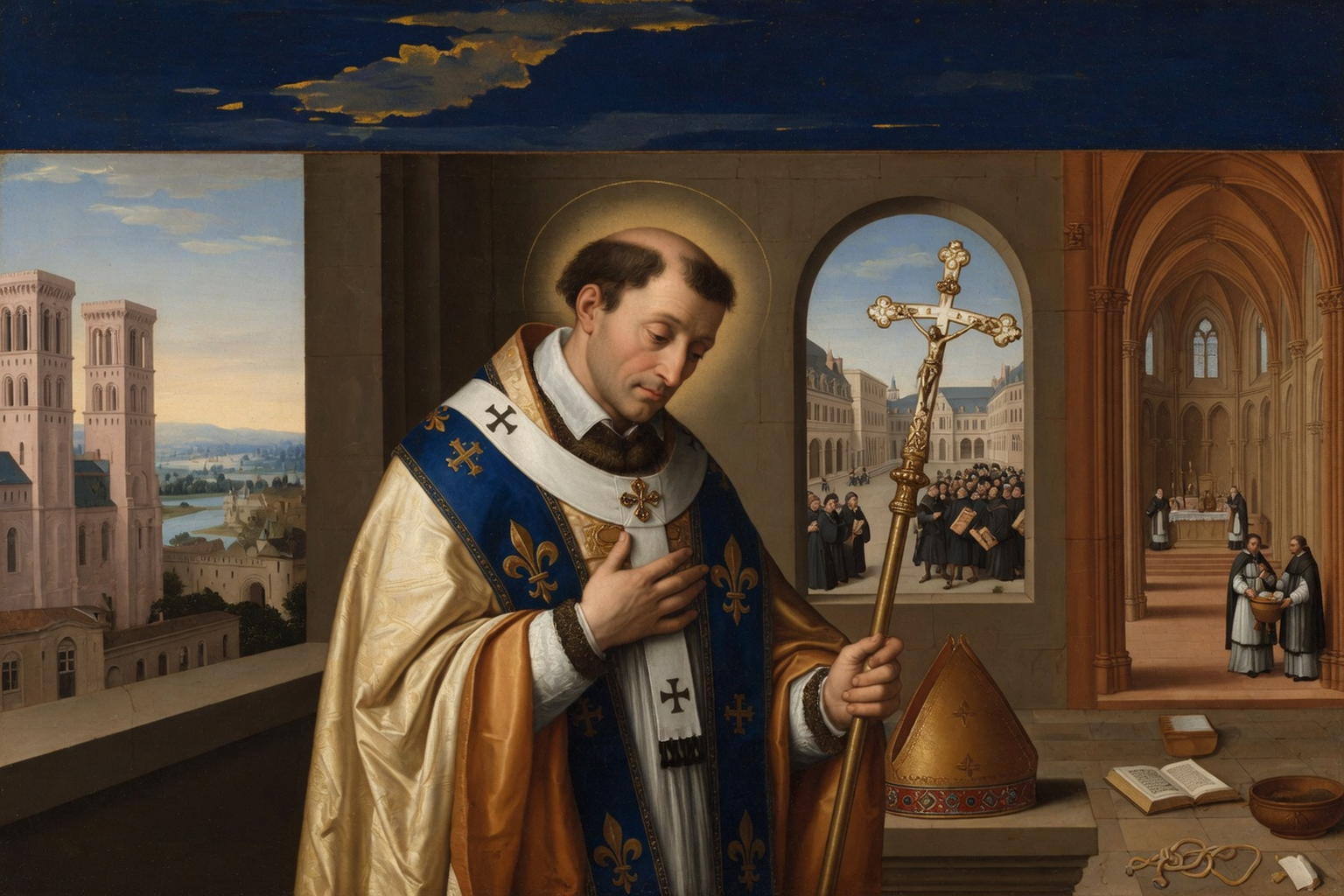
Nephew of Saint Guillaume of Bourges, Philippe Berruyer was an exemplary prelate of the 13th century, serving successively as Bishop of Orléans and then Archbishop of Bourges. Known for his profound humility and inexhaustible charity toward the poor, he led a life of rigorous penance while administering his dioceses with zeal. He died in 1261, having left his mark on his time through his eloquent preaching and several miracles.
Guided reading
8 reading sections
THE B. PHILIPPE BERRUYER, ARCHBISHOP OF BOURGES
Historical context and family origins
Philippe Berruyer was born at the end of the 12th century into a noble family from the Nivernais and Touraine regions, which included several saints, among them his uncle Guillaume of Bourges.
Towards the end of the 12th century. — 1264. — Popes: Celestine III; Urban IV. — Kings of France: Philip II, Augustus; Saint Louis. Give alms of thy substance, and turn not away thy face from any poor person. Tob. 4:7. Philipp Philippe Berruyer Archbishop of Bourges and the primary subject of the biography. e Berruyer, called a saint by some authors and blessed by others, was the nephew of Saint Guilla saint Guillaume Archbishop of Bourges and Cistercian saint of the 13th century. ume, Archbishop of Bourges, of whom we shall speak on the following day. He came from an ancient noble family of the Nivernais on his father's side; his mother was from a house no less noble in Touraine; one may say of his family what has been said of those of Saint Gregory of Nazianzus, Saint Basil, and several others, that they were composed of Saints.
Youth and intellectual formation
Born in Tours, he chose the clerical state rather than arms and left to study at the University of Paris, where he shone for his piety and erudition.
Philippe, born in To Tours Place of retirement for Clotilde near the tomb of Saint Martin. urs towards the end of the 11th century to virtuous parents, did not degenerate from their piety; on the contrary, he soon surpassed them through the rare qualities that ennobled his soul and made him the model of the greatest prelates of his century. When he was still a child, his father, on his deathbed, asked him to which profession and state of life he felt inclined; he replied that he willingly left the profession of arms to his elder brothers, to devote himself to the service of God in the clerical state. Then this holy man, feeling filled with joy, gave him his special blessing and said these prophetic words: "May God be infinitely blessed, my dear child, for having inspired in you such a holy resolution! It will be for you a source of graces and supernatural favors; you will be the honor of your parents, the joy of your relatives, and the greatest ornament of your family, and I hope that having served God in the lowest offices with innocence and fidelity, He will raise you to the rank of the first priests of His Church." He also blessed Archambault and Gervais, his other two sons, and predicted that by keeping inviolably the commandments of God and the precepts of the Gospel, they would draw upon their posterity the blessing of heaven for all the centuries to come. Mathée, their mother, also seconded these wishes; for, after the death of her husband, seeing Philippe's nature entirely inclined toward devotion, she offered him to God at the foot of the altars during a Mass she had said for him; and to cultivate his mind through the sciences, she sent him to study in Paris. It w Paris Place of birth, ministry, and death of the saint. as at this famous University that he began to show the beauty of his mind and the rich seeds of virtue that God had cast into his soul. The corruption of the other students, great at that time when they arrived in Paris from all the nations of Europe, was not contagious to him; he always kept there an innocence, a purity, a modesty, and admirable manners, sure omens of his future holiness. He became very skilled there not only in the humanities and philosophy, but also in theology, and acquired all the knowledge that is proper to an ecclesiastic.
Ministry and preaching in Touraine
Having become archdeacon in Tours, he distinguished himself by his humility in refusing dignities and by his talent as an orator that attracted crowds.
Having returned to Tours, where his father had settled after his marriage, he was provided with a canonry at Saint-Gatien, the cathedral; as his virtues and great erudition placed him far above the other canons, the Archbishop of Tours, Geoffroy de Ludes, a person of eminent piety, wished to have him as his archdeacon. Philippe conducted himself in this ministry with such zeal and prudence, and showed such capacity for government, that when this excellent prelate died, he was strongly urged to accept the archbishopric. Philippe, who had shortly before refused the dignity of cantor in the cathedral church of Le Mans because he did not believe it was permitted for him to be a member of two bodies and to possess two benefices, refused this archbishopric with the same constancy, because his humility persuaded him that he was not capable of it. I also believe that he was moved to this refusal by the example of his uncle Saint Guillaume, whom, eight years earlier, one could only persuade to accept the archbishopric of Bourges by the express command of the legate of the Holy See and the Abbot of Cîteaux, his superiors. Thus our Blessed one remained for several more years in his office of archdeacon. The ardent desire that God inspired in him for the conversion of sinners led him to undertake the preaching of the Gospel; as he possessed at the same time all the qualities of a great orator and a truly apostolic man, he succeeded admirably in this function, and obtained the happiest results throughout the diocese of Tours. The charity with which he was filled flowed from his heart into that of his listeners and gave them such unction that those who had heard him once became as if famished for his word; when he preached several times a day, they would run to hear him a second and a third time: thus, he was followed everywhere by a crowd that would not leave him until his last sermon of the day was finished. Fearing that, by preaching to others and working for their salvation, he might become reprobate, he began to chastise his body in a very severe manner. He secretly took a hairshirt, which he wore under his ecclesiastical garments, and cut back as much as he could on sleep and food, fasting often and eating only what was absolutely necessary for him to live. He also joined mercy to fasting, distributing to the poor with such profusion what he denied himself, that he did not seem to be the master of it, but only the steward and the dispenser.
Bishop of Orléans
Elected Bishop of Orléans in 1221, he exercised his ministry there for fourteen years before being called by the Pope to succeed his uncle in Bourges.
However, Manasses II, that blessed Bishop of Or léans w Orléans The first diocese of which Roger was bishop. hose memory is still in benediction, having died in the year 1221, the clergy and the people of that city believed they could not repair such a great loss except by choosing our holy archdeacon as his successor. It is true that his refusal of the Archbishopric of Tours made them fear that he would have no regard for their prayers; but, all the canons did not fail to give him their votes; and, so as not to be frustrated in what they desired, they ordered a public prayer in the city, in order to ask for the consent of such a holy ecclesiastic from God, who holds all the hearts of men in His hands. Their vows were not in vain: for the Blessed Philip, feeling as if forced by the entreaties and tears of the deputies of Orléans, finally gave his hand to his election and consented to his consecration, which was performed by Peter of Corbeil, Archbishop of Sens.
The first thing that his history remarks of him, after taking possession, is a generous action of that justice which is called vindicative: he obtained from the King the exemplary punishment of certain reckless judges who, in contempt of the Church and by a detestable sacrilege, had caused some ecclesiastics to die a shameful and cruel death; and he was no less loved by everyone for this act of equity than for the deliverance
The administration of the Archdiocese of Bourges
Appointed archbishop by Gregory IX, he reformed the clergy, founded the Dominican convent, and traveled throughout Berry to preach.
THE BLESSED PHILIPPE BERRUYER. 241 of all the prisoners which took place, according to custom, at his solemn entry into Orleans. He remained bishop of this see for fourteen years: he cast such brilliant rays of holiness on all sides that, the archbishopr ic of B Bourges City where Leopardin received his episcopal blessing. ourges having become vacant by the death of Simon de Soliac, and the canons of the cathedral having been unable, for three years, to agree on the choice of a successor, Pope Grego Grégoire IX Pope who attested to the miracles of Bruno. ry IX, to whom this long delay gave cause to provide for it himself, appointed him to fill this place: which he did with a great testimony of esteem for his merit and virtue. As the memory of Saint William, his uncle, was very recent there, and as one still had before one's eyes the admirable examples of humility, patience, mortification, devotion, prudence, zeal, episcopal generosity, mercy for the poor, and charity for all his diocesans, with which the ten years of his prelacy had been filled, and as one even saw every day great wonders that were performed through his intercession, it was learned, with great joy, of the choice that His Holiness had made of this blessed nephew to be one of his successors. He himself, whatever aversion he had for honors, could not resist the command of the Vicar of Jesus Christ, and he was compelled, despite all the sentiments of his humility, to leave the pontifical chair of Orleans, which was filled by Philippe de Jouy, to ascend the patriarchal throne of Bourges. This new dignity, which raised him above bishops and archbishops, did not swell his heart and did not give him any feelings of pride or vanity: he looked upon it only as a new obligation to humble himself before God, to crucify his flesh, to rise from virtue to virtue, and to work tirelessly for the salvation of those whom divine providence had committed to his charge. After having so holily regulated his house, that vice was entirely banished from it, and that one saw the true spirit of Christian piety shine in all those who composed it, and after having made himself a living host through the harshest practices of penance and mortification, he applied himself with incredible fervor to the good regulation of his diocese.
His first concern was to have under him ministers and officers who would faithfully cooperate with his zeal; this is why he took care to fill the chapters with virtuous canons, the parishes with learned priests of irreproachable life, and the tribunals, both ecclesiastical and secular, which depended on him, with upright and just judges who had only the honor of God and justice before their eyes; if there were any who failed in their duty, and if there were found above all priests who violated the vow of chastity, which the oldest Canons have attached to the holiness of their ordination, he deprived them of their benefices, not wanting holy things to be administered by others than saints; but he gave them enough to live on, so that they would not be forced to beg: which can only be to the shame and contempt of the Church. In this same desire to procure the spiritual good of his diocese, he attracted as many learned and zealous people as he could, and it is in this spirit that, through the liberality of Blanche, Countess of Joigny and Lady of Vierzon, he established the Dominican convent in Bourges, in order to have in their person a company of soldiers of Jesus Christ always ready to fight vice and to wage war on the devil everywhere. He did not, however, rely so mu ch on his e Dominicains Religious order to which Magdeleine belonged. vangelical workers that he did not himself visit his diocese, and that he did not go from village to village to seek the lost sheep of his flock. As he was the most eloquent preacher of his century, and as he distributed the bread of the word of God on all sides, one cannot believe to what extent
LIVES OF THE SAINTS. — Volume 147 16 he won the love of his flock nor what good he did throughout Berry. After his sermons, he was surrounded by a multitude of people: some strove to kiss the hem of his robe; others presented their children to be blessed by his hand; and those who could not approach him gave him great praise aloud and proclaimed themselves blessed to have a pastor of such extraordinary merit. There were even some who scraped the boards where his feet had rested during his preaching, and kept these scrapings as very precious relics. This great man, whose humility seemed to surpass even his zeal and fervor, could not suffer these honors and rejected them as much as he could; but he showed, in rejecting them, that he was truly worthy of them, because he attributed to God alone all the good success he obtained in favor of his people.
Charity and mercy towards the poor
Renowned for his extreme generosity, he did not hesitate to strip himself of his own garments to give them to the needy during his visitations.
Although his primary study was to procure the salvation of souls, he nevertheless took great care in the relief of bodies and in providing the poor and the afflicted with what was necessary for their subsistence. His episcopal houses were almonries that were always open, and although the revenues of his bishopric were not very considerable, he did not wish for any poor person to be turned away, because it is written: "Give alms from your possessions, and do not turn your face away from any poor person." His steward, a wise man according to the world, had much trouble enduring his liberality and sometimes reproached him for it, telling him that his income was not significant enough to suffice; but the blessed man brought him back with gentle words, saying: "Do you not know, my son, that God commands him who has two tunics to give one to those who have none, and him who has bread and other food to give a portion to those who are in need? Thus, do not be saddened, but execute with joy what I command you. I absolutely want general alms to be given every day in my house in Bourges, and for it to be given three times a week in all my country houses; and no consideration will make me change this order." During a great famine that afflicted the province of Berry, as he was the sole refuge for the starving, he had up to fourteen setiers of wheat distributed to them daily. This profusion extremely displeased the same steward who, complaining to the holy archbishop, told him that his prodigality was going to bring him and his whole family into indigence, and that there would soon be no more wheat to feed them. But the blessed man, animated by a holy zeal, replied: "Ah! Wretched man, what would it be if it were your own goods that were being given to the poor, since you cannot suffer that one gives them what does not belong to you? Is your eye evil because, in imitating my master, I desire to become good? Know that your murmurs will not make me change my conduct, and that instead of diminishing my alms, I will increase them even more: I want them henceforth to be no longer limited, but that in Bourges and in my farms, a loaf of bread be given to all who present themselves. If my revenues are not sufficient for these charities, I will sell my patrimony, and I will find by this means the wherewithal to provide for them." O incomparable prelate, worthy of immortal glory! Who can doubt that, having thus distributed his goods to the poor, he has earned, according to the word of the Prophet, that his justice remains for all ages of ages?
Here are other heroic actions of this same mercy. One day, while visiting his diocese in winter, he met in the open countryside a poor man, half-naked and shivering with cold, who asked him for alms; his bowels were moved with compassion, and he pondered how he could relieve such great misery: he had with him only an archpriest and a valet; it was therefore difficult for him to give this afflicted man something to cover himself and protect him from the rigor of the season at that very moment; nevertheless, his charity, more industrious than all human prudence, inspired him to do something very extraordinary that must fill all readers with admiration. Having left the poor man with the archpriest, and having retired to a secret place with his valet, he stripped off his undergarments and brought them to him to clothe him. The poor man was delighted with such a considerable alms, and having thanked his benefactor, he withdrew: but the Saint was even more so for having clothed Jesus Christ in the person of one of his members. Shortly after, another poor man presented himself to him, even more suffering than the first, and to whom the violence of the cold made his teeth chatter in a deplorable manner. What will the holy archbishop do in this necessity, he who, having given his under-tunic, had only his ecclesiastical garments left to cover himself? He did not, despite this, leave this shivering man without assistance; but turning toward his valet, he begged him to do for this poor man what he himself had done for the first, assuring him that as soon as they returned home, he would pay him double for the tunic he would have given. The valet had the glory of imitating the fervor of his master. Thus, the two poor men were helped, and our Saint had the consolation of not having left people redeemed by the blood of Jesus Christ in danger of losing their lives due to the rigor of the cold that tormented them. These heroic actions took place near Vierzon, in Berry. Another time, a man of status having lost all his goods and having become extremely poor, he gave him a large sum of money to lift him out of misery and to re-establish his fortune: this showed that his charity was prudent and that it knew how to proportion its distributions, not only to the need, but also to the quality of the persons.
He wanted his palace and his audience chamber to be open to everyone, and for the poor to have as much freedom to enter and represent their needs to him as the most noble and the richest. Sometimes, he even showed himself more accessible to the former than to the latter, so that they would have no shame in approaching him and would more freely declare their troubles and the oppression they suffered at the hands of the great. One day, the Lord of Châteauroux having come to find him for important matters for which he requested a prompt resolution, our Saint, having seen an old peasant woman enter the antechamber who was very poorly dressed, covered in mud, and appeared extremely weary, immediately left this lord to listen to her and give her the satisfaction she requested; he then returned to him and begged him to excuse him if he had left him for this peasant woman; she had just arrived on foot from her village and was obliged to return there the same day, on foot, while he, being well-mounted with all his men, had come very comfortably and would also return in very little time and without any inconvenience. When he made his visitations in the hamlets, he did not fail to take the list of the poor and the sick who were there, and went to see them in their cottages. After having exhorted them to live well and having given them spiritual consolation, he gave them a considerable alms. Often, he even listened to their confessions with invincible patience, in order to make up for the deficiency of their previous confessions, and to prepare them for a happy death.
Ascetic life and supernatural signs
Despite his infirmities, he practiced rigorous penance and performed several miraculous healings during his pastoral visits.
If the blessed Philip had so much charity and mercy for others, it can be said that he had only severity and rigor for himself. He was not content with the fasts commanded by the Church; he also fasted for forty days before Christmas with the same severity as in Lent. On Fridays, the vigils of the feasts of Our Lady, and eleven days before Pentecost, he ate only in the evening and practiced rigorous abstinence on bread and water. He confessed every evening after Compline with such an abundance of tears that he seemed guilty of several great crimes, although his life was very pure and very innocent. His bed was so hard that it was more suited to tormenting him than to giving him rest, and he lay down in it fully clothed, without even removing his undergarments, which alone was enough to prevent his sleep. He always rose in the middle of the night, and after striking his chest several times and bloodying his body with a cruel discipline, he performed one hundred genuflections to adore the greatness and sovereignty of God; then, placing his face against the ground, he prayed with great urgency for the Church, for his diocese, for victory over his passions, and for his own perfection. His hair shirt was so rough that he was sometimes pricked by it until he bled; but he always asked for coarser and pricklier ones, and when his valet presented him with a new one, he would kiss it with great affection, saying these words: "If my Lord Jesus Christ suffered the torment of the cross for me, is it not just that I should take this hair shirt for his love, and that I should afflict my body with this mortification to make myself more pleasing to his divine Majesty?" However, as a fall from a horse dislocated his limbs and made him sickly and subject to great infirmities, Pope Innocent IV, who did not want to see the Church so soon deprived of the help of such a great prelate, moderated his austerities, c ommanding h Innocent IV 13th-century pope who testified to the saint's miracles. im to eat meat and sleep on a mattress: which he was obliged to do, without, however, lying down in any way other than fully clothed.
Although the holiness of our Blessed one was made known by such eminent actions of zeal, charity, and penance, God nevertheless wished to manifest it even more through the miracles and supernatural healings that He commanded him to perform. At the priory of Blète, of the Order of Saint Augustine, he healed, by his blessing, the prior, who had fallen into apoplexy and had lost the use of all his senses. At the monastery of Celle, the abbot's servant had fallen into such a strange illness that his face was so swollen that no human form remained; the holy bishop restored him to health by his touch alone. Through his prayer, he delivered one of his archpriests who was about to be submerged with his boat on the Gironde. He also merited the return of an apostate who had left the abbey of Pierres out of inconstancy. As there was difficulty in knowing in which part of a church the sacred body of Saint Severus rested, he obtained the knowledge of it through a small stone that fell from the roof of that church and marked the place where they had to dig. H e then raise saint Sévère Saint whose relics were recovered and translated by Philip. d this rich treasure and placed it with great solemnity in a more honorable place; he did the same for several other holy bodies during the visitation of his diocese, thus honoring on earth those whose companion he hoped soon to be in heaven.
Last days, death and cult
He died in 1261 after a life of service. His body was buried in the cathedral of Bourges where his memory remains honored.
He was not content to merely fulfill the duties of a vigilant bishop; he also wished to fulfill those of primate and archbishop, and in this capacity, he visited the archdioceses subject to his primacy and the dioceses subject to his metropolitan see. He was received everywhere, not as a great lord, but as a saint; and indeed, he did not walk with the brilliance and pomp that too often accompanied the princes of the Church, but in the modesty and humility that is becoming to the disciples of Jesus Christ and the successors of the Apostles. His clothes, his words, his gestures, his manner of traveling, everything about him breathed humility: which did not prevent people from coming from all sides to meet him, from humbly kissing his feet, from leading him in triumph into the cities, and from paying him all the honors that the most ambitious could desire. While in the diocese of Bordeaux, where it was lamented that all the fruits of the earth were perishing due to the drought suffered there for a long time, he offered his prayer to God and obtained an abundant rain that restored the grains and fruits to a good state. In that of Albi, he learned the news of a great fire that had occurred in Bourges; this was in 1252; it compelled him to return as soon as possible, and then, as if he had done nothing before, he applied himself more than ever to feeding the poor, protecting widows, defending wards and orphans, visiting prisoners, consoling the sick, and even, as he had learned from Saint William, his uncle, to attending the funerals of the deceased. He also settled a great dispute that had broken out between the Chapter of his cathedral and the royal bailiff of Bourges, and reconciled them perfectly. Finally, after having embraced, with a truly paternal affection, each of his canons in particular, and having recommended that they sanctify their ministry by a life worthy of the holy altars they had the honor of approaching, knowing that the time of his death was not far off, he retired to Toury, one of his country houses, to prepare himself with more tranquility for an important hour upon which eternity depends. His great weaknesses did not prevent him from going every day to his chapel to celebrate the holy sacrifice of the Mass or at least to receive communion; he did so with admirable joy, fervor, and eagerness. The Sunday before his passing, which occurred on a Friday, having recited the Creed aloud at the foot of the altar, and having received with renewed devotion the august sacrament of the Eucharist, he said to Our Lord, in holy confidence: "My Lord, I place into your hands and into your keeping the people you have entrusted to me." Then, he was put to bed where he had to suffer very acute pains; but, far from becoming impatient, he often raised his eyes and hands toward heaven, and said to God: "Lord, I thank you for the punishment you send me. Punish me as much as you please, because I have deserved all these scourges of your justice." Then he added these words of Saint Augustine: "O good Jesus, burn, cut here below, so as to forgive me in eternity!" He had an altar set up in his room where Mass was said for him every day, and where all the canonical hours were recited aloud at the times ordered by the Church; he attended them as attentively as the violence of his illness could allow him. On Friday, when the body of Our Lord was brought to him to receive as Viaticum, he adored it with profound respect, and addressed these words to Him: "O sweetest and most lovable Jesus, how great is the sweetness of a soul that sees itself called to the feast of Eternity, where it has no other food than yourself who are its sovereign good, and the one it desires above all things in the world! I believe firmly that I possess you in this Sacrament, and I wish to die in this faith as I have lived in it; but not seeing you openly, I desire with an incredible ardor to go and contemplate you in heaven: for, to open the very depths of my heart to you, there is no one but you alone who can console me and give me true rest: all creatures are nothing to me: you are my whole treasure, you are my whole happiness, and I can have no joy and contentment except in the happy possession of your divinity and your humanity." After these fiery words, he received communion and immediately after rendered his spirit to Him who was the sole object of his desires. This was on January 9, 1261. The next day, he appeared to a monk of Cîteaux, who did not know of his passing, and made his happiness known to him. His body was buried in the middle of the choir of his cathedral, with an epitaph that bore witness to his virtues and his miracles. He performed more even after his death; for he healed a nun of a very painful gout that had rendered one of her arms paralyzed, and he also resurrected a child who had drowned in a vat of water.
He is not invoked publicly in Bourges, nor in Orléans, nor in Tours, which was the place of his birth; nevertheless, his memory is very famous and in great blessing in all these places. He was formerly honored at the Sainte-Chapelle in Paris, whose lower church he had consecrated in honor of the Blessed Virgin, in the year 1248.
His life was written, along with those of the other archbishops of Berry, by a monk of Saint-Benoît, from the monastery o f Saint-Sulpice in the f Sainte-Chapelle de Paris Edifice whose lower church was consecrated by Philip. aubourg of Bourges. It is reported by de La Saussaye, in his Annales d'Orléans and by Father Labbe, in the second volume of his Nouvelle Bibliothèque. We also have a manuscript of his nobility, reported by Guy Coquille in the Histoire du Nivernais, which is an act of Mabault, Countess of Havers. She calls Saint William Berruyer her maternal uncle, from which it follows that our Blessed one was his first cousin. By this same act, she bequeaths to the church of Bourges twelve pounds of annual rent, to make a lamp shine perpetually before the sepulcher of the same Saint William. — This life is by Father Giry.
Annexes & related entities
Structured data for exploration: events, miracles, quotes, places, attributes, patronages, and important entities cited in the text.
Key Events
- Born in Tours towards the end of the 12th century
- Studies at the University of Paris
- Archdeacon of Tours under Geoffroy de Ludes
- Election as Bishop of Orléans in 1221
- Appointment to the Archbishopric of Bourges by Gregory IX in 1235
- Consecration of the lower chapel of the Sainte-Chapelle in Paris in 1248
- Died in Toury on January 9, 1261
Miracles
- Healing of the prior of Blète from apoplexy
- Healing by touch of the servant of the Abbot of Celle
- Rescue of an archpriest from drowning on the Gironde
- Discovery of the body of Saint Severus by a stone fallen from the roof
- Obtaining abundant rain in Guyenne through prayer
- Resuscitation of a drowned child after death
Quotes
-
Give alms from your possessions, and do not turn your face away from any poor person.
Tobit 4:7 (cited by the subject) -
O good Jesus, burn and cut here below, so that You may spare me in eternity!
Saint Augustine (cited by the subject on his deathbed)