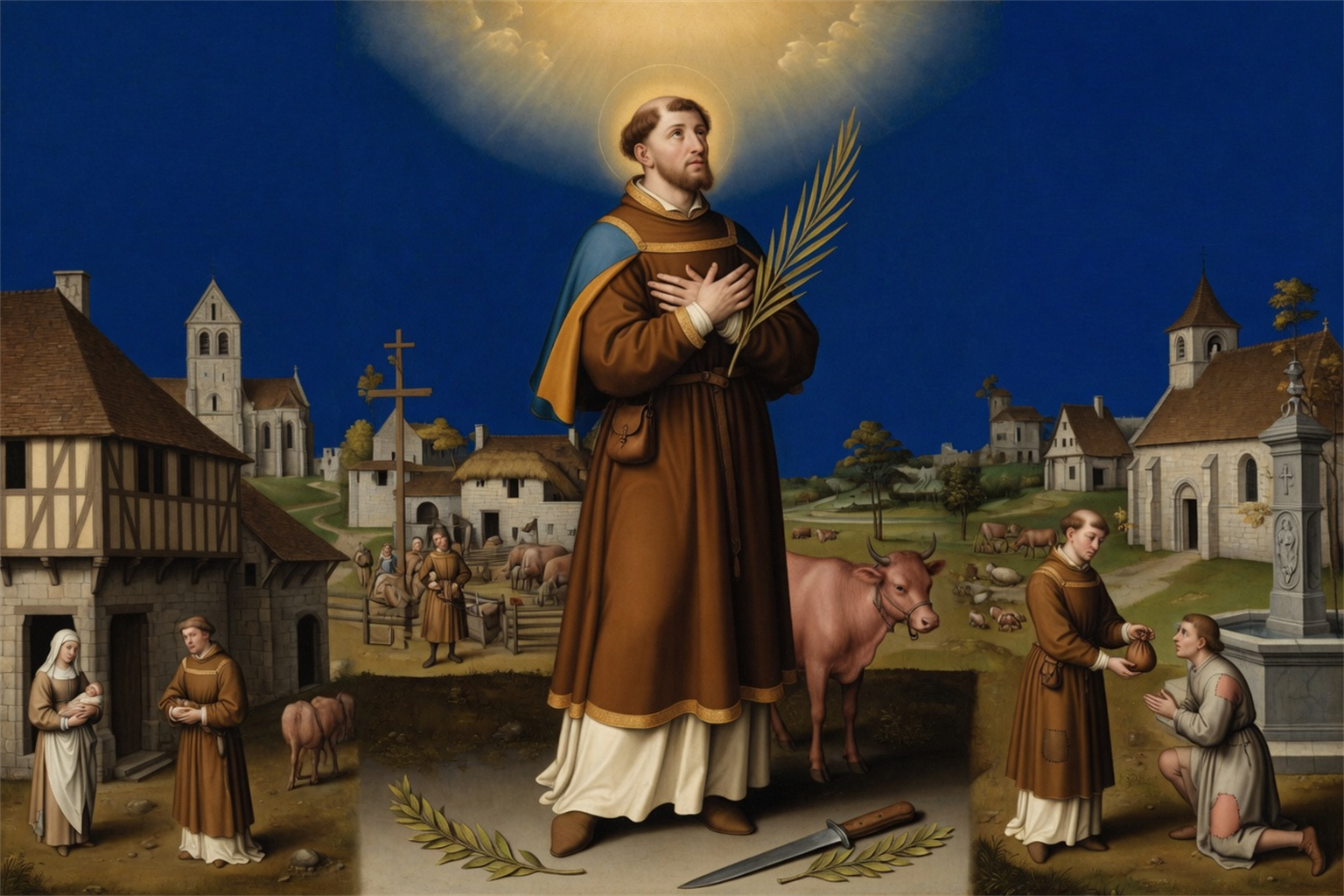
A cattle merchant in Buzançais in the 13th century, Honoré was renowned for his piety and charity, particularly towards poor couples. He was cowardly murdered by his two servants, the Gabidier brothers, near Thénezay while he was drinking at a fountain. His cult was confirmed by Pope Eugene IV in 1444.
Guided reading
6 reading sections
SAINT HONORÉ, PATRON OF BUZANÇAIS
A Charitable Merchant in Buzançais
Honoré, a prosperous 13th-century cattle merchant, distinguished himself by his piety and generosity, notably by providing dowries for the marriages of poor working women.
The square and the churc h of Buza Buzançais Birthplace of the saint and the primary site of his cult in Berry. nçais are teeming with people. The bells are ringing a triple chime for a double wedding.
Why this brilliant ringing and this unusual eagerness? No doubt, some great houses of the province are uniting their coats of arms and their estates. No doubt, the crowd is watching for the rich finery of the brides and the generosity of the grooms.
But no; the procession advances, greeted by the shrill sounds of the bagpipe and the hurdy-gurdy. Here are the brides: two poor working women, whose attire seems as modest as their faces. Moreover, it is not them that the multitude is waiting for and watching.
Here are the grooms: two robust sons of the fields, all decked out in ribbons, who are distributing hearty handshakes with a radiant air; but public curiosity seeks other nourishment.
Suddenly the cheers redouble; eyes and arms reach out toward a new personage who appears on the threshold of the church, and whose appearance, however, differs in no way from that of the other guests.
This man, still young, with a gentle and almost melancholy face, gives his arm to a respectable old woman, his mother no doubt, who, with eyes full of tears, smiles at these acclamations.
The satisfied crowd then joins the procession and follows it with a redoubling of enthusiasm to a small house on the main street where the couple just described stops, despite the insistence of the newlyweds and the guests.
— Excuse me, my friends, says the man who is the object of general attention, I am leaving tomorrow for my usual rounds, and I must prepare myself for the fatigues of the journey through rest. Go, my heart is with you. Enjoy yourselves decently, as befits good people and honest Christians. Above all, do not forget that you are coming from the church, and that, even in your pleasures, you are under the eye of God.
A final cry of sympathy greets this short address, and the procession resumes its march.
While the crowd runs to its pleasures, let us enter the small house and say now who is the one surrounded by such unanimous and fervent homage.
It is Honoré, the ox merchant, Honoré, the good man, the servant of God, the friend of the poor, whose little-known legend offers, with touching details, the purest model of filial love, charity, and commercial probity.
Born in Buzançais, at the end of the 13th century, Honoré had been rai sed by hi Buzançais Birthplace of the saint and the primary site of his cult in Berry. s parents in the fear of the Lord and the love of his neighbor. His father, a cattle merchant, would go to buy oxen in Poitou that he would resell in Berry, and had thus a cquire Poitou Region of origin and veneration of the saint. d a fairly comfortable living. The Berry Historical province where the saint settled. child was initiated early into this laborious life, by following his father on his travels, and when the latter died, he continued the trade, where he in turn earned considerable sums, part of which was used to increase the comfort of his old mother, upon whom all his affections were concentrated, and the other for the relief of the unfortunate.
One of the greatest joys that the worthy young man gave himself in his abundant almsgiving was to provide dowries for poor marriages that he matched in virtue, and this sweet act of charity was so familiar to him that he had made his name popular in matters of conjugal unions.
He was finishing a similar work when we saw him leaving the church with two new households that owed him their happiness and whose gratitude he fled in order to meditate on new good deeds.
The Last Journey and the Mystic Laurel
Despite his mother's pleas, Honoré leaves for Poitou. He symbolically binds his life to the health of a laurel tree planted in his garden.
However, his mother lamented his continual absences, and, convinced that they had enough fortune to live comfortably and do good, she begged him to settle near her permanently.
Now, with thoughts sadder than usual haunting her mind upon returning from the ceremony we witnessed, the poor old woman led her son into a small garden adjacent to the house. There, sitting with him under a laurel tree, hand in hand, eyes turned toward heaven, like the Saint Monica of our painter Scheffer, she said to him:
— My dear child, I am growing old, and age perhaps makes me more timid than is reasonable. Your absences cause me constant anxiety. As soon as you are no longer here, I no longer eat, I no longer sleep, I no longer live. Why work so much? We are rich enough for our needs and our tastes. It is high time for you to rest and restore my peace of mind. I beg you, give up this journey.
— Good mother, Honoré replied gently, it pains me to grieve you and not to obey you instantly. But, you know, I have commitments to fulfill, accounts to settle, appointments that I cannot miss. We are rich enough, you say, for our needs and our tastes? For our needs, it is true; but you forget our poor. The poor are an expensive taste, and one never has enough money for them. Let me then make this journey once more, which, I swear, will be the last... Besides, what do you have to fear?
— I fear everything, the fatigue and the dangers of the road; for the road is so long from Buzançais to Thénezay. It takes only an instant to fall ill or have a bad encounter.
— Thanks be to God, I am young and robust, and, far from harming my h ealth, t Thénezay Site of the martyrdom and preservation of the saint's head in Poitou. he exercise suits me. As for dangers and bad encounters, I do not fear them any more. I know of no enemies; besides, in case of need, I have a strong arm and a stout heart, and then I will not be alone, the Gabidiers are accompanying me.
— Do you think they would be of much help to you in a pressing circumstance? I hardly like their airs and their manners.
— They are a b it rough, in les Gabidier Servants and assassins of Saint Honoratus. deed; but that is not a bad thing for their trade...
Finally, I do not know why I am so sad today; I see everything in black and cannot get used to the thought of remaining for another month without news...
— Dear mother, Honoré resumed, pointing to the tree under which they were sitting, if you want to have news of me at every moment, look at this beautiful laurel, planted by my father on the day of my birth. I have always imagined that its existence depended on mine. You yourself have told me a hundred times that, during a serious illness of my childhood, it began to yellow and languish, and that it regained its vigor as soon as I returned to health. So then, as long as it remains green and healthy, have no worry on my account; but, if it were to yellow again, if it were to wither, if it were to die... oh then!...
— Be quiet, be quiet!...
— Yes, yes, I am talking nonsense in my turn; come, good mother, kiss me and let us chase away these dark ideas.
The next day, the worthy woman rose before dawn, checked the clothes and travel provisions, and went in all haste to the church to light a candle and say her prayer before the altar of the Virgin.
Upon returning, she found her son ready to leave for Poitou, with his two drovers, the Gabidier brothers. At this sight, she felt a terrible tightening of the heart which soon translated into sobs.
— Good mother, said Honoré, you are not being reasonable; I shall get angry...
— It is true, replied the old woman; but what would you have? I cannot get used to it; every time you go away, it seems to me that I will never see you again.
— And yet I return every time, in good health and with a full purse. It will be the same again; and besides, you know, it is the last journey.
— So be it! sighed the unhappy woman.
Then she approached the drovers, slipped a silver coin into the hand of each, and said to the eldest, whose physiognomy and form were hardly less wild than those of the robust animals entrusted to his care:
— Ah well! Gabidier my friend, try to ensure that no harm comes to him. I entrust him to you...
— We will watch over him, we will watch over him, the boor replied abruptly with a grimacing smile which, far from reassuring her, finished discouraging the poor woman.
The hour of separation had arrived. The good old woman kissed her son one last time, and, when he had disappeared around the bend of the street, she returned to her house, which had become sad, and there gave free rein to her tears.
The sign of death and the mobilization
The laurel suddenly withers, alerting Honoré's mother. The inhabitants of Buzançais mobilize to find the merchant who disappeared on the road to Poitou.
However, Honoré's mother regained courage by remembering the conversation of the day before. She rose calmer, went down to the garden, sat down in front of the mysterious laurel, to which her son's destiny was linked, and remained until evening with her eyes fixed on it, happy to see it so fresh and vigorous.
The following days were spent in similar contemplation, from which she only emerged to water the shrub, remove insects from it, and pull the grass from its base. Sometimes she spoke to it in a caressing voice, asking it for news of the traveler. It had become her confidant and her friend. At night, she saw it in her dreams; upon waking, her first thought and her first visit were for it.
Thus, what were her surprise and terror when, one morning, she found her dear laurel yellow and withered, whose beautiful greenery she had admired only a few hours before. She could not believe her eyes. She touched one by one those leaves that were so shiny yesterday, today stiff and curled, as if they had been burned by all the frosts of winter. She tried to bend a branch, which snapped with a noise and showed dried-up pith.
Finally, no longer able to doubt her misfortune, she rushed into the street, mad with grief, crying out:
— Help! People of Buzançais, help! I no longer have a child, and you have lost your friend.
At this call, the neighbors ran up and questioned the poor mother, who told them of the conversation in which Honoré had warned her that his life was attached to that of the laurel. Then she led them to the garden, where she showed them the tree, dead down to its roots. For a moment, the neighbors tried to persuade her that her alarms were chimerical, that she was a victim of appearances and sad forebodings; but soon, convinced themselves that this suddenly withered tree was a warning from heaven, they went to the bell tower and rang the tocsin as if there were a fire in the town or the enemy at the gates.
The city was stirred, the armed inhabitants gathered in the church square, and, upon learning the sinister news, decided that they would leave immediately to rescue Honoré, if there was still time, or to bring back his body if he had succumbed.
Indeed, without further delay, all those who could procure mounts set off toward Poitou, taking care to gather information in the places where the cattle merchant was accustomed to stopping. As he was no ordinary guest, his trail was easy to find. Everyone remembered perfectly having seen him pass on such a day, at such an hour, with his two drovers, but no one had seen him return.
Martyrdom at the fountain of Buzay
Near Thénezay, miraculous signs lead to the discovery of the decapitated body of Honoré, murdered by his own servants, the Gabidier brothers.
The horsemen thus arrived in sight of the village of Buzay, about a quarter of a league from the parish of Thénezay. In this place, to their great astonishment, the horses reared, and despite all efforts refused to go any further.
Then some men dismounted and reached a hut located in the fields, where they found an old woman whom they questioned. The peasant woman, recently settled in this house, which was not one of Honoré's stops, apologized for knowing the worthy merchant only by name and for having only imprecise information to give. She recounted, however, that three days earlier, a drover had left his herd and his companions to come and ask her for a drink, just as she was finishing kneading her bread. Unable to satisfy him, for she had used up her water for making her dough, she had pointed him toward a spring hidden in a nearby thicket, on the other side of the road, and toward which he had headed. She had not seen this man again; but, a few moments after his departure, she had been greatly surprised and frightened to notice that her dough was turning completely red, as if blood were mixed into it. Then, casting a glance outside to see if anyone was passing by to whom she could share her adventure, she had caught sight of the herd of oxen heading back toward Poitiers, under the guidance of only two individuals, in whom she did not recognize the one who had asked her for a drink.
Agitated by the most sinister forebodings at these indications, and convinced that they related directly to the object of their search, the travelers rejoined their companions and found them in conference with another troop of horsemen marching in the opposite direction.
These were the people and officers of justice of Thénezay, also in search of Honoré, whose sudden and unexplained disappearance was causing the most lively alarm in the region; for the virtuous cattle merchant was no less known, no less loved, and no less venerated in Poitou than in Berry. They informed those from Buzançais that the day before, Honoré's drovers, the Gabidier brothers, had been seen at a fair, in possession of a large sum of money, which they were spending foolishly and for which they had not justified the origin; that when questioned about the absence of their master, they had provided embarrassed explanations, which had increased suspicions and determined their arrest. This account, compared with that of the old woman, left little hope for the fate of Honoré, who had undoubtedly been the victim of a cowardly ambush in these parts. It was therefore decided to carry out a meticulous search on the spot and to surrender to the instinct of the horses which, feeling free, left the main road, entered the thicket resolutely, and soon stopped at the edge of a small fountain. Then everyone dismounted, examined the ground, and searched the woods. It was not long before they noticed a long trail of blood on the grass, starting from the spring and disappearing under the trees. The anguish redoubled, the outcome was approaching. Finally, cries were heard; one of the travelers had discovered a decapitated corpse among the brush. The head was found a little further away, and, in these sad remains covered in bloody mud, the two troops recognized the features of Honoré.
After washing away these stains and giving free rein to the first outbursts of grief, the body was placed on an improvised litter, and, by common consent, they headed toward Thénezay, where they were to obtain a decent coffin, pay the last honors to the martyr, and confront the assassins with their victim.
The entry o Thénezay Site of the martyrdom and preservation of the saint's head in Poitou. f the procession into the city was greeted by one of those rare explosions of popular grief, which are the finest tribute to a good man and turn a funeral march into a triumphal march.
The clergy, warned in time, received the remains of Honoré at the doors of the church and placed them in a burning chapel, where the entire population came to see them, touch them, and invoke them as those of a saint.
The lessons of the ancient offices of Buzançais and Thénezay report that many sick people suffering from fevers and languor were cured on this occasion by touching the body, and that the first effect manifested itself on three bearers who had taken turns carrying it from the fountain to the church.
Taken from prison and suddenly brought before the corpse, the Gabidier brothers lost their composure and made full confessions. They then recounted how, having introduced a peasant's cow into their herd with the intention les frères Gabidier Servants and assassins of Saint Honoratus. of appropriating it, they had been severely reprimanded by their master and forced to return the animal, from which they had conceived a deep resentment; how, certain of being dismissed at the end of the journey, they had meditated on covering their fault with a crime; how finally they had executed their abominable design by following Honoré to the fountain and striking him from behind with their cutlasses, at the moment he leaned over to drink.
Dispute over the relics and official recognition
The people of Berry and Poitou dispute the possession of the body. Honoré is officially beatified by Pope Eugene IV in 1444.
However, once the ceremonies were over, a great conflict arose between the people of Buzançais and those of Thénezay. The former wanted to take the body of their compatriot back to Berry, while the latter claimed to keep it as belonging to them through his death and the blood shed on their territory. Then a scene took place quite similar to that which occurred at Candes between the people of Tours and the people of Poitou after the death of the great Saint Martin. The tumult was at its height, and they were about to come to blows, when a transaction was proposed and accepted by both sides. It was agreed that the body of Honoré would be devolved to the people of Berry and his head to those of Poitou. However, this division had to be adjourned, as the officers of justice declared they could not release the corpse, which was to be the main piece of evidence in the future trial of the Gabidier brothers.
The delegation from Berry therefore brought back to Buzançais only unfortunately too precise details on the tragic end of Honoré and the assurance of one day possessing his relics.
As for Honoré's mother, I will not attempt to paint the state of her heart, which can only be understood by those who have climbed the Calvary of life to see a child die, their only hope, their only love.
Moreover, her suffering was not long, for heaven soon sent her the supreme consolation of the greatly afflicted. One morning, her neighbors, who surrounded her with the tenderest care, found her asleep in the arms of death, and guessed from the sweet smile wandering on her frozen lips that she had just rejoined her son.
To conclude, let us hasten to add that, despite their confessions and their protestations of repentance, the assassins underwent the ultimate rigors of the law, without the punishment being enough to expiate their crime. The reprobation that accompanied them to the scaffold attached itself to their memory, and, towards the end of the last century, their last descendants were still designated by these insulting words: race of Gabidier.
Anticipating the sentence of time and the Church, the inhabitants of Berry, like those of Poitou, rendered a spontaneous cult to Honoré, and immediately invoked him as a saint. A century later, the new wonders that were performed daily at his tomb, and the eagerness of the faithful, determined the lord of Thénezay and the bishop of Poitiers to request his canonization. A solemn inquiry took place, the documents were transmitted to the court of Rome, which, in 1444, Eugène IV Pope who sent Nicholas Albergati to the Council of Basel. under the pontificate of Eugene IV, inscribed the humble cattle merchant on the list of the blessed, and regularized the voluntary tributes of which he was the object.
From that moment, the church of Thénezay, originally placed under the invocation of Saint Matthias, placed itself under that of Saint Honoré, whose feast it celebrated on January 9, the anniversary of his death. The office is from the common of confessors, and, if some documents have given our Saint the title of Martyr, it is in the sense that he perished for justice. Thus is explained the palm placed in the hand of his statues, the Church ordinarily attributing the glorious name of Martyr only to those who die for the faith.
The Lord of the place built, near the fountain that witnessed the crime, a chapel which became the goal of pious pilgrimages and numerous processions. This chapel, located a quarter of a league from Thénezay, was destroyed during the Revolution, and the fountain where the sick recovered their health dried up by itself, as if to protest against this profanation.
Relics throughout history
The saint's remains were largely burned by Calvinist troops in 1562, but a few fragments survived and remain the object of persistent devotion.
Despite solemn promises, the convention of Thénezay concerning the sharing of Saint Honoré's relics was not executed until the beginning of the 16th century. Having finally won their case after long debates, the lords of Buzançais had the church altar prepared to place the body of the Saint, which had been returned by the parish of Thénezay, which kept the head in accordance with the old treaty. This translation took place with the greatest pomp; the church, originally dedicated to Saint Stephen, took the name of Saint-Honoré, and the town was placed under his patronage; but both the church and the town enjoyed their treasure for only a very short time.
In 1562, the Calvinist bands of the Count of Montgomery, who had comte de Montgomery Leader of the Protestant troops who burned the relics in 1569. burned the bodies of Saint William and the good Duchess Joan of Valois in Bourges, rushed into Lower Berry to reach Touraine, and passed through Buzançais, where they consigned the remains of Saint Honoré to the flames. A finger and a small bone, which fell while the body was being carried to the pyre, were the only ones to escape this disaster. These precious remains, collected by a pious hand, were placed in a reliquary, and an expiatory procession was ordered in perpetuity for Whit Monday. On this same day, a vow made by the town several centuries ago was fulfilled, on the occasion of a great epidemic that was ravaging the country, and which ceased miraculously through the intercession of Saint Honoré, as the old chronicles recount.
The church of Thénezay still possesses the head and a part of the clothing of the holy Martyr. These relics, already recognized as authentic in the 17th century, were recognized more recently by the Bishop of Poitiers, J.-B. de Bouillé, who then placed them in a new reliquary. Relics of the Saint are kept at the Carmelites of Abbeville, the Poor Clares of Amiens, and the convent of Davenescourt.
In 1833, Buzançais obtained a part of the distinguished relic that the diocese of Poitiers had the good fortune to preserve.
The heifer stolen on his behalf by unfaithful servants is the iconographic attribute of Saint Honoré.
Saint Honoré is invoked above all when it comes to contracting marriage.
We have borrowed this delightful biography of the patron saint of our native land from the Pieuses légendes du Berry, by J. Veillia J. Veilliat Author of 'Pieuses légendes du Berry', source of the text. t, while making slight revisions to it. We hope that every diocese will write a legendary like that of M. Veilliat: his book is charming, and in many respects could serve as a model for the hagiographers of the future.
Annexes & related entities
Structured data for exploration: events, miracles, quotes, places, attributes, patronages, and important entities cited in the text.
Key Events
- Born in Buzançais
- Took over his father's cattle business
- Provided dowries for poor marriages out of charity
- Departure for a final journey to Thénezay despite his mother's premonitions
- Assassinated by his servants near a fountain in Buzay
- Discovery of the body thanks to the instinct of the horses
- Canonization/Beatification in 1444 by Eugene IV
Miracles
- The laurel of his birth withered at the moment of his death
- A baker's dough turns blood-red at the moment of the crime
- The horses refuse to move forward and point out the scene of the crime
- Healing of fevers through touching the body
- Cessation of an epidemic in Buzançais through his intercession
Quotes
-
The poor are an expensive taste, and one never has enough money for them.
Words attributed to Saint Honoré in the text