Saint Paschasie
Virgin and Martyr
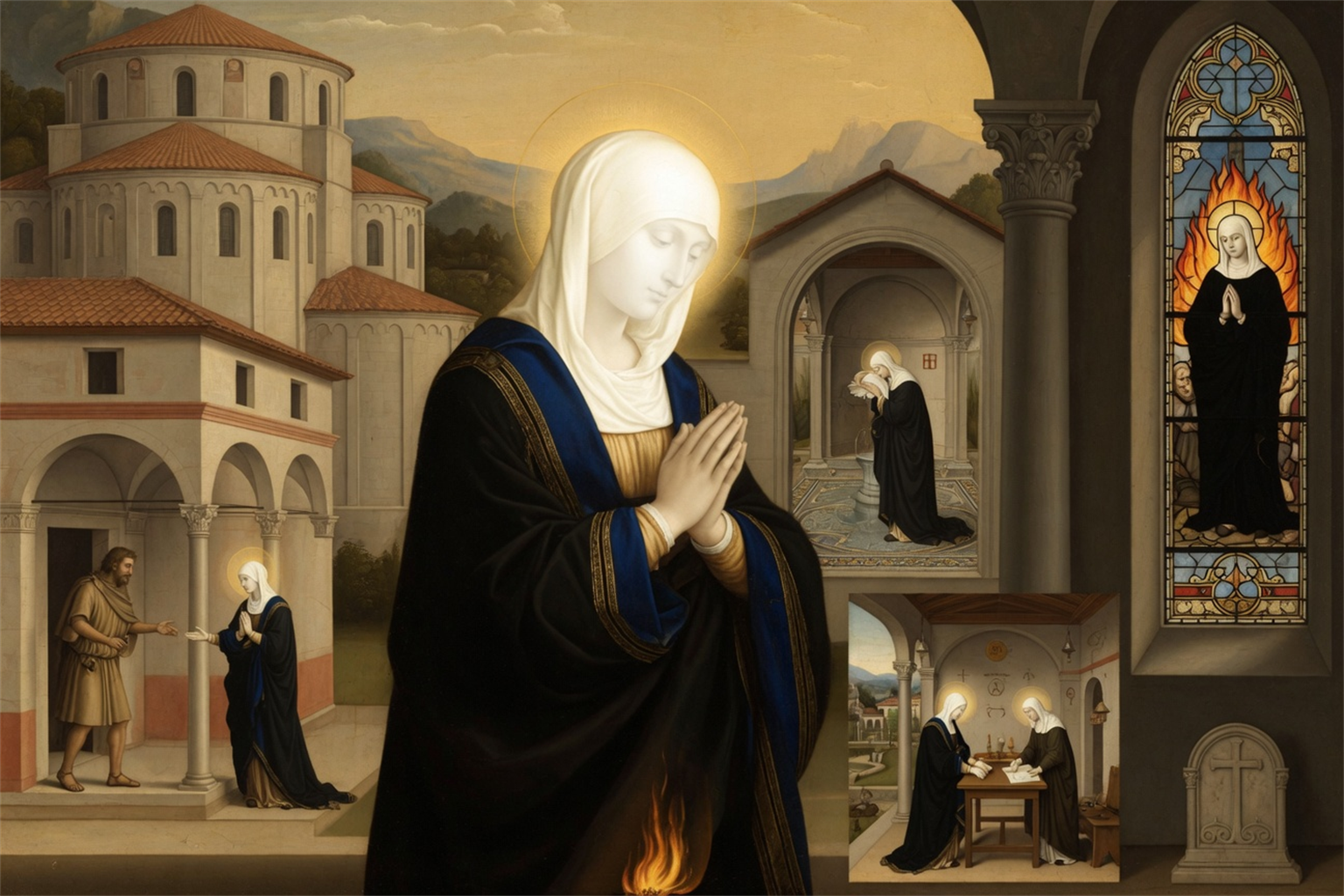
A 2nd-century virgin from Dijon, Paschasie welcomed Saint Benignus and became his active collaborator. After the apostle's martyrdom, she was condemned to the fire for her Christian faith. Her relics, long venerated in Dijon and Flavigny, rest alongside Saint Benignus.
Guided reading
4 reading sections
SAINT PASCHASIE, VIRGIN AND MARTYR (circa 180).
Conversion and support for the apostolate
Paschasia, close to Saint Leonilla, converted to Christianity under the influence of Saint Benignus and transformed her home into a mission center in Dijon.
Upon arriving in Dijon, Saint Benignus was received by a virgin na med Pasch Paschasie Virgin and martyr in Dijon in the 2nd century, disciple of Saint Benignus. asia, a relative or friend of Saint Leonilla of Lang sainte Léonilla de Langres Relative or friend of Saint Paschasie. res. She was a generous soul, who embraced the truth with ardor and offered her life to Him. Instructed and baptized by the holy apostle, she became, despite her advanced age, his very active co-worker in the propagation of the Gospel.
She lived in a house or villa outside the fortified enclosure, at the place where the church of Saint-Jean now stands; it is there that Saint Benignus established the center of his mission, and where Our Lord was offered for the first time, no doubt, in Dijon, under the Eucharistic veils.
Arrest and Martyrdom
Denounced after the martyrdom of Saint Benignus, she refused to abjure her faith before the judges and died condemned to the stake.
The zeal of Paschasie in speaking of Jesus Christ, her numerous efforts among her compatriots, and her devotion to the stranger who preached a new God, awakened the vigilance of the pagans, and no sooner had Saint Benignus crowned his apostolate with martyrdom than she was denounced as a rebel against the laws and thrown into prison. Accused before the judges of despising the gods and the edicts of the empire by adoring the Crucified, she gloried in it; threatened with the ultimate punishment if she remained obstinate, she mocked the idols and loudly confessed the adorable mystery of one God in three persons, and the most holy name of Jesus Christ, our only Savior.
The magistrates, humiliated and irritated all at once, condemned her to perish by fire and delivered her to the executioners.
Burial and posthumous miracle
Her remains were buried in secret and a chapel was erected. Gregory of Tours reports an apparition of the saint encouraging the builders of the Basilica of Saint-Bénigne.
Friendly hands secretly gathered the bones that the flames had spared, and buried them with honor; others later built a chapel over her tomb: it is probable that this was in the place where the desolate church of Saint-Philibert is seen.
One day, recounts Gregory of Tours, while the workmen were laboring at the Basilica of Saint-Bénigne, they saw a woman of venerable and august appearance emerge from the church of Saint Paschasie, dressed in black with a head radiant with whiteness. Come, courage, my friends, she said to the workers, finish your work, set up your machines, and let the construction rise; besides, with such an architect, the task can only proceed quickly. For, if your eyes could be opened, you would see Saint Benignus himself di recting your saint Bénigne Missionary from Smyrna, apostle of Burgundy. labors. At these words, she returned to the basilica from which she had emerged, and no one saw her again.
In the 9th century, an ancient stained-glass window depicted "with sufficient elegance, the scene of her martyrdom."
Translation of the relics
Her relics were transferred to the crypt of Saint-Bénigne, while a portion of her body was sent to the abbey of Flavigny.
When this basilica was ruined, the relics of Saint Paschasie we re transferred t sainte Paschasie Virgin and martyr in Dijon in the 2nd century, disciple of Saint Benignus. o the crypt of Saint-Bénigne, and they were placed to the right of the glorious apostle, the daughter beside her father. In the 11th century, Saint William dedicated one of the altars of the underground church to the holy martyr and to all the virgins. Some time before, half of the most holy body of this blessed one had been brought to the abbey church of Flavigny through the care of Fulchérius, abbot of Saint-Bénigne of Dijon and of Saint-Pierre of Flavigny. Her head, encased in a magnificent reliquary, enriched the treasury of Saint-Bénigne until recent times.
Saint Gregory of Tours: On t Saint Grégoire de Tours Bishop of Tours, contemporary historian, and friend of Palladius. he Glory of the Martyrs, an De la gloire des martyrs Work by Gregory of Tours mentioning the saint. d Saint of Dijon, by M. Duplus.
Annexes & related entities
Structured data for exploration: events, miracles, quotes, places, attributes, patronages, and important entities cited in the text.
Key Events
- Reception of Saint Benignus in Dijon
- Baptism by Saint Benignus
- Establishment of the mission center in her villa
- Denunciation and imprisonment following the martyrdom of Saint Benignus
- Condemned to the fire by the magistrates
Miracles
- Posthumous apparition to the workers of Saint-Bénigne Basilica to encourage them
Quotes
-
Come, courage, my friends, finish your work, set up your machines, and let the construction rise; besides, with such an architect, the task cannot but go quickly.
Gregory of Tours