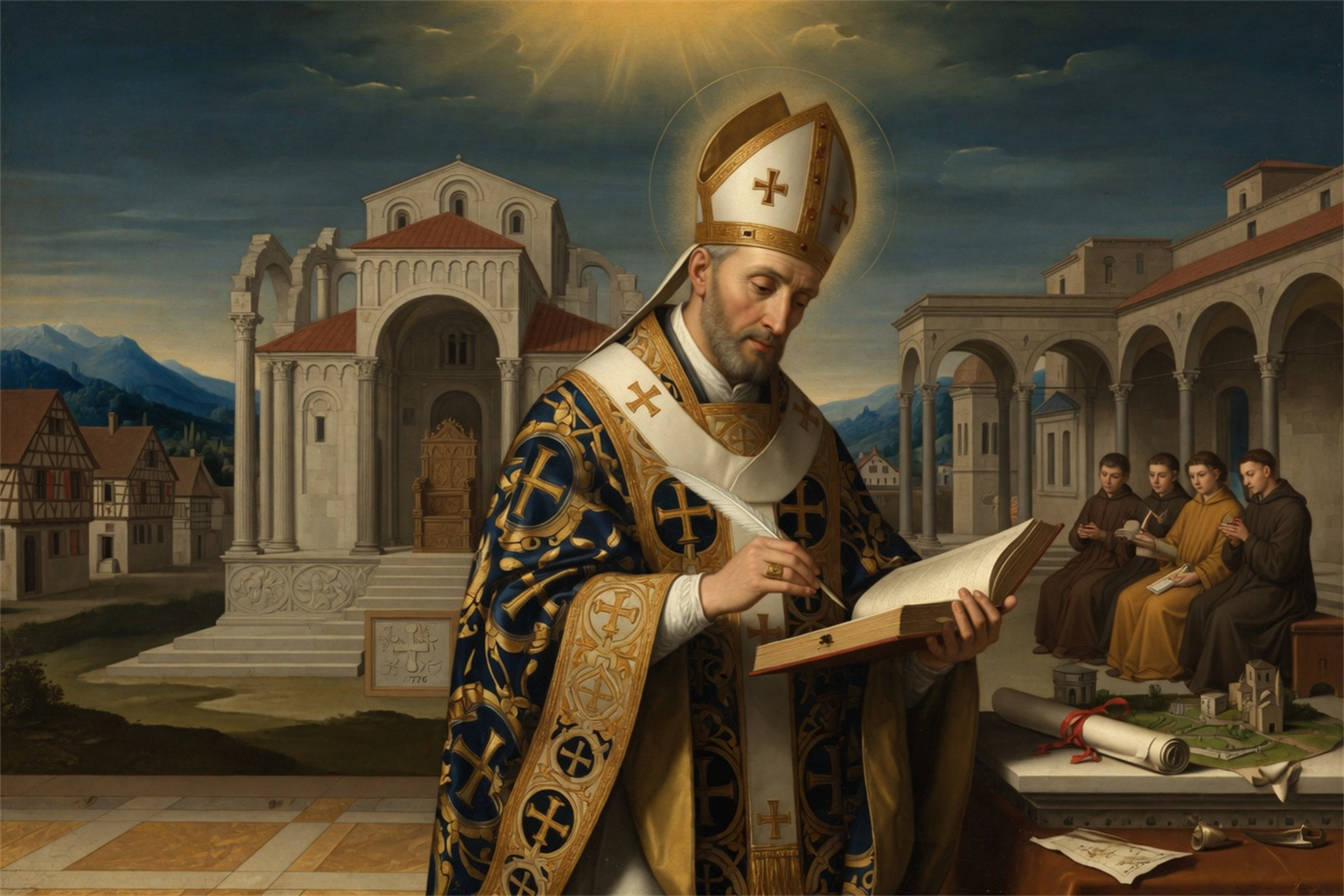
Originally from Alsace, Paulinus was an illustrious prelate and scholar under the reign of Charlemagne, becoming Patriarch of Aquileia in 776. A great defender of orthodoxy against the heresy of Elipand and Felix of Urgel, he was a central figure in the Carolingian councils and a close friend of Alcuin. He died in 804 after a life dedicated to the reform of the Church and the evangelization of the Avars.
Guided reading
6 reading sections
SAINT PAULINUS, PATRIARCH OF AQUILEIA
Origins and Ascension
Born in Alsace, Paulinus taught letters in Italy before being noticed by Charlemagne, who appointed him Patriarch of Aquileia in 776.
Let us pray to Saint Paulinus to intercede with God, so that his homeland, which was French in the 8th century, may be delivered from the Prussian yoke and retur ned to Paulin Carolingian prelate, theologian, and poet, Patriarch of Aquileia. France.
Paulinus, the second of that name on the see of Aquileia, one of the most learned prelates of Charlemagne's reign, was born in Alsace, and consequently in France. It is unknown what his family was or the precise place of his birth. From Alsace, he moved to Italy where he publicly taught the humanities. He acquired such a reputati on in this roi Charles Emperor of the Franks and uncle of Saint Folquin. position that King Charles, who protected the liberal arts, while in Loredo, gave him, as a form of recognition for the services he rendered to the public, a land in Lombardy. The act was passed in 776, and by the end of the year at the earliest, the knowledge of Paulinus and the good odor of his virtues and conduct led to his elevation to the dignity of Patriarch of Aquileia, whose Frioul Italian duchy where Evrard exercised his command. see was then in Friuli.
Imperial Advisor and Missionary
Paulinus evangelized the Avars in Carinthia and became an influential advisor to Charlemagne, actively participating in the councils of the Empire.
Soon the new prelate became the light of all Italy, lux Ausoniae patriae, as Alcuin describes him. But he did not limit himself to enlightening provinces that were already Christian; he wished to carry the torch of faith into what has since been called Carinthia, where he contributed greatly to the conversion of the Avars. King Charlemagne undertook nothing without Paulinus being either called or consulted. Of this, illustrious vestiges remain in some fragments of his letters to that monarch. Nothing is more admirable than the advice he gave him for establishing good order, justice, and virtue in his realms. He himself testifies that he was often present at the Councils that this prince assembled almost every year in all the lands under his obedience. He shone especially in that of Regensburg (792), and in that of Frankfurt, held in 794, against the heresy of Elipandus of Toledo and Felix of Urgel. One of our ancient annalists, who speaks only with admiration of his learning and his holiness, places him at the head of this famous assembly. It is believed that in his capacity as legat e of Pope Leo pape Léon III Pope who presented the relics of Hippolytus to Charlemagne. III, he also presided over another great Council that Charlemagne assembled at Aachen at the end of the year 802.
Intellectual friendship with Alcuin
A deep friendship bound Paulinus to Alcuin, the two scholars collaborating closely to defend Christian orthodoxy.
It was undoubtedly on these various occasions that Paulinus became acquainted with Alcuin Famous abbot under whom Aldric began his monastic life. Alcuin, another favorite of King Charles, who had drawn him to France. From this was formed between these two great men that holy, intimate, and mutual friendship of which one reads so many edifying traits in the letters and poems of Alcuin. The latter regarded Paulinus as his father and bore him, in that capacity, a filial respect. Paulinus, for his part, had an unreserved confidence in Alcuin, and a singular esteem for his merit.
Struggle against heresy
At the request of Charlemagne, Paulinus wrote major treatises to refute the theses of Elipandus of Toledo and Felix of Urgel.
The writing of Felix of Urgel having been brought to France, Alcuin, whom Charles had charged with responding to it, distrusting his own strength, begged this prince to send it to Paulinus, as one of the most learned bishops and the most capable of refuting it. Paulinus, who had already distinguished himself by another writing against Elipandus of Toledo, which had earned him the reputation of a famous author, inclytus auctor, took up the pen again and composed three books against Felix.
Diocesan Governance and Death
After holding several local councils and defending the immunities of the Church against the Doge of Venice, Paulinus died in 804.
So many services rendered to the Church in general did not lead him to neglect the particular needs of his diocese. As early as the year 791, he held a Council where, after condemning the errors that tended to renew those of Nestorius against the divine maternity and those that teach that the Holy Spirit does not proceed from the Father as from the Son, he regulated several points of discipline that he wished to revive in its original integrity. In 803, he assembled another Council at Altino, where he gave signs of his episcopal vigor in favor of the immunities of the Church. This concerned the violence of John, Doge of Ve Jean, doge de Venise Successor of Alexander and predecessor of Marcellus. nice, who had indignantly put to death John, Patriarch of Grado, because that prelate had reproached him for his scandals. Paulinus wrote a long synodal letter to Charlemagne to implore his protection. This was one of the last actions of our holy bishop, who died the following year, 804, on the eleventh of January, the day on which he is honored in the Church. Alcuin, his friend, composed the following epitaph for him:
"Here, Paulinus triumphant rests forever; may this holy father deign to remain in this fold. May the odious enemy never cross this temple, lest he immediately disunite the dear friends of heart whom the charity of Christ has united in a tender love."
Literary Heritage
The work of Paulinus includes theological treatises, synodal letters, and liturgical hymns still used in the Roman Breviary.
## ON THE WRITINGS OF SAINT PAULINUS OF AQUILEIA.
The manner in which most of the writings of Saint Paulinus were discovered would lead one to believe that not all those that came from his pen have yet been recovered. It is at least true that a large part of some, of which we have only fragments, is still hidden or entirely lost. Here is what remains of them:
A Treatise on the Trinity ent itled *Sacros Sacrosyllabus Theological work by Paulinus against Adoptionism. yllabus*, against the errors of Elipand of Toledo and Felix of Urgel.
Three books against Felix, Bishop of Urgel. Saint Paulinus relies primarily on Scripture and the Holy Fathers.
Books of salutary instructions to a count.
Salutary advice drawn from the writings of the holy Fathers. This is an exhortation to penance.
Acts of the Council of Friuli held in 791.
Synodal letter of Saint Paulinus regarding the violence of John, Doge of Venice.
Letters of Saint Paulinus.
Hymns, seven in number. Two stanzas of the hymn for Matins of the feast of Saint Peter-in-the-Lakes, in the Roman Breviary, are by Saint Paulinus.
The most complete edition of the works of Saint Paulinus was provided in 1737 by Madrisius, a priest of the Oratory; it is reproduced in the *Patrologia Latina*, volume xcix.
"Here, Paulinus triumphant rests forevermore; may this holy father deign to remain in this fold. May the hateful enemy never cross this temple, for fear that he might suddenly disunite the dear friends of heart whom the charity of Christ has joined in tender love."
Hic Paulinus ovans toto requiescit in aevo ; Hocque sub hoc pater dignus dignatur habere. Institus hoc templum nunquam pertransient hostis, Ne caros antecessores subito disjungat amicos Quos Christi caritas caros conjunxit antecessores.
Annexes & related entities
Structured data for exploration: events, miracles, quotes, places, attributes, patronages, and important entities cited in the text.
Key Events
- Teaching of the humanities in Italy
- Donation of land in Lombardy by Charlemagne in 776
- Elevation to the dignity of Patriarch of Aquileia at the end of 776
- Participation in the Council of Regensburg in 792
- Participation in the Council of Frankfurt in 794
- Presumed presidency of the Council of Aachen in 802
- Council of Altino in 803 against the violence of the Doge of Venice
Quotes
-
lux Ausonix patrix
Alcuin -
Hic Paulinus ovans toto requiescit in aevo
Epitaph by Alcuin