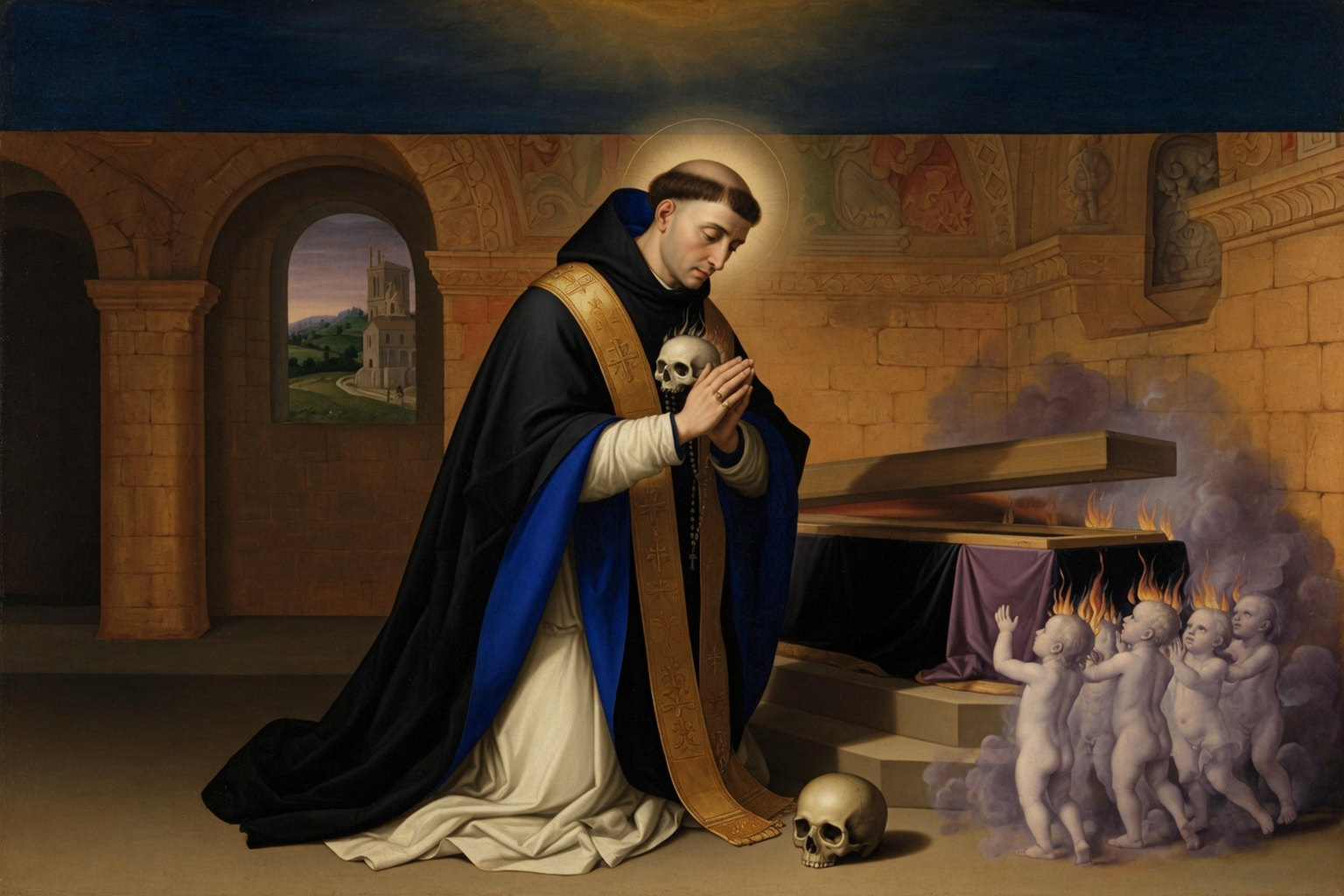
The fifth Abbot of Cluny in the 11th century, Odilo is famous for having instituted All Souls' Day on November 2nd. A great diplomat and promoter of the Truce of God, he distinguished himself by his immense charity toward the poor and his zeal for the relief of the departed. He died in Souvigny after having led his order for fifty-six years.
Guided reading
9 reading sections
SAINT ODILO, ABBOT OF CLUNY.
Sources and origins
The biography is based on the accounts of Peter Damian and the disciple Jotsaud. Odilo was born in Auvergne in 962 into a noble and pious family.
We shall report here, all the more freely, the admirable actions of this great light of the Order of Cluny, as we draw them from two very pure sources, where one need not fear any mixture of error. I speak of the life written by the blessed Peter Damian, Cardinal and Bishop of Ostia, at the solicitation of Saint Hugh, successor to the same Saint Odilo, at the Abbey of Cluny; and of anot her, compose saint Odilon Abbot of Cluny in the 10th century, founder of the commemoration of the faithful departed in his order. d by one of his disciples, named Lotsalde or Jotsaud, who had the honor of dwelling with him for a long time, and of being a witness to a great part of the wonders that God wrought through him.
He was born in Auvergne, of parents illustrious according to God and according to the world, in the year of Our Lord 962, with Otto I reigning in Germany, and Lothair in France, under the pontificate of Pope John XII. His father, Lord of Mercœur, was named Béralde, surnamed the Great, both because of the greatness of his courage in arms, and because of a probity and sincerity so recognized that more faith was placed in his words than in the oaths and execrations of any other person. His mother was named Gerberga; after the death of her husband, with whom she had always lived in perfect obedience and honesty, she became a nun at Saint-Jean d'Autun, where she persevered for a long time in the exercise of all virtues, and left behind, upon dying, a great reputation for holiness. He also had several brothers who made themselves famous in the world, and a sister named Blismonde, an abbess, who lived nearly one hundred years, serving God night and day in an exact observance of the rule. While still a child and under the care of a nurse, our Saint became so crippled in all his limbs that he could not move them: he was cured of this malady in a most extraordinary manner: one day when his father was going to the countryside with his whole family, it happened that, while passing through a village where they had to stop, his nurse left him for an instant at the door of a church dedicated to the Blessed Virgin. This child, seeing himself alone, struggled so well that he rolled little by little to the altar, where, clinging to the altar cloth, he strove to rise to his feet; by a miraculous assistance of the same Virgin, his limbs were loosened, he stood up, and began to run here and there around the altar.
The Monastic Ascension
After studies in Brioude, Odilo entered Cluny under Saint Mayeul. He quickly became coadjutor and then abbot general, considerably developing the Order.
We know nothing particular about his youth, other than that he spent it in the study of the sciences and in the practice of piety. At the age of 26, he received the clerical tonsure in the church of Saint-Julien, in Brioude, and shortly after, he entered the Order of Cluny, where he was received by Saint May saint Mayeul Fourth abbot of Cluny and predecessor of Odilo. eul, who was its third abbot, or the fourth if counting Berno, its founder and first abbot of Gigny (990). There are trees that bear fruit only long after they are planted; but Saint Odilo bore such excellent fruit at once and in such abundance that he was at once a subject of astonishment and a perfect model of virtue for all that great monastery. Thus, Saint Mayeul chose him as his coadjutor in 991, although the young professed monk was only twenty-nine years old. Three years later, the holy abbot having fallen ill at Souvigny-en-Bourbonnais, he had no difficulty in designating him as his successor. The monks of Cluny subscribed very willingly to this choice of their holy Father; so that the young Odilo, after having been canonically elected and ordained priest by Leutald, Archbishop of Besançon, was placed, despite all his resistance, on that abbatial chair which was the head of the entire Order. It was not in vain that one had hoped his government would be happy; scarcely was he raised upon this candlestick than he spread an admirable light on all sides. He marvelously expanded this holy Order of which he was the abbot general; he built new convents; he restored the old ones that the misery of wars or other accidents had ruined. He perfected those that were the most flourishing, and especially that of Cluny, whose church he embellished, whose buildings he increased, and whose cloister he rebuilt entirely anew, placing marble columns there instead of the wooden ones that were there before. Finally, he assembled a great number of holy religious who made his congregation very illustrious throughout the world.
Devotion and Purity
The abbot distinguished himself through a life of intense prayer, deep Marian devotion, and exemplary chastity, which earned him the nickname of the "hundred-year-old virgin."
This pastoral solicitude was supported by every virtue; he had such constant devotion that, in the fifty-six years he was priest and abbot, he barely passed a single day without offering the most august sacrifice of the Mass, although the multitude of his affairs, the inconvenience of his travels, and the acute pains by which he was often tormented seemed to make this great regularity almost impossible. Thus, being on his deathbed and wishing to know the number of Masses he had celebrated, he only had the count made based on the number of days that had elapsed since the time of his ordination. He was very assiduous in the reading of divine books, in psalmody, and in mental prayer, and he performed his exercises with such ardor and piety that he often accompanied them with sighs, groans, and an abundance of tears. Even his sleep did not pass without prayer; he would fall asleep reciting psalms and spiritual canticles, and he would always continue them as if he had been awake. To this devotion toward God corresponded a singular affection for the Blessed Virgin. Not yet a religious, he offered himself to her with a rope around his neck, at the foot of an altar dedicated to her, to be her perpetual servant. When this verse of the Te Deum was sung in the choir: Tu, ad liberandum suscepturus hominem, non horruisti virginis uterum, "Lord Jesus, when you took upon yourself to deliver man, you did not disdain the Virgin's womb," he entered into such a great feeling of respect for her that he could not help but prostrate himself to the ground, and every time he pronounced or heard the name of Mary pronounced, he felt extreme joy and made a deep bow. He strove above all to please her through the love of purity, and this virtue had so deeply entered his heart that in extreme old age he still showed the circumspection and modesty of a young virgin; he was even called the hundred-year-old virgin, Virgo centenarius.
Charity during the famine
During the great famine of 1030, Odilo exhausted the resources of Cluny and sold the church's treasures to feed the poor, traveling through cities to raise funds.
His charity and mercy for his neighbor were marvelous: he was the eye of the blind, the foot of the lame, the consolation of the afflicted, the hope of the unhappy, the wealth of the poor, and the food of those who suffered from hunger. He sometimes gave alms with such profusion that he seemed to be prodigal rather than liberal, and when he was remonstrated about it, he said that he would rather be judged with mercy for having slightly exceeded in mercy, than to be judged without pity for not having had pity on the calamities of his neighbor.
One of the cruelest famines mentioned in history was then devastating the kingdom of France. It began in the year 1030 and lasted three years, during which almost continuous rains prevented the harvests and other fruits of the earth from reaching maturity. What miseries and atrocious sufferings existed at that time would be difficult to describe. The Church was then the Providence of the starving unfortunate. The monastery of Cluny was one of the richest in the Christian world; Saint Odilo made it poor to relieve public misery. For the subsistence of his monks, he relied on the care of Providence; but for that of the poor, he believed that the goods of his monastery should be used first. His liberality was so great that he was accused of profusion: a reproach which, in such circumstances, is a true eulogy. When the holy abbot had exhausted the provisions of his monastery, he sold the chalices, the sacred vessels, and the precious ornaments of his church, and did not even spare the golden crown that the Emperor Saint Henry had given to Saint-Pierre de Cluny. As his income and treasures were nevertheless too modest to relieve the misery of all the poor, he went from city to city and from castle to castle, in order to excite princes, lords, and wealthy persons, both ecclesiastical and lay, to open their purses to relieve the pressing needs of so many wretches. It is asserted that he saved, by this means, several thousand people from a cruel death, into which famine would have plunged them. One day, going from Saint-Denis to Paris, he encountered on the high road two children dead from hunger and cold, who were exposed to the sight of passersby: such a tragic object filled him with pain and compassion; he dismounted from his horse, and stripping off the serge shirt he was wearing, he wrapped them with his own hands, and, having hired gravediggers to bury them, he led them himself to the burial. Who can doubt that he equaled, by this action, the one that made Saint Martin so famous and so glorious throughout the Church? Another time, a leper having begged him to come and visit him, the Saint not only came to see him, but embraced him, and conversed with him for a long time, without such an infectious disease being able to cause him horror.
Signs and wonders
Numerous miracles are attributed to him: healings of the blind and lepers, the multiplication of wine, and divine protection during his travels.
This great mercy, with which his heart was filled, sometimes even led him to perform miracles in favor of those he saw in misery. He restored sight to the son of one of his farmers, who had been blind from birth; he healed a novice of his monastery of Paternac, who was cruelly afflicted with scrofula; in another of his monasteries, which was on Mount Jura, he delivered a child named Gerard, who often suffered from the falling sickness, by having him receive communion at his mass and by giving him to drink, from the chalice of Saint Mayeul, water sanctified by his blessing; a nobleman having been dangerously wounded in the eye by a splinter of wood, and suffering great pain there, he healed him with the sign of the cross; he aided, by the same sign, an ecclesiastic from Tours who had anthrax on his arm; finally, he restored intelligence to a gentleman whose madness led him to such great excesses that, abandoning his house, he would run about without modesty and let out horrible cries in the countryside. Thus, he drew incessantly from the store of God and from the infinite treasure of His power, to relieve all kinds of needy people, and to satisfy the inclinations of his charity. Our Lord, for His part, often performed other wonders to reward this charity and to show how pleasing it was to Him. One day when the Saint was passing through one of his monasteries called Saint-Martin, he was visited there by a large number of religious who came to be refreshed in the spiritual unction with which his conversations were always filled. His charity compelled him to keep them with him in the evening and to have them served the fish that had been intended for him; but although there was very little of it, nevertheless all were fully satisfied, and there still remained an abundance for the servants and the poor. Another time, he had had all the wine that was being carried for his refreshment and that of his company distributed to poor travelers; when they later sat down at the table, the vessels were found to be as full of wine as if they had not been touched at all. This multiplication or reproduction of wine also occurred on other occasions.
Institution of the Feast of the Dead
Inspired by revelations regarding purgatory, Odilo institutes November 2nd as a day of prayer for the deceased, a practice subsequently adopted by the universal Church.
It is time to speak of that which shone most brightly in the charity of Saint Odilo, and which rendered him most famous and glorious throughout the entire Church; I mean his zeal for the relief and deliverance of the souls in purgatory. The practice of praying for them has been in use since the time of the written law, as is easy to see in the history of the Maccabees. We also learn, through the holy Fathers and the ancient liturgies, that it has always been very religiously observed since the time of the Apostles; but there was no day in the course of the year that was particularly assigned to it. Saint Odilo was the first to make this pious establishment. He had taken great care, from the first years of his prelacy, to have many prayers, fasts, and alms performed in his Order, and to offer often, and have offered, the unbloody sacrifice of the body and blood of Jesus Christ for these suffering souls, burdened under the weight of the justice of God. But his compassion for them growing day by day, he wished to provide them, for the centuries to come, with an ordinary aid that could not be so easily interrupted. He was, moreover, spurred by revelations that were made to some of his monks, and in particular to a holy hermit.
A French religious, returning from Jerusalem, was cast by a storm onto an island near Sicily, where he met a hermit who spent his days there in austere penance, having only a cave for a dwelling. This holy recluse received him very charitably; and having learned that he was French by nation, he asked for news of Cluny and its abbot, so famous throughout the world, and said to him: "Here, very close by, I have often seen frightful flames and fires that seem capable of devouring this whole land: they emerge from the abysses of the earth, raising with them a million souls, who endure unbearable torments and expiate their sins in this conflagration. They utter lamentable cries, in the midst of which I have distinguished the horrible howls of the demons whom I have seen, in hideous figures, complaining with rage that many of these souls are snatched from them before their time and are led to heaven in triumph, thanks to the prayers, sacrifices, and penances of all the faithful, and especially to the continual mortifications, sacrifices, and prayers of the Abbot of Cluny and his religious, who apply themselves to this work of charity and fervor with more zeal than all the children of the Church." Having said this, he strongly exhorted the religious, as soon as he arrived in France, to give notice to this good abbot and to beg him on his behalf to continue and redouble his holy exercises, and to urge his religious to do the same for the glory of God, for the deliverance of the poor souls in purgatory, and for the confusion of the demons, who are in despair when they are deprived of the means to harm the human race. The religious, having arrived in France, went promptly to Cluny, where he recounted to Saint Odilo what he had heard; the latter conceived a great joy from it and had all the monasteries under his dependence pray to be more zealous than ever in these charitable exercises.
It was then that he established that, each year, on the second day of November, which is the day after the feast of all the Saints, the Commemoration of all the faithful departed would be held in the monasteries of his obedience, and that this day would be entirely consecrated to procuring for them, before God, the remission of their Commémoraison de tous les fidèles défunts Liturgical institution created by Odilo to relieve the souls in purgatory. pains and their blessed entry into the kingdom of heaven. The universal Church found this ordinance so reasonable that it adopted it and made it a law for all the faithful, as is expressly noted in the Roman Martyrology, on the first day of January. Pope Benedict VIII was one of the principal ones who felt the effects of this charitable compassion of our Saint; for the blessed Peter Damian, and several authors pape Benoît VIII Pope supported by Henry II against an antipope. after him, recount that having been condemned to a long purgatory, he was delivered from it by his suffrages and those of his spiritual children. This fact was revealed to Eldebert, a religious of holy life and consummate in the exercises of mercy toward the poor.
A European Mediator
An advisor to popes and emperors, he refused the archbishopric of Lyon and played a major diplomatic role, notably for the city of Pavia and the kingdom of Poland.
After having dwelt so much on the charity of Saint Odilo, we must say a word about his other virtues. His prudence and discretion were so recognized that the popes themselves, the emperors, and the kings consulted him as an oracle and held his advice in very high regard. With what skill did he not preserve the city of Pavia, which was very dear to him, from the murders and fire with which it was threatened under the emperors Henry and Conrad! What wisdom did he not show when the ambassadors of Poland came to him to ask back their king Casimir, who had taken refuge in his monastery of Cluny, and had there taken the habit, made profession, and even received the order of the diaconate! Another, less discreet than he, would have either cowardly granted them what they asked, overcome by their arguments and their tears, or would have on the contrary driven them to despair by a pitiless refusal; but the Saint knew so well how to temper all things that he satisfied them without granting them anything; he referred them to the Sovereign Pontiff, giving them hope that His Holiness would have regard for the salvation of this great kingdom, which seemed to depend on the restoration of its legitimate king. His justice was no less than his prudence. He never did any wrong to anyone, but he was very exact in rendering to each what was due to him. He honored his superiors, he loved his equals, he watched very carefully over his inferiors. Thus his historian assures us that he was everywhere considered and respected as an angel. The continual labors to which the duty of his office obliged him, and a thousand others, which he undertook for the good of the Church and the monastic state, and for the relief of the people, often showed how invincible his courage and patience were. He gave great signs of this again in the acute illnesses by which he was tormented; for he then had no other complaint on his lips than that he did not suffer as much as his sins deserved.
He possessed in an excellent degree those two virtues that Our Lord wants us to learn from His example: meekness and humility. His meekness was so wonderful that the most zealous sometimes complained of it, recognizing an excess in it; but he answered them, with a tranquil spirit, that if he were to be damned, he would rather it be for having been too meek than for having been harsh and cruel. There was nothing so humble or so modest as he. The honors rendered to him, whether by the religious, or by the abbots, his confreres, or by the ecclesiastical or secular princes, were unbearable to him. One could never oblige him to accept the archbishopric of Lyon, although all the clergy and the people asked for it with much insistence, and although Pope Benedict IX had named him to this dignity and had even sent him the pallium and the ring to force him to bow his shoulders under a burden of this importance.
Being at Monte Cassino, he was asked by Abbot Theobald, who had a singular veneration for his merits, to say the solemn mass on the day of Saint Benedict: far from judging himself worthy of this honor, he did not even want to take the crosier, or the pastoral staff, which this abbot presented to him as the mark of his prelacy. The only favor he asked of him was to be allowed to humbly kiss the feet of all the religious of his community; and, having finally obtained it through a holy importunity, he did it with so much affection and such a great demonstration of contempt for himself that he filled all those who saw it with astonishment and drew tears to their eyes. When he wanted to perform some miraculous healing, he had this skill, which could only come from a consummate humility: he gave the sick water to drink from the chalice of Saint Mayeul, so that the miracle would not be attributed to his merits, but to those of the Saint. What shall I say of his austerity and the extreme rigor he exercised against his body? He slept very little, he wore a hair shirt continually, he tightened his limbs from time to time with iron bonds that caused him unbearable pain, he exhausted himself with very long fasts, and, although he was usually in the refectory with his religious and, to avoid singularity, ate what was served to him there, nevertheless he ate in such small quantity that he irritated his appetite instead of satisfying it.
This admirable union of all virtues made him loved by everyone. He was extremely dear to the popes, emperors, and kings who reigned in his time, and principally to Pope Clement II, to the emperors Saint Henry and Henry III, to our very pious King Robert, son of Hugh Capet, to Henry I of France, to Saint Stephen, King of Hungary, and to Sancho the Great, King of Spain. Where ver he we Henri III Emperor present at the announcement of Bardon's death. nt, whether in France or in Italy, he was received with joy and general applause; and such a great number of religious gathered around him that the Blessed Fulbert, Bishop of Chartres, called him for this reason the Archangel of the religious.
Death and Posterity
Odilo died at Souvigny in 1049. His relics, long venerated, were destroyed during the French Revolution in 1793.
A life so holy and so marvelous could not fail to be crowned by a beautiful death. Before it arrived, Saint Odilo was tormented for five years by very serious illnesses and fell into a great languor. Believing himself near his end, he wished to pay his final respects at the tombs of the blessed apostles Saint Peter and Saint Paul, and for this purpose went to Rome. Pope Damasus II, who was elected around that time (1048), gave him testimonies of perfect friendship and often conversed with him. All the most notable people in Rome visited him, and especially Lawrence, Archbishop of Amalfi, illustrious for his learning and piety, who formed a close friendship with him. He desired to end his career in this great city, under the protection of the holy Apostles; but God having restored his health, after a stay of four months, he felt obliged to return to France, to his abbey of Cluny. He spent nearly another year there, in continual prayer and extraordinary austerity, to better prepare himself for death. Then, feeling a little vigor, he undertook to make one last visit to his monasteries, persuading himself that he could not end his days more gloriously than in the exercise of his office. Having arrived at Souvigny, in Bourbonnais (today the department of Allier, 15 km southwest of Moulins) Souvigny Place of death and burial of Saint Mayeul. , where we have already said that Saint Mayeul, his predecessor, had died, he was preaching to the people on the mysteries of the advent and the temporal birth of Our Lord, whose feast was near, when he felt his old pains return: he then predicted that he would die around the feast of the Circumcision, which the event justified; for on the very night of this feast, after having received all the sacraments that the Church confers at the hour of death, and bathed his bed with the tears of holy compunction, he quietly surrendered his soul into the hands of his God. The admirable purity of his life, joined to his admirable penances, did not prevent the demon from presenting himself to him at the time of his agony, with a frightful figure, to terrify him and lead him to sin. But the Saint, fortified by the grace of God to whom he had always been faithful, repelled this monster so vigorously that he compelled him to disappear. His death occurred on the first day of the year 1049 or (according to some, who believe he died before midnight) the last day of the year 1048. He was eighty-seven years old, of which he had spent twenty-six in the world, five in the cloister before being abbot, and fifty-six in the office of abbot. He appeared on the very night of his burial to a religious named Gregory, and, the following Lent, to a virtuous ecclesiastic named Alberon, and revealed his happiness to them.
His body, after remaining for nearly three hundred years in the tomb, was removed from it, with much solemnity, on June 24 of the year 1345, by Roger-le-Fort, Archbishop of Bourges, with the permission of Clement VI, in the presence of two other bishops and several abbots, priors, and other ecclesiastical personages; and, having been placed in a shrine, it was placed very honorably in the church of the priory of Souvigny. A first translation had taken place under the pontificate of Urban II, who had been a monk of Cluny; its feast was celebrated on November 13. An annual commemoration of the discovery of his body was also held on May 13, and another of the reception of his head, on April 19. All these feasts prove how famous the cult of Saint Odilo was. Before the pillage by the Calvinists, one could see in the church of Cluny the vermeil statue of our holy abbot; it wore a miter enriched with sapphires; at the foot of the statue, four silver angels were seated on a stool supported by four lions of the same metal.
The relics of Saint Odilo were burned in 1793, with all the rich ornaments and all the precious relics contained in the treasury of the priory of Souvigny. One can still see in the church two types of shrines or cupboards in Apremont stone, richly sculpted. It is a small monument from the 15th century. The portraits of two great saints, Mayeul and Odilo, are painted on the panels of the two doors; but the reliquary is completely empty. The name of Saint Odilo is still in veneration in the parish of Souvigny; it is much less so, however, than that of Saint Mayeul, his predecessor.
The priory of Souvigny still subsists in very large part; but it has become a private dwelling which is unfortunately deteriorating every day. The prior's apartment, separated entirely from that of the monks, is in a better state of preservation. The magnificent enclosure adjoining the priory and the monastery has been cut by a road for about ten years.
We still possess the beautiful main church, which became a parish church after the restoration of worship. It is, despite the mutilations suffered in 1793, the most beautiful and complete monument in the Bourbonnais. Its vast dimensions, the variety of its architectural styles, the severity of the Romanesque style of the side aisles, the richness of its ogival chapels which contain the tomb of the Dukes of Bourbon, and the beauty of the sanctuary make it the wonder of the province. It needs a prompt restoration to save it from imminent ruin. We learn with pleasure that the wish of all friends of art is about to be satisfied on this point.
The Truce of God and Writings
He contributed to the establishment of the Truce of God and left a literary body of work including sermons and the biographies of Saint Adelaide and Saint Mayeul.
Saint Odilo contributed greatly, along with Blessed Richard, Abbot of Saint-Vanne in Verdun, to the adopt ion of the Tr trêve de Dieu Medieval peace convention limiting the days of warfare. uce of God, an agreement between lords by which they pledged to cease all hostilities from Wednesday evening until Monday morning, out of respect for the days on which the final mysteries of the life of Jesus Christ were accomplished. The first Truce of God was established in a synod held at Elne, in Roussillon, in 1027.
Odilo had succeeded a Saint and he had a Saint as his successor: Saint Hugh of Cluny. He also had other very illustrious disciples, among whom one can count Hildebrand, who later became Sovereign Pontiff under the name of Saint Gregory VII.
## WRITINGS OF SAINT ODILO.
We have from Saint Odilo several sermons on the feasts of Our Lord and the Blessed Virgin: letters and poems, in Bibl. Clun., p. 370, and in Bibl. Patr., vol. XVII, p. 653. Dom Martène published in Anecdot., vol. V, two new sermons under the Saint's name. Saint Odilo wrote, around the year 1047, the life of Saint Adelaide, in whic h he describes himself vie de sainte Adélaïde Hagiographical work written by Odilo around 1047. as frat. Odilo, Cluniensium pauperum cunctorum peripsema. Basnage, in Lec., Ant. Canisii, vol. III, part 1, p. 71, seeks to deprive the Saint of the honor of this work; he even regarded it as the production of an ambitious and hungry courtier, who was courting the empress to obtain money, offices, and honors. But he has been soundly refuted by Dom Rivet, Hist. litt. de la Fr., vol. VII, p. 418, and by Dom Coillier, vol. XX, p. 237, old edition. Saint Odilo also provided the life of Saint Mayeul.
The sources from which we have drawn this biography are found in Bollandus, on the first day of January. The Roman Martyrology also mentions Saint Odilo on this day, as we have seen; nevertheless, his feast is moved in his Order to the second day, because the first is occupied by the solemnity of the Circumcision of Our Lord.
Annexes & related entities
Structured data for exploration: events, miracles, quotes, places, attributes, patronages, and important entities cited in the text.
Key Events
- Born in Auvergne (962)
- Miraculous healing of paralysis in a church of the Virgin
- Clerical tonsure at Brioude (988)
- Entered the Order of Cluny (990)
- Election as coadjutor (991) then Abbot of Cluny (994)
- Establishment of the Commemoration of All the Faithful Departed (November 2)
- Promotion of the Truce of God
- Died in Souvigny at the age of 87
Miracles
- Healing of his childhood paralysis before an altar of the Virgin
- Multiplication of wine for his monks and the poor
- Changing water into wine at Orval
- Miraculous repair of a broken crystal vase
- Crossing rivers without getting feet wet
Quotes
-
I would rather be judged with mercy for having been a little excessive in mercy, than to be judged without pity for not having had pity on the calamities of my neighbor.
Source text -
I sleep, but my heart watches for you!
Song of Songs (cited by the author)