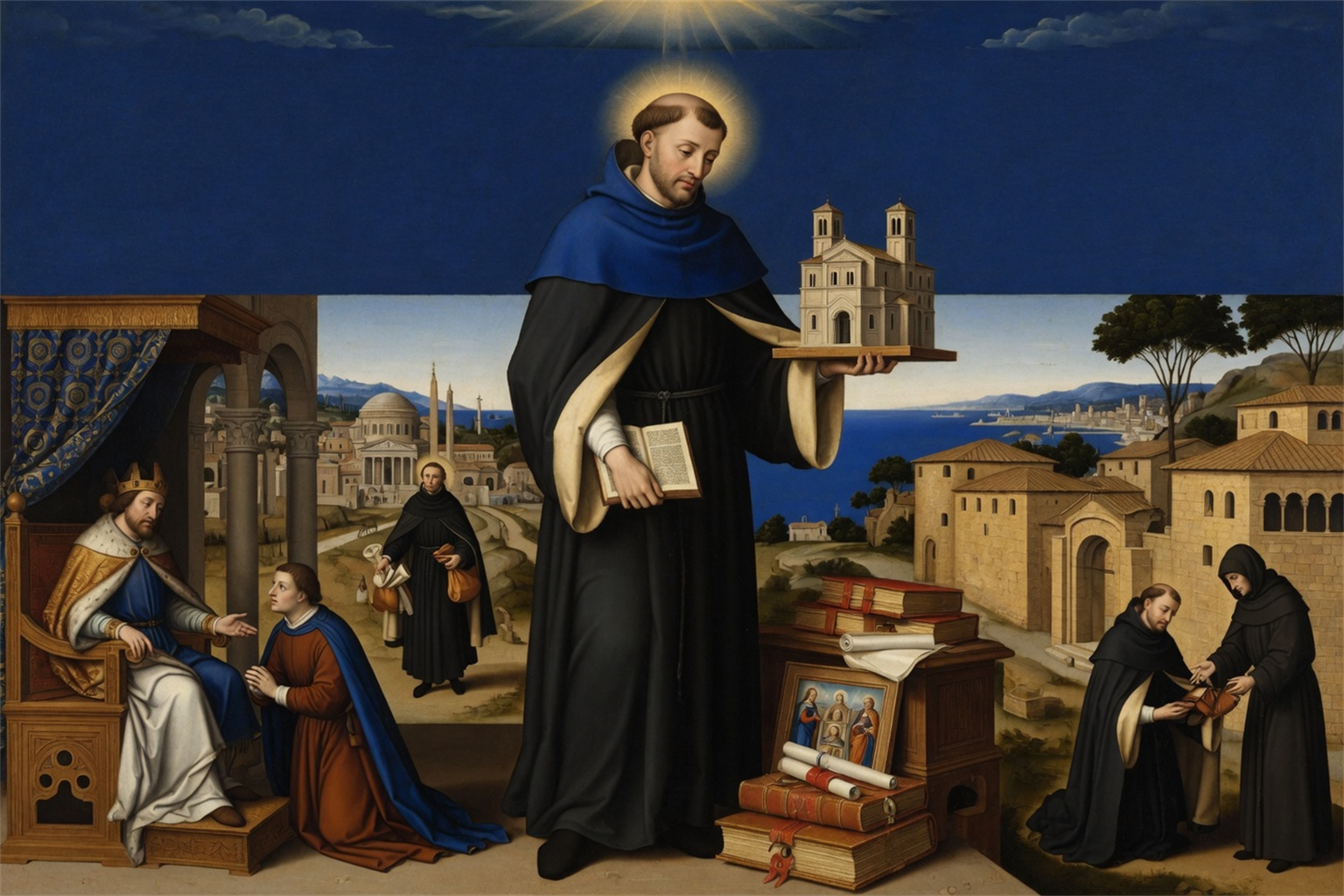
An English nobleman who became a monk at Lérins, Benedict Biscop founded the abbeys of Wearmouth and Jarrow in the 7th century. A great traveler, he brought back books, relics, and artists from Rome to introduce Roman culture and arts to England. He was the teacher of the Venerable Bede and died in 690 after a long illness.
Guided reading
6 reading sections
SAINT BENEDICT BISCOP, ABBOT IN ENGLAND
Youth and conversion
Benedict, an English nobleman and career soldier at the court of King Oswy, renounces the world to dedicate himself to God and undertakes his first journey to Rome.
Benedi Benoît Founder of the monasteries of Wearmouth and Jarrow and kinsman of Ceolfrid. ct was English by birth, from a family of great standing due to its nobility. His parents had him raised in military exercises, with the intention of making him a great captain in the future; and, as he was naturally very courageous, he soon acquired much reputation in arms. Oswy, King of Northumbria, a northern country of England, having called him to his court, the Saint spent several years there; but Our Lord, who destined him for other tasks, spoke to him in the secret of his heart and led him to resolve to abandon the world. He left not only the court, but also the place of his birth, and undertook the journey to Rome to honor the tombs o f th Rome Birthplace of Maximian. e blessed apostles Saint Peter and Saint Paul and to be better instructed in the principles of the faith and the rules of Christian perfection, which were taught only very imperfectly in his newly converted country. Having arrived in this famous city, he visited with singular piety all the sanctuaries that make it so venerable; upon his return, he applied himself entirely to the study of the Holy Scriptures and to the exercises of piety. Five or six years later, Alcfrid, son of King Oswy, had the desire to visit the tombs of the holy apostles Peter and Paul; he begged the Saint to accompany him; but the prince's father having opposed this pilgrimage, Benedict left alone for Rome, in order to perfect himself more and more in the science of salvation. Returning from Italy, he passed through the famous monastery of Lérins, where he took the religious habit. After remaining there for two years, he returned to Rome in the year 668. His intention was not to leave it; but Pope Vitalian wis pape Vitalien Pope from 657 to 671, defender of discipline and orthodoxy against Monothelitism. hed him to accompany Saint Theodore, Arc saint Théodore Archbishop of Canterbury sent on a mission with Benedict. hbishop of Canterbury, and Saint Adrian, whom he was sending to England in order to work for the instruction of this new Christian people.
Monastic formation and mission
After a period at the monastery of Lérins and several stays in Rome, he was commissioned by Pope Vitalian to accompany Saint Theodore and Saint Adrian to England.
Saint Benedict was placed in charge of the monastery of Saint Peter and Saint Paul, which was not far from the city of Canterbury: leaving this charge some time later to Saint Adrian, he made a new journey to Rome. He wished to acquire new insights into the discipline of the Church and the various monastic constitutions: which led him to remain for a considerable time in several places in Italy. Upon his return, having found favor with his prince, who was Egfrid, successor to Oswy, he built two monasteries: one near the river Were, in honor of the prince of the Apostles, called for this reason Wearmouth (674); the other, under the invocation of Saint Paul, near the river Tyne; the latter first bore the name of Girwy, then that of Jarrow, around 677. As they were close to one another, he was superior of both; but he took care to place under him persons of eminent holiness, namely: Eosterwine and Ceolfrid, whom the Church of England honors as Saints. The establishment of these subordinate superiors had become necessary, because the Saint's travels and various occupations did not allow him to do everything by himself. He taught his monks all the practices of piety that were observed in the convents of Rome and in those he had visited on the way, passionately wishing to see monastic life flourish in his country, as it flourished in France and Italy; he even established in his abbey a college where he taught publicly; and there were at one time up to six hundred monks who took his lessons. The venerable Bede was entrusted to him at the age of seven, so that, being raised under his discipline, he would fulfill the great hopes that were conceived of his fine nature: which vénérable Bède Hagiographer whose martyrology attests to the antiquity of the cult. succeeded very advantageously.
Foundations of Wearmouth and Jarrow
Under the patronage of King Ecgfrith, Benedict founded the monasteries of Wearmouth and Jarrow, establishing a rigorous discipline and educating the young Bede.
This blessed abbot made other journeys to France and Italy, both for the good of his order and for the benefit of the entire Church of England, which he always cared for with great diligence. He had, above all, an extraordinary zeal for everything that could enhance the glory and beauty of the house of God, and make ecclesiastical ceremonies pompous and magnificent. There were almost no churches or chapels built of stone in England at that time; the use of glass in windows was unknown, sacred paintings were very rare, and the books of the holy Fathers were found only in very small quantities. But this industrious man admirably provided for all these needs. He brought with him, from overseas, architects, glaziers, and painters, the most skillful he could find, and had basilicas built of solid stone, adorned the windows with historiated glass, and decorated the altars and walls with beautiful paintings. He also brought a great number of books with which he enriched the libraries of his monasteries, and many paintings where our mysteries were represented; he exposed them to the eyes of the faithful, so that the ignorant might learn there what we believe, just as others learn it from books. He did not fail, either, to procure for his country very considerable relics which were given to him.
Cultural and Artistic Influence
Benedict imported architects, glaziers, and books from Europe to embellish English churches and introduced the Roman liturgy with the help of the cantor John.
by the Popes, to whom his ardor for holy things was very pleasing. But what satisfied him primarily was that Pope Saint Agatho sent with him John Pape saint Agathon Pope who exonerated Wilfrid during his first exile. , Abbot of Saint Martin, master of music an Jean, abbé de Saint-Martin Master of music and ceremonies sent by the Pope to instruct the English. d ceremonies of Saint Peter, to introduce these ceremonies in England and to teach the method of singing well. Thus, as long as he was on the island, Saint Benedict took extraordinary care of him and did not allow anyone other than his monks to provide for his subsistence; hence it is that they were the best instructed in everything pertaining to the celebration of ecclesiastical offices. He himself became so skilled in this that he composed a book on the subject, entitled: *De la Célébration des Fêt es* (On the Celebration of De la Célébration des Fêtes Liturgical work composed by Benedict Biscop. Feasts), so that what had been learned from this cantor of the Roman Church would not be forgotten. The Venerable Bede, speaking of this charitable foresight of his master Saint Benedict, says that he worked with such zeal so that his own might live in peace; and that he undertook so many journeys so that, being provided with all necessary things, they could serve Our Lord peacefully within the enclosure of their monasteries, without being obliged to leave them. He made a fifth journey to Rome at a time that would be difficult to specify.
Last days and death
Afflicted by paralysis, he gave an example of patience to his monks before passing away in 690, leaving behind a rule compiled from seventeen monasteries.
Finally, having become old and infirm, he gave rare examples of patience to his disciples, suffering very painful illnesses without sorrow and with great tranquility and joy. His greatest recreation was to speak sometimes of the holy places he had visited, of the exact observance of religious houses, and of the happiness of those who love their vocation. For the last three years of his life, a cruel paralysis deprived him of the use of his limbs and finally forced him to stay in bed. When it was no longer possible for him to attend the canonical office, some monks, divided into two choirs, came to sing the psalms of each hour of the day or night beside him; he joined them as much as he could, even mingling his voice with theirs. His mind was occupied only with God and the perfection of his disciples, whom he frequently exhorted to observe their rule with exactitude: "My children," he said to them, "do not look upon the constitutions I have given you as an invention of my own mind. After visiting seventeen well-disciplined monasteries, whose laws and customs I endeavored to know perfectly, I formed a collection of all the rules that seemed best to me: it is this collection that I have given you.
He died after receiving the holy Viaticum on January 12, 690. His relics were transferred to Thorney Abbey in 970. The monks of Glastonbury claimed to possess a portion of them. The En glish Benedictine abbaye de Thorney Site of the translation of the saint's relics in 970. s honor this Saint as one of their patrons.
History of relics and sources
The text details the transfer of his relics and lists the hagiographic sources used, notably the writings of Bede the Venerable.
The abbeys of Wearmouth and Jarrow were destroyed by the Danes. Partially restored, they still existed under the title of *priories* when the monasteries of England were destroyed in the 37th year of the reign of Henry VIII. These two *priories* had been subject to the abbey of Durham since the year 1083.
Placed near him are the two monasteries of Saint Peter and Saint Paul, which were the origin of the two towns of Wearmouth and Jarrow: he is or was one of the patrons of these localities.
Father Giry composed this life of Saint Benedict Biscop using a homily by the Venerable Bede, Bellandus, and the *Benedictine Year*.
We have reviewed and supplemented it with Butler, with the *Life of the First Abbots of Wearmouth*, written by Bede and published in Dublin by James Ware in 1664; and finally with the information kindly provided to us by the Rev. Father Faber, of the London Oratory.
Annexes & related entities
Structured data for exploration: events, miracles, quotes, places, attributes, patronages, and important entities cited in the text.
Key Events
- Service at the court of King Oswy of Northumbria
- First journey to Rome to be instructed in the faith
- Took the religious habit at the monastery of Lérins
- Mission to England with Saint Theodore and Saint Adrian in 668
- Foundation of the monastery of Wearmouth in 674
- Foundation of Jarrow monastery around 677
- Five journeys to Rome to bring back books, relics, and artists
- Education of the Venerable Bede from the age of seven
Quotes
-
My children, do not regard the constitutions I have given you as an invention of my own mind. After visiting seventeen well-disciplined monasteries... I compiled a collection of all the rules that seemed best to me.
Source text (reported speech)