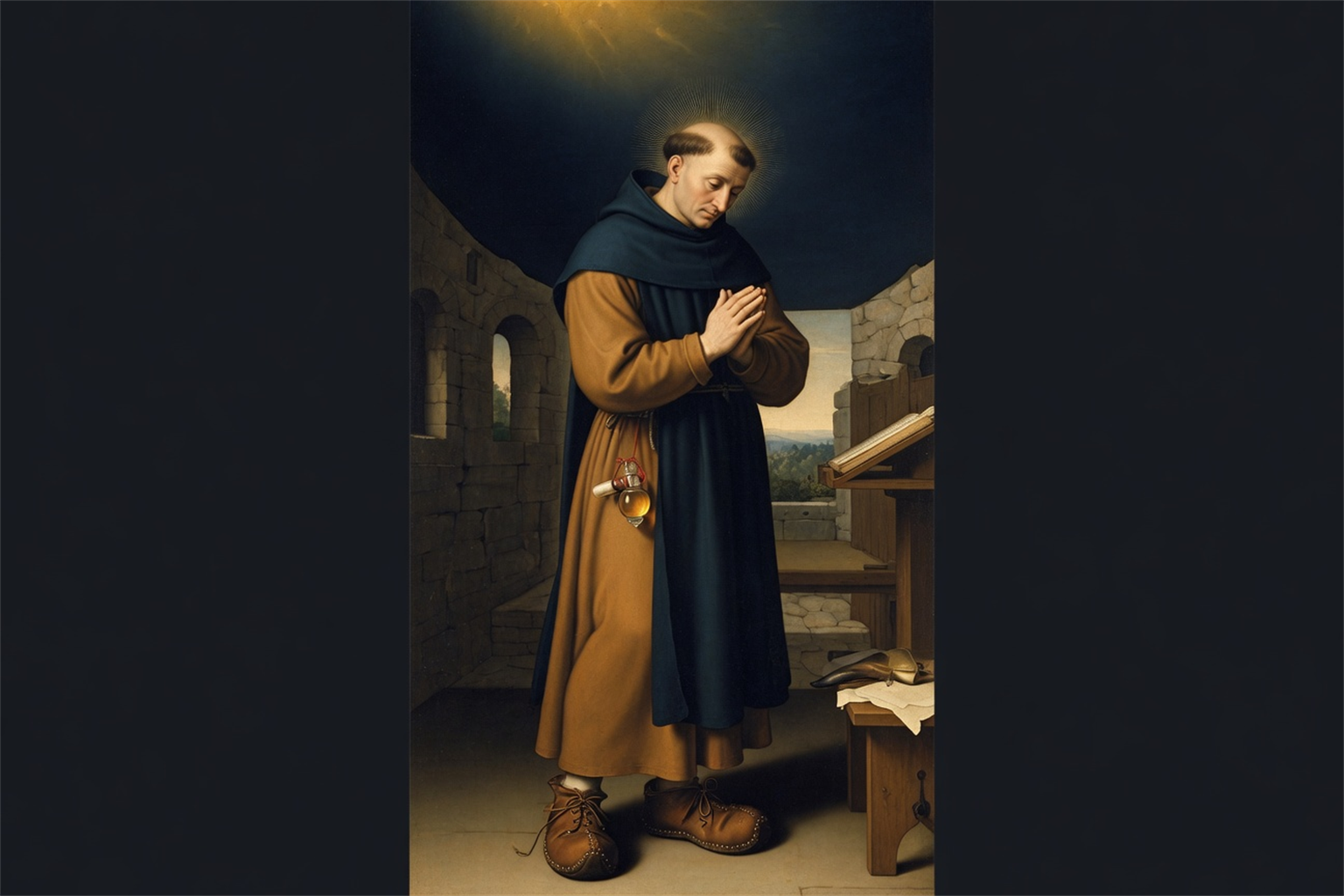
The fourth abbot of Condat in the 6th century, Saint Oyend was a model of monastic life and Greek and Latin scholarship. He reformed his abbey by establishing a common dormitory and reading in the refectory, while being famous for his miracles and visions. His relics rest today in the cathedral of Saint-Claude.
Guided reading
8 reading sections
SAINT OYEND OR EUGENDUS
FOURTH ABBOT OF CONDAT.
Origins and early visions
Born in Izernore around 449, Oyend was initiated very early into religious life by his father and joined the abbots Romanus and Lupicinus at the monastery of Condat after a prophetic vision.
Saint Oyend (Eugendus) Saint Oyend (Eugendus) Successor of Minase as head of Condat. was born around the year 449, in the Bugey, at Izernore, a center of idolatry that had become a center of Christianity; Romanus, Lupicinus, and their sister Jole illustrated Izernore at that time by their holiness. Oyend's mother being either dead or retired to some monastery, his father received the priesthood to offer the holy mysteries in a church that had just been erected on the ruins of a pagan temple. He initiated his son, from the tenderest age, into the sacred ceremonies. This holy child already showed, not only by his virtues but by heavenly favors, what he would one day be. At the age of six, God revealed Himself to him in a dream: it seemed to him that the two abbots Romanus and Lupicinus, who perfumed the deserts of the Jura with the fragrance of all monastic virtues, and of whom he had often heard, came to take him from the bed where he was resting; having placed him on the threshold of his father's house, his face turned toward the East, they showed him the innumerable stars whose light embellished the night, and made him hear, as the Lord once did to Abraham, these mysterious words: "So shall thy posterity be." Soon, indeed, as the future unfolded before him, he saw swarms of religious men running toward him; then the sky opened, and a gentle and luminous slope led into it, like Jacob's ladder, and angels went and came singing, and among their songs, the young Saint noticed these words, repeated by two choirs: "I am the way, the truth, and the life." This vision was recounted by Oyend himself, and his historian assures that he heard it from his own mouth. His father, to whom he communicated this warning from heaven, had him learn, for a year, in his house, the first elements of letters, and then led him, at the age of seven, to Romanus and Lupicinus. From that time, until the age of sixty, Oyend almost never left the solitudes of Condat; although still a child, every day, a solitudes de Condat Monastery where Viventiolus was a monk and scholasticus. fter having accomplished the task imposed upon him by the superior or the abbot, he applied himself for long hours to study and reading; he even devoted a part of the night to it, and it is thus that he became skilled in Latin and Greek letters. He took the greatest care to keep his heart pure; thus God rewarded him with heavenly visions. One day when he had fallen asleep under a tree, he received a visit from the holy apostles Peter, Paul, and Andrew. After the death of Saint Romanus, Minase, his successor, watched over Oyend with the te nderes Minase Successor of Romain and predecessor of Oyend as abbot. t affection: he even associated him, though it is not said at what age, in the government of the monastery, naming him, in the presence of all the brothers gathered, his coadjutor; but he made vain efforts to make him accept the priestly dignity: the entreaties of the bishops to whom he had recourse found the young Oyend unshakable in his resolution; he feared that this sublime dignity would prevent him from being humble.
Accession to the Abbacy
After refusing the priesthood out of humility, Oyend succeeded Minase as head of the monastery following a vision confirmed by miracles, despite the opposition of certain monks.
He was no less resolved, no doubt, to shrink from the office of abbot; but a heavenly warning taught him that he could not escape it: 'Romanus and Lupicinus appeared to him, and, with their own hands, taking the insignia of Minase, they invested him with them, while a certain number of angry monks, by extinguishing their candles, protested against this election.' The entire vision came to pass. Minase died, Oyend succeeded him, and the oldest of the religious, refusing to obey the young abbot, left the convent and the monastic life. But God defended his servant through the gift of miracles: healings were performed by his hands, and his reputation for holiness soon attracted to him the most distinguished figures of the century: his letters were received as blessings; people considered themselves fortunate to have seen him; they gathered his advice like the oracles of wisdom. Priests and bishops repeated everywhere that they found the greatest charms in his letters and his conversations.
Asceticism and Spiritual Gifts
The saint leads a life of extreme austerity, marked by nocturnal prayer, the gift of exorcism, and miraculous healings performed through his letters or blessed oil.
Oyend gave his monks the example of regularity and mortification; simple in his clothing, he never possessed more than one tunic and one cowl at a time, and only replaced them when they were completely worn out. His bed was made of a hard and coarse straw mattress, upon which he spread an animal skin. During the summer, he wore a caracalla, a long robe in use among the Gauls, or a camelot scapular, which Saint Leonianus, abbot of a monastery in Vienne, had given him as a token of fraternal friendship. He wore, in the manner of the ancient Fathers, heavy and rustic shoes. He endured the rigors of the season and the climate with great courage; often, in winter, he would go early in the morning, through the snow, to the brothers' cemetery to pray there. Always the first in the choir, even during the night, and always the last, he would pray there for a long time before and after the offices; on his knees in his stall, he nourished himself in spirit with the presence of God and union with Our Lord, and his heart was flooded with such abundant consolations that one could see him, upon leaving the church, with a radiant face. He took only one meal a day, usually in the evening, at the hour when the other brothers took their second repast; however, when he was too tired during the long summer days, he would take this single meal in the middle of the day. Among the gifts that God granted him, one must especially note the power to cast out demons; a simple formula of exorcism, which he wrote and signed, sufficed to deliver, in the vicinity of Condat, the daughter of a lord tormented by an evil spirit.
A pious woman, from the family of Syagrius, who was defeated at Soissons by Clovis, also named Syagria and nicknamed the Mother of Churches and Monasteri es, fel Syagrie A pious woman miraculously healed by a letter from the saint. l into an illness that doctors deemed incurable; she had the idea of watering with her tears, kissing, and placing in her mouth a letter from the holy abbot; she obtained her healing from heaven. The solitude of Condat was soon filled with the sick who flocked from all sides to Oyend. He welcomed them like a good father and offered them a refuge until God had healed them; before dismissing them, yielding to their requests, he gave them prayer formulas that he wrote himself, and blessed oil; this spread healing even to the most remote provinces; but his historian remarks that often, instead of performing miracles himself for his neighbor, he left this task, out of humility, to some of the religious; he would order them to do this as he would anything else. O times, O heavenly men! One no longer believes oneself to be on earth, merely by following them in history!
The School of Condat and the Trials
Under his leadership, Condat became a major intellectual center (Maison de Jouvent), preserving letters in the face of barbarian invasions and material difficulties.
Our holy abbot governed his monastery with rare prudence, entrusting to each the functions that suited them, supporting the weak, consoling the afflicted, and repressing negligence and frivolity. He set the priests apart so that, being ignorant of the faults of others, they might be freer to judge them at the tribunal of penance and to give them the body of Our Lord at the holy table.
Letters, already taught at Condat before Saint Oyend, flourished much more under the direction of a man instructed from his childhood in sacred and profane literature. Even today, near the town of Saint-Claude, a place is shown called the Maison de Jouvent, or the house of youth (domus juventutis); it is undoubtedly there that the famous school of Condat was held, a refuge for science, letters, and the arts during the barbarian invasions. The gorges of the Jura were indeed almost the only place sheltered from the Germans, who then infested all of Switzerland and the entire eastern part of the Jura, falling unexpectedly upon travelers, not like men, but like ferocious beasts. The monks of Condat did not dare to go to that side, to the Salines, to obtain the salt necessary for the needs of the monastery; the holy abbot sent his religious to fetch salt as far as the shores of the Tuscan Sea; but two months having passed before the return of the travelers, there was murmuring in the monastery against Oyend, and he was accused of having yielded to vain fears and of having sent religious to die in a foreign land. Afflicted by these murmurs, and anxious about the fate of these dear absent ones, he had recourse to prayer; he groaned and wept day and night before God. Finally, fatigue having one day cast him into sleep, God consoled him with a vision: a celestial light surrounded him, and he perceived near him the blessed Saint Martin, who gently reproached him for his alarms. "Do you the n forget," h saint Martin Spiritual model for Aquilin. e said to him, "that on the day of your travelers' departure, you recommended them to me?" He then announced their arrival for the next day. Oyend shared this news with his religious, and the following day the absent brothers arrived at the predicted hour.
Reconstruction and reform of the rule
After a devastating fire, Oyend rebuilt the monastery and imposed a more communal life, replacing individual cells with a common dormitory.
Another trial tested the patience of the holy abbot; the entire monastery was built of wood; one day, as night approached, fire broke out, and in a few moments, buildings, furnishings, provisions, and clothing were all consumed. However, the next morning, despite the violence of the fire and the fall of the flaming beams, the holy ampulla containing the oil of Saint Martin was found intact. This wonder restored the courage of the religious! Oyend also sustained them with his equanimity, and through a visible protection of Providence, everyone in the neighborhood wanted to take part in repairing this misfortune; the monastery was soon standing again, better built than before, and provided with double what it had lost in food and clothing.
Saint Oyend took advantage of this circumstance to reform his monastery; until then, the monks had no common rooms other than the refectory and the chapel. Like the monks of the East, each worked, read, rested, and lived in his cell. These cells were replaced by a vast dormitory, where each brother had his bed; the abbot himself slept there in their midst. A lamp was kept lit there all night, as well as in the chapel. It was also our Saint who established at Condat the custom of reading during meals. As for him, he was so eager to know useful things, and reading charmed him so much, that often, entirely absorbed in the delights of the heavenly feast, of which this reading painted a picture for him, he would remain as if in ecstasy, forgetting the earthly food placed before him.
As he united firmness with gentleness, he knew how to maintain the most exact discipline among his monks. The peace that reigned in his soul reflecting on his face, he always had an amiable and joyful air. Far from raising himself above others, he seemed to ignore the virtues with which heaven had enriched him, and considered not the high degree of perfection he had reached, but how imperfect he was. He constantly had before his eyes the great models of monastic life; the actions and customs of Saint Anthony and Saint Martin never left his mind for an instant. He believed himself the first to be bound by the rule, and he never ordered or recommended anything without having observed it himself and made it easy by his example.
He had the tenderest charity for those who suffered; he required that the infirm and the elderly be treated with every possible consideration, and served in their particular needs by the brothers they themselves had designated; not only did he have dishes prepared for them that suited them, but because of the requirements of illness, he had them lodged and cared for separately until their health was completely restored. Apart from these cases that required exceptions, everything was common, and everything was done in common. If, by chance, relatives made a gift to a religious, he had to immediately bring it to the abbot or the steward. The monks had neither cupboards nor chests for their personal use: the most common items, which are used most often, such as needles and spun wool for sewing or knitting, were provided to them in common.
Last days and historical context
Oyend died around 510 (or 540 according to sources) after having governed Condat during a period of political unrest between the Franks, Visigoths, and Burgundians.
Strangers were all received, poor and rich alike, by our Saint with the same affability; he saw in them only one thing, their merits before God: a thing he had the gift of knowing by scent, says his historian; he would sniff out virtue and vice. God had also given him the ability to read the future: ten days before the death of Valentinian, a deacon of the monastery of Condat, he announced to this holy religious the day and the hour when he would leave the earth to go and receive the crown due to his merits.
Such was the calm, recollected, heavenly life that this man of God led: he governed his monastery from the year 496 to the year 510; it was a time of trouble and blood; the Franks, the Visigoths, and the Burgundians were disputing the possession of Gaul. Fortunately, the solitudes of the Jura were sheltered from these storms; they were the asylum of virtue and science, and like an oasis in the midst of the desolate lands of the Sequania. Our Saint was content to pray for the peace of the world and the conversion of princes, without ever going to pay them court: it is said that he did not leave his solitude a single time. Around the year 510, he was struck by the illness that was to open to him the entrance to the heavenly homeland. He had then passed sixty years: despite his age and suffering, he continued to take only one meal a day and to recite the canonical office. After about six months of illness, he had the Extreme Unction administered to him; the next day, at the break of day, he complained tenderly to the monks gathered around him that they were holding him so long by their prayers in the bonds of this miserable body, and conjured them to let him die. Then he exhorted them to remain always faithful to their holy rules, adding that he was taking this sweet hope with him. His children replied only with their tears and groans. Five days later, as they were assembled around his bed, he appeared to them to fall into a peaceful sleep; it was the sleep of the just who falls asleep in the Lord.
This death occurred, according to the best critics, on January 4 of the year 540.
Posterity and Cult at Saint-Claude
The monastery took his name before becoming the city of Saint-Claude. His relics, preserved despite wars and the Revolution, are still venerated.
A few years later, Saint Antidiole, successor to the deceased, had a church built on the very spot where he had been buried; this church was placed under the invocation of Saint Oyend; this soon became the name of the monastery as well; pilgrims flocked there in such great numbers that Saint Olympe, the sixth abbot of Condat, was obliged to allow a few houses to be built near the monastery to lodge the pilgrims. Such was the origin of the city of Sai nt-Claude, a Saint-Claude Abbey directed by Aurelian. name that has replaced that of Oyend since the 14th century, because of the relics of Saint Claude, which then became the object of the greatest veneration, without those of our Saint being forgotten for all that. The first church, falling into ruin at the beginning of the 14th century, was rebuilt, and the relics of Saint Oyend, removed during construction, were brought back in 1016. In 1249, Abbot Humbert de Buenc had two beautiful silver shrines placed in this church, which from then on bore the name of Saint-Claude, in which were enclosed the bodies of the two glorious Saints, that of Saint Oyend on the Epistle side, and that of Saint Claude on the Gospel side. Despite the fury of the heretics, who tried several times to remove and destroy the abbey's relics (1534 and 1571), despite the fires that ravaged the city and the monastery (1579, 1639); and finally, despite the taxes and profanations of the French Revolution, the sacred remains of Saint Oyend have been happily preserved to this day. In 1854, they were authentically recognized when all the relics preserved until then in the church of Saint-Claude, which was falling into ruin, were transported to the cathedral of Saint-Pierre. It was recognized and confirmed that the former abbey still possessed "the head and all the bones of Saint Oyend, its fourth abbot." These relics are still exposed today in their entirety to the veneration of the faithful in the cathedral of Saint-Claude. But the Saint's belt (perhaps the hair shirt that Saint Leonien had given him), to which a miraculous power was still attributed in the last century, is no longer possessed.
Father Chifflet reports that, in 1601, Pétronille Birod, a Calvinist woman, was threatened with certain death because she could not give birth. Scarcely had the Saint's relic been applied to her than she was delivered on the spot. Struck by the miracle, she converted to the Catholic faith with her whole family.
The name of Saint Oyend is inscribed on January 4th in the ancient Martyrologies of Bede, Ado, and Usuard. His feast, first moved to January 2nd because of the day of the Circumcision, is celebrated today on the 4th of the same month, under the semi-double rite, in the dioceses of Besançon and Saint-Claude. The diocese of Belley celebrates his office under the simple rite on October 11th, which is the day of the translation. Several churches in this diocese are under the patronage of this Blessed one: the same is true in the Jura, at Saint-Olan-de-Joux, for example.
He is depicted with a vial in his hand as an attribute, undoubtedly the one containing the oil that he sent, after having blessed it, to the various sick people who sought their healing from him.
Sources of the saint's life
The biography is based on the account of Pragmanus, a disciple of the saint, and on the work of the professors of the Saint-François-Xavier College in Besançon.
The life of Saint Oyend was written by the priest Pragman Pragmane Priest and disciple of Oyend, author of his original biography. us, his disciple; the professors of the Saint-François-Xavier College in Besançon included it in their collection (Vie des Saints de Franche-Comté), which served us in composing this summary.
Annexes & related entities
Structured data for exploration: events, miracles, quotes, places, attributes, patronages, and important entities cited in the text.
Key Events
- Born in Izernore around 449
- Entered the monastery of Condat at the age of seven
- Vision of the celestial ladder and the stars
- Appointment as coadjutor to Abbot Minase
- Election as fourth abbot of Condat in 496
- Reform of monastic life (common dormitory, reading during meals)
- Reconstruction of the monastery after a fire
Miracles
- Healing of Syagria by a letter
- Exorcism of a nobleman's daughter using a written formula
- Multiplication of provisions after the monastery fire
- Gift of prophecy (announcement of the death of Valentinian)
- Intact preservation of Saint Martin's oil ampulla during the fire
Quotes
-
I am the way, the truth, and the life
Childhood vision (Song of the angels) -
So shall your descendants be
Childhood vision (Words of Romanus and Lupicinus)