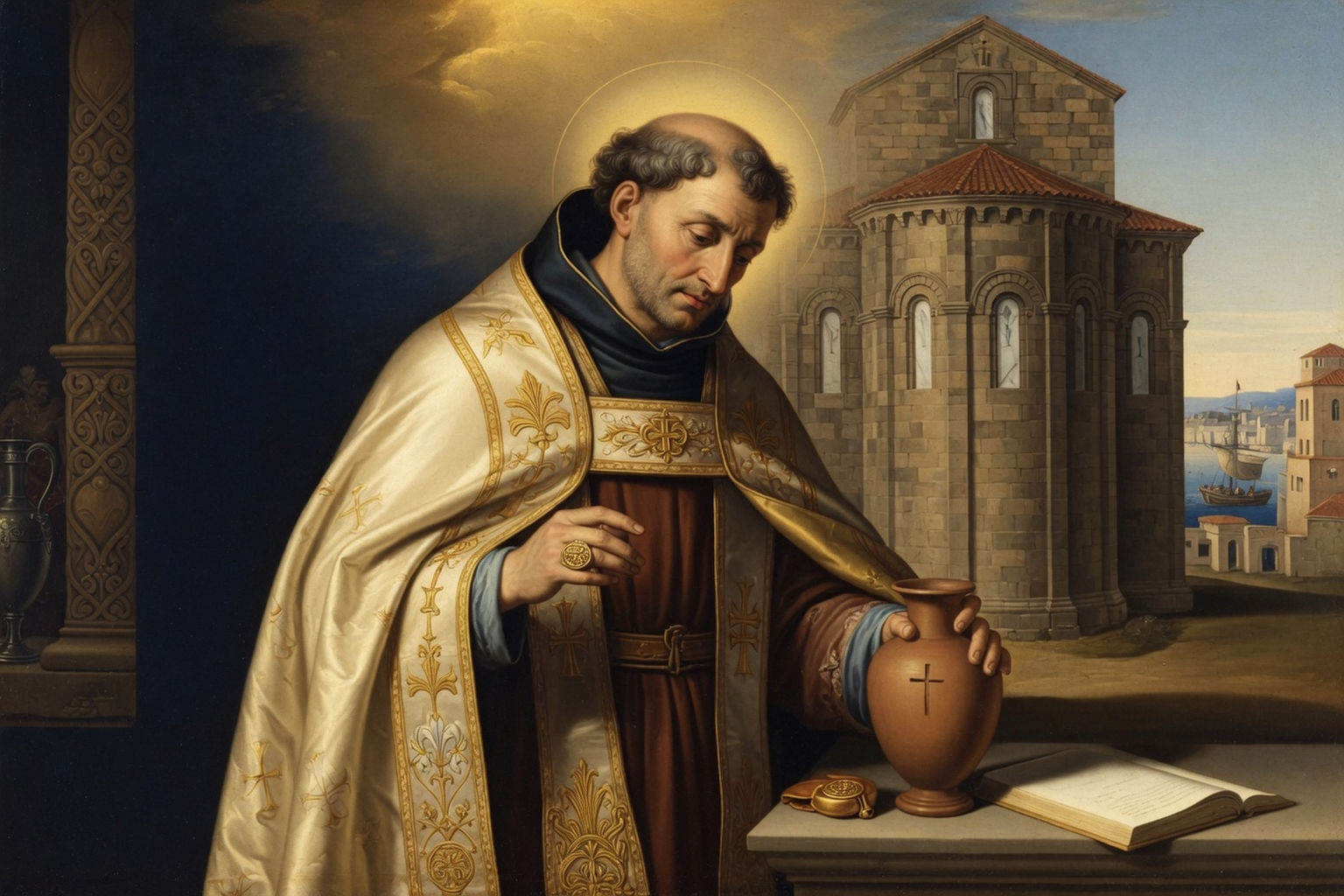
A high-ranking official and Chancellor of Austrasia, then Governor of Provence, Saint Bont became Bishop of Clermont following his brother. Marked by profound humility and a devotion to the Virgin, who miraculously presented him with a chasuble, he ended his days as a monk after renouncing his episcopal see due to canonical scruples.
Guided reading
7 reading sections
SAINT BONT OR BONET,
CHANCELLOR OF FRANCE, BISHOP OF CLERMONT IN AUVERGNE
Origins and prophecy
Born in Auvergne to noble parents, Bont was the subject of a prophecy while still in his mother's womb, announcing his future role as a governor and a light of the Church.
Here is a Saint who can serve as a model for many, but especially for those in the highest dignities, since we have in his person a pious courtier, an incorruptible magistrate, a vigilant and merciful provincial governor, a bishop filled with the spirit of Jesus Christ and apostolic virtues, and a religious of perfectly exemplary austerity and devotion. He was born in Auvergne to parents illustrious for their piety and high Auvergne Region of the martyrdom of Saint Antolian. ly regarded for their nobility. His father was named Theodat, and his mother Siagria: both were descended from the ancient senators of Rome. When this pious woman carried him in her womb, she threw herself at the feet of a holy priest who had come to visit her, begging him to give her his blessing: "But you rather," replied the priest, "bless me, O holy Father and venerable Lord." These words greatly surprised Siagria, who found them ill-suited to her sex and the status of the one who spoke; but the servant of God calmed her confusion, letting her know that it was not from her that he requested the blessing, but from her child, who was one day to be one of the most worthy governors of provinces and one of the most brilliant lights of the Church. This prediction compelled his parents to pay particular attention to his education, and to have him instructed in all the sciences that are accustomed to prepare minds for the greatest things.
Chancellor and Governor
Bont served as chancellor to Sigebert II in Austrasia for thirty years before becoming governor of Provence, where he distinguished himself by his fight against slavery.
Theodat having died, Bont, though still young, left his country and came to the court of Sigeber Sigebert II King of France mentioned for historical context. t II, who was then rei gning in Austrasie Merovingian kingdom of which Dagobert II was the sovereign. Austrasia. Scarcely had this prince known him than he took a particular affection for him. He first made him his grand cupbearer; then, recognizing in him all the qualities required of a statesman, he raised him to the office of referendary, which is the same as that of chancellor, placing his gold ring or his seal in his hands. He exercised this position with such integrity for the space of thirty years that he earned the esteem and respect of everyone. Leading the life of a religious in his private conduct, where chastity and innocence shone, he caused justice and religion to reign throughout the kingdom of Austrasia. Theuderic III, King o Thierry III King of the Franks who made donations to Saint Condedus. f Neustria, having united Austrasia with Neustria after the death of Dagobert II, his cousin, son of Sigebert, gave Bont the government of Provence or Marseille, whi ch was th Marseille Birthplace of the saint. en considered the most important in the Frankish monarchy (680). He governed this country for nine years with such gentleness and kindness that he was considered its father. He expressly forbade the sale of slaves there, which was still in use in the country, and he himself redeemed with his own money all those he could identify and set them free. He also took great care to reconcile different parties and to reconcile individuals and families who were in dissension. To these public virtues which concerned the good of his subjects, he joined private ones for the regulation of his inner life: such as penance, prayer, and purity of heart; it is therefore not surprising that God finally drew him from his secular employments to make him a minister of His altars.
Bishop of Clermont
Succeeding his brother Avitus II, he became Bishop of Clermont, leading a life of extreme austerity and charity toward the poor.
Saint Avit Saint Avit Bishop of Clermont in the 7th century, member of the illustrious Avitus family. us, second of the name, his elder brother, was then Bis hop of C Clermont City of origin of the two saints. lermont in Auvergne; seeing himself already advanced in age and burdened by illness, he proposed to his clergy, by divine inspiration, to elect in his place this holy governor of Provence, whose merits were sufficiently known to them. His election was unanimous, and King Theuderic readily gave his consent, being well pleased that he whom he had chosen as magistrate was judged worthy of the priesthood. Saint Bonitus therefore departed from Marseille and went to Auvergne, where he was consecrated bishop. This episcopal anointing was for him a principle of sanctification. He appeared, in an instant, not as a man who aspires to perfection, but as a man who has already acquired it, which is proper to bishops. He would pass three or even four days without eating anything. His life was a continuous recollection. He gave the day to the duties of his office, and almost the entire night to prayer; and although he had not yet embraced the monastic life, he already imitated its retreat during Lent. His charity for the poor and for pilgrims was extreme; he never sent one away without help, and the only difference he made between them was that he became more merciful and more liberal toward the most needy. As spiritual food is even more necessary than the bread of the body, he distributed it abundantly to his people, sometimes by himself, sometimes through serving priests, who acted indeed as his feet and his tongue. He assiduously visited his diocese, and took particular care to instruct his ecclesiastics well and to lead them to an irreproachable life; which he did through frequent conferences on the holy canons, which he obliged them to attend. His prayer was always accompanied by tears, and he shed such an abundance that his habit was completely soaked. While in his church, he did not sit on his episcopal throne, but on a very low seat; and, although he knew very well how to uphold his dignity when he judged it necessary, most often, nevertheless, he reduced himself to such an abject state that those who did not know him would never have taken him for the bishop.
Miracles and Marian favor
Author of numerous miracles, he receives a celestial chasuble from the hands of the Virgin Mary during a miraculous mass celebrated by the angels.
While he strove to humble himself and make himself small before men, God took pleasure in raising his merit through great miracles. The entire region of Auvergne being afflicted by a great drought, he ordered a fast and a procession to obtain rain, and no sooner had he finished the mass than such an abundance fell that one could not leave the church that day. Several sick people were healed by drinking water in which he had dipped his hands. His mere touch straightened a lame man. He delivered two possessed persons without knowing they were so, by conferring upon them the sacrament of Confirmation. A Breton woman, by invoking God through his merits, found herself delivered, without leaving her country, from the blindness, the paralysis of an arm, and the inability to walk with which she was afflicted. But what is most admirable in the life of this great Saint is the signal favor he received from the Blessed Virgin on the night of the sainte Vierge Object of the blessed one's meditation and devotion. feast of her Assumption. He had remained in the church of Saint-Michel to spend that night in prayer; as he was in his greatest fervor, this Queen of heaven and earth appeared there in great splendor, accompanied by an infinite number of Saints and blessed Spirits who filled the whole place with a marvelous concert. They immediately prepared everything to sing the mass, and some having asked the Blessed Virgin who would be the celebrant, she replied that her servant Bont was present and that there was no need to look for another. At these words, the Saint, pressing himself against a pillar to hide, the stone softened and received the impression of his whole body, an eternal testimony to his humility. The angels took him and led him before their Sovereign. She commanded him, in a very gracious manner, to offer the divine Sacrifice; the Saint, unable to refuse, was immediately vested in priestly garments and solemnly led to the altar. The Saints served as his ministers in this great action, which they can only contemplate with awe, and the entire mass was sung with celestial music by this multitude of blessed ones who accompanied the Mother of God. After the mass, she left her beloved servant the chasuble that had been given to him, recommending that he keep it as a token of her benevole nce and chasuble Sacerdotal vestment gifted by the Virgin Mary, destroyed in 1793. tenderness toward him, and this chasuble could still be seen in Clermont in the last century; it was of a very light and delicate fabric; but this treasure, as well as a great number of holy bodies, became the prey of the flames in 1793 1793 Period during which the saint's relics were hidden and lost. .
Retirement and journey to Rome
Scrupulous about the conditions of his election, he resigned on the advice of Saint Tillon, retired to the Benedictines, and undertook a pilgrimage to Rome at the age of 80.
Although Saint Bont received, at all times, extraordinary marks of God's love, there was nevertheless one thing that had troubled him for more than the ten years he had been Bishop of Clermont: he had been raised to his brother's chair at the latter's solicitation, which he regarded as a sort of heredity in ecclesiastical offices, a heredity forbidden by the holy canons. He resolved to go and find Saint Tillon, or Théau, at Solignac, to propose his difficulty saint Tillon Religious of Solignac who advised Bont to resign. to him and obtain his advice. The servant of God told him freely and without flattery to resign his office, since his election had been defective. The Saint, who, moreover, was ardently sighing for a private and solitary life, did not hesitate; he put the affairs of his church in order, had another bishop established in his place, distributed all his goods to hospitals, churches, and monasteries, went to shut himself up in the Abbey of Manlieu, of the Order of Saint Benedict, which was nearby, and began to serve God t Ordre de Saint-Benoît Religious order occupying the monastery of Honnecourt. here with new fervor, under the habit of that blessed patriarch. He spent nearly four years in this house, edifying others by his humility and his mortification. But, by a surprising and courageous resolution for a recluse of eighty years, he undertook the pilgrimage to Rome, and the great deeds he performed on the way soon showed that it was Rome Birthplace of Maximian. the spirit of God that was leading him. In Lyon, he reconciled Archbishop Godin and the Duke of Burgundy, who had old quarrels between them. From there he went to the monastery of Île-Barbe, which he miraculously provided with food and honored with several other miracles. Wherever he encountered monasteries, he did not fail to choose his lodging there, the company of the religious being incomparably more agreeable to him than that of worldly people. In Italy, he obtained a very signal victory for Aripert II, King of the Lombards, against Luitpert, his enemy. Having embarked to go to Rome, he was assailed by a horrible storm, which threatened his vessel with shipwreck, after having already caused the loss of another vessel that was accompanying him; but he calmed it with his prayers, which were stronger than the rage of that proud element.
End of life and cult
He died in Lyon in 710. His body was later transferred to Clermont, and his cult spread, notably as the patron saint of potters.
While in Rome, he satisfied his devotion by visiting all the places consecrated by the blood of the martyrs; from there he resumed the Lyon Episcopal see of Saint Eucher. road to Lyon (706), bringing back with him several captives whom he had ransomed with the remainder of his goods. Throughout the journey he continued to perform great miracles; but, to prevent the glory from being attributed to him, he used, to perform them, an oil he had brought from the sepulcher of the apostle Saint Peter. He remained for the rest of his life, which lasted another four years, in the monastery of Lyon. During this time he reconciled Nodobert, his successor, with an adversary who envied him. Toward the end of his life he was tormented by gout, which gave him the opportunity to show admirable patience. He received a revelation of the day and hour of his death; feeling it approach, he prepared for it by receiving the divine Sacraments, and looking at the sky through the window of his cell, which he had opened on purpose, he rendered, bathed in tears, his beautiful soul to God, on January 15, 710, at the age of about eighty-six.
His body was carried, with great honor, into the church of Saint-Pierre, a famous abbey of Saint Benedict nuns, and that day he healed a paralyzed woman who touched his coffin. In the year 723, it was transported to Clermont, of which he had been bishop, and deposited in the church of Saint-Maurice, which has since borne the name of Saint-Bont. This translation was also honored by many miracles; but most remained unknown, because the Saint, retaining in heaven the inclination he had had to remain hidden, granted healing to the sick only on condition that they would keep it secret, so that as soon as they published it, they fell back into their infirmity. Several churches were built and several altars erected in honor of Saint Bont, in Paris, in Moulins, in Bourges. These churches generally bear the name of Saint-Bont.
Saint Bont is characterized by a chasuble that he receives from the hands of the Blessed Virgin. He is the patron saint of potters, no doubt because a vase of this material, in which the holy bishop had washed his hands, was long preserved in Clermont.
Sources of the Life
The life of Saint Bont is based on the accounts of Surius, the Bollandists, and François de la Mone.
His life was written by an author of his time; it is found in volume IV of Surius and the Bollandists. Father François de la Mone, of the Order of Minims, provided another in his Recueil des saints Chancelliers de France, drawn from the manuscripts of the church of Clermont; both have served us in correcting this one. See also the Année bénédictine and Jacques Branche.
Annexes & related entities
Structured data for exploration: events, miracles, quotes, places, attributes, patronages, and important entities cited in the text.
Key Events
- Grand Cupbearer then Referendary (Chancellor) of Austrasia under Sigebert II
- Governor of Provence (Marseille) in 680 under Theuderic III
- Election to the bishopric of Clermont following his brother Avitus II
- Apparition of the Virgin Mary and reception of a celestial chasuble
- Resignation from his bishopric following the advice of Saint Tillon
- Retirement to the Abbey of Manlieu, then pilgrimage to Rome at age 80
- Died at the monastery of Lyon in 710
Miracles
- Rain obtained after a procession during a drought in Auvergne
- Healing of the sick through the water from his hands
- Deliverance of the possessed during Confirmation
- Distant healing of a Breton woman
- Impression of his body in a stone pillar
- Celestial mass served by angels and the Virgin Mary
- Calming of a storm at sea
- Multiplication of provisions at Île-Barbe
Quotes
-
Bless me, O holy Father and venerable Lord
A holy priest addressing the pregnant Siagria