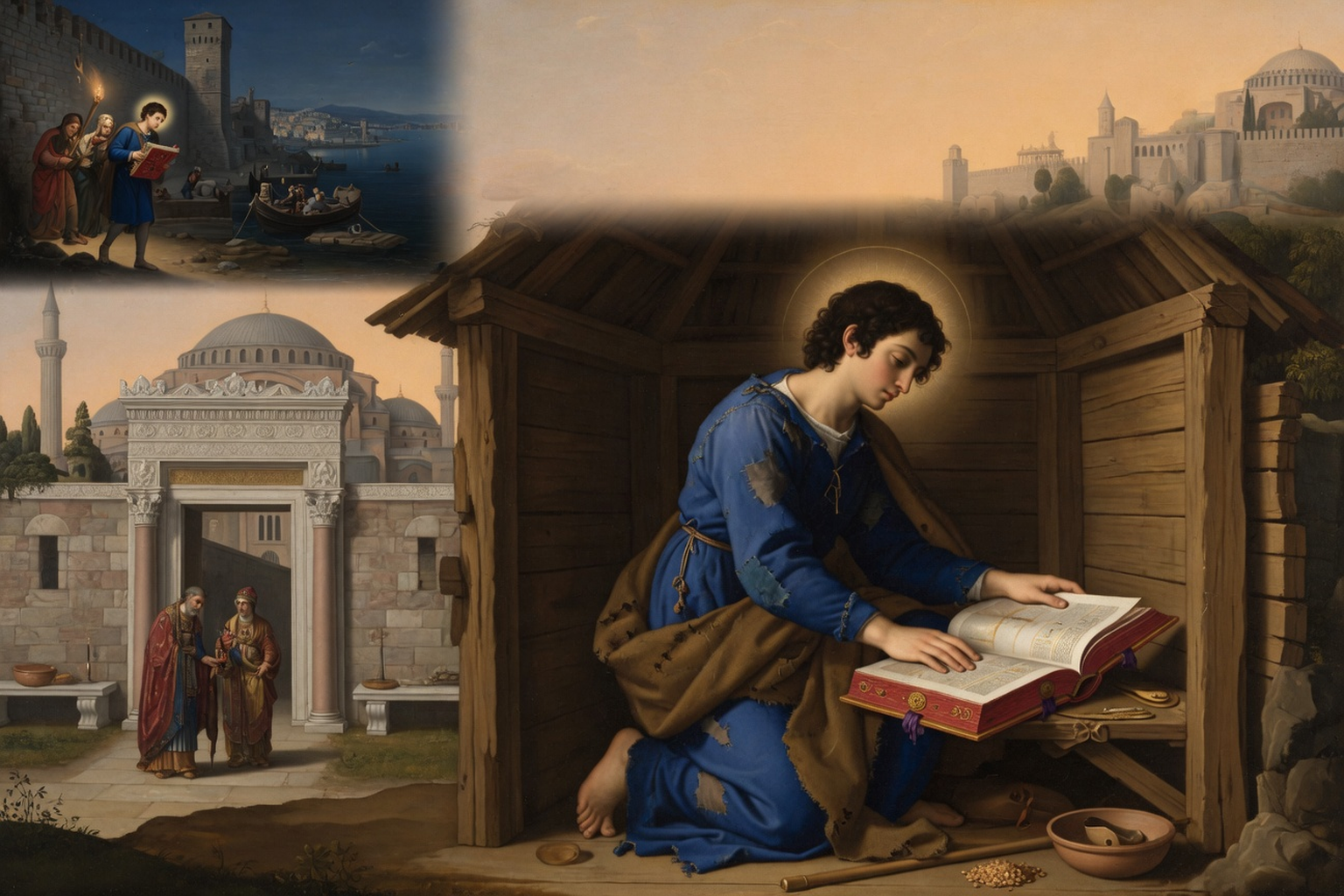
The son of a general in Constantinople, John fled as a youth to join the Acoemete monks. Returning incognito to his parents, he lived for three years as a beggar in a hut at their door without being recognized. He only revealed his identity on his deathbed by showing them the precious Gospel they had given him.
Guided reading
6 reading sections
SAINT JOHN THE CALYBITE
Youth and monastic vocation
John, son of a noble family of Constantinople, manifests an early piety and secretly commits to joining the Acoemete monks after meeting one of them.
Saint John, nicknamed Calybit Saint Jean, surnommé Calybite A 5th-century hermit saint who lived anonymously in a hut near his family. e because of the hut where he lived poor and unknown in the midst of his relatives and in the capital of the empire, is less a model for those who must go to heaven by common paths, than an example of the power of God who makes those whom He leads immediately by Himself take, when it pleases Him, extraordinary routes. He was born in Constantinople, the Rome of the f Constantinople City where the saint exercised his ministry and patriarchate. irst Christian emperors, to a very illustrious family. His father, named Eutropius, comma nded on Eutrope Elder brother of Maura, who became provost of the chapter of Troyes. e of the emperor's armies; his mother, who was called Theodora, was also a Théodora Empress regent who restored the veneration of icons in 842. lady of great quality; but it can be said that their piety made them both even more commendable than their birth and their riches. They had three sons, the two eldest of whom were raised to offices and honors. But, however great they were according to the world, the one whose life we are writing, and who was the third, surpassed them by far in merit through his eminent holiness. His father and mother had such a particular tenderness for him that nothing could be added to the care they took of his education; as he also had an excellent nature, he applied himself with ardor to study from the age of twelve and already showed much piety; he was not content with going to church during the day, he even went there at night.
There were at some distance from Constantinople religious men called Acoemetes, that is to say, who do not sleep, not that they did not Acémètes Religious practitioners of perpetual praise. sleep in reality, a thing impossible for man, but because they divided themselves in such a way that the praises of God were sung day and night in this monastery. One of them, passing through Constantinople one day to go on a pilgrimage to the Holy Places, and knowing that Eutropius and Theodora were very charitable, came to stay with them. John inquired as to which monastery he belonged, the manner in which they lived there, and all other things regarding religious life; and after having been instructed in them, he was touched by such a violent desire to consecrate himself to God in that house, that he obliged this religious man, by oath, to pass through Constantinople on his return to take him with him.
When he saw him depart, he thought only of the execution of his design; despising the goods of the earth to acquire heavenly ones, he begged his father and mother to give him a book of the Gospels, wanting no oth er treasure. They h livre des Évangiles A precious book gifted by his parents, later serving as proof of identity. ad such joy in seeing him desire a thing that others do not think to seek at that age, that they gave him one very well written and perfectly bound.
The Trial of the Monastery
After six years of an exemplary ascetic life, John is assailed by a temptation of filial piety which pushes him, with the agreement of his abbot, to return to see his parents.
The religious man did not fail to return; John, taking nothing but his book, went with him, boarded a ship, and arrived at the monastery. The religious man told his superior what had happened, and John begged him to receive him and to cut his hair. This holy man, considering his youth and the delicacy with which he had been raised, replied to him that he did not believe he could endure a life so laborious and so austere. He represented the difficulties to him and advised him to test himself beforehand. John burst into tears: he feared that his parents, if they discovered where he was before he had been consecrated to God, would make the greatest efforts to bring him back to them; he begged the abbot with such insistence to grant his request that this good religious man, moved by his prayers and touched by his extreme fervor, received him and cut his hair. On can judge by the great affection that his father and mother had for him, what surprise and what pain his retreat caused. There was nothing they did not do to inquire about the place where he might be; but it seemed that God had spread darkness to hide him, for, although this monastery was quite close to Constantinople, they could never know what had become of their son. During the six years that John remained in this house, he practiced all kinds of virtues with such perfection that he was proposed as an example to the other religious, but as an example more admirable than imitable. The demon could not suffer such eminent holiness; he used his ordinary artifices to make him abandon his undertaking; seeing that he could not succeed, he decided to attack him with another sort of temptation more difficult to overcome, because it was more specious and founded on filial piety. He represented to him the extreme pain that his retreat had caused his father and mother, that their hearts were torn by it, and that he could not refuse them the consolation of going to see them. This thought made a strong impression on his mind, and the sadness he conceived from it, joined to his great austerities, reduced him to such a state that it seemed he was going to die. His superior, attributing this state to the excess of his abstinence, reproved him for it and thereby forced him to tell him the cause. Thus, he confessed to him that he was so strongly tempted by the desire to go and see his parents again that he could not resist it, and begged him to permit this visit, in the hope that God would assist him by His grace and that no prejudice to the salvation of his soul would result from it. The abbot, very surprised by this speech, placed his first fervor before his eyes, and reminded him how he had compelled him to receive him, despite all his representations. Seeing that this was useless, he assembled his religious, declared to them what was happening, had public prayers said for John, and, his heart pierced with pain to see one of his children, and a child who was so dear to him, as if torn from his arms, he said to him in tears: "Go then, my son, under the guidance of God. I pray Him to be pleased to serve as your guide, and to prevent you from doing anything except by His order or to accomplish His will." Thus, John, mingling his tears with those of such a good father and all the brothers, embraced them and separated from them without having the intention of leaving them; for it was more a violence that he suffered than an effect of his inclination. He left the monastery, overwhelmed with sadness; along the road and as long as his eyes could perceive it, he turned back constantly to see again that blessed place of his retreat.
Anonymity at the paternal threshold
Having returned to Constantinople in the guise of a beggar, John lived for three years in a hut (calybe) before his parents' door without being recognized.
He gave his habit to a poor man he met and took the beggar's; when, after crossing the sea, he found himself near his father's house, he offered this prayer to God: "Lord, who have imprinted in the hearts of children such great love for those from whom they derive life, and who nevertheless desire that we rise above the sentiments of nature to love You much more than them, You know that from my childhood my soul has always been parched with the desire to serve and please You, and that, without dwelling on the affliction I caused my parents, I have despised for the love of You, pleasures, riches, and honors. Do not abandon me now, my God, in this violent temptation to which I have exposed myself through the artifice of the demon, but give me, if it pleases You, the courage and strength to conduct myself in such a way that I may overcome and conquer it."
He arrived at night at his father's house and lay down on the threshold of the door. The servants, having found him the next morning in this state, took pity on him, and knowing that their masters did not refuse hospitality to any poor person, they allowed him to build a small hut nearby to retire into. It was in this place that he experienced in his heart a strange struggle between the love of God and that which nature inspires in us; on one hand, seeing his father and mother pass before him so often, he felt touched by an ardent desire to make himself known to them; and on the other hand, he was held back by the fidelity he wished to show to God, by remaining in the state of humiliation and suffering to which He had called him.
After he had spent a year in this manner, in misery that one cannot imagine, and exposed to the contempt and mockery of everyone, his father, touched by his patience, often sent him food from what was served to himself; but the Saint took for himself only what was absolutely necessary and gave the rest to the poor.
As for his mother, who could imagine the state she was in then? It was impossible for her to erase from her memory and her heart this son whom she wept for every day; and having him before her eyes, poor, miserable, and completely disfigured, without recognizing him, she felt such disgust that she would have wished for him to be sent away, so as not to see at every hour such a disagreeable object.
Final revelation and passing
Feeling his death approaching, John reveals his identity to his parents through a precious book of the Gospels, before dying around the year 450.
Two more years passed in this manner, without all these hardships combined being able to weaken the courage of this generous soldier of Jesus Christ. He remained firm in his resolution not to make himself known; at the end of this time, God assured him in a dream that he would receive the reward for his labors in three days. This happy revelation filled him with consolation and joy. He prepared himself for death, prayed with all his heart for his father and mother, and when he saw that his hour was approaching, he implored the steward of their house to beg his mistress to come and see him. This surprised her extremely; she spoke of it to her husband; as he was very virtuous, he told her that she should not disdain to visit a poor man, since it is particularly upon the poor that God pours out His mercies. While going there, she wondered to herself if it was not to give her news of her son that this poor man was asking for her with such insistence. They brought the Saint, almost dying, out of his poor hut to speak to her, and it was mainly on this occasion that God gave him an admirable strength to continue not to make himself known. He said to his mother, with deep humility: "God will undoubtedly reward you, as well as your husband, for the charity you have shown to a poor stranger, since Jesus Christ has said with His own mouth: I will regard as done to myself what you have done for the least of my brothers. And as I am here at the end of my life, I beg you to promise me, in the presence of God, to grant the last request I have to make of you: it is to be willing that I be buried in this hut that I built, and in these wretched, tattered clothes, without any other ceremony." She promised him, not thinking that she was his mother and that it was to her son, her dear son, that she was making this promise. The Saint then gave her his book of the Gospels and said to her: "I pray to God that this book may serve you and your husband as an excellent preservative against all the evils of this life, and be a pledge of your eternal salvation." She received it with great kindness, but not without great astonishment that such a poor man had a book of such great price; and, after having attentively considered it, she said: "It is exactly like the one I once gave to my youngest son." Then, bringing that dear son before her eyes, her grief was renewed in such a way that she cried out and shed tears. But even this was not capable of shaking John's constancy, and he persevered in not making himself known. Having returned to herself, Theodora went to find her husband and showed him the book. He recognized it immediately: his heart was moved, and he said to her: "It is undoubtedly the same book that we gave to our son; let us go find this poor man and learn from him since when, and in what manner, he obtained it; for we may be able to learn news of what we desire so much to know." They went there at that very hour and compelled the Saint, by oath, to tell them sincerely everything he knew on the subject of this book. Then, seeing himself near to giving up the ghost, and fearing to lie, he heaved a deep sigh and said to his parents: "It is true that I am this son whom you have sought for so long, and that this book is the one you gave me some time before my departure." At these words they looked at him with such attention that they recognized him by several signs; overwhelmed all at once by the excess of joy at having found him and the pain of being so close to losing him, they almost fainted. They embraced him for the last time, and said to him while shedding more tears than they spoke words: "O dear son, whom we have so wished to see again, we finally find you, but more unhappily for us than when we lost you; for then we consoled ourselves in the hope of seeing you and possessing you again; but now no hope remains for us. Would it not have been better for us, since you did not want to give us the consolation of knowing you, that you had died without us knowing you? Was there ever an affliction like ours? We had before our eyes the one whom we had searched for throughout the earth, and we were ignorant of our happiness." While they were speaking in this way, their holy son was growing weaker and weaker, and he rendered his soul to God in their arms, around the year 450. The whole city of Constantinople rushed to this spectacle: some rejoiced at having found such a holy person; others admired his incredible patience; and others deplored the loss that his parents were suffering and the grief in which they were plunged.
The mother of the Saint, no longer remembering what she had promised him, or unable to resist the extreme love she had for him, had his rags removed and clothed him in very rich garments; but immediately she became paralyzed, and her husband reminded her of what she had promised her son. They returned the dead man's first clothes to him and she was instantly healed.
Saint John Calybite is represented asking for and giving alms.
Translation of the relics to Besançon
The head of the saint was brought from Constantinople to Besançon in 1284 by the knight Jean de Besançon following the crusade.
## CULT AND RELICS OF SAINT JOHN CALYBITES.
Saint John Calybites was buried in his small hut, as he had desired; his father and mother later built a beautiful church on the same site. His relics remained there for a long time in great abundance; but when the Latins seized Constantinople, in 1284, his holy head was
THE BLESSED PIERRE DE CASTELNAU.
brought to Besançon, where it can stil l be see Besançon Episcopal see restored by Saint Nicet. n in the cathedral church dedicated to Saint Stephen. Among the warriors who took part in this expedition was Jean de Besançon, a knight, on e of the heroes Jean de Besançon Knight who brought back the saint's relic during the Fifth Crusade. of the Fifth Crusade. It was thr ough his intervent cinquième croisade Military expedition during which the relic was acquired. ion that the head of Saint John Calybites was sent to Besançon. It was enclosed in a copper reliquary, surrounded by a silver band on which one could read two Greek verses, written in the following manner:
## XEIP MEN BEBHAOC TIMIAN CYNGAA KAPAN, AAA'EYCEBHC XEIP IOTANNOT CYNAEEL.
Manus quidem profana venerandum confregit caput, Sed pia manus Joannis colligat.
The canons of Besançon who possessed this relic were not skilled Hellenists. None of them could interpret this inscription, and to obtain an explanation, the theological canon, Jean de Corcondray, traveled in 1321, with the reliquary, to Avignon, to consult two Greek bishops, Olinao, Bishop of Amazones in Sarmatia, and Leodios, Bishop of Soise in Cilicia. These two prelates, who knew the ancient state of Constantinople, certified that this was truly the head of Saint John Calybites. They also provided the meaning of the two Greek verses in a report dated April 17, 1321. Their translation, as barbaric as it is unfaithful, deserves to be cited:
- The hands of the evil person and heretic, - This holy head of St. John Calybites did break; - And the hands of the just and true man of worth, - This holy head of St. John Calybites did adore and prize.
The learned Ducange provided a much more reasonable explanation of this inscription. We know, through the testimony of Nicetas, that at the taking of Constantinople, the soldiers profaned several holy relics to seize the gold and silver reliquaries. This is what undoubtedly happened to the head of Saint John Calybites, which the pious hand of Jean de Besançon gathered up and surrounded with a silver band on which were engraved these words: "A profane hand has broken this venerable head, but the pious hand of John has gathered it up."
The chapter of Saint-Étienne had a silver bust made in honor of this Saint, on which one could read this inscription in very ancient characters: *Caput sancti Joannis Calybite*. This reliquary was transported to Saint-Jean in 1674, and visited by the delegates of the chapter in 1723. It contained then, besides the head of Saint Calybites, that of Saint Agapitus, which was deposited there during the demolition of Saint-Ét saint Agapit Saint whose head was placed in the same reliquary as that of John Calybites. ienne. These sacred remains disappeared in 1794.
Cult in Rome and liturgical legacy
The cult of Saint John Calybites extended to Rome, where a church is dedicated to him on the Tiber Island, and his office is maintained in the Besançon breviary.
The office of the Saint was, from the third century, introduced into the Besançon Breviary, with proper lessons. It is still celebrated today on January 15, under the simple rite. The ancient Roman martyrology and that of Moïanes mention, on this day, the feast of Saint John Calybites, adding that his head is honorably preserved in Besançon.
One sees in Rome a church under the name of Saint John Calybites, on the T iber Island; île du Tibre A site in Rome housing a church dedicated to the saint. it was given to the religious of Charity, established by Saint John of God. His body, or rather a large part of his relics, were found there in the year 1680, along with those of Saint Marius and Saint Martha, martyrs; they appear to have been transported there quite early.
Metaphrastes, Acta Sanctorum, and Vie des Saints de Franche-Comté.
Annexes & related entities
Structured data for exploration: events, miracles, quotes, places, attributes, patronages, and important entities cited in the text.
Key Events
- Born in Constantinople to an illustrious family
- Studies and early piety from the age of twelve
- Secret flight to an Acoemete monastery with a book of Gospels
- Austere monastic life for six years
- Return incognito to Constantinople disguised as a beggar
- Lived for three years in a hut (shack) at the threshold of his father's house
- Revelation of his identity to his parents just before his death
Miracles
- Instant healing of his mother's paralysis after honoring his vow of poverty for his burial
Quotes
-
Lord, forgive him as I forgive him
Source text (attributed by paragraph error or confusion with Castelnau in the global text) -
It is true that I am the son whom you have sought for so long
Words of Saint John to his parents