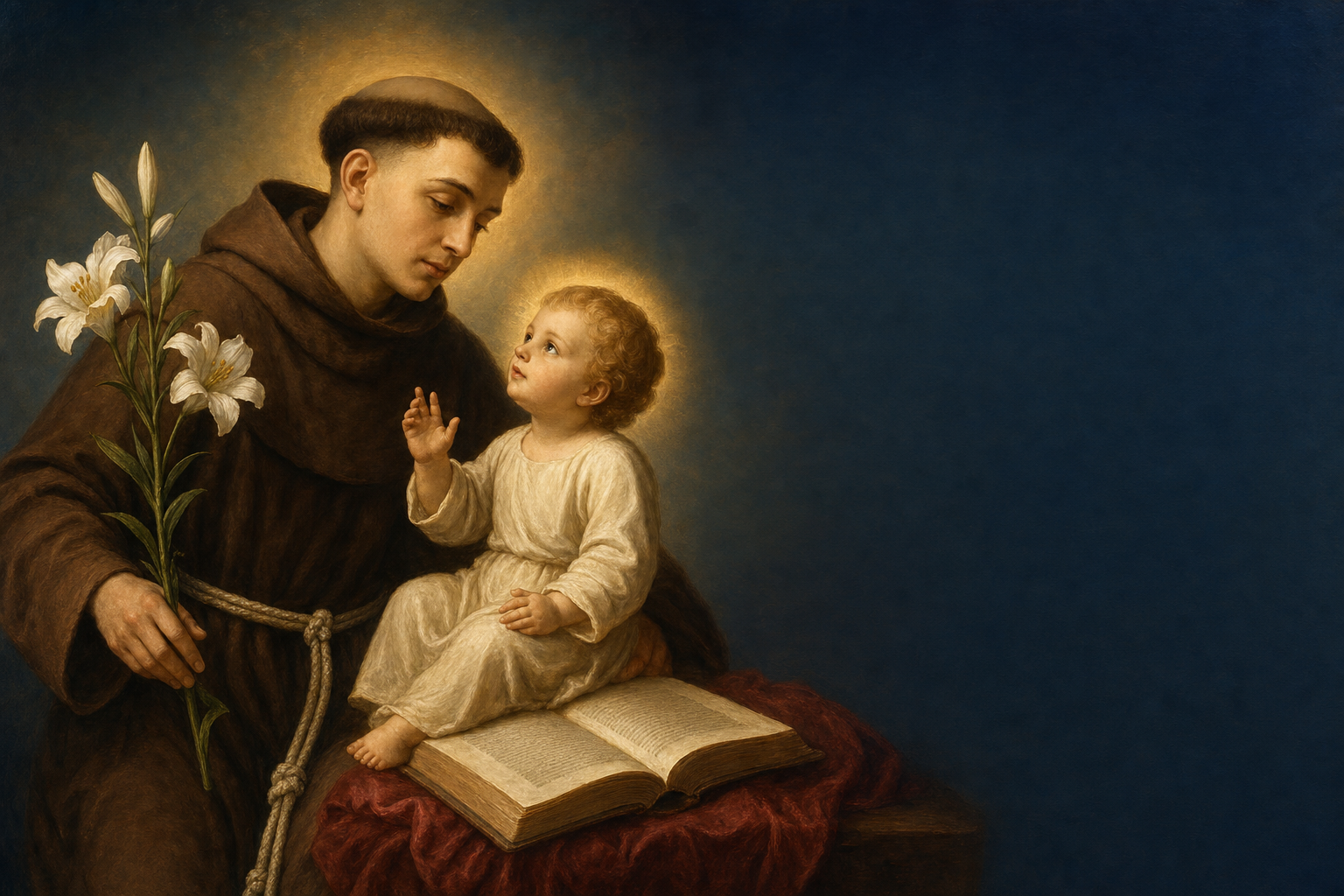
Born in Lisbon in 1195, Ferdinand became Anthony upon joining the Franciscans to seek martyrdom. A prodigious preacher and thaumaturge, he combated heresy in France and Italy through his eloquence and striking miracles. He died in Padua at the age of 36 and was canonized less than a year after his death.
Life Milestones
- Origines et éducation à Lisbonne
- L'engagement chez les Chanoines de Saint-Augustin
- L'appel de l'Ordre Séraphique
- L'arrivée en Italie et la révélation de l'orateur
- Le premier lecteur de l'Ordre
- Le marteau des hérétiques
- Les grands miracles du thaumaturge
- Retraite et mort à Padoue
- Canonisation et gloire posthume
- L'œuvre doctrinale
Guided reading
10 reading sections
SAINT ANTHONY OF PADUA,
APOSTLE AND THAUMATURGE
Origins and education in Lisbon
Born Ferdinand in Lisbon in 1195, the future saint came from an illustrious lineage and received a rigorous Christian and intellectual education.
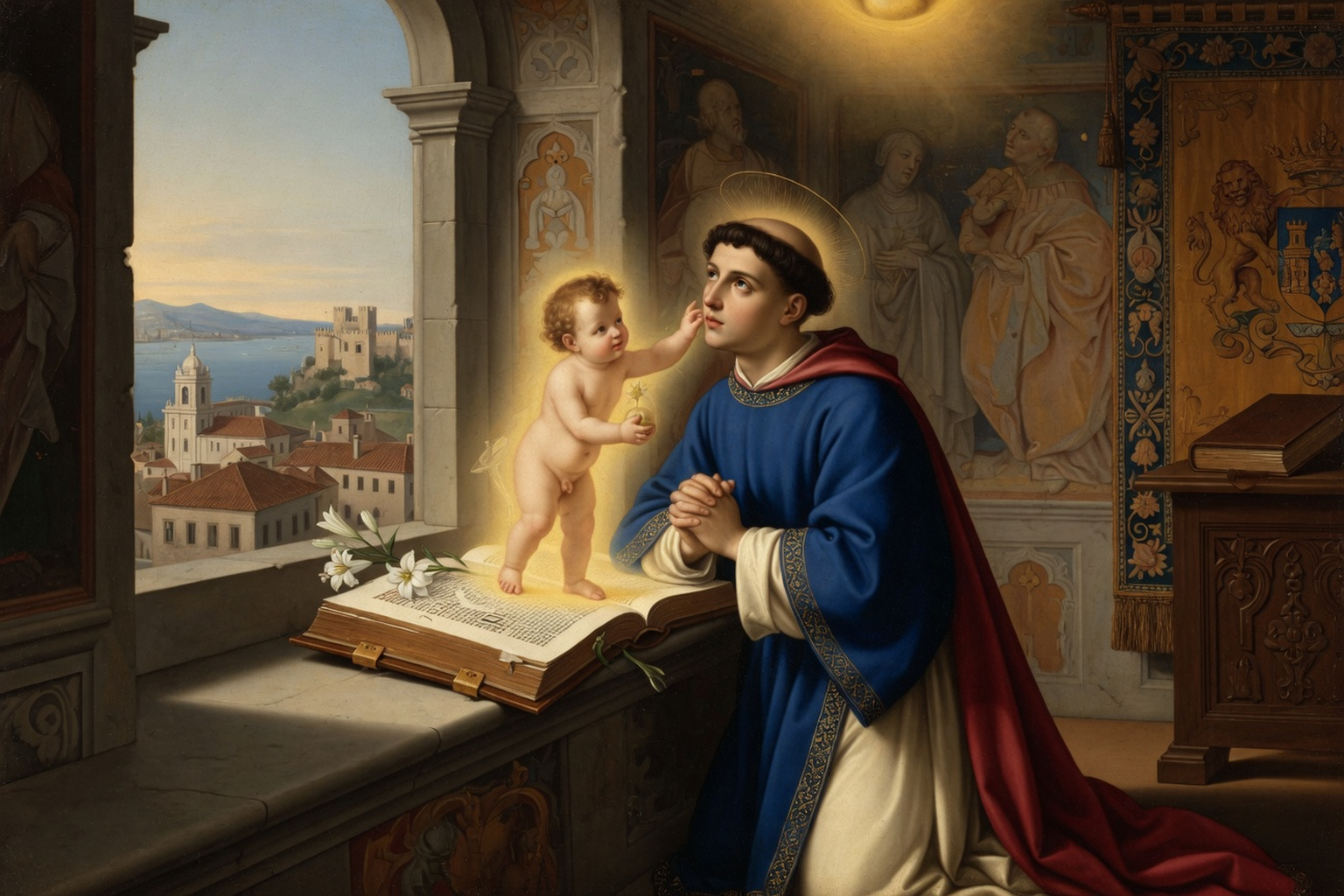
Saint Anthony of Padua Saint Antoine de Padoue Franciscan friar, Doctor of the Church, and renowned preacher. was born in 1195, in Lisbon, the capital of Portugal, one of the oldest cities in the world, on the day of the feast of the Assumption. His father was Martin de Bouillon and his mother was Teresa or Maria-Teresa de Tavera. Everything suggests that Martin de Bouillon, or, according to others, de Bullones, de Bulhan, or de Bulhem, was not of Portuguese origin, and that he belonged to the family of the famous Godfrey of Bouillon, Duke of Lorraine, King of Jerusalem, conqueror of the Holy Places.
Maria-Teresa de Tavera was also of the highest lineage; she descended, it seems, from Froila or Fruela, King of Asturias, who reigned in the eighth century. The Taveras are, moreover, famous in Spain and Portugal; there was a Didacus de Tavera, Archbishop of Seville, and a John de Tavera, Cardinal-Archbishop of Toledo.
Saint Anthony received the na me Ferdin Ferdinand Franciscan friar, Doctor of the Church, and renowned preacher. and at his baptism. According to an ancient custom of Portugal, he was baptized solemnly eight days after his birth. The font upon which the Sacrament of regeneration was conferred upon him still exists; it is preserved with religious care in the church of Our Lady. One of the stone steps used to ascend to the choir of the cathedral now bears, as it did in the 12th century, the miraculous imprint of a cross that the Saint traced with his finger one day when the devil appeared to him in a horrible form. Finally, John II, King of Portugal, a great admirer of Anthony, transformed the house where the wonder-working saint was born into a splendid church. It is called today the Church of Saint Anthony.
Ferdinand was raised in the fear of God and in the practice of all virtues. His parents, pious themselves and fervent Christians, guided his first steps on the path of salvation with tender solicitude. His mother especially, the virtuous Teresa de Tavera, who, in asking the Lord for a son, had thought more of the glory of the Most High than of the honor of her name, offered him to God while giving him life, and, as soon as he could stammer a few words, taught him to repeat the blessed names of Jesus and Mary. Full of devotion to the Queen of Heaven, she spoke to her beloved son only of her power and goodness, thus accustoming him early on to place his trust and love in her.
Ferdinand responded to his mother's affection. Everything about him foreshadowed a heart of gold and an elite intelligence; with his heart he loved God, with his intelligence he understood Him. He was only happy when people spoke to him of the Holy Trinity, of the Blessed Virgin, and of the Saints; and the ardor with which he recited his prayers was the admiration of all. It can be said that his education took place in the church, at the foot of the altars, and that his knowledge was based first and foremost on the understanding of religious matters. He quickly learned Latin, and in general everything that was taught in the schools of the time: humanities, rhetoric, and philosophy. Everything related to religion, ecclesiastical history, and liturgy was for him an object of marked predilection.
His ardor for work, the energy with which he approached often daunting studies, but above all his modesty, his gentleness, and his piety, were the consolation of his teachers and the admiration of all his comrades. He was cited as a model of all virtues, and he deserved even more than the praise heaped upon him. Here is how one of his main biographers speaks of this first period of his glorious life:
"He would have keenly desired to occupy the place of his Savior attached to the cross, and that of his neighbor, when he saw him in affliction and need. He kept pace, in his mind and in his heart, with obedience to the laws of his country and the commandments of his parents, feelings of reverence toward bishops and priests, submission to his masters, respect for the elderly, the love of purity, of retreat, of humility, of suffering, of gentleness, of charity, of temperance, of fasting, of abstinence, and a horror of even the most playful lie. He never laughed out loud, and uttered no useless word; he was the declared enemy of vanity, of noisy games, of pomp, of vengeance, of hatreds, of murmurs, of rash judgments... What then must this sun be, announced by such a brilliant dawn!"
The Commitment to the Canons of Saint Augustine
Ferdinand enters the Canons Regular of Saint Augustine in Lisbon and then in Coimbra to flee the solicitations of the world and devote himself to study.
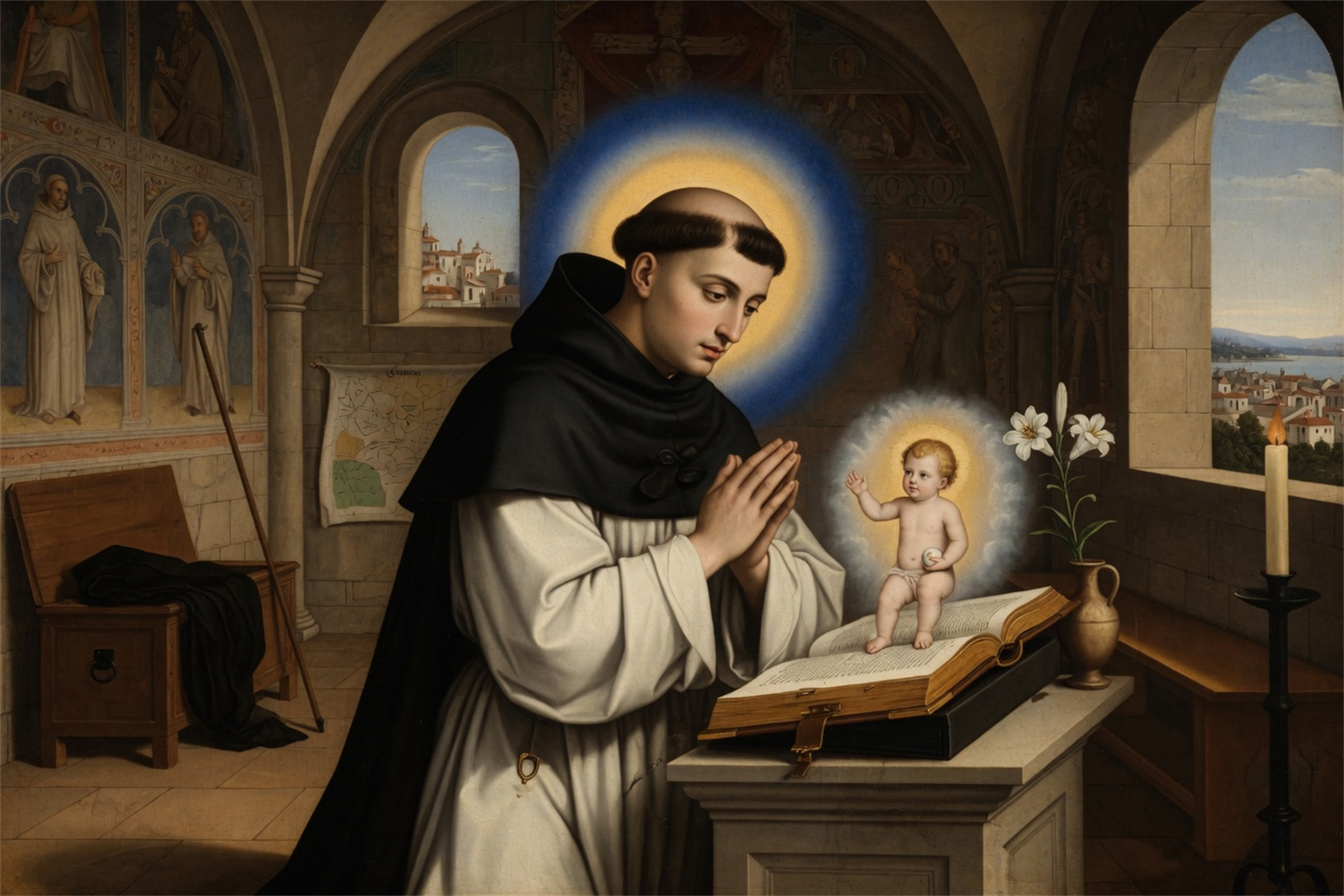
However, the child was reaching adolescence, the age when passions ferment, the time of deceptive dreams and illusions, a critical period of life, a dangerous reef upon which so many beautiful souls that seemed to be growing for heaven come to grief. All sorts of seductions surrounded Anthony. Rich, of illustrious birth, and of pleasant appearance, he was exposed to all the attacks of the world in a city that, then as now, was a true place of delights. He did not succumb; not that elite souls like his are not as exposed as others to perils, temptations, and falls; he undoubtedly had much to struggle against within himself and against the demon, and his heart was the plaything of great uncertainties; but God was with him, and God never abandoned him. In moments when he felt himself weakening, he commended himself to the Most High and to the Queen of Angels, his patroness, and he asked her with tears for help and protection. Then one day, raised by grace above the world and himself, he resolved not to wait any longer to dedicate himself to God, and he went to ask for the habit at the convent of the Canons Regular of Saint Augustine in Lisbon.
The Canons Regular of Saint Augustine, among whom the blessed Anthony had been raised, enjoyed a great reputation for science and piety throughout the region. The abbot, named Pelagius, touched by the candor, modesty, and ardent faith of the young man, received him with open arms and gave him the white mozzetta of the novices.
Anthony was happy: he had only to think of God. Under the great arches and in the long, silent corridors, he walked slowly, his arms crossed on his chest, his eyes raised to heaven, his soul immersed in an immense love. He was not left long to enjoy the peace he desired with such ardor. His parents and friends, during the year of his novitiate, tormented him incessantly to bring him back to the world, whose joys he had disdained. All means were good to them: caresses and threats, flatteries and bitter mockery; they spoke to him of his riches, of the brilliance of his name, of the obscure poverty that awaited him at the convent; so much so that the young novice, harassed on all sides, tired of an incessant struggle that tore his soul from the pure joys of the sanctuary, resolved to move away from Lisbon and go elsewhere to seek the tranquility he could not find there.
He reflected and prayed for a long time before deciding; then finally, he asked his superiors for permission to move to the convent of Coimbra. The prior granted it to him, not without difficulty; it cost him much to p art wit Coïmbre City where the saint founded a monastery and where she is buried. h a novice so pious, so submissive to the Rule, and so ardent in his work. In Coimbra, as in Lisbon, Anthony became the admiration of the other religious. At the same time, his progress in virtue as well as in science became more rapid. Already in Lisbon, he had applied himself to the study of theology and the Holy Scriptures; now freed from the obsessions and recriminations of his parents, alone with God, meditating incessantly on the infinite power of the Father and the infinite goodness of the Son, he had an almost full and complete knowledge of the things of heaven. It was as if the Holy Spirit had descended upon him as it once did upon the Apostles, to give him the gift of tongues, an immense science, and an irresistible eloquence. The most learned doctors of the convent were ashamed of their ignorance in the presence of this young novice who seemed to possess the secrets of God; the holiest religious also found themselves too worldly compared to this austere servant of Christ, so humble, so poor, and so occupied with fasts, vigils, retreats, and mortifications.
Moreover, the Most High was already taking care to affirm the holiness of his servant to the eyes of the world through striking miracles. One day, while he was occupied near the church with some humble task, he suddenly heard the bell ring that announces the elevation. He knelt down, and he suddenly saw the stone walls open before him, and the priest appear to him standing on the steps of the altar, performing the holy sacrifice.
One day, he was caring for a sick brother, who was letting out frightful cries or nervous, jerky bursts of laughter, even more frightening. The idea came to him that the unfortunate man must be under the power of the demon, and, indeed, he delivered him immediately by covering him with his mantle.
Another time, while he was assisting the priest at the altar as a deacon or subdeacon, he perceived the soul of a Franciscan religious, who had come from Rome with Saint Zachary, rising into the air in the form of a white bird, crossing purgatory, and entering, with wings fully spread, into the kingdom of the elect.
The Augustinian Canons of Santa Cruz in Coimbra had conceived such a high esteem for the virtues of Anthony that they wrote of him in their archives, barely two years after he had left them: *Vir utique famosus, doctus et pius, magna litteratura ornatus, et gloria meritorum stipatus*: "He was certainly a remarkable man, learned and pious, of immense science, and whom a deserved glory already accompanied everywhere!"
The Call of the Seraphic Order
Inspired by the martyrdom of five Franciscans in Morocco, he joined the Friars Minor in 1220 under the name Anthony, hoping for martyrdom in Africa.
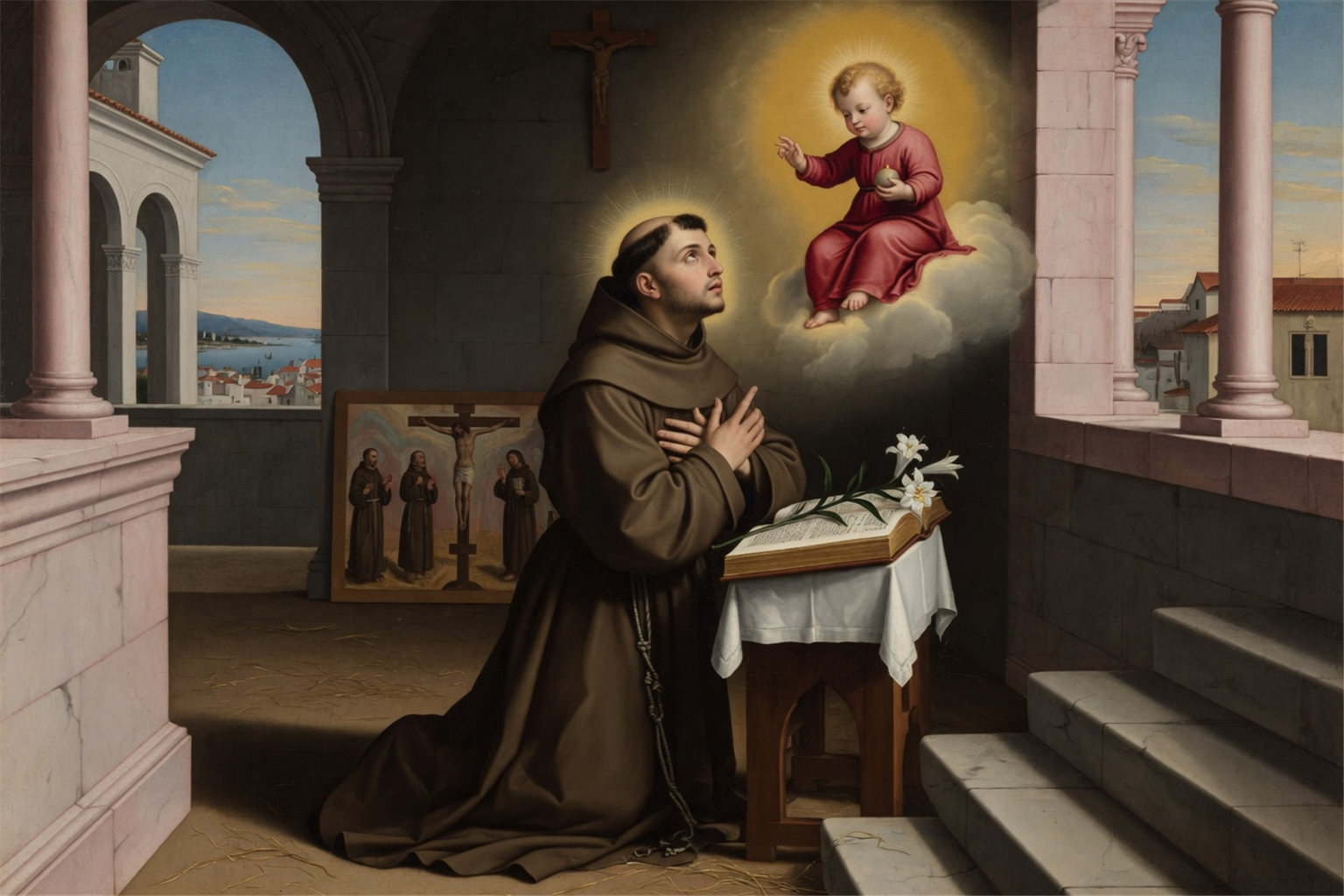
However, t he holy patriarch of Assisi le saint patriarche d'Assise Founder of the Order of Friars Minor. had just sent to Portugal, in the year 1216, Saint Zachary and Saint Walter with some other Friars Minor. King Alfonso II had given them the chapel of the holy abbot Anthony, half a league from Coimbra, and had a convent built for them. As they often came to beg at the Augustinian convent, Anthony did not take long to get to know them, and, consequently, to admire the austerity of their apostolic life. He loved to converse with them, and felt in his heart an immense desire to imitate them. It was quite another thing, however, when the solemn translation of the bodies of five Franciscan religious who had just been martyred in Morocco took place. Upon learning the glorious story of these five apostles, he too wanted to give his blood for Christ by propagating his faith. Day and night, he dreamed of the palm of martyrdom, which he believed he could best merit under the habit of a Friar Minor.
But he did not dare to decide on his own to leave the Order of the Augustinians, where the will of God had first called him. He wanted to wait until it pleased the Lord to manifest His intentions to him clearly, and he redoubled his prayers to obtain this grace. The Lord finally answered him: one day, while retired in his cell, as he was pouring out his soul into the heart of his God, Saint Francis appeared to him and ordered him, in the name of the Most High, to take the habit of a Friar Minor, to work for the glory of Christ and the good of souls. The very next day, Anthony presented himself at the convent of Saint Anthony of the Olives and was admitted among the novices (July 1220).
Great was the sorrow of the Augustinian Canons when they learned of this determination. They had cherished the hope that their young brother would one day be the honor of their Order; they had become accustomed to surrounding him with care and affection, and suddenly he was abandoning them. The prior, in giving him the authorization he could not refuse him, did not hide his displeasure, and one of the canons, to whom he was saying his farewells, said to him with bitterness: "Go, perhaps you will become a Saint"; to which Anthony replied humbly: "The day you learn of my canonization, you will be the first to give thanks to God for it."
The good Fathers could not be consoled for the loss of Anthony, and the entirely paternal sorrow they had felt at first gradually changed into poorly contained resentment and muffled hostility. It was neces sary for Pope Grego le pape Grégoire IX Pope who attested to the miracles of Bruno. ry IX to intervene with two briefs addressed, one to the Bishop of Viseu, the other to the Augustinian community of Coimbra, to put an end to the ill-treatment they were using against the Friars Minor.
The new Franciscan received, with the habit of the Order, the name Anthony, in honor of the holy abbot to whom the first Seraphic convent in Portugal was dedicated. It was also a way for him to live more unknown and to escape the constantly renewed pursuits of his relatives and worldly friends.
Arrival in Italy and the Revelation of the Orator
After a failure in Africa and a shipwreck in Sicily, he meets Saint Francis in Assisi and reveals his exceptional talent as an orator in Forli in 1222.
During his novitiate, Anthony gave himself entirely to prayer, contemplation, and the works of obedience and humility. When he had taken his vows, remembering that he had entered the Seraphic Order only with the desire to win the palm of martyrdom, he asked his superiors for permission to go to Africa to preach the truth to the Moors. His superiors let him go; but God did not desire his sacrifice; in His eternal wisdom, He had decided that Anthony would convert the infidels of Christian Europe, and not those of Mohammedan Asia and Africa. Scarcely had he arrived at the end of his journey when Anthony was struck by a cruel illness, which more than once put his life in danger, and forced him, in the spring, to re-embark for Portugal, where he hoped to regain his strength and health. The crossing was unfortunate: a violent storm cast him upon the shores of Sicily.
Anthony landed at Tauromenium, an ancient episcopal city in the province of Messina. There, having learned that Saint Francis was going to hold the General Chapter of the Order in the city of Assisi, he resolved to go there, although he was still weakened by his illness. Friars Minor from all parts of Europe were gathered there. Anthony could not thank the Lord enough for having brought him into the midst of this imposing assembly. He was happy to contemplate these valiant soldiers of Christ, always ready to shed their blood for their God, poor, austere, without concern for the world that had its eyes fixed upon them, greater in their humility than kings in their pride, and above all the venerable patriarch of Assisi, whom all of Europe already honored as a Saint, and who possessed his calm and serenity.
When the distribution of offices and dignities came, Anthony, a newcomer to the Order, still unknown, and whom his modesty kept in the shadows, was completely forgotten. He rejoiced in the depths of his heart, for he had taken the Franciscan habit only to be humbled, and not to be exalted. It was then that he met Father Gratian, a holy man, minister of the province of Bologna. This venerable Father was looking for a chaplain to say Mass for some religious who lived a contemplative life in a hermitage; he had noticed at the assembly the learning of Anthony, whose humility had first won his heart. Upon his reply that he was ordained to the priesthood, he took him to exercise those functions at the small monastery of Saint Paul, on the mountain of the same name.
The convent was admirably situated. At the summit of the mountain, suspended so to speak between earth and heaven, no worldly noise penetrated it, and the enraptured soul could listen there in silence and peace to the great harmonies of nature celebrating the greatness and power of its Creator. This was what Anthony had always desired; he had a religious give him a small cell carved into the rock on the mountainside, and he would come there, his duties as chaplain fulfilled, to spend days and nights in perpetual meditation, interrupted only by austere practices. He lived on bread and water, and wore under his clothes a hair shirt, harsh and rough, which is still preserved in Padua in a silver reliquary. His mortifications weakened him so much that he could barely stand. But if the body was weak, the soul was valiant and robust, constantly refreshing itself in prayer and preparing, through constant communion with God, to fight victoriously against heresy and all the vanities of the world.
Anthony lived thus for a year in solitude and contemplation, submitted to the Providence of God, of which he never doubted for a moment. He hid his great learning under the veil of excessive modesty; and as desirous as he was to work for the glory of the Lord and the salvation of souls, he was afraid of the world, and the spectacle he would have before his eyes frightened him. He also knew that men are inclined to admire the very virtues they do not put into practice, and that often they distribute with full hands praise and glory to those who chastise their vices with the most vigor, and the thought that he might sin through pride made him fall to his knees.
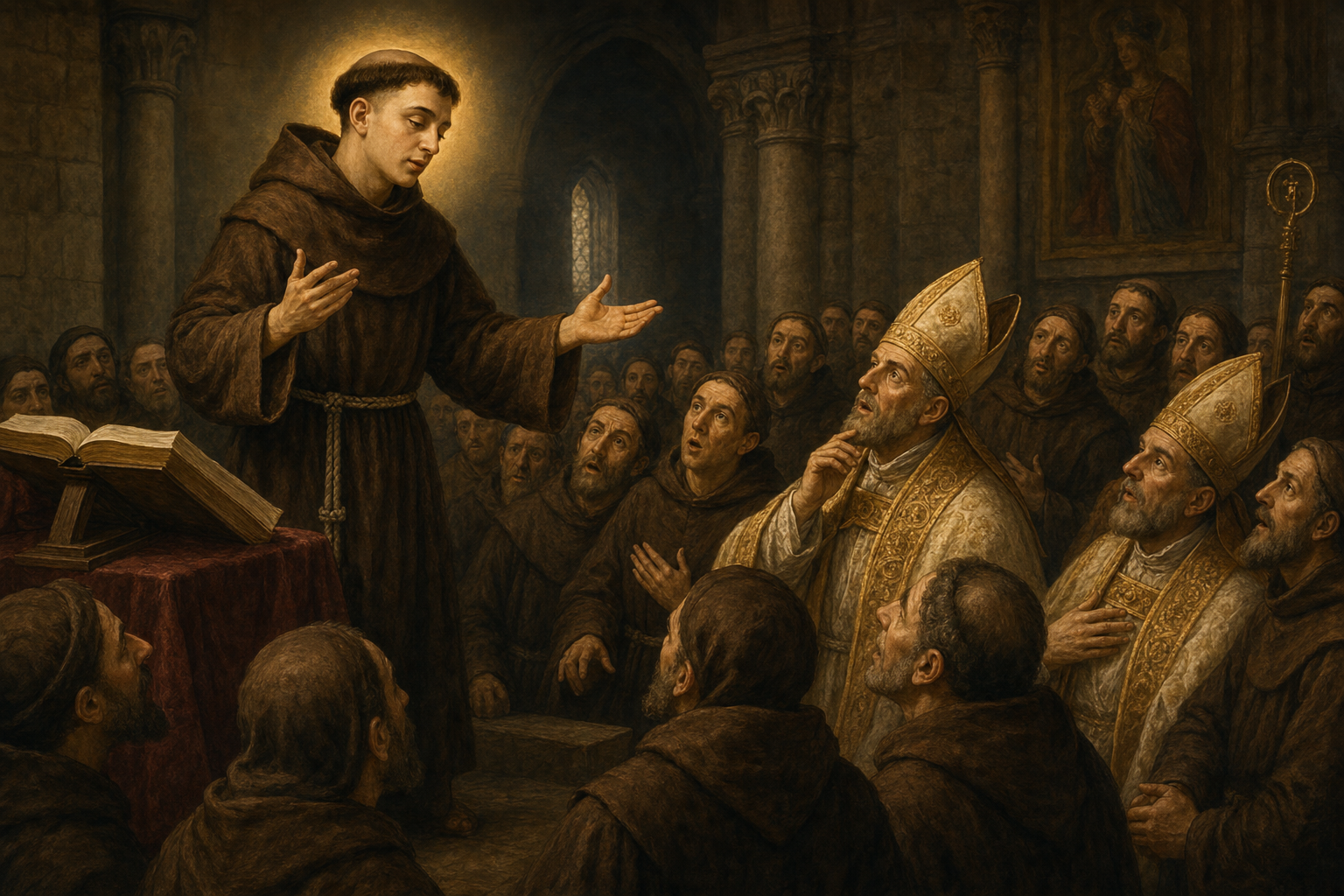
The time was approaching, however, when the pious Anthony would bring to light the precious gifts he had received from heaven. In 1222, Anthony accompanied the Friars of Mount Saint Paul who were going to Forli, with religious from Saint Dominic, to receive holy orders. It was the custom, after an ordination, to address a few words to the young clerics who had just been consecrated ministers of the Most High. The Bishop of Forli asked the guardian of Mount Saint Paul to take on this mission, or to entrust it to one of his religious. It was upon Anthony that the eyes of his superior fell, and it was he who received the order, in the name of holy obedience, to mount the pulpit and deliver the customary speech. He resigned himself to it reluctantly, considering himself unworthy of such an honor; but he had to obey; he sought the bishop's blessing and prepared to speak. None of those present suspected that he had studied or even read the holy books, and his brothers imagined him more readily in the kitchen, busy washing the convent dishes, than immersed in the works of the Doctors of the Church.
He took for his text this passage from the Holy Thursday office: *Christus factus est pro nobis obediens usque ad mortem*. His speech, at first calm, without brilliance, almost hesitant, became animated in a way despite himself, and became rapid, energetic, and inflamed. This monk, exhausted by suffering and deprivation, with a miserable appearance, had the authority of an apostle and the eloquence of a prophet; with a powerful voice and superb gestures, he dominated this entire assembly, to whom, by his very attitude, he seemed to say: "Listen, children of men, for I am he who speaks in the name of the Lord." They listened to him, indeed, in religious admiration. The silent, astonished, beside-themselves assistants shed tears of happiness, and, at the same time, seeing a ray of divine wisdom shine in him, they felt penetrated by a holy respect. A new life was about to begin for Anthony.
Public rumor and the reports of Anthony's superiors did not take long to inform the holy patriarch Francis of the success of the first sermon delivered by the young religious and what magnificent hopes could be founded on such a beginning. Almost immediately he entrusted him with the difficult mission of working for the conversion and salvation of souls (1222). Anthony was then twenty-seven years old.
From the day he began his arduous and glorious labor, until the day he ceased to preach, an attentive and pious multitude crowded his sermons. He first evangelized the main cities of Romagna and Lombardy. Success crowned his efforts beyond all hope; sinners sobbed in the churches where he spoke, and the most unexpected conversions were brought about by his care. Moreover, nature and grace seemed to have formed him for preaching. Here is the portrait drawn by one of his biographers:
"He had a polished exterior, easy manners, and an interesting air. His voice was strong, clear, and pleasant, and his memory was excellent. To these advantages, he added a grace-filled delivery; he knew, by varying the tone of his voice at the right time, how to insinuate himself into the souls of his listeners. He was well-versed in the knowledge of Scripture, which he had the talent of applying with great accuracy to the subjects he treated. The sacred text became in his hands a fertile source of light, and he developed its meaning and spirit with admirable ease and energy. But his eloquence drew its main strength from the unction with which he delivered his speeches. The love with which he was inflamed for the practice of all virtues made him speak with a zeal that could not be resisted. His words were like so many arrows that went to pierce the heart of each of his listeners. He communicated his fullness to others, and it was not surprising that after having kindled the fire of divine charity in his own soul, he kindled it in the souls of all those who listened to him!"
The First Lector of the Order
By order of Saint Francis, Anthony teaches theology in Montpellier, Bologna, Padua, and Toulouse, becoming the first official professor of the Franciscans.
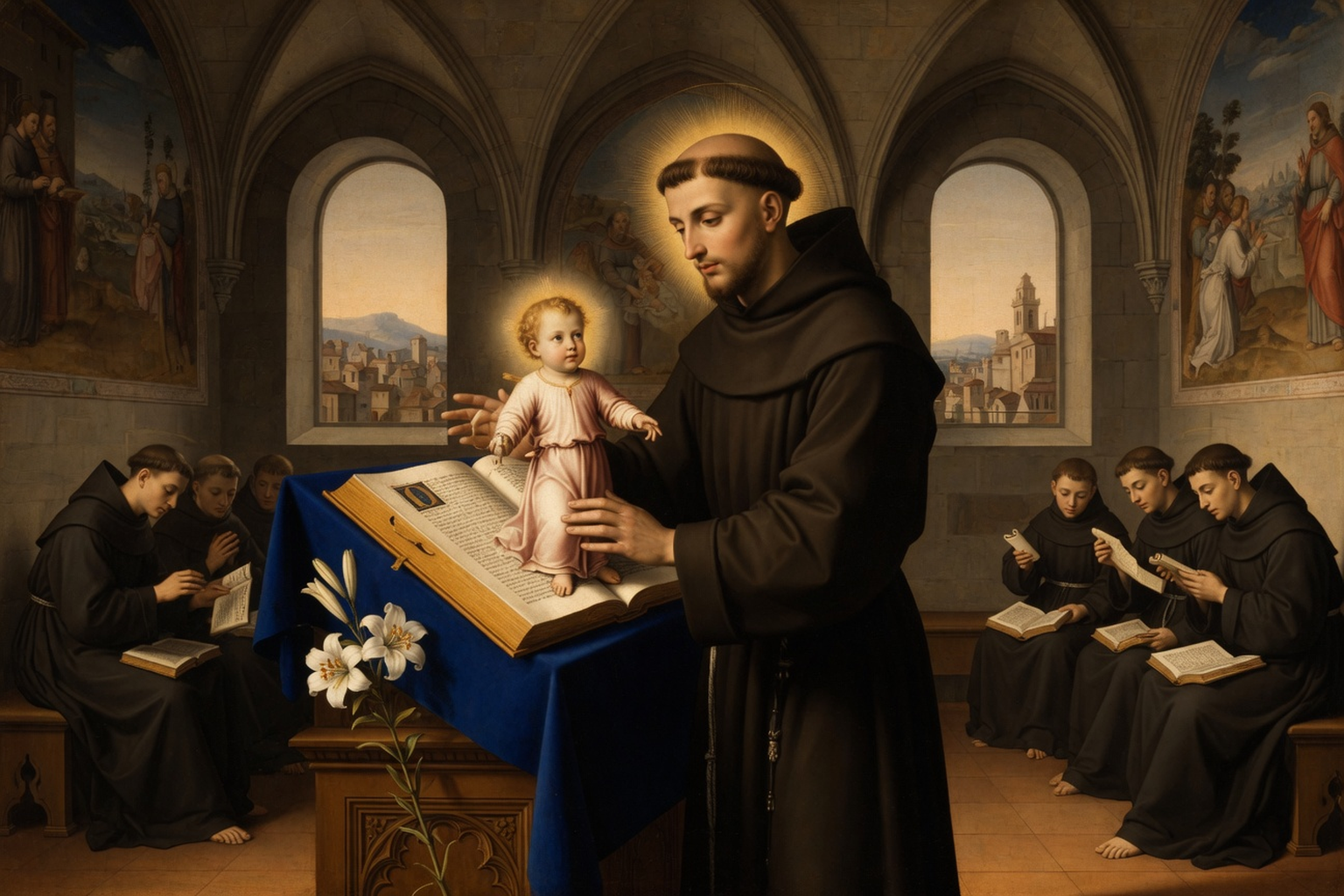
Anthony had already been traveling and evangelizing the towns and villages of Northern Italy for a year when Saint Francis asked saint François Founder of the Order of Friars Minor. him to teach theology to the Friars Minor, and even to laypeople who wished to be instructed under his direction. Here is the letter he addressed to him on this occasion: "To my dearest brother Anthony, greetings and blessing in Our Lord Jesus-Christ. I desire that you teach our brothers sacred theology; but take care, at the same time, to develop in them as in yourself the spirit of prayer and devotion, according to the ordinances of the Rule that we profess. Farewell!" In virtue of this order, while continuing his preaching, Anthony taught theology, first in France, at Montpellier, then at Bologna and Padua, and, lastly, at Toulouse, and in several other cities of France. A certain number of his historiographers have called him the first lector (lector) of the Order, because the few Friars Minor who were then beginning to teach in England and Bologna were not, like him, authorized by Saint Francis. Everywhere a crowd of young people eager for knowledge pressed to his lessons; and despite the efforts he made to remain unknown, although he never thought of himself, but of the souls of his listeners, his renown grew from day to day. In 1224, Anthony went to Vercelli to preach a station. It was only then that his relations with the learned Abbot of Saint-André began. Both found in this exchange an inexpressible profit and charm: as pious as he was modest, Anthony knew mystical theology thoroughly, and the abbot, dogmatic theology; they complemented one another in a way, for the greater glory of God and religion, and for the profit of souls. A close affection united them, and the abbot said of Anthony in one of his books: "Love often crosses the boundaries within which science remains; this is what I observed in Anthony, a Friar Minor with whom I had long relations of friendship: he did not have a very deep knowledge of worldly sciences, but by the purity of his soul and the fire of his love, he surpassed the greatest theologians, and one can say of him as of Saint John the Baptist: He was like a lamp that shines while consuming itself; the fire of his love burned him, and by the example of his holy life, he radiated upon the world." Anthony also loved the learned abbot tenderly, and each time he passed through Piedmont, he never failed to visit him. At the hour of his death, he suddenly appeared to the theologian, who, lost in his room amidst his books, was suffering from a violent headache. Anthony embraced him with affection and said to him: "I have left my soul in Padua, and I am returning to my homeland." Then he delivered him from his pain and vanished like a phantom. The abbot, imagining that Anthony was returning to Portugal, searched the convent and was very astonished to learn that no one had seen him; a few days later, everything was explained: he received news from Padua that Anthony had died, precisely at the hour when he had appeared to him.
The Hammer of Heretics
Anthony traveled through France and Italy to combat the Albigensian heresy, multiplying conversions through his preaching and miracles.
However, Anthony traveled through France and Italy, and preached the faith of Christ in cities and villages, always followed by an immense crowd of people, who saw in him an angel descended from heaven, and listened to his word as they would have listened to that of God Himself. Although born in Portugal, he expressed himself in French and Italian with prodigious ease. The results he obtained are almost beyond imagination: sinners were converted by the thousands, and the priests who accompanied Anthony could not keep up with hearing the confessions.
"When the good brother preached," says an ancient author, "all work was immediately suspended, as on feast days; judges, lawyers, and merchants left their occupations to go and hear him. People flocked from the cities and the countryside: the greatest ladies left their homes, and did not hesitate to rise in the middle of the night to walk by the light of torches and come to take their places as close as possible to the preacher's pulpit. Then they forgave each other all offenses, debtors were freed, prisons opened, thieves returned what they had stolen, sinners were converted, heretics abjured their errors, and infidels received the light of the Gospel. And among all these thousands of listeners who gathered around the missionary, one did not hear the slightest whisper or the faintest noise. Finally, the churches were so full and the sacraments so frequented that the priests could not keep up with the functions of the holy ministry; and blessed was the faithful who managed to kiss or even touch the hem of the Saint's garments, and to receive a word from his venerated mouth."
At that time, Frederick II was preparing to wage war in Italy against the holy Church; the roads were filled with partisans and bandits who did not hesitate to pillage and kill when the opportunity arose. Two of them came one day to hear Father Anthony, by way of a pastime, not suspecting what would result from it for them. One of these men, having become old, said to a Friar Minor: "We heard burning words come out of his inflamed mouth that scorched our hearts: every word of the divine preacher came like an arrow to strike us in the middle of the chest; for my part, I would have preferred to receive a hundred wounds. With tears and groans, we went to make our general confession at his feet; I cannot tell you with what paternal sweetness he received us, what wise advice he gave us, with what faith and eloquence he spoke to us of the eternal happiness reserved for true Christians, and of the eternal pains that would be the just punishment of the wicked and the impious. He ordered me as penance to go twelve times on pilgrimage to the tomb of the apostles Peter and Paul; see: I am happily fulfilling this sweet obligation, and I have confidence in the words of the holy man who promised me blessed eternity."
At that time, the Albigensian heresy began to wreak its havoc in the south of France. Similar to a contagious plague, it spread through cities and villages, and claimed numerous victims. Saint Francis was moved by this; his heart bled at the thought of the misfortunes that thousands of men were preparing for l'hérésie des Albigeois Dissident religious movement opposed by Anthony in France. themselves for eternity, and he thought of stopping the progress of the evil. He chose Anthony for this great mission, and charged him to go and found convents of the Order and preach the true faith in Provence and Languedoc. Anthony set out, strong in the support of the Lord.
Hardly arrived, he set himself resolutely to work; without cease or truce, he struck at the heresy until he had reduced it almost to impotence. His sermons, sometimes passionate and burning, sometimes tight as the argumentation of a logician, sometimes sharp and witty, were always eloquent. He challenged the Albigensian doctors to a courteous struggle; but none of them ever dared to measure himself against him: he was called the hammer of heretics. Conversions were frequent; each sermon provoked a large number of them. One saw, when he had ceased to speak, a crowd of men and women approach him with tears in their eyes, and ask him, in the name of the Lord, for pardon and absolution for their errors. It is because, in the light of his science and his eloquence, they had seen clearly into the darkness of their souls; they now understood the enormity of their fault, and if for all repentance had not yet come, at least a salutary fear of the wrath of God was preparing the way.
This great success of Anthony's preaching is confirmed, not only by the testimonies of the time, but also by the numerous religious foundations he began or completed in the south of France. It is thanks to him that numerous convents of Friars Minor were able to establish and maintain themselves in the very center of a heretical country. Moreover, he did not spare himself fatigue. His mass said, he heard confessions until the hour of his sermon; after the sermon, he returned to the confessional, and remained there until evening. His days were spent preaching, catechizing, giving wise advice, and absolving; and entirely devoted to these works of charity and love, he forgot to eat and drink. Often he took his first meal at nightfall. At night, instead of taking the rest that would have been so necessary for him, he devoted himself to study and meditation; he prepared his sermons, composed works on the psalms, which have remained among the best, most learned, and most pious commentaries on the holy books; and his biographer does not fear to affirm that his life, alas, too short, was more filled than that of many old men.
The Great Miracles of the Thaumaturge
The text recounts famous miracles: the preaching to the fish in Rimini, the miracle of the mule in Toulouse, and his confrontation with the tyrant Ezzelino.
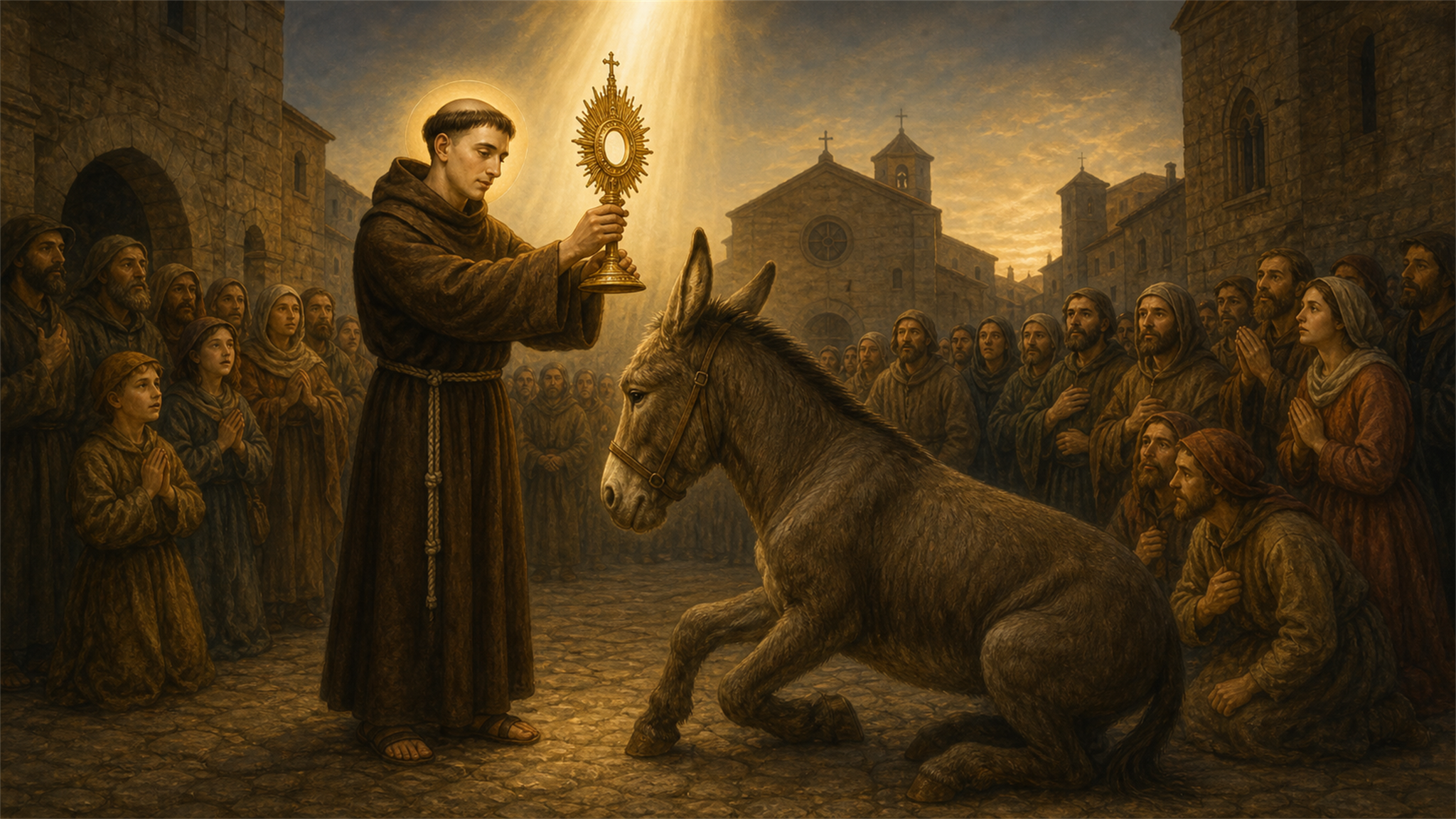
Among the countless titles of the holy apostle to the veneration of the faithful, one must place in the first rank the zeal he always showed for the purification of souls, and the numerous conversions he brought about. Where the eloquence of speech did not suffice, he affirmed the truth of religion through miracles; and it is thus that he brought back into the fold of the Church a multitude of sinners and heretics. The Albigensian doctors dared not appear before this man, in whom was realized once again that promise which Christ had made to his Apostles: "I will put in you a wisdom and a power such that your enemies will be able to do nothing against you."
History has preserved the memory of a striking prodigy that the Saint performed in Toulouse, and which is usually designated by the name of the miracle of the mule. A heretic, named Guiald, quite influential in the city and of a very stubborn character, dared one day to argue with our great Saint on one of the most important points of religion. He knew the Bible perfectly well, spoke Hebrew, and, strong in his science, claimed to triumph over the Father. But, soon beaten in the discussion, in the presence of a large number of Albigensians and Catholics, he tried to get out of trouble with a subterfuge: "Let us leave the speeches," he said, "and come to the facts; I possess a mule, I will deprive it of food for three days. In three days, be here with a consecrated host; I, for my part, will bring my mule and offer it something to eat. If, disdaining the hay that I will present to it, it turns toward you, I will recognize the superiority of your religion and I will convert." The Saint accepted the proposal. On the agreed day, which happened to be a market day, Anthony, after having celebrated the holy sacrifice of the Mass, and prayed to God with fervor, hurried to the meeting place, the sacred monstrance in his hand. The mule arrived, led by the heretic, who had taken care to have it followed by the food it preferred. Anthony walked toward it, his face inspired, surrounded by Christians singing hymns and prayers: "In the name of your creator, whom I carry in my hands," he said to it, "I order you to adore him with humility, so that the heretics may see with confusion that animals themselves are forced to recognize the divinity of Him whom the priest immolates every day on the altar." Immediately the mule, leaving its handler, prostrated itself on the ground, and, placing its head on Anthony's feet, remained motionless in that position. To describe the rage and confusion of the Albigensians as well as the joy of the Catholics is impossible. An immense concert of thanksgiving rose toward heaven; Guiald, faithful to his word, recognized the religion of the holy thaumaturge and provoked the conversion of his entire family and a large number of heretics. He even later had a beautiful church built at the place where the miracle had taken place, which was placed under the invocation of the apostle Saint Peter. One of his nephews also raised a chapel, where an inscription, engraved on the facade, recalled the miracle of the mule.
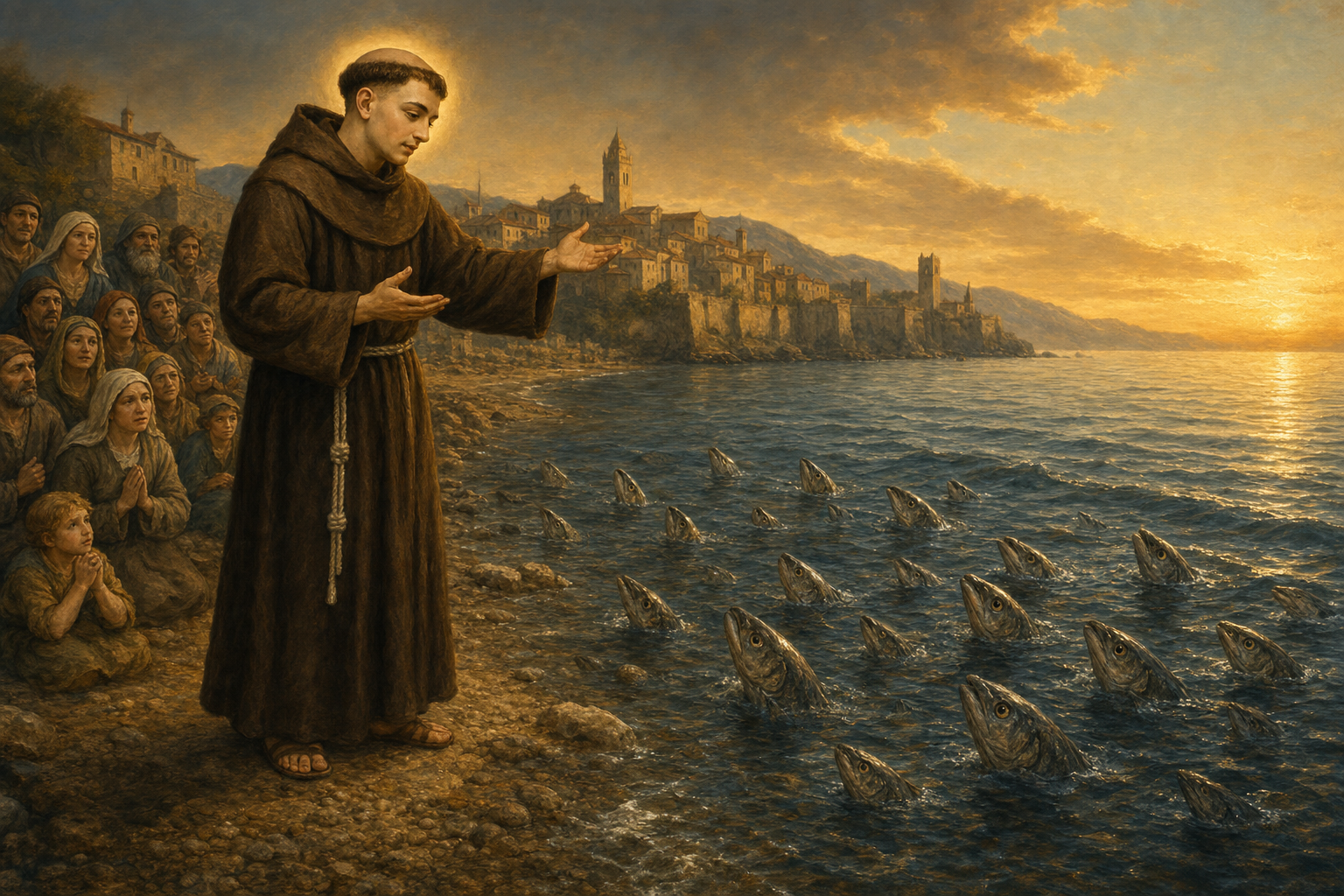
A miracle no less striking, which the Saint performed in Rimini, also decided the conversion of a large nu mber o Rimini Italian city where the saint worked and preached. f heretics. As the eyes of the enemies of the faith closed stubbornly to the light, despite the most eloquent sermons, the most rigorous reasoning, and the most convincing proofs, Anthony declared from the pulpit that those who wished to accompany him to the mouth of the river would see wonderful things. When they had arrived on the banks of the Marecchia, Anthony, raising his voice, cast his gaze over the expanse of the waters, and cried out:
"Fish of the sea and of the river, listen: since men do not want to hear the word of God, it is to you that I will announce it." Immediately, from the depths of the river, from the abysses of the sea, the small mixed with the large, a multitude of fish approached the shore. They arrived from all sides in innumerable troops, pressed one against the other, their heads out of the water, their eyes turned toward the preacher, who spoke to them thus: "What thanksgiving, O fish, must you not render to Him who gave you this immense expanse of water as a dwelling! It is to him that you owe these deep retreats where you take refuge during the storm; it is he who, at the time of the universal flood, when all the men and all the animals that were not in the ark perished, preserved your existence. You saved the holy prophet Jonah, you provided Saint Peter and Our Lord Jesus Christ with the means to pay the tax, finally, you served as food for the King of kings. Praise then and bless the Lord, who has favored you above all creatures."
At these words the fish stirred, beat their tails, opened their mouths, and testified by a thousand signs that they wanted to pay homage to the Most High, and pay him the tribute of their silent praises. The assistants could not contain their admiration and astonishment: "Let us praise God, my brothers," cried Anthony, turning toward the assistants, "let us praise Him whom fish revere more than do men created in his divine likeness." The heretics were confounded; they threw themselves in crowds at the feet of the holy man, and did not consent to leave the place until they had received from him the absolution of their sins. All those who witnessed this miracle returned that very day to the bosom of the Church. The memory of this prodigy has been perpetuated in Italy and even in France, and Father Papebroeck tells us that he saw with his own eyes, on November 26, 1660, an ancient chapel raised on the very spot where it was accomplished. Famous painters have represented it on canvas.
The holy Father, after this striking manifestation of the omnipotence of God, remained a few more days in Rimini to strengthen the new converts in the faith, and to instruct them in the principal dogmas of the religion.
The heretics never had a more intrepid and more formidable enemy, more skillful at profiting from their faults, more capable of unveiling their deceits and their lies. Thus they often tried to tarnish his fame through slander, or even to get rid of him through assassination. One day, they poured poison into the water he was to drink and into the soup he was to eat. Anthony was warned of it by the Lord: "Are you not ashamed," he said to them, "to resort to these miserable means, and do you believe that the eternal vigor of the Catholic religion must weaken if I die?" The poisoners, who knew that there could be no traitors among them, were confounded: "Eat and drink," they replied, "since it is said in the Gospel: You will be able to drink deadly beverages without danger; and, if the poison produces no effect on you, we are ready to recognize that your religion is the true one." Anthony made a sign of the cross, ate and drank: "It is not, Lord," he cried, "it is not to defy you that I absorb this poison, it is to give your glory a new occasion to manifest itself." He did not feel the slightest pain, and the heretics, who had wanted to kill him, returned to the bosom of the Catholic Church.
Everywhere the Saint passed, the same prodigies accompanied him, and not only the heretics, but the sinners feared him like lightning; he was called "the terror of tyrants." And truly, never was a title better deserved. When all of Italy trembled at the mere name of the ferocious Ezzelino, and when, already master of Vicenza, Brescia, and Castel-Fonte, this cruel man threatened to invade the entire region, when the inhabitants of Padua, frightened, already believed they saw the gallows and scaffolds at their doors, Anthony, devoting himself for his fellow citizens, announced that he was going to find the tyrant. He left, arrived in Verona, and presented himself in the palace where the wretch, surrounded by bandits like himself, was seated on a throne of silk and velvet. He walked straight to Ezzelino, and without being frightened by all this display, he cried out: "Cruel tyrant, mad dog, may the wrath of heaven weigh upon your head! How long will you thus pour out the blood of Christians in torrents? Think, think of the day of judgment; it approaches, and the punishment will be terrible..." Ezzelino trembled from head to foot, and he was so pale that he no longer seemed to have a drop of blood in his veins: "I saw coming out of the eyes of this monk," he said to his soldiers, "flashes so threatening that I feared for a moment being immediately precipitated into hell." He confessed, humbly asked for pardon for his crimes and promised to amend, and testified, throughout his life, a great veneration for the man of God.
Unfortunately he kept his promises only halfway, and the holy religious, intrepid defender of the Christians and the Italians, did not cease to fulminate against him the most eloquent speeches. Ezzelino wanted to test him; he sent him through some of his officers a considerable gift, with orders to kill him if he accepted it, but to respect his life if he refused it. The tyrant's messengers approached Anthony very humbly, and said to him: "Your son Ezzelino asks you as a favor to accept this gift, and also asks you to intercede for him with God." Anthony refused with indignation:
"It is the fruit of murder, pillage, and rapine that you carry in your hands; I still see blood on this gold; get out of my house, cursed ones, and do not soil my house any longer with your presence."
They returned all confused, and told Ezzelino the results of their mission: "He is truly a man of God and a Saint," he said, "let him preach against us as he wishes; we will leave him in peace." And as long as Anthony lived, the fear and respect that the great thaumaturge inspired in him stopped him in his excesses.
Later, after the death of Anthony, his all-powerful intercession delivered Padua from the bloody tyranny of the tyrant, and gave victory to the army of the Pope and the Italian republics.
Retreat and death in Padua
Exhausted, Anthony retired to Camposampiero and then died at Arcella, near Padua, on June 13, 1231, at the age of 36.
At the beginning of the year 1231, Anthony returne d to P Padoue Place of his medical studies. adua at the invitation of Cardinal Raynal, protector of the Order, who later became Pope under the name of Alexander IV. Although very tired and in failing health, he resumed his theology course and applied himself, in public lessons, to combating the errors of the heretics called Cathars and Catharins. At the same time, he was writing his sermons on the Saints and preparing himself, through meditation, to preach the Lent of 1231.
As if he had felt death approaching, he redoubled his zeal and performed prodigies of activity. This Lenten station was by far the most fruitful in conversions and miracles. It began on February 5. Anthony preached every day, and sick and suffering, he seemed to draw supernatural strength from the ardor of his faith and charity. People flocked to his sermons from all the surrounding towns and villages for leagues around; the roads were covered with pilgrims eager to hear this eloquent voice, whose accents moved the world. More than thirty thousand people crowded around the thaumaturge's pulpit; bishops, prelates, religious of all Orders, the clergy, and the nobility of Padua considered it an honor to attend his sermons. They waited in recollection and silence for the holy man to arrive. At his approach, not a sound, not a stir, not a breath; all eyes were fixed with eager curiosity on this beautiful, pale, and suffering face; as soon as he spoke, all minds happily received the heavenly seed he poured upon them; and when he descended from the pulpit, had some robust men not protected him against the demonstrations of respect and admiration of the multitude, he would have infallibly succumbed under the weight of the transports of faith and love.
To state the results of this last preaching is almost impossible; converted heretics, the most hardened sinners brought back to the good, fallen women doing penance, prisoners delivered, the poor helped, the sick healed, etc., etc., such are in two words the new titles that Anthony conquered for the veneration of men. In this great city of Padua, where such a numerous clergy had gathered, there were not enough priests to hear the confessions of the faithful. Miracles were accomplished every day; here Anthony heals a poor paralyzed child; there it is a noble lady of Padua, who, while going to the Saint's sermon, falls into a deep and muddy ditch, and comes out without accident because she commended herself to God through the merits of the apostle; another time, it is thieves, twenty-two in number, who, in the middle of a sermon, come to throw themselves at Anthony's feet, giving all the signs of true contrition and asking for forgiveness for their iniquities; or again, it is a woman as virtuous as she is beautiful, mortally struck by her husband in a fit of unjust jealousy, whom the Saint recalls to life by making the sign of the cross over her.
At the end of this station, so long and so fruitful in wonders, it seems that Anthony must have felt the need to take a few weeks of rest; on the contrary, he continued to exercise his ministry in the towns and villages near Padua, and did not cease his work of charity until the time for field work had come. Only then did he think of preparing himself to appear before God, for the time of his death was approaching.
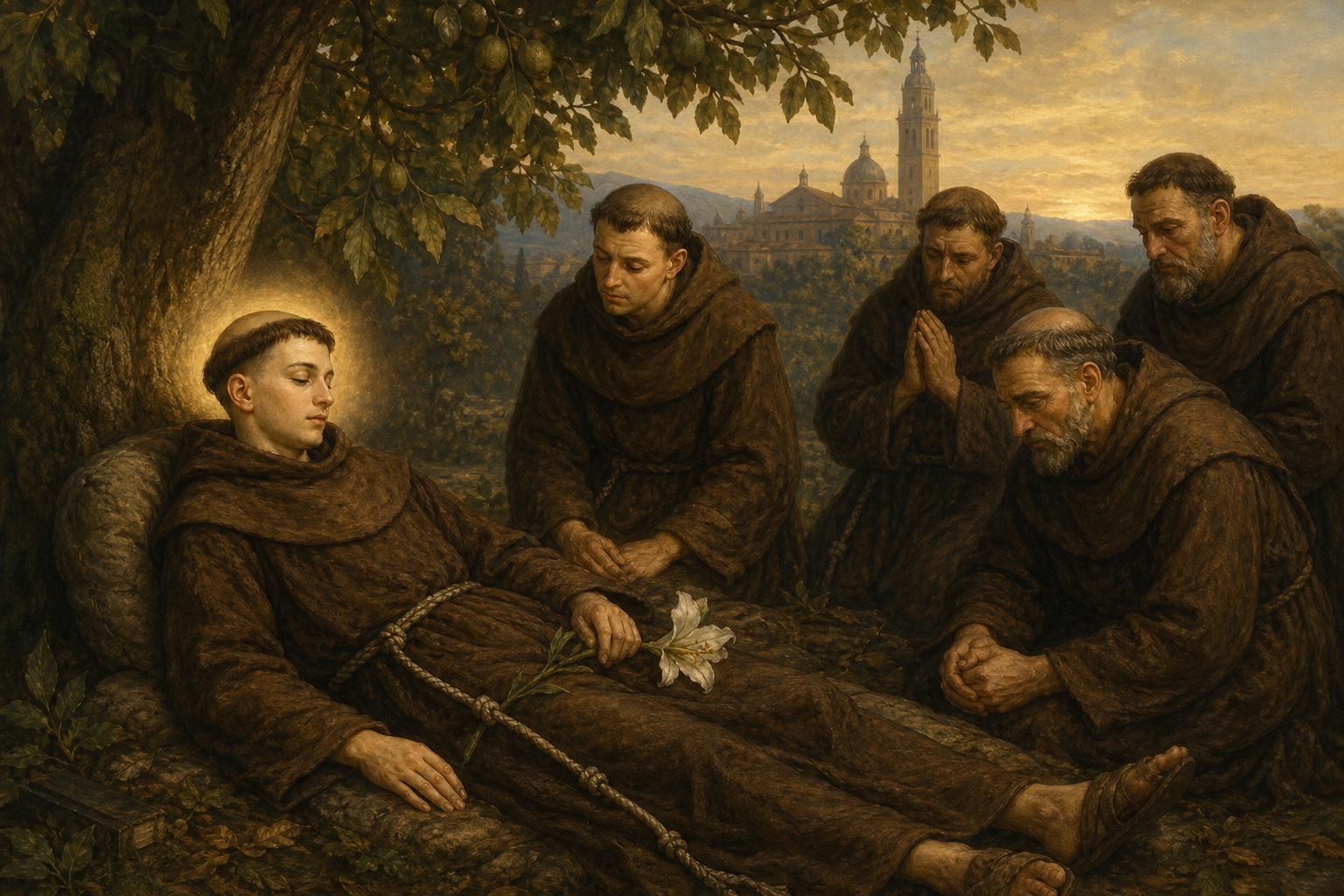
Campo san Pietro, or Campietro, a small village located three leagues from Padua, and where there is a hermitage placed under the invocation of Saint John the Baptist, is the retreat where the great Saint decided to spend the last days of his life. He Campo san Pietro Site of the saint's final retreat in a walnut tree. was received there, at the beginning of June 1231, by a pious gentleman named Tiso, lord of Campietro, with the respect one would have shown to an angel and an envoy from heaven. Through Tiso's care, three cells were built on the trunks and branches of a vast walnut tree, one for Anthony, the other two for his two companions, Brother Luke and Brother Roger. This was the last dwelling of the thaumaturge. Locked day and night in his narrow wooden hut, he fed his mind and heart with heavenly contemplations. No noise in the surroundings, everywhere peace and rest, although numerous pilgrims still came to ask the Saint for prayers or advice; the lord of Campietro sometimes obtained from him a few moments of conversation, and he had the signal happiness of receiving from his hands the habit of the Third Order.
Anthony's strength suddenly weakened; one day when, according to his habit, he was going to the small convent of the Friars Minor of the place to take his frugal meal, he suddenly felt his legs failing him, and he needed the help of his two companions to reach the refectory. He tried to sit at the table, but the illness worsened; he almost lost consciousness, and the religious had to transport him quickly to one of their poor beds. Life was slipping away rapidly; clouds seemed to be gathering before Anthony's eyes, and he saw the darkness of death thickening around him. He rejoiced in it, moreover, like the worker who has well fulfilled his day and who is going to receive the deserved reward for his pains and fatigues, and his face testified to an unspeakable bliss.
After a few minutes of rest, Anthony called Brother Roger to him and asked him, if he saw no obstacle, to have him transported to Padua. They sent for a cart, which they arranged as best they could, and placed the Saint in it, despite the supplications of the monks of Campietro, who claimed the honor of caring for him.
As they approached Padua, they met a Friar Minor, charged by the guardian of the city's convent to inquire about the patient's condition. At the sight of Anthony, so weak and languid, the religious feared that the eagerness and noisy grief of the inhabitants would worsen his situation even more, and he advised Anthony to stop at the brothers who served the cloister of the Poor Clares, outside the city. The thaumaturge consented to everything they wanted, and they led him to the monastery of Arcella.
However, the weakening was making rapid progress, and the august patient, feeling himself failing, asked for the holy sacrament of the Eucharist. Brother Roger hastened to administer it to him amidst the tears of all the religious. A few moments later, Anthony intoned with his melodious voice the hymn: *O Gl oriosa Domina*, which monastère de l'Arcella Place of death of Saint Anthony. expressed so well the sentiments of his soul towards the Queen of virgins; then, lifting his eyes to heaven, he murmured: "I see my God, He is calling me to Him".
When they brought him the holy oils, he said to the priest: "I possess this anointing within me; but although it is not necessary that you give it to me externally, I will receive it with pleasure and it will be useful to my soul". And while he was receiving it in fact with the liveliest faith and the greatest marks of contrition, he sang with his brothers the psalms of penance; then he kept an absolute silence for about half an hour, and suddenly, amidst the sobs of those present, he surrendered his soul into the hands of God, and fell into the eternal sleep on June 13, 1231, a Friday, a little before sunset.
Canonization and posthumous glory
Canonized as early as 1232 by Gregory IX, his cult spread worldwide and a monumental basilica was erected in Padua to house his relics.
The next day, the inhabitants of the suburbs, the very ones who had opposed the translation of the body so violently, came barefoot, with their clergy at their head, to pray at Anthony's tomb and to deposit their offerings. This pious example was followed by the various parishes; processions were organized, and every day the faithful went, in penitential attire, to the church of Saint Mary. All classes mingled in a touching devotion; nobles and bourgeois, soldiers and priests showed the same eagerness. Gifts of all kinds, in gold and silver, abounded in every form; and the tomb was soon literally covered with them. At the same time, the fame of Anthony began to fill the entire Catholic world; nothing was spoken of but the wonders that were accomplished every day through his intercession; from all over Italy, Spain, France, Germany, Hungary, and Slavonia, pilgrims set out to come and pay the Saint the tribute of their admiration and homage. The Friars Minor could not keep up with hearing the confessions of the faithful; and thus was fulfilled the prediction of the Saint a few weeks before his death: "O Padua," he said, looking from the top of a hill at his adopted homeland, "city famous among all cities, your fame will resound throughout the universe!"
A month had not passed since the death of Anthony, and already he was being invoked everywhere as a Blessed and a Saint. Therefore, the bishop, the clergy, the magistracy, and the inhabitants of Padua thought to ask for his canonization, and for this purpose they sent an embassy to Rome. The Pope already knew by public report of the miracles that were being accomplished at the tomb of the wonder-worker; he had, moreover, loved and respected Anthony during his lifetime; he could only welcome the deputation favorably. He therefore charged the bishop of Padua, the prior of the Benedictines, and the prior of the Dominicans to conduct an inquiry into the marvelous events that had followed one another with such rapidity since the death of the Blessed; then, this first work completed, in the month of February 1232, the bishop and the clergy chose two canons and two friars minor, and the senate and the principal citizens designated two knights, who received the mission to go to Rome to carry a new petition and to hasten the canonization of Anthony.
The Pope immediately gathered the Sacred College; two cardinals, designated to make the report, did so in terms that confirmed the truth of the attestations of the first commissioners. However, some prelates seemed to see with regret that there was such a rush to decide such an important matter; they expressed fears and hesitations, which were quite honorable, and were of the opinion that time should be given for accusations, if any were to arise, to be produced. But, during his sleep, the cardinal who was most insistently asking for the adjournment had a vision, following which he became one of the most ardent defenders of the immediate canonization of Anthony. The Holy Father was consecrating a church, and in the middle of the ceremony it was noticed that the relics intended, according to custom, to be sealed under the altar were missing. The Pope then, turning toward the cardinals, pointed to a recently deceased body, lying on the stone of the church and hidden under a veil, and ordered them to remove some fragments from it for the consecration. The shroud was removed, and immediately from this body, already in decomposition, a delicious perfume was exhaled; the face was still intact: they recognized the features of the blessed Anthony, and all those present rushed to kneel around it, crying: "Anthony is a saint! Anthony is a saint!"
The next day, the cardinal told his dream to his intimates, and a few days later, as the deputies of Padua came to beg him not to oppose their just request any longer, without even giving them time to speak, he said to them: "I have changed my opinion since the last meeting of the consistory; Anthony is worthy of being placed in the rank of saints, and be certain now that I will support you with all my strength before the sovereign Pontiff." He kept his word, and did so well that he brought all the other opponents around, and drafted with them a petition to the Pope, to beg him not to leave this great matter pending any longer.
It was the most ardent wish of Gregory IX; all happy to finally see the difficulties smoothed over, he set the ceremony of canonization for May 30, the day o f Pentecost Grégoire IX Pope who attested to the miracles of Bruno. . It was to take place in Spoleto, where the papal court was then being held. All of Christendom wanted to be represented there; and the whole world sent deputies; the superiors of all the religious Orders, many Franciscan provincials, princes, gentlemen, and the entire Sacred College enhanced the splendor of this beautiful feast with their presence. The Pope officiated; then, after the customary prayers, he ordered that the wonders performed through the intercession of Anthony be read publicly.
When the priest had left the platform, Gregory IX, standing on his throne, declared, in the name of the most holy Trinity, that Anthony was inscribed in the catalogue of Saints, and that his feast would be celebrated on the anniversary of his death, that is to say, June 13. They sang the *Te Deum laudamus*, then the Pope intoned the antiphon: "O doctor optime, O excellent doctor, light of the Church, pray for us, Saint Anthony!" Finally, they recited the prayer that the Blessed had composed himself, and which is still said today on the day of his feast.
Some time later, the Pope sent bulls to all the bishops of Christendom, to enjoin them to honor the memory of the confessor with an annual service.
A first office of Saint Anthony was composed, it is said, by Gregory IX himself; another, by Brother Julian of Speyer, in 1249; a third, finally, by Father Azzoguidi in 1737, approved by the Congregation of Rites in 1741. The rhymed office has hardly been preserved since then, except by the Fathers of the Strict Observance. At the convent of Ara Coeli, in Rome, it is still recited; it is far superior in beauty and unction to the new office.
Saint Anthony of Padua is invoked in the danger of shipwreck and to find things that have been lost; and there are an infinity of people who claim to have visibly felt his assistance in this necessity. Sterile women, pregnant women, and travelers also have a very powerful protector in this great saint.
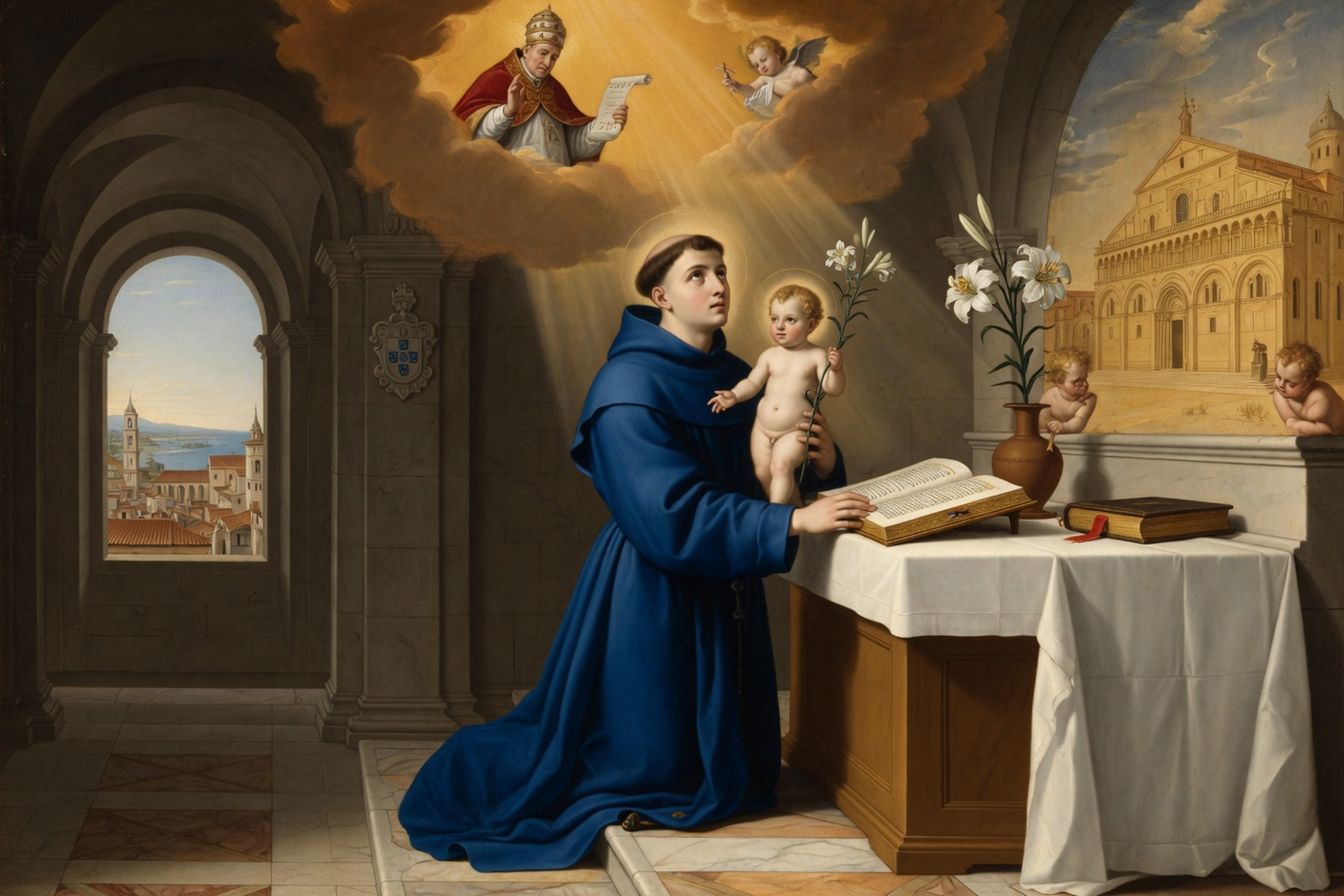
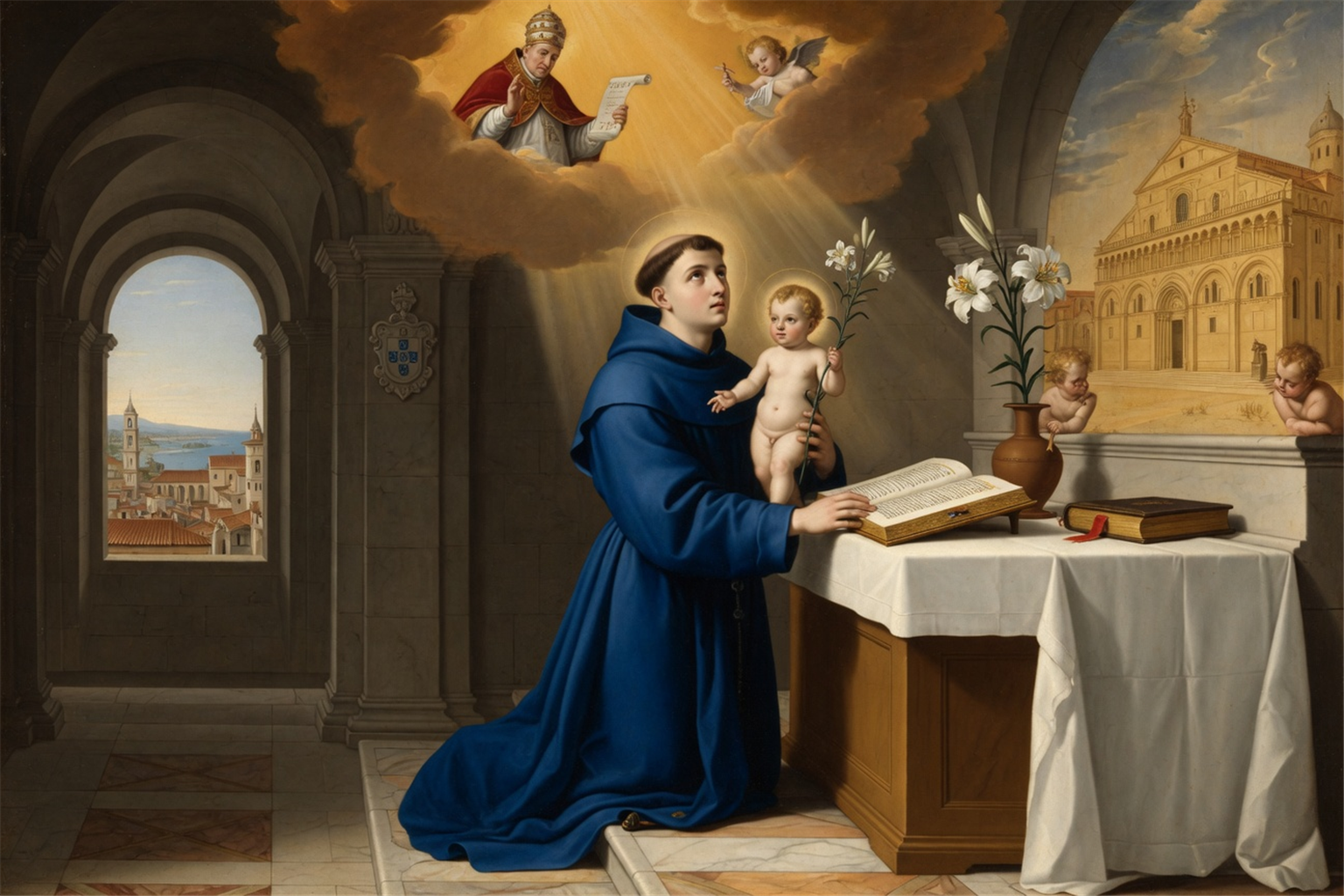
He is represented carrying the Blessed Sacrament and with a donkey kneeling before him; with the child Jesus in his arms; carrying a lily; carrying a crucifix that branches into lily stems; healing a man who had his leg cut off; sometimes his radiant tongue is also represented in the hands of Saint Bonaventure.
The Doctrinal Work
Anthony leaves behind an important literary body of work, notably sermons and a moral concordance of the Bible, testifying to his scriptural knowledge.
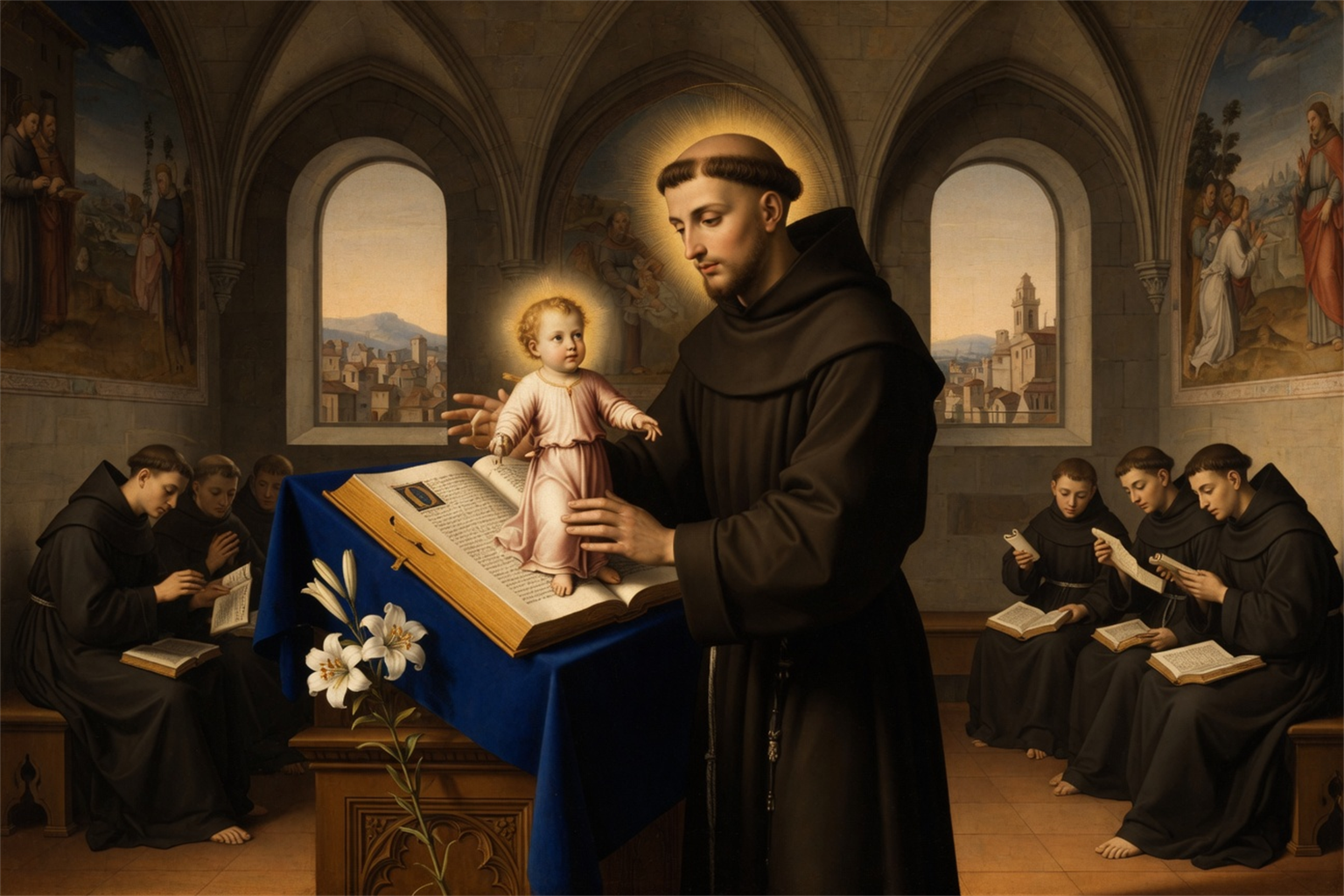
When one considers the small number of years that Saint Anthony spent on earth; when one reflects on the multiplied journeys he undertook, on the time he employed for his theology lessons and especially for preaching and the other functions of the priestly ministry, one is truly surprised that he could have left to the Church and to posterity so many admirable and useful writings. — Here is the list of these precious productions: we first encounter four fairly extensive instructions for the Sundays of Advent. — They are followed by a sermon for the Sunday in the octave of the Nativity. — There are then four exhortations for the first four Sundays after Epiphany. — The Sundays of Septuagesima, Sexagesima, and Quinquagesima offer us fairly developed sermon outlines. — Then opens a series of instructions for each of the days of Lent, up to and including Holy Thursday. These are materials for a complete Lenten station. — Following this Lent, one finds sermons for all the Sundays of Quadragesima, for Passion Sunday, for Palm Sunday, for Good Friday, and for Easte sermons pour tous les dimanches A collection of the saint's sermons and theological teachings. r Day. There are, in addition, four great instructions for the first Sunday of Lent, two for the second Sunday, one for the third, and one for the fourth. These homilies are the explanation of the epistle for each of these Sundays. — Now, the Saint will provide us with sermon outlines for all the Sundays from Easter to Trinity, and from Trinity to Advent. This is the most considerable part of his sermons. — Finally, there are the exhortations for the feasts of the saints. They begin with an instruction on the Lord's Supper, *de carne Domini*. Then, there are nine sermons on the Apostles, four on the evangelists, six on the martyrs, five for All Saints, three for confessors, seven for virgins, and one for All Souls' Day. These sermons, like most of the preceding ones, are, strictly speaking, only drafts or outlines of instructions. The Saint wrote them with care, but when he preached, he usually gave himself over to improvisation for the details of his subject and the development of his ideas. — Besides this great number of sermons, two other very important works are attributed to Saint Anthony: the first is a short mystical commentary on all parts of the Old and New Testament, from Genesis to the Apocalypse of Saint John; the second is a moral concordance of the Bible, in five books. It is very probably the first attempt made in this genre, and it is a most remarkable work. It must have cost the author a great deal; and even today, despite the beautiful concordances we possess, it can still render real services to preachers. The commentaries on the Holy Scriptures breathe the most sweet piety and an admirable knowledge of the human heart and the ways of perfection.
All these works of Saint Anthony were gathered and united with those of Saint Francis of Assisi, in a very large folio volume, by the care of the Reverend Father Jean de La Haye, of the Franciscan Order. They appeared first in Paris, in 1641; then they were reprinted in Lyon, in 1653; and finally, they were edited, most recently, at Pedeponti, near Ratisbon, in 1739.
Since that time, a new work by Saint Anthony of Padua has been discovered: it is a series of sermons on the psalms. There are two hundred and seventy-eight of them. They were found, in 1757, in the treasury of the Franciscan church in Bologna, by Father Azzoguidi. This learned religious hastened to publish them in a small folio volume. He added an ancient Life of Saint Anthony, almost unknown until then, which he enriched with curious historical, chronological, and critical notes. The Bologna manuscript seems to unite the proofs of authenticity desirable in such a matter. Everything indicates that it was written by the Saint himself. It is therefore a monument worthy of the greatest respect.
The writings of Saint Anthony of Padua figure among the inestimable riches that the Middle Ages transmitted to modern society. They deserve, from a multitude of points of view, to fix the serious attention of philosophers, theologians, orators, Christian politicians, and all those who wish to be able to justly appreciate two great epochs of ecclesiastical and secular history: the end of the 12th century and the first part of the 13th.
Wadding; Cardoso; Life of Saint Anthony of Padua, by Abbé Guyard, Vicar General of Montauban; Spirit of the Saints, by Abbé Grimes.
Annexes & related entities
Structured data for exploration: events, miracles, quotes, places, attributes, patronages, and important entities cited in the text.
Key Events
- Born in Lisbon in 1195
- Joined the Canons Regular of Saint Augustine
- Joined the Friars Minor (Franciscans) in 1220
- Preaching mission against the Albigensians in France
- First notable sermon in Forli in 1222
- Teaching theology in Montpellier, Bologna, Padua, and Toulouse
- Meeting with Ezzelino the Tyrant in Verona
- Died at the Arcella monastery near Padua
- Canonization by Gregory IX on May 30, 1232
Miracles
- Preaching to the fish in Rimini
- Miracle of the mule kneeling before the Host in Toulouse
- Bilocation between a church and his convent in Montpellier
- Tongue remained intact after his death
- Healing of a severed leg
- Protection of the crowd from rain during a sermon
Quotes
-
I see my God, He is calling me to Himself.
Reported last words -
O blessed tongue, which has always blessed the Lord...
Saint Bonaventure during the translation of the relics
Geographic Path
9 steps- 01 Lisbonne
- 02 Coïmbre
- 03 Maroc
- 04 Sicile
- 05 Montpellier
- 06 Toulouse
- 07 Limoges
- 08 Monastère de l'Arcella
- 09 Basilique du Saint (Chiesa del Santo)