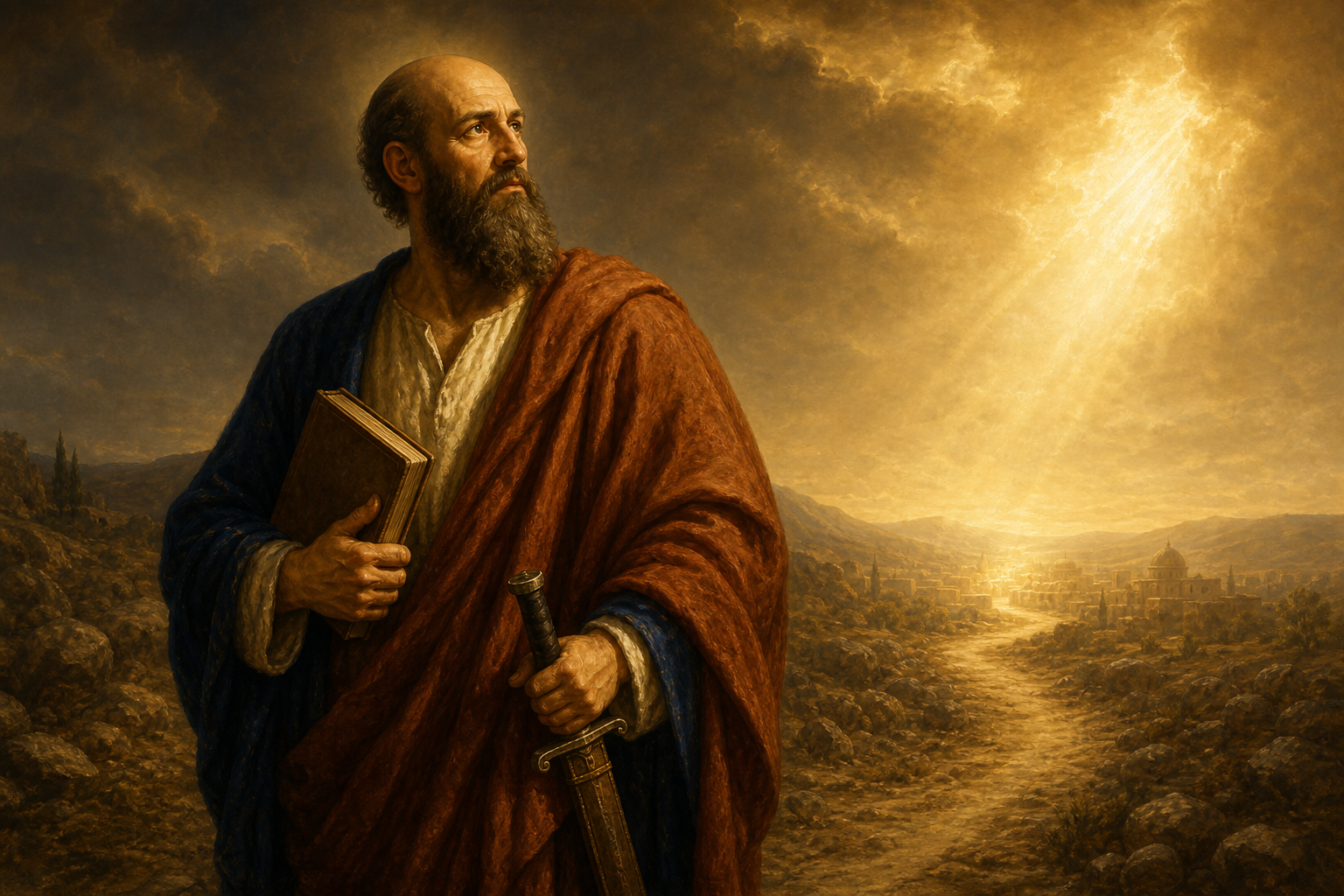
Born in Tarsus and initially a fierce persecutor of Christians, Saul was miraculously converted on the road to Damascus after a vision of Christ. Having become Paul, the Apostle to the Gentiles, he traveled throughout the Roman Empire to found numerous Churches and wrote fourteen major Epistles. He died a martyr in Rome, beheaded under Emperor Nero.
Guided reading
10 reading sections
SAINT PAUL, APOSTLE TO THE GENTILES AND MARTYR
Youth and Pharisaic Formation
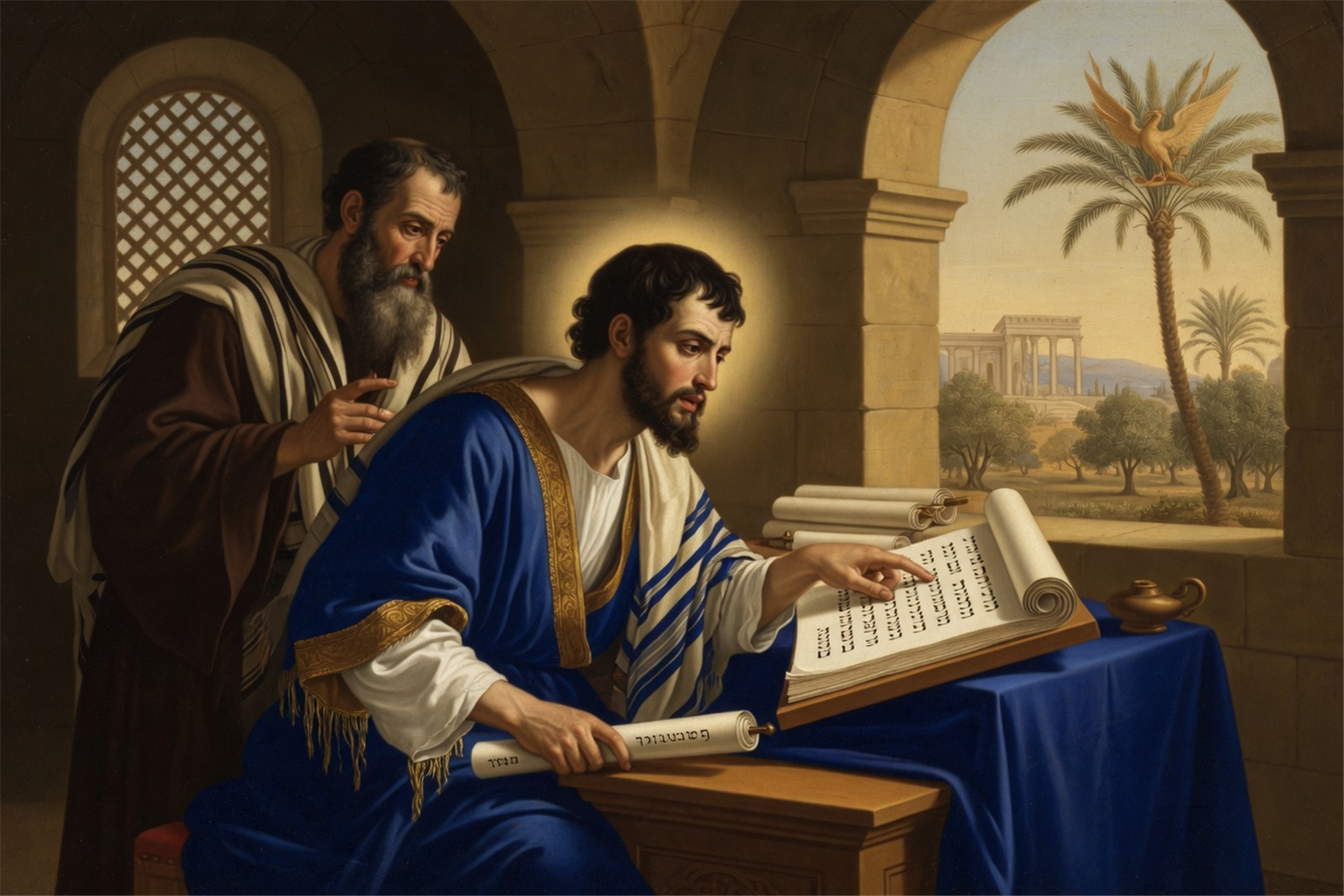
Born in Tarsus, Saul receives a rigorous education in Jerusalem under the direction of Gamaliel, becoming a zealous defender of the Law of Moses.
66. — Emperor: Nero.
*Considera Paulum apostolum prius persecutorem, postea annuntiatorem, ante hoc zizaniam, post hoc frumentum, antea lupum, postea pastorem, prius dissipantem, postea aedificantem.*
Admire the Apostle Saint Paul; he had persecuted Jesus, and now he proclaims Him aloud; he had sown tares, and now he spreads the good grain everywhere. From a ravenous wolf he becomes a vigilant shepherd, and the edifice he had just ruined, he now devotes himself entirely to rebuilding.
S. Chrys., in Homil.
This is without contradiction one of the greatest and most legitimately illustrious Saints that the earth can pride itself on having borne. His miraculous conversion, his extraordinary vocation to the apostolate, his immense labors, his unheard-of sufferings, his chains which never stopped the freedom of his speech, his doctrine so high, his epistles so vivid, so strong, so apostolic, the very sometimes harsh forms of his language, distinguish Saint Paul so much that he summarizes saint Paul Apostle cited by Saint Jerome to illustrate divine decrees. in himself all the glories of the apostolate. He is its finished model; in the Church he is called the great Apostle; and when one simply says the Apostle, it is he who is designated.
Born in Tarsus, in Cilicia, in the year 2 of Jesus Christ, of Jewish parents of the tribe of Benjamin, he received at birth th e na Saul Apostle cited by Saint Jerome to illustrate divine decrees. me of Saul and the title of Roman citizen: God, who destined him to preach the Gospel mainly among the Gentiles, willed that he possess a dignity capable of accrediting him more easily to them, and of delivering him from certain very grave perils to which his work was to expose him. At that time, schools flourished in Tarsus that equaled in reputation those of Athens and Alexandria. Belonging to the sect of the Pharisees, probably by the chance of his birth, the future apostle of the Gentiles frequented them early on, to be initiated there into the science of his century. But the family of Saul, which was distinguished by the uprightness of its morals and served God with a pure conscience, which was rare among the Pharisees, favored his taste for the science of the law and sent him to Jerusalem, to the school o f Gamali Gamaliel Doctor of the Law who had the body of Stephen buried. el, head of the Academy and prince of the Judaic senate. This famous master, honored by all the people, initiated him into the entire and deepest science of the law, as it was studied then, and into the highest speculations of theology, as it was taught in a school where the most considerable young students of Judea were gathered. Saul made such great progress under this skillful master that no one surpassed him in the science of the Law of Moses, in the tradition of the Jews, in the history, customs, and ceremonies of his nation. To this high science he joined a devouring ardor to maintain its practice.
The highest personification of this meticulous practice so cherished by the young student was Pharisaism. The most authorized sect of Judaism, it made religion serve its personal ambition. With the goal of dominating the people and making them accept its domination, it struck them through the practical exaggeration of the law. Looking at interior justice with indifference, the exterior form of piety seemed to it alone essential. The Gospel sharply reproaches it for this immoral conduct which it insolently supported with corrupted maxims. It was within this formidable sect that the future persecutor of the nascent Church was formed. With his resolute character, he embraced its prejudices, its illusions, and strove to make them a reality. His ardent fanaticism, which nothing could moderate, went to collide against Christianity in its cradle. Who could have held him back! The new faith absolutely destroyed his chimerical ideas and threatened to invade everything; before this conquering march, he did not hesitate to oppose it through the use of violence.
From Persecutor to Apostle
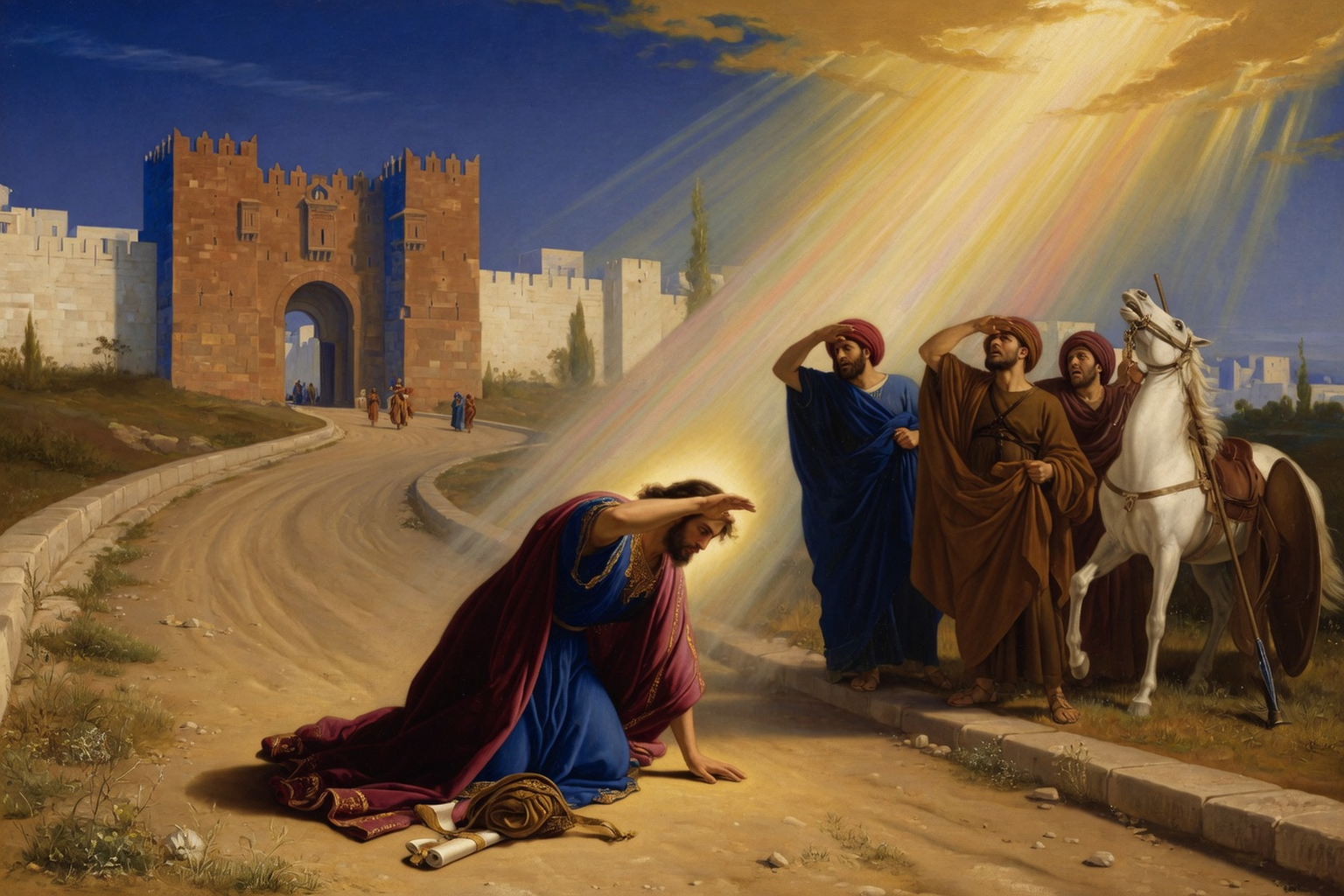
After witnessing the martyrdom of Stephen, Saul is struck down by a vision of Christ on the road to Damascus, which radically transforms his life.
The opportunity was superb; the Church of Jerusalem then presented to the eyes of the world a magnificent spectacle. The Christians, under the direction of the Apostles, were of one heart and one soul and had held all their goods in common. Deacons had been created, charged with distributing the income of this association appropriately to all members. Conquered by this initial impulse, a good number of Jews sold their property and brought the proceeds to the feet of the Apostles. T he deac Étienne Protomartyr to whom Trond dedicated his property and a church. on Stephen, filled with the spirit of God, preached with power and became the main engine of these conversions: the struggle was inevitable, and it broke out. Jews from various provinces, irritated by his miraculous actions, came to argue with Stephen on the subject of religion. Was Saul the first instigator of this dispute, or did he let himself be drawn in by others? Given his character, he must have been the instigator. All these adversaries of Stephen, incapable of resisting the wisdom and the spirit of God that spoke through him, exasperated to see their reputation for learning compromised before the people, abandoned themselves to the hateful excitations of a humiliated pride, and, resorting to the weapon of cowards, they suborned men who dared to affirm that the wonder-worker had spoken words of blasphemy against God and against Moses. A great tumult arose among the people. Stephen was seized and dragged to the council. There, false witnesses testified against him with audacity, supported as they were by the sympathies of the crowd and the power of their accomplices. Then the high priest Joseph Caiaphas asked the accused if the charges brought against him were real: he, for his only answer, his face illuminated like that of an angel, pronounced to the shame of his executioners that well-known discourse which earned him martyrdom. By virtue of the judgment of the people, he was torn from the assembly and dragged outside the city walls to be stoned. The witnesses of his discourse were the executors of the sentence. Now, the witnesses who stoned Stephen laid their garments at the feet of a young man named Saul, as if to express all, in a sympathetic manner, that it was from him, as representative of the council, that they held the right to stone him. Saul, an accomplice in this first murder, was thus preluding a more open, more bloody persecution.
The faithful of Jerusalem, appalled by the violent death of the first of their martyrs, pursued by the hatred of the Sanhedrin and violently dispersed, had believed they would find a protective shelter in Damas Damas City where the actor Cornelius resides. cus. But this capital of Cele-Syria was then subject to the scepter of Aretas, whom disputes with Herod the Tetrarch had made a declared enemy of Jerusalem. Moreover, it was not unknown in the holy city that the disciple Ananias, a good man enjoying great consideration among his compatriots, had succeeded in persuading a good number of Jews of Damascus to embrace the faith of Jesus Christ. It was a matter of striking a great blow whose impact would stop the progress of a detested doctrine. Saul, still breathing only hatred and slaughter against the disciples of the Lord, armed himself with a co sanhédrin Jewish religious authority that prosecuted Paul. mmission from the Sanhedrin, which was at that time invested with dictatorial power over all the synagogues of the dispersion; then he came to find the high priest Caiaphas and solicited from this leader letters of credence for the synagogues of Damascus, so that if he found any member of the sect of the Galilean, men or women, he would be authorized to bring them in chains to Jerusalem. He therefore set out and was already approaching Damascus.
But the moment is near when grace will perform a miracle of transformation and make us witness, not a scene of psychological novel, as an impious rationalism would like to insinuate, but a solemn and mysterious drama, a prodigy unique in the annals of the predestination of the Saints. It will proceed by a lightning bolt, seize the persecutor and change him, in the very heart of his homicidal projects; when his feelings of rage against Christ and hatred against his disciples are at their height, it will precipitate him into the faith and justice that it brings forth: Saint Stephen has prayed for his fellow student, the pupil of Gamaliel, and the Church will salute Saint Paul.
The persecutor was about a kilometer from the city that protected the Christians: a dazzling light suddenly surrounded him; he was struck by it as if by a bolt of lightning and thrown to the ground. It was at midday. At the same time, he heard a voice from heaven saying to him: "Saul, Saul, why do you persecute me?" At the moment the voice rang in his ear, he perceived the face of the Savior: he did not appear to him with that veiled majesty that he had on earth, and which he kept even with his disciples after his resurrection, while conversing with them; he showed himself in all the splendor of his glorified body. Saul alone understood the heavenly voice. His traveling companions saw the light; they heard the sound of the words, but they did not understand their meaning and saw no one: they were Hellenistic Jews, and the supernatural manifestation took place in the Syro-Chaldaic language, well known to the learned disciple of Gamaliel. "Who are you, Lord?" asked Saul, his eyes fixed on the radiant figure. "I am," replied the heavenly personage, "Jesus of Nazareth whom you are persecuting." Conquered, the proud Pharisee of a moment ago replied humbly: "Lord, what do you want me to do?" And the Lord: "Rise, enter the city, and there you will learn what you must do."
When the vision had disappeared, Saul rose; but, dazzled by the light from above, he was blind: his companions were obliged to lead him by the hand. Arrived in Damascus in a state very different from the one he had prepared, he remained deprived of sight for three days, which he spent in fasting and prayer. But if the eyes of the body were plunged into darkness, the eye of the spirit was opening to the heavenly light. In three days he lived several years of penance: grace flooded his soul with divine light. Is it not still through the silence and meditations of a laborious solitude that the Catholic Church forms its ministers for the struggles of the apostolate? Now, the lion struck down at the gates of Damascus had risen as an apostle: it was necessary that, in the favor of this providential retreat, his intelligence understood the most obscure texts of Scripture, and that he knew that the promises of the old law had had their fulfillment in Jesus Christ, the Messiah awaited by the Patriarchs, announced by the Prophets, the object of the ardent hopes of the faithful nation. After the dazzling light that had flooded the body, the interior illumination had to be complete; to this ardent and fanatical nature, ready to make itself the slave of a master who would personify its idea, a new tutor was needed; for Saul converted, a Christian Gamaliel was needed to whose lessons he could appeal. This instructor is given to the future apostle, and he will henceforth be able to inscribe at the head of his immortal epistles: "Paul, servant of Jesus Christ, called to the apostolate and instructed in his new duties not by men, nor by any man in particular, but by Jesus Christ."
The great convert was instructed, but he lacked consecration. Now, Ananias, in a vision, received from God the order to go and lay hands on Saul, in order to restore his sight. Surprised, he objected to the actions of yesterday's persecutor; but the Lord reassured him: "Go, for he is for me a vessel of election; I have destined him to carry my law among the nations, before kings, and to announce it to the children of Israel. I will show him, moreover, how much he will have to suffer for my name."
At the same hour, Saul had a similar vision that announced his healing through the ministry of Ananias. The latter did not delay in knocking at the door of a Jew, named Judas, in the Straight Street, at whose house Saul was staying. "Saul, my brother," he said upon entering, "the Lord Jesus, who appeared to you on the road, has sent me to you to restore your sight and so that you may receive the Holy Spirit." As soon as he had laid his hands on him, something like scales fell from his eyes and he recovered his sight. Saul rose and immediately received baptism.
The Call to the Gentiles
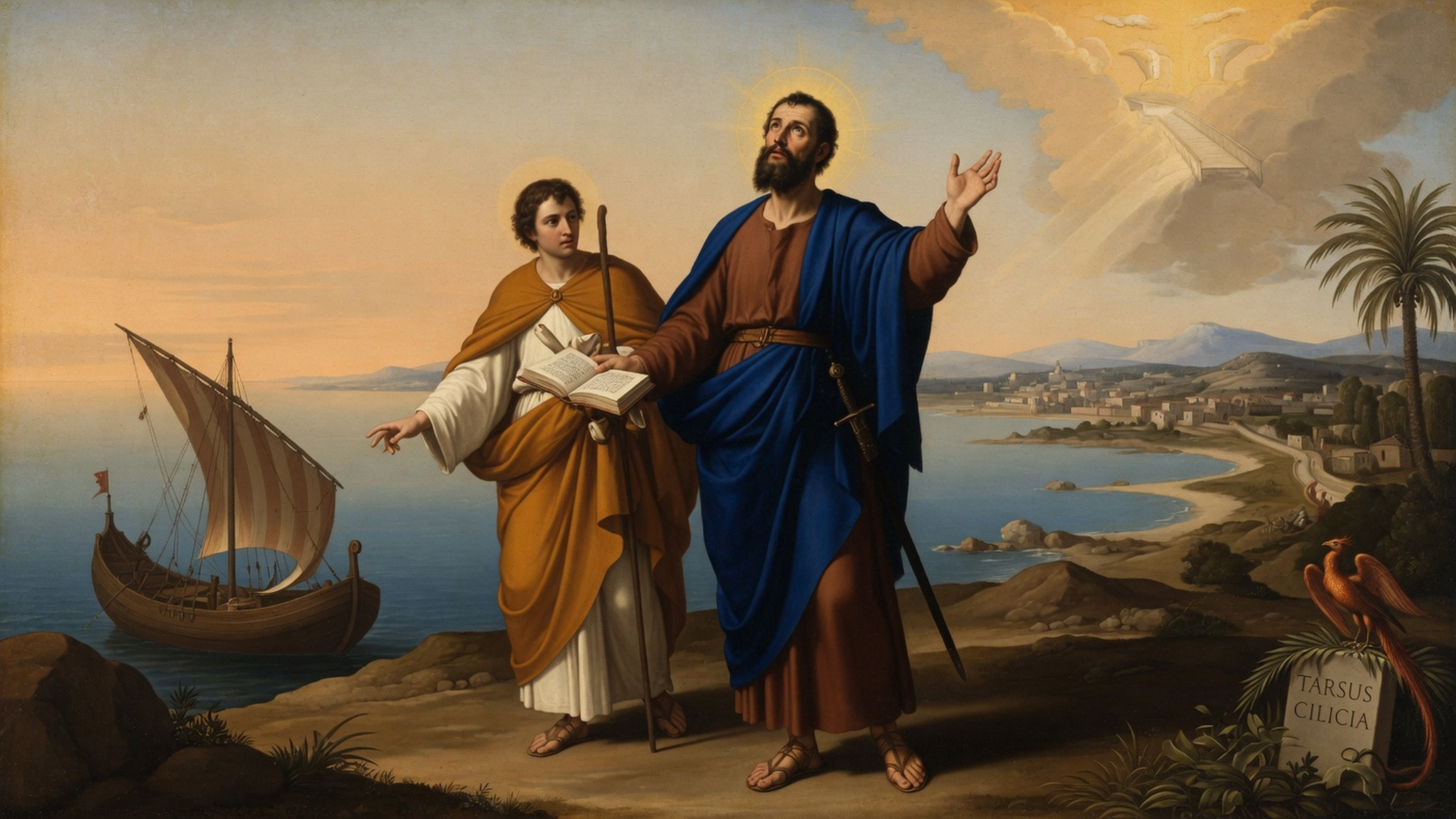
Accompanied by Barnabas, Paul begins his first missionary journeys in Cyprus and Asia Minor, marking the beginning of the evangelization of the pagans.
Here is the solemn moment: converted, instructed, consecrated, and regenerated by the waters of Baptism, the illustrious neophyte had everything necessary to become the instrument of great designs: the diffusion of the faith throughout the entire world, such is the program whose execution is entrusted to him by his new master; his mission is about to begin. He lacked only the immediate preparation: Saul went through his trials. Damascus, which was to be the theater of his furies, was that of his first apostolic attempts. He began to preach in the synagogues, to the great astonishment of the Jews who knew the purpose of his journey. Unable to forgive him for his change of role, they pursued him with implacable hatred; and to finish with him more quickly, they resolved to kill him: this kind of argument, indeed, admits no reply. But Saul, warned of the plot that was being hatched against his person, managed to escape this argumentation.
temptation of the dagger. Flight was difficult for him; the Jews guarded the gates of the city day and night, counting on striking their victim more surely. To thwart their malice, the faithful of Damascus lowered Saul during the night, in a basket, over the city walls. He then withdrew to Arabia. To this ardent nature, it was necessary, before traversing his new apostolic career without stopping, to spend time in solitude: the desert attracts great souls. Saul remained three years in retreat, preparing himself through prayer, meditation, recollection, and penance to fulfill the mission to which God was calling him. These three years were to replace, so to speak, those that the Apostles had the happiness of spending in the company of the divine Master. Moreover, it was just that Saul should go to meditate on the Gospel in the region where Moses had meditated on the law, and that he should go, like Elijah whose ardent zeal he possessed, to visit Horeb, that mountain of divine visions. Of the race of Moses and Elijah, it was fitting that he should go to prepare his sublime apostolate in these places illustrated by so many wonders, and to tread with his apostolic feet upon this land and these rocks that the greatest zealots of the ancient law had traversed several centuries before him. Upon leaving Arabia, at thirty years of age, he was an Apostle and missionary in the full rigor of the expression: he could, in the aftermath of the adventures and labors of his hidden life, begin, following the example of the Savior, the apostolate of his public life.
This is the place to sketch the portrait of the one who played such a great role in the diffusion of Christianity. Of all the characters of the apostolic age, Saint Paul is, without contradiction, the one we know best. Saint Luke, in the Acts, and even more so he himself in his Epistles, have depicted his person and his character. He was of medium height; he was three cubits tall, says Saint Chrysostom, and yet he touched the sky. His physiognomy had more finesse than majesty; thus the Lycaonians took him for Mercury, while they regarded Saint Barnabas as Jupiter, because of his exterior full of dignity. His enemies in Corinth recognized the strength and energy of his soul in his letters; but they were astonished by the weakness of his body and his sickly appearance. In the eyes of some people of refined and difficult taste, his elocution sometimes seemed embarrassed, although it was ordinarily abundant and sufficiently adorned. Absorbed by serious thoughts, he did not make much of eloquence; but his diction was imbued with a certain pride, and, on occasion, his language became compelling, persuasive, noble, sublime. What gave more strength to his discourse is that he had the conviction of possessing the spirit of God and that Jesus Christ spoke through his mouth: hence the confidence that animates him, without ever failing him.
But, under this frail envelope is hidden a strong soul, a generous spirit, a heart that nothing could break, that danger never astonishes or terrifies. If his body is weak, if suffering overwhelms him, he glories in his infirmities. He feels his own weakness, but he is strong with the strength of God. He shows as glorious memories the scars of the blows and wounds that he received in the exercise of the apostolate and with which his body is covered. These are the stigmata by which one recognizes that he is a servant of Jesus Christ. Four times, as he himself tells us, Saint Paul was consoled and strengthened by heavenly visions; he even had an ecstasy where he was transported into the presence of the divine majesty, and heard mysterious words that could not be repeated. Furthermore, he was in direct and continual communication with the Savior who had appeared to him on the road to Damascus. In this supernatural commerce, he found a virtue that revived his strength, often near to failing. About ten years before his death, he had already been scourged five times by the Jews. In violation of his rights as a Roman citizen, three times he was beaten with rods. At Lystra, after having wanted to render him divine honors, the people, following an inconceivable change, stoned him and left him for dead. In his sea voyages, he was shipwrecked three times; once he spent a day and a night at the mercy of the waves, supported on a piece of a ship. During his apostolic wanderings, he was chained and thrown into prison seven times. In the tribulations that he endures, in the midst of the pains that overwhelm him, he sees the continuation and the complement of the sufferings of Jesus Christ in his Passion. Little does he care for life or death, provided that his life or death contributes to the glorification of Jesus. He would have preferred to die to be united to Christ, but he accepts with a great heart the necessity of work to fulfill his mission.
A true model of the Apostle and the pastor of souls, Saint Paul makes himself all things to all men, bends to circumstances, and identifies with the feelings and needs of those he has converted to the faith. He always keeps the dignity of the Apostle; he is firm in the maintenance of the faith and important practices; but for the rest, he is indulgent, easy, and merciful. For his neophytes, he has the bowels of a mother. He thinks, he feels, he suffers, he rejoices with them. Instead of dryly imposing laws upon them, he strives, by using all possible condescension, to lead them to have no other will than his own. Rarely does he use command. He always seems to calculate in advance the effect of his words, guided by his experience of men and by his love for the new Christians.
The rest of this history will highlight all the traits of Saint Paul's character and bring this great figure into relief.
As the success of the propagation of the Gospel and its consolidation in the world depended above all on the unity of views and directions, Saul understood the necessity of putting himself in contact with Saint Peter, prince of the Apostles; for this purpose, he went to Jerusalem where the head of the Churc saint Pierre Apostle and first pope, mentioned as the father of Petronilla. h then resided. This necessary deference, far from diminishing the dignity of his extraordinary vocation, was to give his preaching a more incontestable authority. By uniting himself with the apostolic college in the person of its head, he preserved the unity of the faith; the preaching of the Gospel to the Gentiles, of which he was to be specially in charge and which was to raise against him so many hatreds, calumnies, and atrocious persecutions, was to offer nothing abnormal in the eyes of the Church. This interview between Peter and Paul, "the form of future centuries," according to the expression of Bossuet, is one of the most solemn moments in the history of the Church. Between the first kiss of the two Apostles and their last farewell on the Ostian Way, when they separated to go to martyrdom, the two brothers will have founded Christian Rome and made the name of Jesus adored by the whole universe.
However, when Saul reappeared on the scene of his former furies, all the painful emotions were reawakened: the old fear reappeared, because his conversion found only skeptics. Repulsed from all sides, he was in a state of great perplexity, when the happy encounter with Barnabas brought it to an end. It was an old friend; they had studied together u nder Ga Barnabé Companion of Paul during his first missionary journeys. maliel, it is thought. Having learned of his miraculous conversion, he took him with him, and, using his credit with the Apostles in his favor, he presented him to them, telling them the manner in which the Lord had appeared to him on the road, all that he had said to him in that vision, and how, since that day, he had spoken freely and strongly in the name of Jesus in the city of Damascus. Peter and James, having learned from the mouth of Barnabas of the prodigious change in Saul, received him with joy, the former in his capacity as head of the Church, the latter as the first bishop of Jerusalem; he even remained with Saint Peter for fifteen days. Recommended to the faithful of Jerusalem by these two great Apostles, he was able to communicate with them.
Hardly introduced into this Church, the first of all, Saul did not take a moment of rest; always an Apostle, he immediately began to speak with force to the Gentiles, and to dispute with the Greeks or Hellenistic Jews. Vanquished in these disputes where the genius, faith, and science of Saul shone with such vivid brilliance, dominated above all by that love of Jesus Christ which burned in his heart and gave so much strength to his word, the Hellenists could no longer suffer his presence in Jerusalem. In their impotence to impose silence on him by word, they resolved to silence him by putting him to death. But God watched over his Apostle. Caught up in ecstasy while he was praying in the temple, he was enlightened from above about the clandestine conspiracy of the Hellenists and their stubborn opposition to his discourses; at the same time, Jesus Christ ordered him to leave Jerusalem where he would never find peace, and to go and announce the Gospel to the distant nations to which he was to be sent. The brothers therefore led him to Caesarea Philippi, from where Saul went by sea to Tarsus, his homeland. He returned there with a science and wisdom far superior to those he had taken with him when he left. Tarsus had sent a disciple to the Pharisaic school of Gamaliel: it was an apostle whom Jesus and Saint Peter were sending back to it.
But this was only for a time. "The persecution that arose at the time of Stephen," says the author of the Acts, "had scattered the faithful. Some had stopped in Phoenicia, others had withdrawn to the island of Cyprus, others had established themselves in Antioch: they made the new doctrine known to the Jews only. But some Cypriots and Cyrenians did not hesitate to announce Jesus Christ even to the Greeks. The hand of God was with them, and many were converted to the Lord." God poured out abundant blessings on this expansion of the Gospel beyond the narrow limits of Judaism; effective blows were thus struck at the wall of separation raised between the Jews and the Gentiles, and this wall was soon to crumble under the much stronger blows of the great demolisher whom God held in reserve in the city of Tarsus. However, the number of Gentiles who converted to the faith in the metropolis of Syria became so considerable that, the news having reached Jerusalem, the Apostles judged it necessary to send Barnabas to Antioch. A native of the island of Cyprus, he had a great knowledge of the language of this city, and he could work effectively for the conversion of its inhabitants. His hope was not disappointed; the immense multitude that heard him believed and gave themselves to the Lord through his ministry. But also, he felt with pain that his word would never suffice on its own to sow the truth in a field as vast as the one he had undertaken to clear. A just appraiser of the ardent zeal of Saul, whose vast science he had known for a long time, and whom, moreover, he had heard in Jerusalem, he wisely judged that he should call him to his side. He therefore hastened to go and find him in Tarsus, where he found him occupied in evangelizing his relatives and compatriots; he took him and brought him with him to Antioch.
It was a happy inspiration of a generous soul entirely devoted to the work of the propagation of the faith; thus this laudable initiative had the most complete success, and, during the year that they worked together in this famous city, they spread the divine light in floods. The disciples became so numerous that they had to look for a name that could not be usurped either by the Jews or by the Gentiles: they were happily inspired from above in taking for the first time and forever the glorious name of Christians, a name all the more just as they are the rich spoils snatched by Jesus Christ from the prince of this world.
While Saul and Barnabas were consolidating the new church of Antioch through their labors, the voice of the prophet Agabus announced that a great famine would desolate the earth: this prediction was indeed fulfilled under the reign of Claudius. It excited the pity of the Christians of Antioch. Forgetting that this calamity could reach them, their expansive charity was moved with compassion for the fate of the brothers in Judea. Generously resolved to prevent a misfortune, they worked to gather a sum large enough, and charged Saul and Barnabas to carry this offering to the Christians of Jerusalem. The two envoys handed it over to the leaders of that church, then returned to the capital of Syria, in the company of John Mark, a relative of Barnabas, whom they brought back from the holy city. This mission of Saul and Barnabas is the first example of financial aid sent by one Church to another Church. This movement of spontaneous compassion is the seed of the great developments that Christian charity was to take with its spirit of devotion and sacrifice.
Now, as the labors of the Apostles give the nascent Church greater growth, the mission of Saul is outlined more clearly. Still confused with other sacred ministers, everything announces that his apostolic greatness is finally going to shine with a brighter brilliance; the one who is inscribed last on the list of Prophets and orators of the church of Antioch is going to become the first and eclipse everything.
The apostolic college, for the diffusion of the good news in the universe, was to be composed of twelve, according to the designs of the Savior. Already Matthias had replaced the unfaithful apostle, Judas, who had indignantly betrayed his Master and renounced the honors as well as the labors of the apostolate. Two places were now vacant in the body of the envoys par excellence: Saint James the Greater had just received the crown of martyrdom; Saint James, son of Alphaeus, had been constituted bishop of Jerusalem, and was thus placed outside of apostolic action, near the nations. Now, while the ministers of the Gospel were performing the functions of their sacred ministry before the Lord, that is to say, while they were offering the liturgy or the holy sacrifice and were fasting, God, who disposes of the Apostles themselves according to his good pleasure, said to them through the mouth of the Holy Spirit: "Separate for me Saul and Barnabas for the work to which I have called them." This divine order was intimated with such a manifestation of the heavenly will that all submitted to it with respect. The designated Apostles accepted with joy the labors and fatigues of this itinerary through the pagan nations; their zeal was prepared to overcome all obstacles, to endure with patience all sufferings. The others, animated by the same spirit of obedience and devotion to the cause of the Gospel, looked without envy or spirit of emulation at the choice of Saul and Barnabas. All together, having fasted and put themselves in prayer, they imposed hands on the apostolic travelers, and they let them go where the wind of God pushed them. Filled with the Holy Spirit, who was leading them to new conquests, they took the staff of Apostles and departed.
Saul and Barnabas thus completed the sacred number of those who were to be employed in an active mission; and they were already walking toward the idolatrous countries that were to be conquered, when He who had stopped Saul on the road to Damascus or persecution, wanted to strike him down again on that of the apostolate. The mission of Saul was so great that Jesus, who had entrusted it to him, hesitated to believe him sufficiently prepared for such a gigantic work. It seems that a final interview was missing from the perfection of the divine work, a sublime farewell, where the Master would reveal to the disciple the most intimate secrets and where the disciple would assure the Master that he had perfectly understood him. Saul was therefore caught up in ecstasy to the third heaven; his soul was flooded with lights beyond the common reach of the human spirit: God deigned to open to his eyes the treasures of his grace and his wisdom. This rough apostolate, where he was to carry the name of Jesus Christ to all the powers of the century, was to expose him to so many perils, make him undergo so many contradictions, and suffer so many bloody persecutions, that it deserved to be preceded by this vision of heavenly mysteries. It was this that, by retempering his soul so strong, rendered it so to speak invulnerable and made it emerge happily from all trials.
We can follow him from then on, preaching from Jerusalem to Illyria and in the surrounding regions, even before having set foot in Italy, as he himself wrote to the Romans. Arabia, Seleucia, the country of Damascus, the region of Antioch, the cities of the island of Cyprus, Pamphylia, Pisidia, Lycaonia, Syria, Cilicia, Phrygia, Galatia, Mysia, Achaia, Epirus, and other regions situated between Jerusalem and Illyria, which embraces a space of four to five hundred leagues around, have heard his apostolic word; these regions have seen him creating Churches while running and making the faithful people, destined to adore God in spirit and in truth, spring from the bosom of idolatry.
Saul and Barnabas, in the company of John Mark, who served as their minister, fulfilling the function of catechist and providing for their temporal needs, headed first toward the island of Cyprus, the homeland of Barnabas, passing through Seleucia on the Orontes, where they undoubtedly made some conversions and embarked. They landed and preached in Salamis, where the Jews possessed several synagogues. Their zeal made them traverse the entire island rapidly and they arrived at Paphos, where the proconsul Sergius Paulus had fixed his residence. There was the temple of Venus, the oldest and most venerated of this abominable idol; but where sin abounded, grace was to superabound. The arrival of the two Apostles produced a deep emotion. Saul addressed himself first to the Israelites, which he continued to do subsequently in all the cities where a synagogue existed. The word of salvation was to resound first in the ears of the sons of the patriarchs: when these showed themselves indocile, he turned toward the foreigners.
However, the reputation of the two missionaries having reached the ears of the Roman proconsul, he wanted to see and hear them. Sergius Paulus was a grave and instructed man, who, it seems, was versed in the study of religious questions. As soon as the Apostles had begun to speak to him of Jesus Christ, a Jew, named Bar-Jesus and surnamed Elymas or the Magician, began to contradict them with violence. Unable to bear any longer the insolence of this furious enemy of the Gospel, Saul reproached him sharply for putting obstacles in the ways of the Lord, and struck him with blindness. The impostor immediately lost his sight, and sought, in his unsteady walk, someone who would give him his hand. Saul finished his work; he instructed the proconsul who embraced Christianity. This conversion was apt to make a vivid impression; thus, Saul felt an extreme joy. From that day on, the name of Saul disappears entirely from history, and the apostolic conqueror, adorned with these opime spoils, exchanges the Jewish name, which he held from his ancestors, for that of Paul, the proconsul whom he has birthed to Jesus Christ.
Upon leaving Paphos, Paul and Barnabas, still having John Mark in their company, embarked for the Asian continent. Their first station on the mainland was at Perga, in Pamphylia, the city of the goddess Artemis, whom it worshipped equally to the Diana of Ephesus; but God, who regulates by his decrees the time of his visit, did not permit the Apostles to stop in this place: leaving Perga in its infatuation without making the light shine there, they went, following the impulse of the Holy Spirit, to Antioch of Pisidia. At this time, John Mark left his guides to return to Jerusalem, to his mother. Paul was very sensitive to this retreat, as if the first companion of his travels had appeared discouraged in the face of difficulties or yielding to a movement of inconstancy. Paul was a Roman citizen; he was assured of seeing obstacles fall before him: thus Barnabas did not make difficulty in remaining with him. The Jews were in number in Antioch, and they possessed a frequented synagogue there. On the Sabbath day, the two missionaries entered: the assembly was considerable. Following the custom, when an Israelite of distinction, come from elsewhere, was in the hall, the president of the synagogue invited him to take the floor to explain to his brothers the passage of the sacred books that was being read publicly. That day, they read the first chapter of Deuteronomy and the first chapter of the prophet Isaiah. Paul had a reputation for eloquence: he was invited to make the commentary on the sacred text, and to pronounce some words of edification. The Apostle seized with eagerness the occasion to announce Jesus Christ. He rose immediately, and with his hand imposing silence: "Children of Israel," he said, "and all you who fear the Lord, listen to me." Then, in accordance with a traditional custom among the descendants of Abraham, he recalled briefly some of the great wonders operated by God in favor of the chosen people. It was a kind of exordium to arrive at preaching openly the coming of the Messiah, the solemn testimony rendered by John the Baptist to Jesus Christ, the divine mission of the Savior, his passion, his glorious resurrection. If Christ was delivered to death by the princes of his nation, the Apostle does not fail to say that they did it out of ignorance and because they did not understand the prophecies. "Finally," adds Paul in finishing, "it is through Jesus and in Jesus that the remission of sins is announced to us."
This discourse produced an impression so deep in the minds of the listeners that they prayed the missionaries to resume their conferences the following Sabbath. Those who had made this prayer attached themselves to the two Apostles who applied themselves to developing in them these happy influences of grace; but also, a good number of the members of the assembly had separated, animated by very different sentiments: a brawl was inevitable. On the agreed day, the influx was enormous: the Greeks were there in a crowd, happy to learn that salvation was prepared for them, and that henceforth there would be no difference in Jesus Christ between the Jews and the Gentiles. Paul had no sooner opened his mouth than he was stopped by objections, recriminations, insults even, and blasphemies. Paul and Barnabas then said with firmness to those of their nation: "It was necessary to announce the word of God to you first; but since you push it away with contempt, and you judge yourselves unworthy of eternal life, we address ourselves to the Gentiles, according to the precept of the Lord." At these words, many Greeks were converted, while the Jews uttered threats. Then, following the practice that the disciples had learned from the Savior, apostles and neophytes shook the dust from their feet and withdrew to Iconium, capital of Lycaonia.
They honored in Iconium, just as in Ephesus, a stone fallen from the sky and regarded as the image of the divinity. Arrived in this city, then flourishing, represented today by a heap of wretched hovels, the Apostles entered the synagogue and began to teach. A great number of Jews and Gentiles embraced the faith. Filled with a holy boldness, despite the obstacles that were raised against them, Paul and Barnabas prolonged their stay in such a way as to increase their conquests; miracles added a singular authority to their words. Such was the agitation that seized the minds at the sight of these wonders and in listening to this sublime teaching that the city was divided into two camps: some were openly declared for the Apostles, others encouraged the passions of the Jews. Popular prejudices finally had the upper hand: a riot was imminent. The preachers of the Gospel, to avoid greater evils, moved away from the city, while remaining in the same province; they fixed themselves in Lystra and Derbe, from where they evangelized all the neighboring region.
There was in Lystra a lame man, deprived from his birth of the use of his legs, and whose infirmity was known to all the inhabitants. This man distinguished himself by his application to listening to the word of God. Paul distinguished him among all, and, yielding to an interior movement inspired by heaven, he said to him in a loud voice: "Stand up." The lame man stood up immediately and began to walk. One understands better than one could express the astonishment of the assembly. Stupefaction soon gave way to admiration. All, beside themselves, not understanding the true cause of this prodigy, cried: "Gods, clothed in human form, have descended among us!" In their enthusiasm, they gave Barnabas the name of Jupiter, because of the majestic traits of his face, and Paul was greeted with the name of Mercury, interpreter of the gods, because of his eloquence. The whole city yielded to the same transport, so much so that the priest of Jupiter ran to the temple and brought two bulls crowned with flowers to offer them a sacrifice. The first clamors had been pushed in the Lycaonian idiom; thus the Apostles were surprised and indignant in seeing the preparations for such an act of idolatry: "What are you doing?" they cried while tearing their tunics, "we are mortal men like you; we come precisely to exhort you to leave these vain superstitions of idolatry to adore the living God, Creator of heaven and earth." They had much difficulty in calming the popular effervescence. However (sad example of the inconstancy of the crowd), some Jews from Antioch and Iconium having arrived, succeeded in changing into a furious hatred the admiration just now so enthusiastic of the Lycaonians. They rushed upon the Apostles. Paul was dragged out of the city, overwhelmed with stones, and left for dead. The disciples, desolate, surrounded him; but, to their great joy, the wounds were less serious than they feared. The Apostle rose again, returned with them into the city, and found himself the next day in a state to leave. He had from then on one more trait of resemblance with Him who, after having been received as king in Jerusalem, was, six days later, led by the same people to Calvary, like a criminal.
In Derbe, in the same province of Lycaonia, Paul and Barnabas resumed with ardor the course of their preachings. The persecution had in no way cooled their zeal. After having operated new conquests for the Gospel, they returned to Lystra and Iconium to confirm the neophytes in the faith, not letting them ignore that we must arrive at the kingdom of God through many tribulations. They traversed Pisidia and Pamphylia again, establishing bishops and priests everywhere they judged it useful for the advantage of these nascent Christianities. They finally descended to Attalia, a port of the Mediterranean, from where they embarked for Antioch. The faithful of this great city received them with holy gladness, after an absence of four years. But their soul superabounded with joy when they learned of the great things that God had operated through their ministry, and the abundant harvest gathered among the Gentiles, to whom the door of the Gospel was so widely opened.
Such was, among the Gentiles, the first mission of Paul and Barnabas, crowned with such happy results. It was only a prelude to other successes even more remarkable, but also bought at the price of greater labors. The two Apostles remained two years in the midst of this flourishing Christianity of Antioch.
The Conflict of the Judaizers
Paul defends the freedom of Christians against Mosaic observances during the first Council of Jerusalem, affirming the primacy of faith.
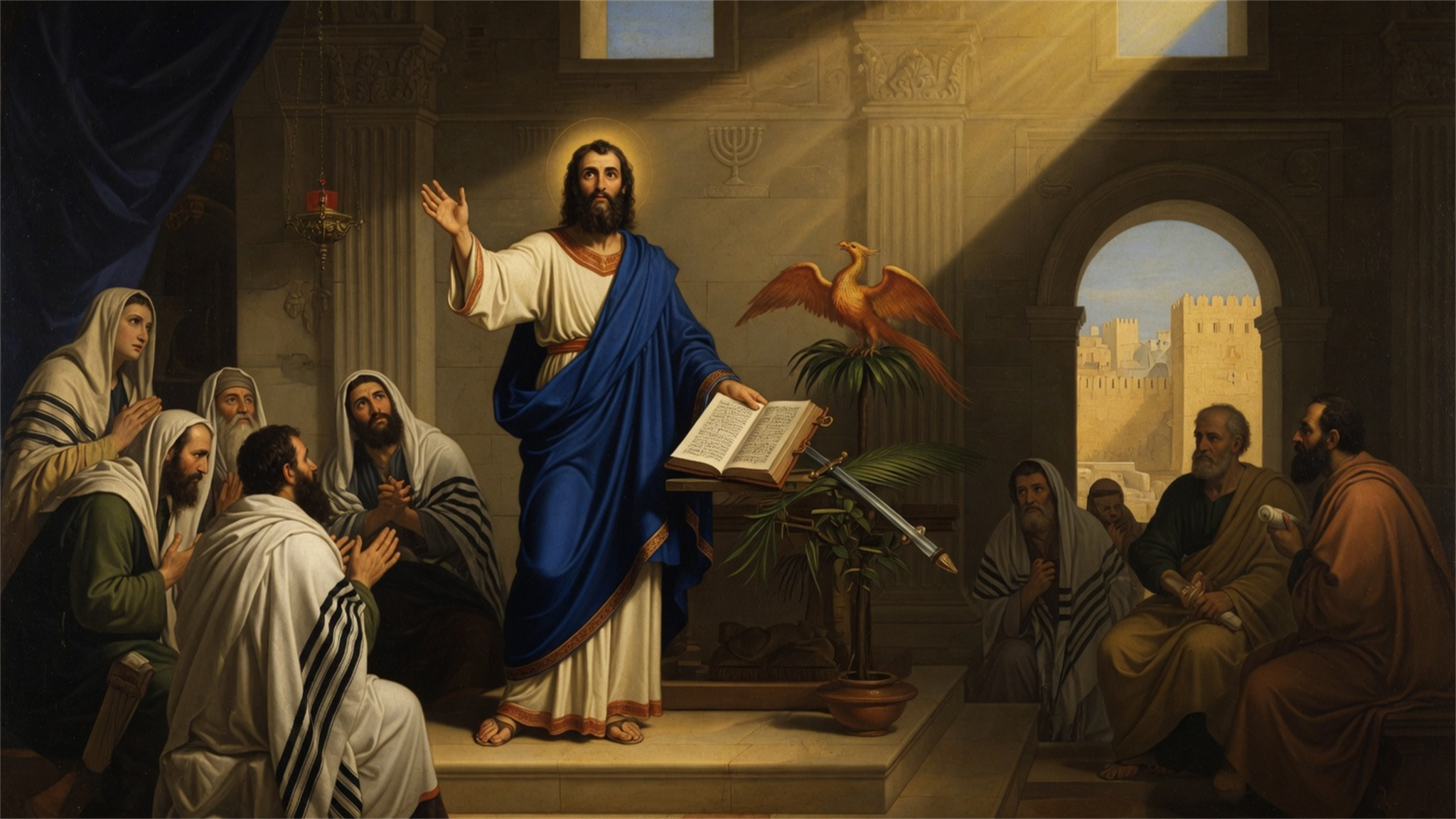
Their rest was disturbed by grave and internal discussions that suddenly arose. The Gentile Christians of Antioch and the Judeo-Christians of Jerusalem, the converted Greeks of Saint Paul and the converted Jews of Saint James were about to be troubled in their mutual relations: the controversy, or rather the error of the Judaizers, timid until then, now cast off its mask and showed itself to be audacious. These converted Pharisees, having come from Judea with their ridiculous attachment to Mosaic formalism, wanted to stifle nascent Christianity in worn-out swaddling clothes, to strangle it in their shackles, and to prevent it from moving and walking in its free ways. Pharisees after as before their conversion, they sowed division in the nascent Christianity of Antioch by maintaining the necessity of circumcision and other observances of the ceremonial law as a preliminary initiation into the Christian Church, while Saint Paul, the converted Pharisee par excellence, subordinating Judaism to the Gospel, sought to deliver the neophytes from this worn-out yoke of the law of Moses. At the origin of the Church, at the passage from pure Judaism to pure Christianity, at the definitive separation of the two cults, this dangerous controversy had to arise, and Paul, whom God had predestined more especially to carry the Gospel to the Gentiles, had to bear the weight of it almost alone. Aided by Barnabas, he vigorously repelled pretensions that tended to nothing less than to chain Christianity to Judaism forever, the Church to the Synagogue. But all the eloquence of the Apostle could not reduce to silence these fierce Judaizers, who repeated their brutal assertion even more loudly, and the faithful of the Church of Antioch ardently desired a solution capable of calming the trouble of their conscience. It was therefore resolved that Paul and Barnabas, accompanied by some of the others, would go up to Jerusalem in order to provoke a decision from the Apostles and the elders or priests of that Church on this fundamental question. A formal decision, coming from such a high source, alone could reassure the timid, give greater weight to the equality before the faith preached by Saint Paul, and reject from the Church the obstinate who would refuse to submit to it. We see the Apostle give a great example of the respect one must have for the judgments of the Church by being the first to submit to this determination.
Paul, Barnabas, Titus, and some other members of the deputation therefore crossed Phoenicia by following the seashore; then, going up through Samaria, they headed toward Jerusalem, where they were received very favorably by the Church, the Apostles, and the priests. Paul, then taking the floor, painted a picture of the success of his first apostolic labors and the subversive pretensions of some converts from the sect of the Pharisees. The Apostles who resided in Jerusalem at that time were Peter, James, and John, regarded as the pillars of the Church. They cle arly p Pierre Apostle and first pope, mentioned as the father of Petronilla. erceived the gravity of the question raised by the Judaizers and resolved to assemble to resolve it after having previously considered it from all sides. It was the first Apostolic Council held by the first pope. After the debates, Peter, head of the Church, rose, developing the proposition that the Jews should not impose upon the Gentiles a yoke that they themselves had not been able to bear. The whole multitude of listeners fell silent, thus approving the forever incontestable dogma of the absolute preeminence of faith over the law of Moses. Peter had decided the principle; Paul and Barnabas showed its happy application by recounting to the assembly all the wonders that God had worked through their ministry among the Gentiles, without them having subjected them to the crude yoke of circumcision and legal observances. Saint James, the natural defender of the Judeo-Christians in his capacity as bishop of Jerusalem and daily witness to their susceptibilities, proposed a transaction that would in no way stop the dogmatic decision, estimating that it was necessary to write to the Gentiles to abstain from the pollutions of idols, from fornication, from strangled meats, and from blood. The decision of Saint Peter and the amendment of Saint James having been generally applauded by the members of the Council, an encyclical letter was drafted that set forth its canons, and two of the principal brothers, Judas and Silas, were chosen to go with Paul and Barnabas to transmit it to the faithful of Antioch. Upon their arrival in that city, their first care was to gather the whole multitude of the brothers, especially those whose conscience had been troubled by the Judaizers, and to deliver the synodal letter to them. Upon learning of this wise decision, they were filled with an inexpressible joy: henceforth they were consoled and strengthened in their faith. Judas returned to Jerusalem; Silas attached himself to Paul and remained in Antioch. Paul and Barnabas also prolonged their stay there: aided by several other preachers, these Apostles taught and announced the word of the Lord without interruption.
However, Saint Peter, warned of the prodigious growth of the Christianity of Antioch and unable to forget this church where he had established his first chair before transferring it to Rome, came to visit it. Seeing it composed mainly of uncircumcised Christians, he judged it appropriate to converse and eat freely with them; but these dispositions changed when ardent zealots of the law arrived from Jerusalem, where the Judeo-Christians still observed the prescriptions of the law of Moses. Peter, specially charged with preaching the Gospel to the Jews, perhaps yielding to the fear of offending them, began to separate himself from the table of the faithful who had come from the Gentiles; he ceased to eat with them. This inopportune conduct led, by the authority of his example, all the faithful who had come from Judaism to separate themselves from them as well, so that Barnabas himself felt his courage weaken and began to withdraw from their way of life. But Paul, more especially charged with preaching the faith to the Gentiles, was moved by the incident, and yielding to a movement of zeal, he publicly rebuked the prince of the Apostles for this distancing, whose influence could lead the Christians who had come from the Gentiles to Judaize. However, this controversy agitated between Saint Peter and Saint Paul, being a simple question of opportunity, of convenience, and not of faith, this disagreement was immediately ended; and the two Apostles remained always closely united, until martyrdom gave them a supreme union in Rome.
The Evangelization of Europe
Paul founds major churches in Philippi, Thessalonica, Athens, and Corinth, confronting Greek philosophy and paganism.
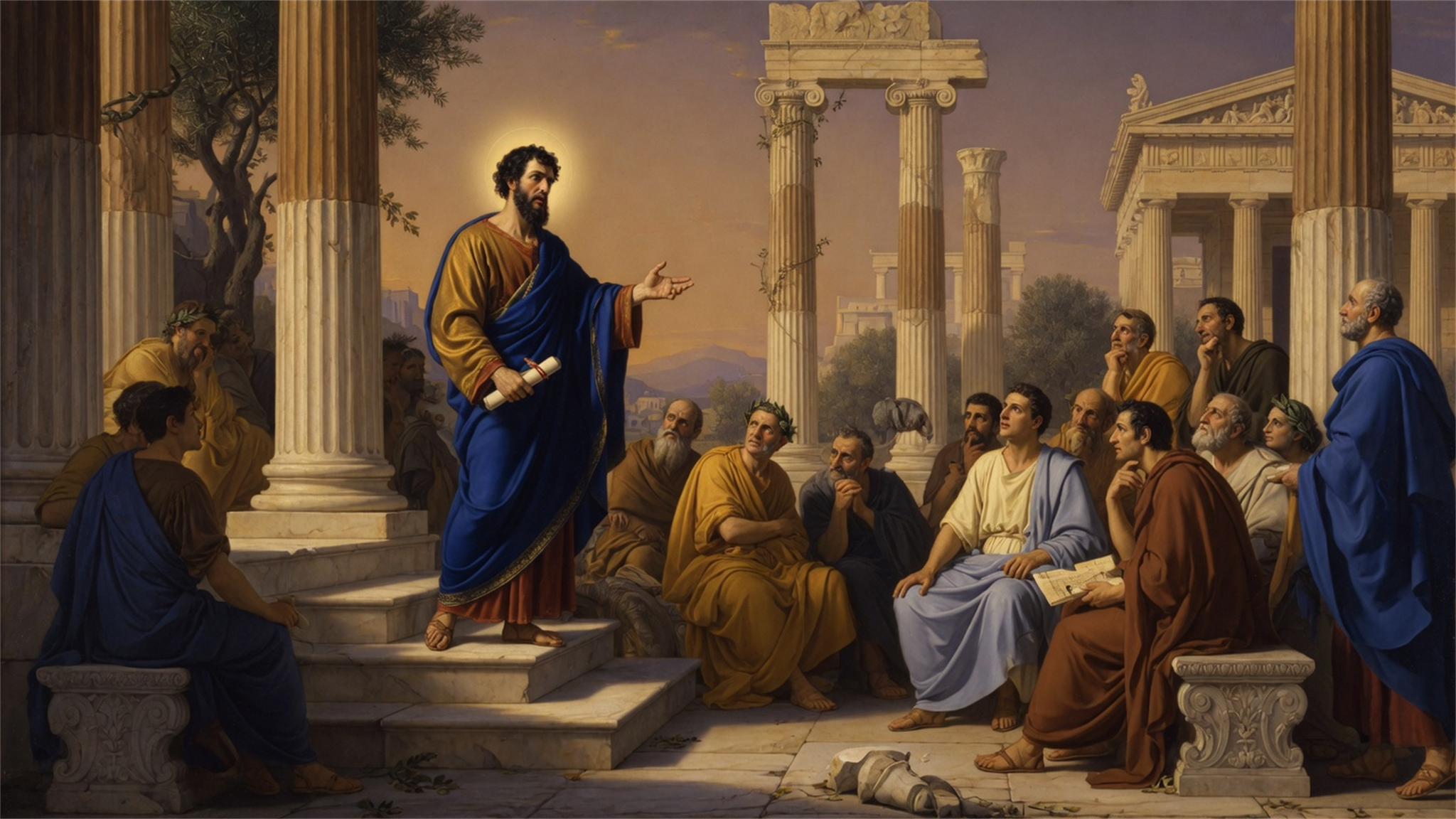
Having taken leave of the head of the Church, Paul hastened to pursue new conquests. Impatient to win the whole world to Jesus Christ, he proposed to Barnabas that they go and visit the cities and countries where they had brought the faith. A faithful cooperator of Paul and an intimate confidant of his designs, Barnabas welcomed this project; but, as he wanted to take with him his relative John Mark, who had abandoned them on their first journey, and as Saint Paul refused, not understanding how one could be inconstant in the work of propagating the faith, they agreed to go their separate ways, which, in the secret designs of Providence, had the advantage of doubling the number of preachings. Barnabas then took John Mark into his company and set sail for the island of Cyprus, his homeland, where he evangelized the parts of the region that had not yet received the faith; while Paul, joining the eloquent Silas to himself, departed with him after having been commended to the grace of God by his brethren. While passing through Cilicia and Syria, he strengthened the churches in the faith and ordered the faithful who had come out of paganism to
keep inviolably the precepts of the Apostles and priests, drawn up at the Council of Jerusalem, without stopping at the reckless speeches of the Judaizers. Continuing his itinerary, he went to Derbe, and from that city he went to Lystra, the end of his first mission. There he met a disciple Timothée Martyr who came from the East to evangelize Reims. named Timothy, son of a Gentile father and a Jewish mother named Eunice. She had taken great care to raise him holily in the study of the divine Scriptures, the exercises of piety, and the fear and love of the Lord. Struck by the maturity of his spirit, the Apostle judged him capable of bearing the word and effecting conversions; he took him with him, laid his hands upon him despite his youth, and, consulting the utility of religion, he spontaneously did what he had refused in another encounter to the Judaizers of Jerusalem, himself giving circumcision to his new disciple so that he could preach in the synagogues without obstacles. Paul now had with him two great evangelical workers: his second mission was about to begin.
This second apostolic journey was to have even more considerable results than the first. From this period, in fact, dates the foundation of the great Churches of Macedonia and Greece properly so-called. Paganism was to be defeated in the capitals of ancient philosophy and civilization: Athens, Corinth, and other renowned cities.
The Apostles therefore crossed Phrygia and Galatia, beginning to preach the Gospel there; but soon, the Holy Spirit, who directed all their movements, forbade them to announce the word of God in Asia. They were preparing to go into Bithynia, from where they could have reached Pergamum, when the same prohibition was given to them. God undoubtedly foresaw that the inhabitants of these regions were disposed to despise his word, and he awaited better times before having it announced to them. Faithful to the divine order, Paul, leaving Bithynia, descended with his cooperators to Troas, a maritime city of Lesser Phrygia and capital of the Troad. There, during the night, he had a vision that made him change his apostolic itinerary entirely. A man from Macedonia appeared before him and made this prayer: "Pass over into Macedonia and help us." Now, certain signs always prevented the Apostle from confusing divine visions received during sleep with visions born of ordinary dreams. Thus, this order was hardly manifested to the evangelical workers when they prepared to leave, so eager were they to go and spread the word in this Macedonia, the first fruits of the Greece of Europe, where numerous Churches were to be founded by their labors.
Meanwhile, Saint Luke, one of the seventy-two disciples, amazed by the apostolic labors of Paul whom he had known in Antioch, his native city, was in search of this great propagator of the Gospel. He met him at Troas and never left him again, becoming from then on the companion of his sufferings and the historian of his life. Paul, Silas, Timothy, and Luke, having therefore embarked at Troas, set sail directly for Samothrace; the next day they landed at Neapolis, but did not stop there, impatient to arrive at Philippi, a Roman colony and the first city of this part of Macedonia. Saint Paul was in the habit of going first to the most populous or central cities to form influential Churches there, whose salutary action would be felt all around. In his capacity as a Roman citizen, he willingly stopped at Philippi, where a considerable number of Roman citizens were found; they were governed according to the laws and customs of Rome. On favorable occasions, the Apostle did not hesitate to use this earthly advantage, which was of such great value at that time when a huge crowd of men were deprived of it, for the success of the Gospel. Now, on the first Sabbath day that followed their arrival, Paul, accompanied by Silas, Timothy, and Luke, left the city and went to the river where the ordinary place of prayer for the Jews was situated. Having sat down, the Apostles spoke of the faith to the women who were already assembled there, waiting for the people to arrive. One of these women, named Lydia, docile to the truth whose sudden illumination chased away the darkness of her soul, believed in Jesus Christ with a perfect faith and was found worthy to be baptized, she and all her family. Then manifesting her faith by an act of charity, she obliged Paul and those of his company to take lodging at her house.
This first success, the first fruits of several others, irritated the enemy of salvation; this instigator of troubles stirred up a very great one, in the hope of putting an end to the progress of the faith: a young girl possessed by the spirit of Python was the instrument he used with the goal of ruining the cause of the Gospel. This girl, having one day met Saint Paul and those who were with him in the streets of the city, began to follow them, crying: "These men are the servants of the Most High God, and they announce to us the way of salvation." She continued in this way for several days. Saint Paul let her speak at first: it was indeed a remarkable thing to hear the truth published by the father of lies. But seeing that the demon continued always and thus arrogated to itself a function that did not belong to it, he commanded it in the name of Jesus Christ to come out of this girl, whose state moved him to compassion, imitating in this his divine Master, who had silenced the demons even when they published that he was the Messiah and the Son of God. Conquered by the power of the name of Jesus Christ, the demon came out of the body of the possessed girl at once; but the masters of this girl, angry at seeing themselves suddenly deprived of the illicit gains that her faculty allowed them to realize, and coloring their avarice with the appearance of zeal for the religion of their country, stirred up the populace and dragged the Apostles before the magistrates who, without wanting to hear them, had them beaten with rods as seditious. Luke and Timothy were not subjected to this flagellation; finding themselves behind Paul and Silas, they were separated from them by the impetuous movement of the crowd. However, the magistrates, not content with having covered the bodies of their victims with numerous wounds, adding injustice to injustice, sent them to prison, with an order to the jailer to keep them closely. The latter executed this order with unheard-of rigor: he put the holy personages in a dark dungeon, a kind of prison within a prison, and tightened their feet in wooden stocks that prevented them from moving and forced them to remain lying on their backs. This luxury of precautions was useless; neither Paul nor Silas had the idea of fleeing. In the midst of the darkness of the night and in the heart of horrible pains, they celebrated, with pious hymns, the signal favor that the Savior had just granted them by making them share his sufferings. Suddenly there was a violent earthquake: the foundations of the prison were shaken, all the doors opened, and the bonds of all the prisoners were broken. The jailer, having awakened, found the prison doors open, and imagining that all those who were under his guard and for whom he answered with his life had escaped, he took his sword in despair to kill himself; but Paul, warned by the Spirit of God, cried out to him with force: "Do yourself no harm, for we are all here." Touched by this prodigy, the jailer, having asked for light, entered and threw himself, all trembling, at the feet of Saint Paul and Silas; then, pulling them in haste from this low pit where he had
SAINT PAUL, APOSTLE OF THE GENTILES AND MARTYR. thrown them, he asked them what he must do to be saved. Saint Paul, who knew so well the cries that came from the bottom of the heart, answered him with Silas: "Believe in the Lord Jesus, and you will be saved, you and your family." They began to instruct him, him and all those who were in his house, and they received baptism. The day having come, the magistrates sent word to the jailer to let the two prisoners of the day before go; but Paul, who had endured the mistreatment without complaining, refused to leave, saying that it was very strange that they had imprisoned Roman citizens without giving them a trial and that they still pretended to send them away secretly from prison without making any kind of reparation to them. He acted in this way to intimidate the judges and make them gentler toward the Christians in the future. The magistrates, who had failed doubly against the laws by refusing to hear and by having a Roman citizen beaten with rods, came in person to the prison and begged the Apostles to leave it, and, when they were outside, they conjured them to withdraw from their city, fearing that this affair would make noise and be troublesome for them. Saint Paul did not insist on staying there any longer; he only returned to the house of Lydia, the woman he had converted, to take leave of her and the faithful he had won to the Lord: he found Luke and Timothy there. All these neophytes having been consoled and strengthened in their faith, the holy missionaries departed, happy to leave a flourishing Christianity in this city. One sees, by the epistle that Saint Paul wrote later to the Philippians, that this Church maintained itself and always bore a lively affection for its founder.
The intrepid travelers, then directing their apostolic itinerary toward the south, penetrated further into Macedonia, and crossing Amphipolis and Apollonia, they came to Thessalonica where they boldly announced the Gospel, developing the dogma of the necessity of the sufferings of Jesus Christ, of his death, and of his resurrection from the dead. Several believed in this powerful word and joined the Apostle and Silas after their conversion. These nascent successes were of a nature to revive the tenacious hatred of Paul's enemies. They excited a great tumult in the city, and, furious, rushed upon the house of Jason, a converted Jew who had given hospitality to Paul and Silas; but they did not find their victims there. The brothers who had saved the Apostles from a violent death led them out of the city, on the road to Beroea, where the two Apostles directed their steps. The zeal for the salvation of souls that devoured them, similar to the flame which, the more it is pushed by the wind, the more it grows and sets fire to everything it encounters, pushed them into the synagogue where Paul spoke with energy about the Messiah, whose every character he showed in Jesus Christ. The Jews of Beroea, of a gentler nature than those of Thessalonica, showed a great love for the truth: Sosipater, son of Pyrrhus and a relative of Saint Paul who speaks of him in his epistle to the Romans, was among those who converted. The rioters of Thessalonica ran to Beroea to continue their violence there: but these madmen were ignorant that the Gospel cannot be suppressed by a riot. The brothers hastened to get the Apostle out, while Silas and Timothy remained in the city, and by their presence prevented the cause of Jesus Christ from perishing there. Paul arrived without hindrance, by land, as far as Athens: there he sent back those who had accompanied him, asking them to tell his two auxiliaries in the preaching of the Gospel to come and join him as soon as possible, for Athens offered a harvest that was great and difficult to gather; it required great workers.
Athens, the capital of Attica, was situated at a short distance from the sea, in a sterile territory. Cecrops, its founder, brought it the cult of Minerva. At the moment when the Apostle appeared there, it had fallen far from its ancient splendor, and had hardly kept anything but its monuments and its beautiful language, its philosophers, its sophists, its love of novelties, its loquacity, and its mocking spirit. While waiting for the arrival of Silas and Timothy, Saint Paul began to travel through this city with the goal of taking stock of the religious spirit of its inhabitants. As a profound and experienced man, he sounded out the terrain. A sad mixture of darkness and light, such was the spectacle that offered itself to his eyes. Certainly there was much to do, but for that, one had to face the mockery of the Athenians: he who had not faltered before the prison and the rods would have taken care not to recoil before the mocking spirit of the people. Faithful therefore to the divine order, Paul began his preaching with the Jews; on the Sabbath days, he went into the synagogues to discourse with them and with the Greeks who feared God; on the other days of the week, he approached the philosophers and the other inhabitants of Athens whom he met at the Forum. Among the philosophers, the Stoics and the Epicureans shared the arena. Could he hope to persuade the Epicureans of the mortification of the senses, and the Stoics, the proudest of men, of submission to the decrees of Providence? Hearing him speak of penance and the resurrection of the dead, some said: "What goal does this sower of words propose to himself?" Others replied: "He is undoubtedly a man who announces new gods." Be that as it may, the discourses of the Apostle sharply pricked the general curiosity, and he was asked to go up to the Areopagus. The Apostle had to lend himself with good enough grace to this invitation; he was not a man to recoil before this tribunal, the most famous of the pagan world. Charged with the great mission of bearing witness to Jesus Christ before all the powers of the century, he let himself be led without resistance to where he could learnedly plead the cause of his master.
Standing in the middle of the Areopagus, the Apostle made this discourse heard: "Men of Athens, I see you in all things superstitious to excess, for, passing by and seeing your simulacra, I found an altar bearing this inscription: To the Unknown God. Now, what you adore without knowing it, I announce to you. The God who made the world and everything that is in the world, being the Lord of heaven and earth, does not dwell in temples made by human hands: he is not honored by human hands, as if he had need of something, since he himself gives to all life, breath, and all things. He has made from one all the race of men to dwell on the whole face of the earth, determining the time of their duration and the limits of their habitation to seek God and find him as if by groping, although he is not far from each of us; for in him we live, we move, and we are, and, as some of your poets have said: 'We are of his race.' Being therefore of the race of God, we must not estimate that the divine Being is similar to gold, or to silver, or to stone sculpted by the art and thought of man. Now, God, turning his eyes from the times of this ignorance, now announces to men that all everywhere should do penance, because he has decreed a day when he must judge the world by Him whom he has established for this end, and whom he has resurrected from the dead to manifest him to all."
One would not grasp the goal of this discourse if one sought in it a simple exposition of the Christian faith; the Apostle had another idea; he proposed to refute above all the ancient errors of the philosophers and the superstitious opinions of the Athenians on the nature of God; he wanted to undermine at the base the subversive doctrines of Zeno and Epicurus, to crush the unbridled pride of the one and annihilate the abject materialism of the other, to implant in a virgin land the humility and spirituality of the cross.
The listeners gathered in the Areopagus remained struck by the gravity and elevation of this apostolic word, so different from that of the sophists and philosophers with whom the frivolous public of Athens amused itself; but as soon as Saint Paul had approached the dogma of the resurrection of the dead, a dogma incredible in the eyes of the pagans, they turned the innovator into derision and let the moment of the truth of God pass. A few, but in small number, insensitive to the Athenian mockery, joined the Apostle and believed with a firm and unshakable faith. Among these converts, Saint Luke cites Dionysius the Areopagite and a woman named Damaris, perhaps his wife.
Having left the Areopagus, Paul met Timothy and Silas who were arriving from Beroea; he would have liked to keep them near him, but, impatient to console the Thessalonians and to confirm them in the faith, he charged the holy travelers with this mission, and remained alone in Athens with Saint Luke. This stay was about three months. Meanwhile, the faithful cooperators of the Apostle were accomplishing their holy ministry: they then returned to the city where they had left their master, in the hope of finding him there; but pushed by the Spirit, he had gone to other lands to sow the word of life.
He had left for Corinth, passing through Eleusis, the city of mysteries and initiations. At Eleusis, the temple of Ceres was the monument consecrated to agriculture, and recalled the memory of Triptolemus who, first, taught men the art of cultivating the earth. By importing barley and wheat from Asia Minor to Greece, he had at the same time introduced certain religious doctrines whose most mysterious parts were to be revealed only to the initiated. Paul, according to the beautiful expression of a Father of the Church, was a new Triptolemus; he became, in this region of ancient Greece, the great initiator into the mysteries of Christianity. The Apostle finally arrived in Corinth: it was a city of luxury and pleasure, like Athens, and like it also a city of rhetoricians. As everywhere, Paul addressed himself first to the Jews. He had met, very opportunely, a hospitable house where he could meditate in solitude and alone with God on the divine teachings with which he astonished the pagan world: it was that of Aquila and his wife Priscilla, two Jews of the dispersion, whose trade, like that of Saint Paul, was the manufacture of tents. As long as the illustrious stranger remained in their house, he worked with them, earning his living by the work of his hands, rather than using the right that the Apostles had to live from the Gospel, so much did he fear that the merchants of this city, so skilled in business, daring to judge him according to their ideas, could imagine, if he had acted otherwise, that the preaching was a speculation for him. He therefore gave the day to the word and the night to the work of his hands. Each Sabbath day he went to the synagogue where he announced Jesus Christ to the Jews and the proselytes. Unable to refute the arguments of the Apostle and jealous of the progress that Christianity did not take long to make among the Gentiles, the Israelites resorted to other weapons; they burst into insults against the preacher and into blasphemies against the new religion. Indignant, Paul stood up in the middle of the assembly, shook his garments, and said in a loud voice: "May your blood fall back on your heads, from this day I am pure and I pass to the Gentiles." Immediately he left the synagogue and, leaving the house of his devoted hosts Aquila and Priscilla for the cause of the Gospel, he chose the house of Titus, surnamed the Just, as a place of meeting. His mission, however, was not without producing fruits among the sons of the promise. A leader of the synagogue, named Crispus, converted with all his family, as well as several of his coreligionists. Paul baptized Crispus with his own hand and had the others baptized by his disciples.
Meanwhile, the Christianity of Corinth was becoming more flourishing from day to day. The envy of the Jews knew no bounds; they denounced Paul to the proconsul of Achaia, accusing him of teaching men a new way of adoring God. The proconsul was then Gallio, son of the philosopher Seneca; he affected the greatest indifference for religious questions. The accused opened his mouth to defend himself, when the proconsul, interpellating the accusers, made this declaration to them: "If it were a question of a crime or an injustice, I would hear you, but for questions of words and your law, I do not want to establish myself as judge: that concerns you." And he dismissed them. Exasperated, they fell upon Sosthenes, prince of the synagogue, and beat him; Gallio did not seem to take the slightest concern about it. Sosthenes was a Christian; Saint Paul speaks of him in his first epistle to the Corinthians.
In the midst of the present success, the Apostle considered with an attentive eye the state of the various Churches founded by his zeal. That of Thessalonica was in a prosperous state and could be cited as a model to the Christians of Macedonia and Achaia. The report of Timothy and Silas on the constancy in the faith, manifested by the Christians of Thessalonica in the midst of the persecutions of which they were the object on the part of the Jews and the pagans, so rejoiced the heart of Saint Paul that he hastened to express all his joy to them. These happy faithful thus had the first fruits of the apostolic correspondence.
Some felt too lively a pain at the death of their loved ones; others had false ideas about the resurrection, about the advent of Jesus Christ, and about the last judgment. The Apostle, in the first epistle, praises them for their firmness in the faith, and expresses the most lively affection for them. He exhorts them not to be saddened beyond measure by the death of their parents, and not to imitate in this the pagans who have no hope. The death of Christians is only a sleep. Jesus Christ, our head, is resurrected: those who will have fallen asleep in Christ will resurrect like him, to remain together eternally in the Lord. Several faithful manifested an extreme fear, caused by a false interpretation of some passages of this epistle. One can even suppose that an apocryphal letter, under the name of the great doctor, had been put into circulation by the enemies of the Christian faith, in order to trouble consciences. Paul wrote the second epistle to the Thessalonians a short time after the first. He had not said that the last day was near; but that the advent of Jesus Christ would be sudden, and that it could not be foreseen in advance. To tranquilize them, he makes known to them what certain signs must precede the second advent of Christ. He exhorts them not to let themselves be surprised by false doctors. Let them remain faithful to the teachings
that he has given them by word of mouth, and to the traditions that they have learned. The Apostle does not explain himself here at greater length; which is why there are in this epistle expressions veiled in half-obscurity, but which those to whom he was addressing himself understood without difficulty. Before closing his letter, he reproves with a holy vigor those who let themselves go to an anxious curiosity, or who abandoned themselves to idleness. Finally, after having affixed his signature with his own hand, he engages them to notice it, so as not to be exposed in the future to letting themselves be surprised by a forger.
The Ministry in Ephesus
For two years, Paul teaches in Ephesus, performing numerous miracles and provoking a riot among the silversmiths devoted to the goddess Diana.
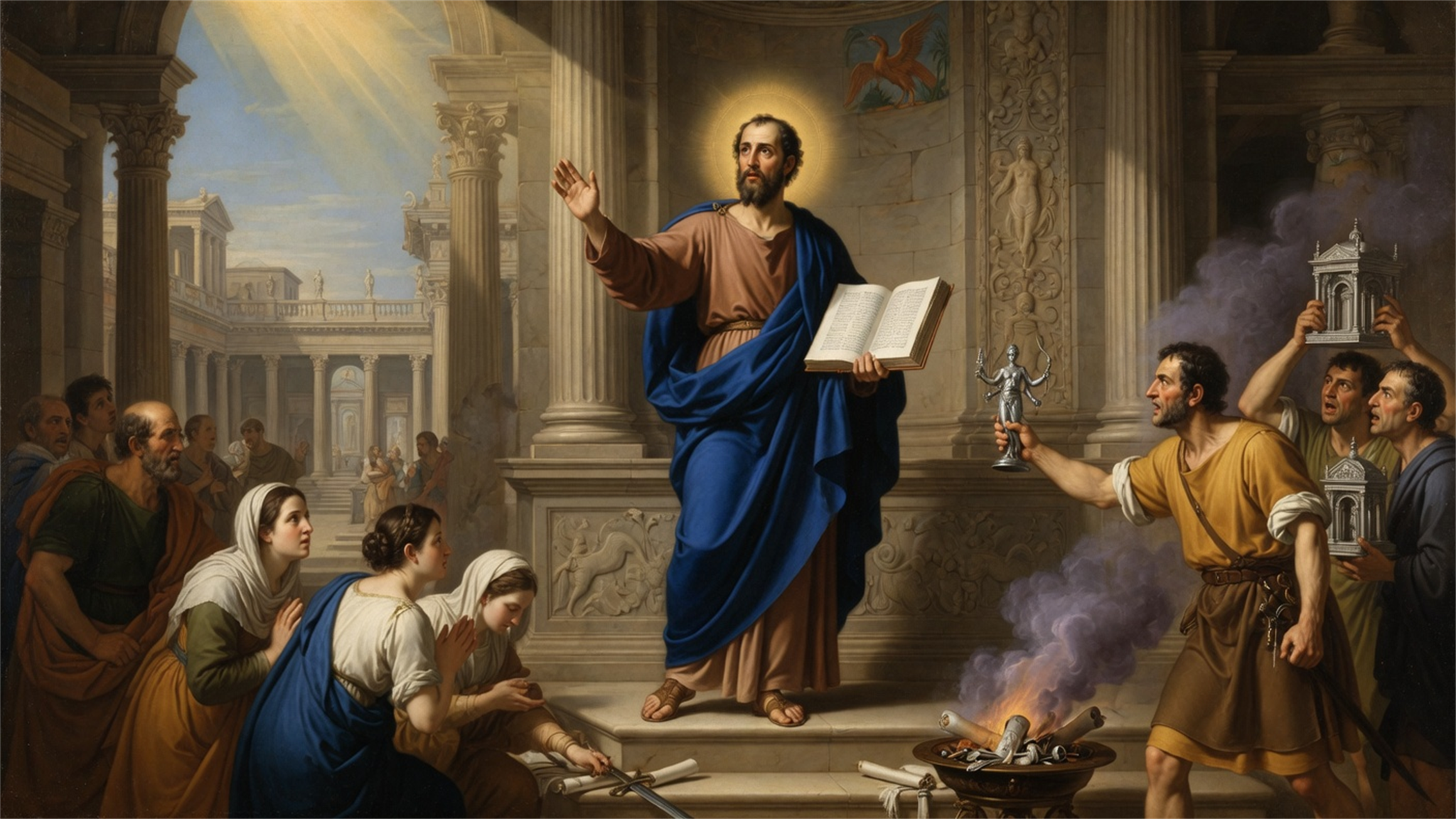
Corinth had the good fortune to possess for eighteen months the great sower of Churches: this was a considerable time in the life of an Apostle charged with carrying the faith to the ends of the world, from the East to the West. However, he was eager to go to Jerusalem: his thoughts were always turned toward that mysterious city, the theater of his stormy life during his conversion, a city of terrible memories, where Christianity had been born. After saying goodbye to his brothers, he went, in the company of Aquila, Priscilla, and his traveling companions, to Cenchreae, the eastern port of Corinth. There he had his hair cut because of a vow he had made: similar to that of the Nazirite, it consisted of abstaining from wine, from any intoxicating liquor, and even from dried grapes, and not cutting one's hair for the duration of the vow; it was usually for an entire month. This ceremony being accomplished, the Apostle embarked at the port of Cenchreae with Aquila and Priscilla and set sail with them for Syria. The voyage was stormy. After crossing the entire Aegean Sea, he reached Ephesus, the metropolis of Asia Minor: it was a commercial, rich, and very busy city. Saint Paul understood the importance of a Church founded in this metropolis; the places where there was more activity, external life, business, and science, the most brilliant theaters of the world in that century, attracted him by preference. He stopped for a few days in this city; he only wanted to set foot there, to mark it with his imprint as a land of his own, before making a longer stay there. Scarcely off the ship, still broken by the fatigues of the voyage, he ran to the synagogue where he conferred with the Jews of Ephesus. His word, new to them, charmed them; they begged him to stay longer with them. He would have willingly acceded to their prayer if he had not been in a hurry to reach Jerusalem; but he promised them to return to Ephesus, if such was the will of God.
After having cast this first seed into their hearts, the Apostle said goodbye to them, leaving among them Aquila and Priscilla with the mission of fertilizing the nascent Church. The vessel he boarded with his other co-workers sailed toward Caesarea of Palestine, known previously by the name of Strato's Tower. He landed there happily. After greeting the faithful of that city, he went up to Jerusalem to celebrate the upcoming feast, that of Passover, according to some, that of Pentecost, according to others. There, as elsewhere, his stay was not of long duration; after greeting the Church, he went down to Antioch of Syria, where he spent some time, strengthening the Christians in the faith by his powerful word. Upon leaving Antioch, he traveled in order, and from city to city, through Galatia and Phrygia; as the founder of the various Churches of these regions, he returned there as an apostolic visitor.
In the meantime, a man by the name of Apollos, a Jew by nation and born in Alexandria, arrived in Ephesus; powerful in the Scriptures, this man was very eloquent. He was instructed in the way of the Lord, he spoke with zeal and fervor of spirit; he explained and taught with care what concerned Jesus, although he knew only the baptism of John. Aquila and Priscilla, who were fulfilling the apostolic ministry in Ephesus in the absence of Saint Paul, were as struck by the eloquence of Apollos as by the imperfection of his knowledge; they took him into their home and taught him, in their familiar commerce, the way of God, that is to say, the entire doctrine of Jesus Christ. The student promptly became a great master in the science of the faith; with his genius, his good will, and the lights of the Spirit of God, his successes were rapid. As soon as his word was less necessary in Ephesus, he resolved to go to Achaia and exercise his apostolate there. This plan received the approval of the brothers; they even strongly exhorted him to leave. His arrival in Corinth was preceded by letters in which he was highly recommended to the Church of that city. Since the departure of Saint Paul, it was to be feared that the movement of affairs might weaken the faith among these Christians exposed, in that city, to all sorts of seductions. The eloquence of Apollos prevented this misfortune; he instructed the ignorant, he fortified the spirits that were wavering, he triumphed over the contradiction of the enemies of the Gospel. The celebrity of his eloquence and his erudition, supported by a vehement zeal, gave this new apostle such authority in the Church of Corinth that, in the eyes of a certain number of the faithful, he eclipsed the great Apostle himself. The Church of Corinth divided into two camps; one of the two took the name of this orator, in opposition to Saint Paul; later another party formed and took the name of Cephas. The Apostle was saddened by this rivalry of names, the ordinary sources of deplorable schisms. It is not that he envied Apollos, much less the success of his eloquence, for he speaks of him with praise and willingly recognizes in this orator a worthy co-worker in his labors and a true propagator of the Gospel.
However, Saint Paul, according to the promise he had made to the Ephesians, had gone to their city. Metropolis of proconsular Asia, one of the most illustrious of Greek Asia, this capital of Ionia was situated at the mouth of the Cayster, about a league from the sea. Its inhabitants devoted themselves to the pursuit of delights; they were accused of surpassing all Greek cities in their luxury and the excessive care of their bodies; they carried to excess the magnificence of the clothing and ornaments intended to embellish them. One understands what great difficulties the Apostle must have encountered there when he established himself with the design of preaching the Gospel and inspiring a new spirit in it. He first met disciples to the number of twelve, initiated only into the baptism of John. The question he asked them: "Have you received the Holy Spirit?" and their answer: "We have not even heard that there is a Holy Spirit," shows us they were barely imbued with the weakest elements of the faith. Astonished by this ignorance, Saint Paul, continuing to question them, said to them: "What baptism then have you received?" They answered him: "We were baptized with the baptism of John." The Apostle hastened to complete their knowledge of Christianity, which was barely sketched out, by teaching them the difference that separated the baptism of John from that of Jesus Christ. After this preliminary instruction, he baptized them in the name of our Savior and laid his hands on them: then the Holy Spirit descended upon them and enriched them with his gifts, for they spoke in various tongues and prophesied.
Skilled at seizing opportunities favorable to the advancement of the Gospel, the Apostle, supported by this signal miracle, began to speak with more confidence to the Jews and Gentiles of Ephesus. Full of a noble assurance, he entered the synagogue, where he cast to the children of Israel a free and bold word, capable of convincing them of the truths relative to the kingdom of God.
For three months he continued to confer with them, never tiring, so unshakable was his confidence in the cause he was supporting. Alas! The seed of the word fell on their hearts as if on stone. The prophetic exhortations of the Apostle found them at first as insensitive as dried-up trunks; then, irritated by his constancy in preaching to them, furious at his successes, they endeavored to stop them with the weapon of slander; then, by an artful contrast, they opposed him with the brilliant painting of their temporal Messiah and his alleged earthly kingdom. Perceiving that this struggle exposed his neophytes to shipwreck in the faith, the Apostle put an end to it by separating them from these obstinate people. He hastened to move his chair from the synagogue to the school of Tyrannus. This Tyrannus could well have been a Greek philosopher converted by Saint Paul to Jesus Christ, who held a literary school. His premises having appeared convertible to the design of the Apostle, he placed them at his disposal. Henceforth sheltered from violent and disorderly opposition, the great doctor of the Gentiles could expose with calm and in all safety the way of God to all those who gathered around his chair to hear him. For two years, the Apostle taught there every day, without interruption, the doctrine of salvation. All the inhabitants of Asia, Jews, Greeks, foreigners, thus had the faculty of hearing his word. It was supported by the operation of miracles so numerous and so extraordinary that the cloths that had touched the body of the Apostle, by their application to the sick, effected the healing of their infirmities. The simple touch of these objects had the virtue of driving out evil spirits from the bodies of the possessed. These miraculous healings were, moreover, more necessary in Ephesus than in other cities: magicians and itinerant exorcists who had flocked from Judea and other regions abounded in this metropolis.
At the sight of the numerous wonders of which they were witnesses every day, these jugglers imagined that the name of Jesus Christ, used by the Apostle, was a simple form of incantation more powerful than their own; they believed, therefore, by stealing it from him, they could produce effects similar to his. These Jews were seven brothers of the priestly order and children of Sceva, whom Saint Luke calls a chief priest. They had the audacity to pronounce over the demoniacs and other possessed people the sacred name of Jesus, in whose divinity they did not believe, saying to them: "We adjure you by the name of Jesus Christ, whom Paul preaches." This criminal attempt had a sad outcome; the impure spirit said to these wicked men: "I know Jesus and I know who Paul is; but you, who are you?" Immediately, the man possessed by a very evil spirit threw himself on two of these exorcists and, having mastered them, treated them so roughly that they were forced to flee naked and wounded. The news of this tragic event having spread instantly in Ephesus, struck with fear the Jews and Greeks who inhabited it. All their illusions about magic dissipated. They glorified the name of the Lord Jesus, many even came and confessed the criminal actions of their lives; others brought their books of magic and burned them before everyone.
According to Baronius and other scholars, Apollonius of Tyana, in Cappadocia, was in Ephesus around the time of Saint Paul and showed himself to be one of his most violent adversaries. A defender of paganism, he endeavored to stop its decline; he could not suffer that the Apostle destroyed the idols of the gods he adored and overturned their altars. Through his practices and his false miracles, he sought to ruin those of Paul. Besides this alleged demigod, the Apostle had to fight philosophers. The capital of Ionia attracted them into its bosom; a theater less famous than Athens, they could nevertheless cast there a brilliance capable of satisfying their pride. To this double obstacle, Saint Paul opposed a double weapon: to his public preaching he joined private teaching, he exhorted each person in particular, his word was often accompanied by tears. Thus, says the sacred historian, the word of God was strengthened and grew with force. The blessing of God, cooperating with the word of the Apostle, brought forth this marvelous success.
Around this time (year 56) Saint Paul wrote his epistle to the Galatians. It is the one in which he displays the most verve. He rises against the Judaizers with a vigor that one does not encounter to the same degree in his other epistles. He reprimands the Galatians for having opened their ears so easily to doctrines foreign to the instructions he himself gave them. "Even if," he says, "an angel descended from heaven were to teach you a doctrine different from the Gospel of Jesus Christ that I have announced to you, let him be anathema!" If he then enters into the details of his conversion, it is to recall that he received his mission directly from Jesus Christ. He insists at length on this point, that the law does not justify, but faith in Jesus Christ. Why then renounce evangelical liberty, to submit to the yoke of the ancient law? "Know," he continues, "that those who have faith are the true sons of Abraham." Before finishing, he exhorts the faithful to practice good toward all, and principally toward those he calls *domesticos fidei*; an expression difficult to render, but of an admirable significance. The true Church is the house of God, where the deposit of faith is kept intact. Believers are of the house of God, they truly belong to the family of the heavenly Father; they are the domestics of the faith, to the exclusion of heretics, strangers to the privileges of the great family, from which they have voluntarily separated themselves by their obstinacy.
After the solidly established foundation of the Church of Ephesus, Saint Paul, at the sight of its flourishing state, found that, by its stability in the faith, its love of the truth, the repudiation of occult sciences and evil practices, it had reached a high perfection. He resolved therefore to leave, to visit Corinth first, to go then to Macedonia, then to return again to Corinth; from this city he wanted to reach Judea, from where, after having delivered to the priests of Jerusalem the collections of money made in Macedonia and Achaia, in favor of the poor Christians of the first of the Churches, he would have left for Rome; then, from the queen of the cities of the world, he would have gone to Spain. Such was his plan. While waiting for God to permit him to realize it, he sent to Macedonia two of his co-workers, Timothy and Erastus. As for him, he remained for a certain time longer in Asia, with the intention of traveling through Lydian Asia, of preaching the Gospel in the cities near Ephesus, of even penetrating into Caria, and of returning then to Ephesus, where he had resolved to stay until Pentecost.
Saint Paul was turning these projects in his mind, when Apollos, who was suffering from the great schism that had arisen in the Church of Corinth on his account, came to Asia with other brothers, bearer of a letter from the Corinthians to Saint Paul: they were consulting him on the subject of the grave question of marriage and celibacy. Such was the occasion he had to write his first epistle to the Corinthians: he sent it to them by Stephanas, Fortunatus, and Achaicus, Christians who had come from Corinth to accompany Apollos. The latter refused to return immediately; he did not want to appear to favor by his presence the faction that was covering itself with his name. The first epistle to the Corinthians was written from Ephesus in the year 56. He always claims Christian liberty in favor of the faithful and resists energetically the attempts of the Judaizers who want to enslave them to Mosaicism. To repair the scandal of the incestuous Christian and to raise this unfortunate man from the sad state into which he had fallen, he excommunicates him by using the most energetic expressions. To such a revolting disorder, a public condemnation and a manifest reprobation were necessary. The Apostle seizes this occasion to treat directly of the duties of marriage. He gives useful advice to Christian spouses. Not content with recommending conjugal chastity, he raises spirits to higher thoughts, and advises the practice of perfect continence and virginity to the chosen souls to whom God inspires the attraction of this angelic virtue. These counsels, dictated by an enlightened zeal, are exposed with a divine prudence. The resurrection of the flesh is a dogma of which the philosophers of Athens had refused to hear talk in the Areopagus. Saint Paul explains it by the comparison of the grain of wheat. Sown in the earth, the grain undergoes a prompt decomposition. It appears to have fallen into rot. But soon it germinates, sprouts, turns green, rises, and produces several ears; it had not therefore died, it was undergoing a transformation. He seizes the occasion of the disorder of the Agapes to remind the faithful of Corinth of the mystery of the Eucharistic table. It would be impossible to express in more precise and energetic terms the real presence of Jesus Christ under the veils of the sacrament. He who communicates unworthily eats and drinks his own condemnation. Before eating the heavenly bread, one must test oneself, that is to say, one must communicate with a great purity of conscience. The Apostle also disapproves that the faithful take their disputes before the tribunal of pagan judges. The Church is an amicable tribunal, venerated by all, proper for arranging all difficulties, for having wrongs repaired, for re-establishing concord, for softening relations that have become painful, for redressing, in a word, all the grievances that too often exist between men. It is not necessary, moreover, to scandalize the infidels by making them witnesses of the discussions that interest or other human infirmities can raise between the disciples of Christ. Finally, in the presence of the magistrate, Christians are exposed to the peril of idolatry, by taking the judicial oath in the name of false divinities.
Nothing henceforth could, it seems, stop the departure of the great missionary; he was making his preparations with full security; he did not have the slightest suspicion of the great trouble that was going to cross the way of the Lord. A popular storm, stirred up by one of the most lucrative industries of Ephesus, almost carried him away in its fury. It was a city very famous for the temple of Diana, which was counted among the seven wonders of the world. Asia had employed two hundred years to build it, and all its provinces had contributed to such a great work. Its length was four hundred and twenty-five feet and its width two hundred and twenty. One saw there one hundred and twenty-seven columns, made by as many kings, of which thirty-seven were chiseled. Their height reached sixty feet, and all the rules of architecture were admirably well observed there. But what gave so much reputation to Ephesus was also the cause of its misfortune, because this temple, by attracting the vows of all the provinces of the world, made it attached to the worship of idols. Pagan Greece carried to the extreme its veneration toward this inanimate Diana; a great influx of worshipers flocked to this temple and did not want to leave Ephesus without carrying home a lasting souvenir of this idol. This superstitious desire gave birth to various lucrative industries: skillful workers made reductions of the idol and the temple on a scale more or less small, and sold a considerable quantity of these silver shrines. The head of the corporation of these silversmiths, at the time when Saint Paul was preaching in Ephesus, was a certain Demetrius; he had a large factory of small silver temples on the model of the great temple of Diana. Very perspicacious about his interests, he perceived with terror the coming ruin of his industry. One was buying many fewer of his shrines, the sale of his products was becoming more difficult from day to day. When all of Asia was flocking to the chair of Saint Paul, what listener, after having heard him, would have had the courage to buy such idols? He therefore gathered his workers, and, in a warm harangue, he studied to irritate this mass against the great preacher. As soon as they had heard the speech of their leader, transported with fury, the workers began to vociferate: "Great is Diana of the Ephesians! Great is Diana of the Ephesians!" An extreme confusion filled the whole city in an instant. The ringleaders went to the theater where the bulk of the people were gathered. In their tumultuous rush, having met Gaius of Derbe, and Aristarchus of Thessalonica, traveling companions of the Apostle and his co-workers, they seized their persons and dragged them with them. As soon as Saint Paul learned of the danger they were running, he wanted to throw himself into the midst of this multitude of people in delirium, in the hope of delivering them or sharing their fate, but his disciples prudently prevented him from facing this storm. Finally, after two hours of such vociferation, this multitude, tired and exhausted by its own cries, finally lent an ear to the city secretary and let its anger fall before his words. The fury of the people was appeased, and Paul and his friends were delivered from their hands.
The Arrest in Jerusalem
Returning to Jerusalem, Paul is arrested at the Temple and appears before the Sanhedrin, then before the governors Felix and Festus.
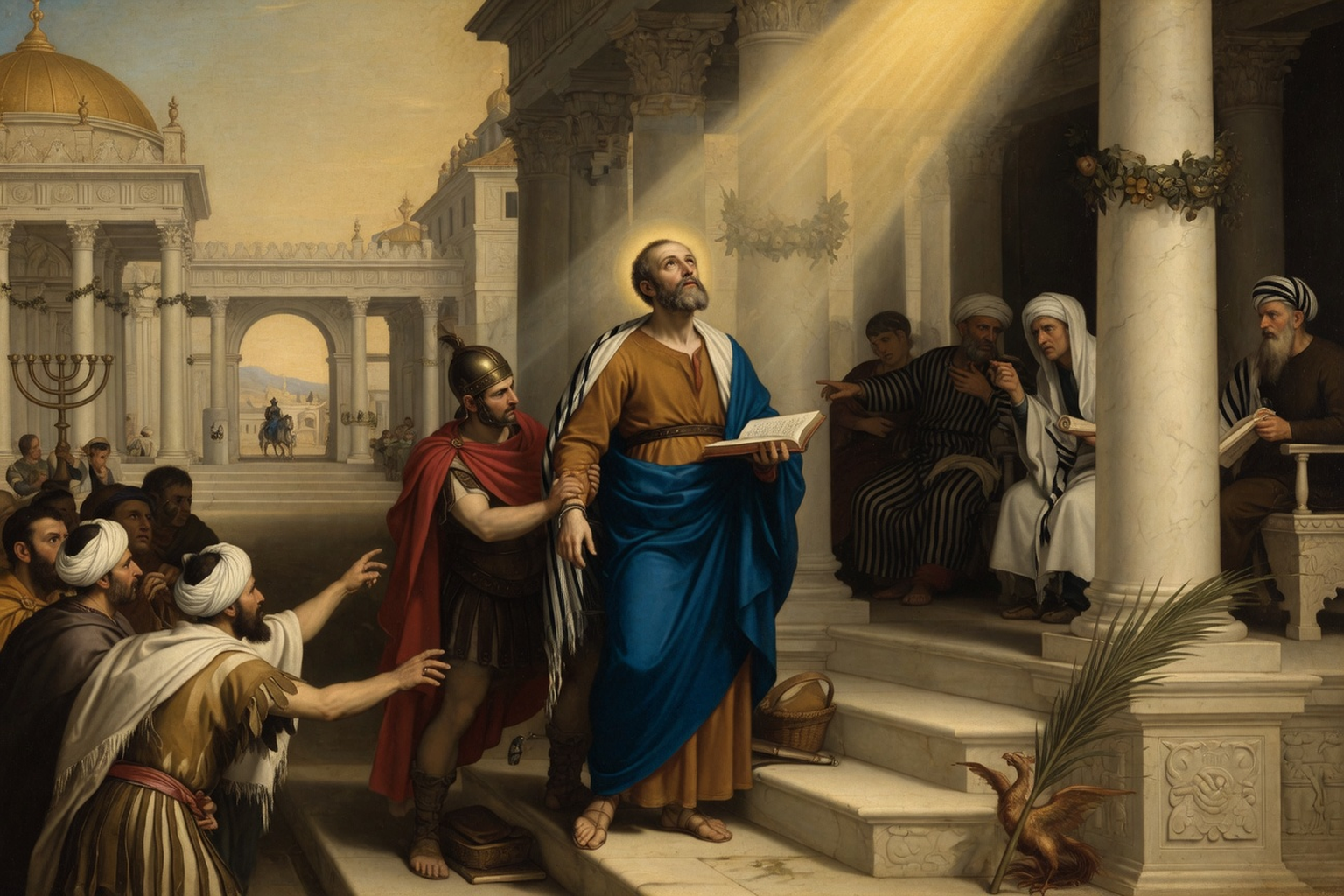
This uprising hastened his departure by a few days: having summoned his disciples, he gave them a pathetic exhortation, embraced them with paternal piety, and set out for Macedonia. Around this same time, Aquila and Priscilla, who had generously risked their lives for the salvation of Saint Paul, upon hearing of the death of Claudius, left Ephesus and returned to Rome. The death of this emperor had annulled the edict that had driven them from the city along with the other Jews. The beginnings of a new reign were favorable to this kind of exile; eyes were closed to their return. These devoted friends of Saint Paul were in Ephesus when he wrote his first Epistle to the Corinthians; their departure must therefore have coincided with that of the Apostle. In the company of Timothy, Saint Paul went down from Ephesus to Troas; his spirit was troubled at not meeting Titus, whom he had hoped to find there; after bidding farewell to the faithful, he boarded a ship that carried him to Macedonia. Scarcely had he landed when he began to travel through the Churches of that province, where he counted so many devoted friends; he sowed the word and supported the disciples with his powerful exhortations. It is at this time that we see him experiencing interior afflictions and terrible fears; outwardly he had to suffer battles and struggles from the infidels, and too often from the still imperfect faithful; and inwardly he experienced fears. God tested him by delivering him to this interior desolation; it was necessary to make him feel that all his strength came from grace and not from his natural qualities. Fortunately, the arrival of Titus consoled him; he rejoiced at the happy news he brought him regarding the state of the Corinthians. The example of their generosity served him to exhort the Macedonians to prepare their collections for Jerusalem; he told them that Achaia had prepared its contribution since the previous year. Touched by this example, the faithful of Macedonia showed themselves generous beyond their means. Shortly after, he sent Titus to Corinth to carry his second Epistle to the Corinthians (year 37), and had him accompanied by Saint Luke; both were charged with preparing the collections of the Corinthians. Saint Paul, of great circumspection regarding things that easily lend themselves to unpleasant discourse, wanted the administration of these sums of money to be above all suspicion. This Epistle is remarkable for a wise mixture of strength and sweetness, of indulgence and firmness.
Using first the power of binding and loosing, he lifts the excommunication brought against the incestuous man who had submitted to penance. He then raises the dignity of the ministers of the New Testament. Indignant that proud and reckless men were spreading slander against the Christian Church and its priesthood, he stigmatizes in an indelible manner these false prophets, Jews by origin, swollen with presumption. He then speaks of patience in tribulations, which befits the pastor of souls. Finally, so that his preaching might not remain sterile through his fault and fall into contempt, Paul does not hesitate to highlight everything that can recommend him in the eyes of the faithful. By his birth, he possesses the same privileges as those of his nation: like them, he is of the race of Abraham. But what he esteems above the privileges of race is that he is the "ambassador of Jesus Christ." In this capacity, he glories in his labors, the fatigues, the persecutions he has endured, the chains he has worn, the scourging he has suffered five times at the hands of the Jews. "Three times," he says, "I was beaten with rods, once I was stoned, three times I was shipwrecked, a day and a night I was tossed at the mercy of the waves; I have been exposed to a thousand dangers from robbers, from the Jews, from the Gentiles, in the cities, in the desert, crossing rivers, sailing on the sea; I have endured labors and privations; I have endured hunger and thirst; I have imposed vigils and fasts upon myself; I have suffered cold and nakedness. Besides these exterior things, shall I speak of my daily worries, and my solicitude for all the Churches?" The Apostle seizes this occasion to make known the ecstasy in which he was caught up to the third heaven, where secrets were revealed to him that it is not permitted for the human tongue to repeat. The glorification of the great Apostle is complete. He adds, before finishing, that if he has spoken thus of himself, it is because he was constrained to do so. One feels that he does violence to his modesty, and that grave reasons were needed to engage him to break his silence. He can well say: "My heart has expanded for you, O Corinthians."
After having traveled through Macedonia as an apostle and a friend, Paul came to Greece, that is to say, to Achaia; faithful to his promise, he went to visit the Corinthians again. According to Saint Augustine, during this third journey to this city, he regulated the most suitable way to offer the holy sacrifice and to receive the Holy Eucharist; he particularly established the law of fasting before communion. His stay in these regions was for three months, visiting the churches of Achaia and those of Athens, using his apostolic authority everywhere in the reformation of reprehensible things, and collecting the alms prepared in advance in these various Churches.
According to the general sentiment of the exegetes, Saint Paul wrote his famous Epistle to the Romans from Corinth; he dictated it to his secretary Tertius under the immediate inspiration of the Holy Spirit and had it carried to Rome by Phoebe, a deaconess of the Church of Cenchreae, the more famous of the two ports of Corinth. The subscription stating that it was written from Corinth would not suffice on its own to designate exactly the place where he dictated it; but the author's recommendation in the Epistle to welcome and treat Phoebe properly, the various greetings in which the Apostle recalls the memory of the persons who accompanied him from Greece to Jerusalem, such as Sopater, son of Pyrrhus of Beroea, Aristarchus and Secundus of Thessalonica, Gaius of Derbe, Timothy and Trophimus of Asia, demonstrate, according to Origen, that it was indeed written from Corinth.
The Epistle of Saint Paul to the Romans contains a very elevated doctrine; thus it has always been considered difficult to explain, at least in certain passages. The Jews settled in Rome, yielding, as in many other cities, to a feeling of jealousy upon seeing the Gentiles participate in the grace of the Gospel with the same ease and abundance as themselves, gloried excessively in the privileges granted to their nation and the graces they owed to the Mosaic law. They looked upon all the peoples of the world as profane, and some, due to an excessive complacency in the glory of their birth and in the promises made to their fathers, claimed that the nations should have no part in the grace of the new covenant as long as they remained strangers to legal observances. The Romans, for their part, stubborn in their vain philosophy, touted the merit of their philosophers who had discovered the principal precepts of morality by the sole force of their genius, without the help of revelation and the law. Abusing the favors with which they had been showered, the Jews had frequently shown themselves rebellious to God. The Gentiles had adored Jesus Christ as soon as they had known him, while the Israelites had rejected and crucified him. Saint Paul humbles the Gentiles by showing that the lights of their philosophers had only served to make them more guilty. If they knew God, they did not adore him as God. They had even fallen into inexcusable errors of conduct and into the most shameful vices. The Apostle does not fear to enumerate them, so public and generally known were the disorders of Rome under the reign of Nero. The children of Abraham, for their part, do they have good reason to glory? No; for works without faith in Jesus Christ, purely legal works, cannot justify. Saint Paul starts from there to expose the mysteries of predestination and reprobation. Terrible mysteries! Here we must cry out with him: "O the depth of the riches of the wisdom and knowledge of God! How incomprehensible are the judgments of God and his ways unsearchable!" In ending his Epistle, the Apostle exhorts the Romans to peace; he prays to God, the author of peace and concord, to dwell with them and to grant them the spirit of union and charity.
When he had finished his apostolic visit and strengthened the Churches of Greece and Macedonia in the faith, the Apostle resolved to go directly from Corinth to Syria; a perverse design of his enemies forced him to change his itinerary. At the moment of setting out, he learned that wicked Jews had laid ambushes for him on the road he was to travel. Their goal was to seize the money collections he was bringing to Jerusalem. He therefore returned through Macedonia, and went directly from that province to Asia properly so called. Sopater, son of Pyrrhus of Beroea, Aristarchus and Secundus of Thessalonica, Gaius of Derbe and Timothy, Tychicus and Trophimus, both of Asia, accompanied him on this journey, and Saint Luke as well, for it is said that the latter two preceded them and waited for them at Troas. "As for us, after the day of Unleavened Bread we embarked at Philippi, and we came in five days to rejoin them at Troas, where we stayed for seven more days."
After this rest of seven days at Troas, a city of little Phrygia, on the first day of the week, that is to say, Sunday, the disciples being assembled with a view to breaking bread, an expression that designates the oblation of the Eucharistic sacrifice and communion, Saint Paul, who was to leave the next day, began a discourse and prolonged it until the middle of the night. The assembly was held in an upper room lit by a large number of lamps: it was entirely under the spell of this word animated by the fire of charity that gushed from his heart. Forgetting in the ardor of his speech that the hours were flying, the Apostle had been speaking for a long time, when a young man by the name of Eutychus, who had sat on a window, let himself be surprised by a deep sleep; his body, which was swaying with a mechanical movement, lost its balance and fell from the third floor into the street: he was picked up dead! The Apostle immediately interrupted his discourse and hurried down from the third floor into the street, threw himself on the body of the young man, and, having embraced him, he felt that life was reviving this corpse: "Do not be troubled," he said to those present, "for he lives." The Apostle renewed in the middle of the street the miracles of Elijah and Elisha, when they recalled to life, one the son of the widow of Zarephath, the other that of the Shunammite. Feeling the need to restore the assembly from its double instantaneous emotion of sadness and lively joy, he "broke the bread." After these holy agapes, he resumed speaking and continued his discourse until the break of day. Insensible to the fatigues of the night, he left this assembly all moved by his word, his great miracle, and the pious exercises of such a long vigil; then, without taking any rest, he went to have his co-workers embark on a vessel that was to carry them to Assos, the place where they were to pick him up, according to the order he had given them. As for him, he preferred to take the land route. The Apostle rejoined his friends at Assos; he boarded the vessel that carried them, and all together set sail toward Mitylene, one of the principal cities of the island of Lesbos. The speed with which Saint Paul and his companions were traveling at this moment left them neither the time to stop on this island nor to visit Mitylene. They arrived the next day opposite Chios, one of the islands of the Archipelago. The little importance of this island and the haste they were in to arrive at Jerusalem did not allow them to land. The next day, they docked at Samos. They went to anchor, to spend the night, at the small port, or rather the promontory of Trogyllium. The day after, they went to Miletus, an opulent and voluptuous city. Saint Paul ardently desired to be in Jerusalem on the day of Pentecost, to celebrate the anniversary of the promulgation of the Gospel. That is why he resolved to pass by Ephesus without landing there. On the other hand, it did not suit him to pass by stealth, without casting into the hearts of the faithful ministers placed by himself at the head of the Churches of this city one of those lively and penetrating exhortations, so capable of reviving their zeal. To this effect, he took advantage of his stay in Miletus, located at a short distance from Ephesus: he had the bishops and priests of this Church assembled near him, and when they were all gathered together, he addressed these touching words to them: "I am going to Jerusalem without knowing what is to happen to me there, except that in every city through which I pass, the Holy Spirit makes it known to me that chains and afflictions are prepared for me. But I fear nothing of all these things, for my life is not more precious to me than my person, provided that I finish my course, and the ministry of the word that I have received from the Lord Jesus, to preach the Gospel of the grace of God." As soon as he had finished this moving exhortation in which his apostolic soul reveals itself entirely, he knelt down and prayed with them with that effusion of charity whose fire burned his heart. This outpouring of his soul in this prayer deeply stirred the hearts of those present; all immediately began to melt into tears, then, throwing themselves on his neck, they embraced him, afflicted by the thought of not seeing him again. All these holy personages accompanied the Apostle to the vessel that was to carry him away.
After having torn himself with great difficulty from the arms of these beloved bishops and priests of the Church of Ephesus, the great doctor of the Gentiles and his friends boarded the building that was waiting for them; pressed to leave, he immediately set sail, moved away from the port, and steered straight toward Cos, a small island of the Aegean Sea, at the entrance of the Ceramic Gulf. The next day, they arrived at Rhodes, an island located not far from the southern coast of Caria. From Rhodes the vessel went to Patara, a maritime city and capital of Lycia, where there was a temple of Apollo, whose oracle was regarded as the most famous in all of Asia. Upon descending from his vessel, Saint Paul could perceive the sad victims of this superstition struck at the heart by the Gospel, and groan over their prodigious blindness. The Apostle and his traveling companions left at Patara the vessel on which they had already sailed, and boarded a ship that was setting sail toward Phoenicia. During their route they perceived the island of Cyprus, which they left to the left, and, continuing to sail toward Syria, they docked at Tyre. Disciples they met in this city detained them for seven days. Enlightened by a superior light, they predicted to Saint Paul the evils he was to experience in Jerusalem, and urged him not to go up there. Their eager solicitations left the Apostle unshakable in his resolution. The seven days having elapsed, he and his friends prepared to leave. All the faithful of Tyre, followed by their wives and children, accompanied them outside the city; having arrived on the seashore, they knelt down and prayed all together, and, after having said goodbye to one another with a holy tenderness, the Apostle and his friends boarded their ship. From Tyre the vessel steered straight to Ptolemais, the end of this navigation of the Apostle. The apostolic travelers gave only one day to the brothers of this city. From Ptolemais they went down the next day by the land route to Caesarea of Palestine, or Strato's Tower. Philip the Evangelist, one of the seven deacons, lived in this city. The holy travelers stayed in his house.
During the Apostle's stay in Caesarea, a prophet named Agabus, famous for his preaching of the famine that raged under the empire of Claudius, arrived from Judea. In the visit he paid to Saint Paul and his friends, he took the Apostle's belt and predicted to him, in a symbolic manner, following the example of the ancient Prophets, the bonds that awaited him in Jerusalem. Having bound his feet and hands with this belt, he said: "Here is what the Holy Spirit says: The man to whom this belt belongs will be bound in this way by the Jews in Jerusalem and they will deliver him into the hands of the Gentiles."
As soon as the Apostle's friends and the faithful gathered around him had heard this prophecy, they begged him insistently not to go up to Jerusalem. All these instances made by sincere friends were powerless to shake his resolution. Future martyr of the faith, he could not help, in the expectation of this glorious crown, but to respond with tenderness to their touching prayers: "What are you doing weeping thus and softening my heart?" But far from weakening, resuming all his natural intrepidity, he added: "I declare to you that I am all ready to suffer in Jerusalem not only bonds and prison, but death itself for the name of the Lord Jesus." At these firm and truly apostolic words, those present understood that they could not persuade him; they said to him: "May the will of the Lord be done." After a few days of rest, everything being prepared for the departure, the apostolic travelers took the road to Jerusalem: they were followed by several disciples from the city of Caesarea, among whom there was one, already old, named Mnason, a native of the island of Cyprus, in whose house they were to lodge. Possessor of a house in Jerusalem, he could offer hospitality to the Apostle and his friends in these days when the immense multitude of pilgrims made the suitable choice of a lodging very difficult.
This fifth journey of Saint Paul to Jerusalem, undertaken by a divine impulse, was one of the most dramatic of his life, which was entirely a true apostolic drama. Upon his arrival in the holy city, he and his worthy co-workers were welcomed with joy by the brothers. The day after his arrival, the Apostle and his friends went to visit Saint James the Less, cousin of Jesus Christ and first bishop of Jerusalem. Warned of the arrival and visit of Saint Paul, Saint James, in the desire to receive him with more honor, had gathered the priests of Jerusalem near his person. The Apostle, after having embraced them all, according to custom, handed over to Saint James the amount of the numerous alms he had collected in the heart of the Churches of Achaia, Macedonia, and other regions. Placed in the heart of Judaism, the priests of the Church of Jerusalem underwent the influence of the environment in which they lived. Obliged to compromise with the Jews converted to the faith, but little disposed to detach themselves from all the rites prescribed by the law, they observed the legal prescriptions themselves with these faithful. In this state of false conscience, they wanted the approval of Saint Paul; they therefore said to him: "You see, brother, how many myriads of Jews have believed; but all, despite their faith, are zealous for the law. And, as they are the principal part of the Christian Church, the elders in the faith, prudence as much as charity command that one have indulgence for them by respecting their ideas. Now, they have heard it said that you teach all the Jews who live among the Gentiles to renounce Moses, by saying not to submit their children to circumcision and not to live according to their ancient customs. There are precisely among us four men who have bound themselves by a vow; take them with you; sanctify yourself with them; provide them with the price of the ceremony, so that they may shave their heads, and that all may learn by that that all the things they had heard said about you were false, since you continue to observe the law. As for those among the Gentiles who have believed, we have written to them that we had judged that they should abstain from meats sacrificed to idols, from blood, from strangled meats, and from fornication." Saint Paul believed he should accept this compromise. The Apostle, having therefore vowed himself to God as a temporary Nazirite, took these four men, and having purified himself with them, he went to the temple the following day in their company. In accordance with the law, they made known the days when their purification would be accomplished, and the moment when the offering would be presented for each of them. The Apostle, whose maxim was to make himself all things to all men, with a view to winning them all to Jesus Christ, believed, at a time when the legal ceremonies were not yet deadly or buried in oblivion, that he should use condescension with regard to the prejudices so tenacious of the Judeo-Christians of Jerusalem, so worthy of respect. The ceremonies of the temporary Nazirite vow prescribed by the law were touching their end without having experienced the slightest obstacle. One could already regard peace as assured, when an unforeseen storm suddenly broke, with such violence, upon the Apostle, that he was on the point of being broken. Toward the end of the seventh day of his vow, these Asian Jews having perceived him in the temple, seized him and stirred up all the people by crying: "Men of Israel, help! here is this man who dogmatizes everywhere against the people, against the law, and against this holy place; he has furthermore brought Gentiles into the temple, he has profaned this holy place." All the city was strongly moved. Those who had seized Saint Paul dragged him out of the temple, not wanting to immolate him within its enclosure; immediately the doors were closed; in the paroxysm of their anger, they were preparing to kill him, when someone fortunately came to warn the tribune of the cohort in charge of the guard of the temple that all the city of Jerusalem was in an inexpressible trouble and confusion. Immediately he took soldiers and centurions with him, and ran toward those who were holding the Apostle and beating him. At the sight of the tribune and the soldiers, they ceased beating him, less by moderation and by a feeling of justice than by the fear of severe reprisals on the part of the Romans, dominators of Judea. The tribune Claudius Lysias seized the Apostle vigorously: he chained him first, then, after having loaded him with bonds, he inquired about his person and his alleged crime. Then he commanded his soldiers to lead the Apostle to the camp, which was located in the Antonia fortress. This fortress, backed against the temple on the north side, served as lodging for the Roman garrison. At the moment of entering the fortress, Paul said to the tribune: "Permit me, I pray you, to speak to the people." Having obtained this permission from the chief of the militia, Saint Paul, standing on the steps of the portico of the citadel, made a sign with his hand to the people. As long as the Apostle exposed to them the first institution of his life, the miraculous circumstances of his conversion, and his vocation to the apostolate, they listened patiently to his discourse. If his words shocked them a little, they had, at least for them, the charm of novelty. But when he told them that Jesus Christ had charged him to go and preach the Gospel to the Gentiles, incapable of containing themselves any longer, they lost patience, and with a unanimous voice they cried out with force: "Take this man from the world, it would be a crime to let him live." They did not cease to vociferate, to throw their clothes, and to make the dust fly in the air; the tribune had him led into the fortress. Not being able to discover the cause of these vociferations, he imagined having the Apostle questioned and beaten with rods, in order to draw from his mouth, by the violence of the torments, the knowledge of the alleged crime that exasperated them so strongly against him. When Saint Paul had been bound with straps, he said to the centurion charged with presiding over this execution: "Is it permitted for you to whip a Roman citizen, and who has not been condemned?" The centurion, surprised by this word, hastened to go and find the tribune and say to him: "What are you going to do? this man is a Roman citizen." At this unexpected revelation, the tribune, all troubled, ran toward his prisoner and said to him: "Are you a Roman citizen?" — "Yes, I am," replied the Apostle. The tribune replied to him: "It cost me a lot of money to acquire this right of Roman citizen!" — "And I," said Saint Paul, "I am one by my birth." As soon as Saint Paul had manifested his title of Roman citizen, the soldiers charged with flogging him and questioning him withdrew after having unbound him.
However, the princes of the priests and the council having assembled on the order of the tribune, the latter had the chains removed from Saint Paul and presented him before them. As firm as in front of the multitude in fury, when it was asking for his blood, he looked fixedly at the members of the assembly and said to them: "Men brothers! until this hour I have conducted myself in all things before God with the uprightness of a good conscience!" At these words, pronounced with a noble assurance, prelude to a vigorous apology, the high priest Ananias, son of Zebedee, incapable of suffering this freedom of speech in the Apostle, ordered those who were near him to strike him on the face. He replied to the man who had given the order to strike him: "Whitewashed wall, God will strike you himself one day! What, you are sitting here to judge me according to the law, and contrary to the law you command that I be struck!" The members of the Sanhedrin saw in these words an insult, and said to Saint Paul: "You curse the high priest of God!" He replied to them with calm: "Brothers, I was unaware that it was the prince of the priests; for it is written: You shall not curse the prince of your people." Having spoken in this way, a discussion arose between the Pharisees and the Sadducees. The tumult increasing by mutual recriminations, the tribune was afraid that his prisoner might be torn to pieces by these madmen. Wanting to avoid this frightful misfortune, he commanded that soldiers be brought who took him from their hands and led him into the camp. The following night, Jesus Christ appeared to him, and said to him: "Have good courage; for, as he had borne witness to him in Jerusalem, he must also bear witness to him in Rome." Indeed, the day having come, some Jews banded together, by a terrible vow, confirmed with oath and imprecation, to eat or drink nothing before having killed him. Having therefore presented themselves to the princes of the priests, to the members of the senate, they said to them resolutely: "We have made a vow, with great imprecations, to eat nothing until we have killed Paul! you have therefore only to let the tribune know, on behalf of the council, that you pray him to have Paul brought before you tomorrow, with the goal of knowing his affair more particularly, and we will be all ready to kill him before he arrives." This machination so well woven, whose effect seemed assured, reached the knowledge of the son of Saint Paul's sister. This young man, frightened by the peril his uncle was running, ran in all haste to the camp and warned him of this homicidal design against his person. Saint Paul therefore had a centurion called and said to him: "Lead, I pray you, this young man to the tribune, he has something to tell him." The centurion took this young man with him and led him to the tribune; in presenting him to him, he said to him: "Paul, the prisoner, prayed me to bring you this young man who has some advice to give you." Taking the nephew of the Apostle by the hand and pulling him aside, the tribune asked him what he had to communicate to him; the Roman officers were always disposed to collect all information on persons and things. This young man revealed to him secretly the plan of the conspiracy: "The Jews," he said to him, "have resolved together to pray you to have Paul appear tomorrow in their assembly, under the pretext of knowing more exactly the state of his affair; take good care not to consent to their request. More than forty of them have concerted to set ambushes for him; they have made a vow, with great oaths, to eat or drink nothing before having killed him. They are already prepared to do the deed, awaiting your promise." The tribune Claudius Lysias had two centurions called and said to them: "Keep ready from the third hour of the night two hundred soldiers, seventy horsemen, and two hundred archers to go to Caesarea." He also ordered them to prepare horses to mount Paul and lead him safely to the governor Felix; at the same time he wrote to Felix in these terms: "The Jews having seized this man and beginning to kill him, I ran with soldiers and snatched him from their hands, having known that he was a Roman citizen. Desiring to be instructed on the subject of their accusations, I led him into their council; there I found that he was accused only of certain things relative to their law, and in no way of any crime that was worthy of death or prison; and upon the report that I have received of the ambushes that the Jews had set against him to kill him, I have sent him to you. I have a lso c Félix Priest tasked with carrying the relics and the pope's letter. ommanded his accusers to go and support their cause before you." The horsemen having arrived at Caesarea went to deliver the letter of the tribune to the governor and presented the prisoner to him. The governor, after the reading of the letter of Claudius Lysias, inquired from which province the Apostle was; having learned that he was from Cilicia, he said to him: "I will hear you when your accusers have come." He then commanded that he be kept in the praetorium of Herod where the prisons of the palace were located.
The enemies of the Apostle, with their ardent thirst for his blood, put no delay in bringing their accusation before Felix. In accordance with the practice used among the Greeks and Romans, they had taken a hired lawyer named Tertullus. Felix had Saint Paul appear and put him in their presence, so that after having heard the accusation brought against him, he could put himself in a position to repel it. The orator of the Jews expressed himself in these terms: "As it is by you, most excellent Felix, that we enjoy a profound peace, and that several just and salutary things have been established by your wise foresight in the midst of our nation, everywhere and always we love to recognize it, with all sorts of actions of thanks. We have met this man, a true public pest; prince of the seditious sect of the Nazarenes, he puts division and trouble among all the Jews of the universe; he has even attempted to profane the temple. By questioning him yourself to judge him, you will be able to recognize the truth of all the crimes of which we accuse him." All the Jews present certified the truth of the criminal facts reproached to the Apostle by the orator Tertullus. Saint Paul listened with calm to this lying accusation; before repelling it he waited for Felix to give him the permission to refute it. When he had obtained it, he broke one by one, with a formidable logic, all the weapons of his enemies. Master of his impressions, Felix listened, without manifesting them, to the accusation of the Jews, and the victorious defense of the Apostle. Alleging the necessity of a more ample information, he postponed the parties to another time: "When I have informed myself more exactly of this sect, and that the tribune Lysias has come down from Jerusalem, I will judge your affair."
After this peaceful denouement, Felix left Caesarea momentarily; he went to look for his wife Drusilla, who ardently desired to hear Saint Paul speak, so great was the renown of his apostolic eloquence! A few days later, he returned to the seat of his government with this queen who had become the wife of a freedman. Felix, born of servile race, was the freedman of the emperor Claudius, and of his mother Antonia. Saint Paul appeared before Felix and Drusilla, not as an accused, but as an Apostle of the new law. In his first discourse, he had limited himself to repelling the crimes of which his hardened enemies accused him; in the second, he spoke of faith in Jesus Christ, this great object of his apostolic labors. Without any concern for displeasing the governor who was holding him in bonds, he spoke to him with great freedom of justice, chastity, and the future judgment. He spoke with so much force that Felix was all frightened by it. "That is enough for this hour," he said to him, "withdraw; when I have time, I will send for you." After this audience, he had numerous conversations with the Apostle, in the hope that the holy prisoner would buy his deliverance by giving him money. Saint Paul had collected alms in favor of the poor of Jerusalem, but he would have preferred to undergo a perpetual detention rather than to resort personally to this means of deliverance.
Two years having elapsed, Felix was recalled to Rome; he had for successor Porcius Festus. Before his departure, he could have delivered Saint Paul; but with the goal of pleasing the Jews, he left him in bonds. Porcius Festus went up to Jerusalem. Ananias and the first among the Jews, pressed by the ardent thirst for the death of the prisoner, went to find the new governor and asked him for his condemnation. The hatred against the Apostle had increased by all the resistance that Felix had opposed to the accomplishment of their homicidal projects. Festus, too just or too skillful, refused to condemn, upon their obviously iniquitous request, an absent prisoner. "In a few days," he sai Festus Prince converted by Antoninus at Noble-Val. d to them, "I will go to Caesarea where Paul is detained; let the principal among you come there with me, and if this man has committed any crime, they will accuse him of it before my tribunal." The day after his arrival, having sat on his tribunal, he commanded that before any other cause they bring him the prisoner Paul. The Jewish accusers charged the Apostle with several great crimes, of which they could provide no proof. With the strength that the innocent draws from an irreproachable conscience, the latter defended himself victoriously from having acted against the law of the Jews, against the temple, and against Caesar. Festus suspected easily, by the extreme passion with which the Jews pursued the condemnation of the Apostle, that a secret cause, whose nature was hidden from him, was the true motive of this affair. However, he used a detour that could cover his responsibility. He therefore said to his great prisoner: "Do you want to go up to Jerusalem and be judged there before me on the things of which you are accused?" The great Apostle could not accept such a translation; that is why he replied to Festus: "Here I am before the tribunal of Caesar, it is before him that I must be judged; you are not unaware that I have done no wrong to the Jews... I appeal to Caesar!" Festus was obliged to accept this appeal to a tribunal superior to his own; after having conferred about it with his assessors he said to him: "You have appealed to Caesar, you will go to Caesar!"
Porcius Festus, divested by the appeal of the Apostle of the right to judge him, awaited the opportune moment to send him to Rome. During this time, Agrippa the Younger, last king of the Jews, and his sister Bernice, went down to Caesarea with the intention of greeting the new president of Judea there. Festus, whom the affair of Saint Paul had struck, spoke of it to the king, either as an extraordinary subject of conversation, or that he wanted to consult him on this cause so obscure to his eyes. "There is here," he said to Agrippa, "a man whom Felix has left in bonds; the princes of the priests, the elders of the Jews, came during my visit to Jerusalem to ask me to condemn him to death; I refused, by telling them that the Romans did not have the custom of condemning a man before the accused has his accusers present before him, and that one has given him the freedom to justify himself from the crime of which one accuses him. But here he has appealed to Caesar. As, according to this appeal, it is necessary that the cause be reserved to the knowledge of Augustus, I have ordered that one keep him until the day when I can send him to Caesar." After this account, Agrippa said to Festus: "For some time I have wanted to hear this man speak!" — "You will hear him tomorrow," replied Festus to him. The next day, indeed, Agrippa and Bernice came with great pomp, wearing rich royal ornaments, surrounded by a brilliant cortege composed of their court, the tribunes, and the principal inhabitants of the city of Caesarea, and having taken place in the praetorium, Saint Paul was brought to them by the command of Festus. The prisoner of Jesus Christ appeared in the midst of this brilliant assembly without experiencing the slightest trouble of spirit, despite the chains with which he was bound, and his poor clothes that contrasted with the dazzling luxury of the persons present. Agrippa, addressing himself directly to Saint Paul, without taking the advice of Festus, said to him: "You are permitted to speak for your defense." As calm, as firm before this imposing assembly as in front of the multitude in fury, the Apostle extended his hand. After an exordium where he appeals to the science of Agrippa, which allowed him to give his apology a necessary scientific development, he recounts his life as a Pharisee in Jerusalem, since his young years, a life known to all the Jews. He recounts then the terrible relentlessness with which, pushed by his Pharisaic zeal, he had first persecuted the Christians in the design of erasing from this world the name of Jesus of Nazareth, and finally the miracle of his conversion; he terminates thus: "King Agrippa, I did not resist this heavenly vision; first of all, I announced to those of Damascus, then to those of Jerusalem, then in all Judea and to the Gentiles, that they had to do penance and to convert themselves to God, by doing worthy fruits of penance. Such is the subject for which the Jews having seized me in the temple, have endeavored to kill me. Vain attempt! For by the assistance of God, I have subsisted until this day, rendering always witness of Jesus to the great and to the small, and saying nothing outside of the things that Moses and the Prophets have predicted must happen, namely, that the Christ would suffer death, and that the first he would resurrect from among the dead, and that he would enlighten with his light the Jewish people and the Gentiles." Festus interrupted abruptly the apology of the Apostle by crying out: "Paul, you are insane; your great knowledge has made you lose your sense." Without stopping at this injurious exclamation that surprise had torn from the ignorance and spite of Festus, he replied to him with calm: "I am not insane, most excellent Festus, the words that I have just said are words of truth and good sense!" And so that Festus might return from his false appreciation, he appealed to the testimony of Agrippa. "O king Agrippa, do you not believe in the Prophets? I know that you believe in them." Such is the famous exclamation that the scientific eloquence of Paul tears from the lips of the king: "It lacks little that you do not persuade me to be a Christian!" The Apostle replied: "Would to God that not only it lacked little, but that it lacked nothing at all that you and all those who listen to me presently became such as I am, with the reserve of these bonds." The king, the president, Bernice, and those who were seated with them, then rose, and, having withdrawn apart, they said together: "This man has done nothing that is worthy of death or prison." Agrippa said to Festus: "He could be sent back absolved if he had not appealed to Caesar." Thus fell and vanished all the calumnious accusations of his enemies.
The Perilous Voyage to Rome
Having appealed to Caesar, Paul is transferred to Italy; his ship is wrecked at Malta, where he miraculously survives a viper's bite.
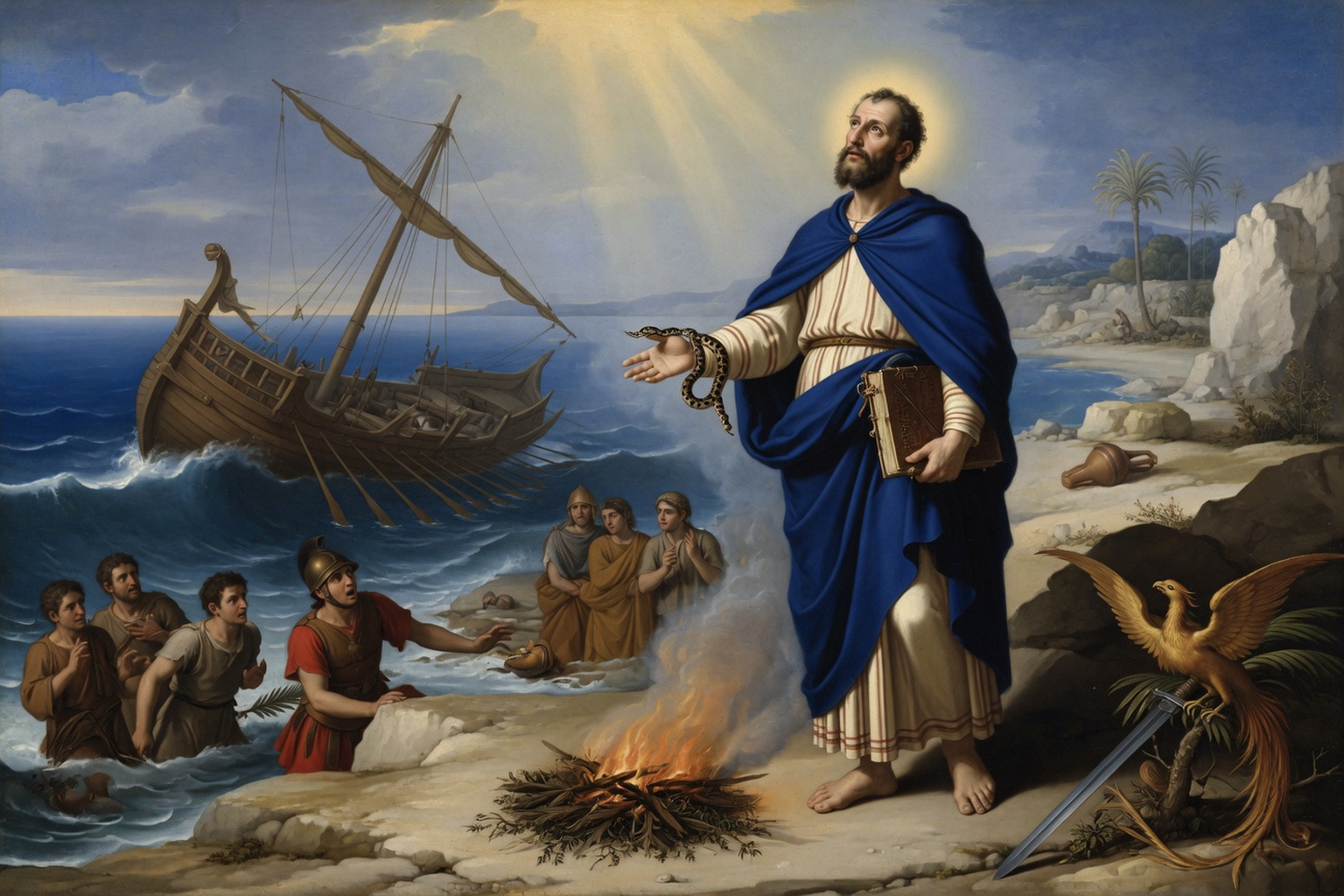
The resolution to send the Apostle to Rome to settle his appeal having been thus decided, "it was determined that he should go by sea to Italy, and that he should be placed with the other prisoners in the hands of one named Julius, a centurion of a cohort of the Augusta legion." As this journey was to be made by sea, he boarded a ship from Adramyttium. Saint Luke and Aristarchus of Macedonia, witnesses of the persecutions and sufferings of the Apostle, were not ashamed of his chains; they vied for the honor of accompanying him on his maritime journey and facing the perils of his navigation. Driven by a favorable wind, the following day the ship docked at Sidon, a famous city of Phoenicia. Julius, stripping himself, with regard to Saint Paul, of the harshness so well known of soldiers toward their prisoners, treated him with such humanity that he ceased to see in him a captive. He gave him liberty on his word; he was thus able to go and visit his friends, the Christians of Sidon, and provide for his own needs. Upon leaving Sidon, the ship was forced, because of contrary winds, to sail along the island of Cyprus; having rounded it, it entered the seas of Cilicia and Pamphylia, and docked at Myra, in Lycia (according to the Greek), and not at Lystra, as the Vulgate states. The latter city, located in Lycaonia, is not a seaport. By a happy encounter, Julius found in this port a ship from Alexandria that was sailing toward Italy. As this was the goal of his journey, he abandoned the one from Adramyttium and boarded this new ship with his prisoners and the friends of the Apostle. The latter, heavily loaded with wheat, sailed with difficulty, having the wind against it, forced to struggle against the west wind at a time when navigation was barely emerging from the infancy of art; it took many days to approach Cnidus, a city located on a promontory of the same name, in the part of Caria more specifically called Boride. The ship then took a course below the island of Crete, by the eastern cape of Salmone, opposite Cnidus and Rhodes, skirted the southern coast of Crete instead of the northern one, for it would have been exposed to all the violence of the northwest wind, and after a difficult navigation, which forced it to tack, it arrived at a place called Fair Havens, near which was located the city of Thalassa or Lasea, whose name still subsists to the south of the island of Crete. This port, much too exposed and subject to gusts of wind, offered an unsafe anchorage for spending the winter.
During this arduous journey, a great number of days had passed: navigation was becoming more and more difficult. Saint Paul knew the imminent peril the ship was running; immediately he gave those who were directing it this prudent advice: "Friends, I see that the navigation will become very troublesome and full of peril, not only for the ship and its cargo, but also for our lives." The centurion Julius preferred the opinion of the seamen; their old experience seemed to him preferable to the supernatural knowledge of Paul. The port where they were offered no suitable shelter for the ship. They put back to sea in order to reach Phoenix, a port of Crete, which faces the west and south winds; the winter could have been spent there without danger. The lack of foresight of the seamen was surprised by an impetuous wind that rose shortly after, between the east and the north; it blew with such violence against the island that it carried the ship away without its mass being able to offer the slightest resistance; all maneuvering becoming useless, it was the plaything of the wind, pushed with impetuosity below a small island called Cauda, located very close to the island of Crete, and famous for its wild donkeys; they were able with great difficulty to take control of the lifeboat. The following day, it was necessary to throw the merchandise into the sea in order to lighten the ship and diminish its harsh jolts; three days later, the sea, always insatiable, demanded other sacrifices; they threw the ship's rigging into the abyss with their own hands. To top off the horror, neither the sun nor the stars appeared for several days. An unhoped-for savior, the Apostle rose in their midst, and with a noble assurance he promised them their lives would be saved. In the expectation of the shipwreck, no one had thought to eat; he exhorted them to take food, saying to them: "Friends, you would have, no doubt, done better to believe my word and not to depart from Crete; you would have spared us such great trouble, and we would not have suffered such a great loss! Nevertheless, no one will perish; this ship alone will be lost; therefore take good courage now, for this very night an angel of the God whom I serve appeared to me and said: Paul, do not fear, you must appear before Caesar; God, touched by your prayers, has given you all those who sail with you! That is why, friends, take good courage! My trust in God will not be betrayed, everything that has been announced to me will happen; we must only be cast against a certain island." This firm word lifted the hearts of the passengers dejected by the fear of death.
The fourteenth night of this horrible navigation on the Adriatic Sea, the sailors noticed around midnight that they were approaching land; immediately they cast the lead and found twenty fathoms; a little further on they found only fifteen. For fear of going to break against a reef, they hastened to cast four anchors from the stern into the sea, and they then waited with impatience for the day to come to illuminate their situation, which shortly before had been so desperate. Saint Paul, attentive to the needs of the passengers, certain that in a little while they would be sheltered from all peril, exhorted them to take food, saying to them: "Fourteen days have passed since you have been fasting. Believe me, take food in order to be able to save yourselves; for none of you will lose even a single hair of his head." To this convinced and reassuring word he added his own example, always powerful on dejected hearts. He took bread, and after having given thanks to God, in the presence of all the passengers, in order to teach them to thank the Master of the world even in the midst of imminent peril, he broke it and began to eat. The calm full of assurance with which he proceeded finished reviving the dejected spirits; all, regaining courage, began to eat like him; there were two hundred and seventy-six people on the ship; after having satisfied themselves, they finished lightening the ship by throwing the wheat into the sea.
Julius commanded those who could swim to throw themselves first out of the ship and thus save themselves to land; all the others placed themselves either on planks or on pieces of the ship; with the help of these various means of rescue, all the passengers reached the land, and God kept the promise He had made to His Apostle; none of them perished! By preserving this great number of people from a horrible death, the prisoner of Jesus Christ glorified his chains; the disgrace fell back upon those who had loaded him with them. This shipwreck of Saint Paul was the fourth. Having escaped this terrible danger, the passengers noticed that they were on the island of Malta; the islanders received them with eagerness and treated them with kindness. Their first care, upon seeing the shipwrecked people all chilled with cold and still wet from the rain, was to light a great fire to warm and dry them. Not disdaining the small offices of charity, he whose burning heart embraced the whole world, Saint Paul gathered brushwood and threw it into the fire in order to give it more Malte Possible place of origin of Publius. intensity; a torpid viper, suddenly revived by the heat, came out of the branches and darted onto his hand; when the inhabitants of the island of Malta saw this dangerous reptile hanging from his hand, struck with astonishment, they said among themselves: "This man is undoubtedly a murderer; see how, after having saved himself from a raging sea, he is pursued by divine vengeance which does not want to let him survive." Without being frightened by their thoughts or by the otherwise dangerous viper, the Apostle shook it quietly into the fire and received no harm from it; attentive to the ordinary effects of the reptile's bite, the barbarians waited with avid curiosity for the poison, after having penetrated his blood, to make his body swell; and after having reached the sources of life, to make him fall dead all of a sudden, as if struck by lightning. It was not so: the violence of the viper's venom was neutralized by a divine virtue; after a long wait, the barbarians, astonished at the harmlessness of this bite on the person of the Apostle, changed their sentiment toward him; full of admiration for this invulnerable shipwrecked man, they went in a leap to the opposite extreme; they cried out that he was a god! Perhaps these pagans suspected him of being their Hercules!
In this place, there were lands that belonged to the First of the island, named Publius; this man put great eagerness into giving the example of hospitality; he received Saint Paul and his friends with much humanity; he kept them for three days. During these days, they had time to recover a little from the horrible fatigues of this long storm, followed by such a shipwreck. Publius received them in his villa which occupied the heights where is now Cixita-Vecchia or Medina-Vecchia, the ancient capital of the island, whose cathedral is dedicated to Saint Peter and Saint Paul. By a happy encounter, the father of Publius was sick with fever and dysentery; the Apostle went to see him, and finding the opportunity to show him a truly apostolic gratitude for his good reception, he laid his hands on him and healed him. This miracle, preceded by that of the viper shaken into the fire without danger, made a great noise on the island; immediately all spirits were moved, all the infirm came to him and were healed. Saint Paul did not limit his ministry to the healing of the bodily illnesses of the infirm inhabitants of the island of Malta; all the spirits that showed themselves docile to his voice were converted, the idols fell, and Jesus Christ reigned in hearts. The conversion of Publius, whom the Apostle established as bishop of this new Church, was the most striking of all and must have led to others. Ancient martyrologies attest to these facts; they add that later Publius directed the Church of Athens in the capacity of bishop, successor to Saint Dionysius the Areopagite; Saint Dionysius of Alexandria affirms, in fact, that a Publius succeeded Saint Dionysius, bishop of Athens. This Publius, it is believed, is the same as the one from Malta. According to Saint Jerome, he won the crown of martyrdom.
After three months of forced residence on the island of Malta, where the numerous miraculous healings he had performed had brought him great honors, the Apostle was finally able to board, with his traveling companions, a ship from Alexandria that had spent the winter in one of the ports of the island, and set sail toward Italy. This ship bore as its figurehead the image of Castor and Pollux. From Malta he sailed directly toward Syracuse, where he docked. He stayed for three days in this famous city. When Saint Paul arrived in this city, the Romans had been its masters for three centuries; according to Cornelius à Lapide, he was received there by Saint Marcian, whom Saint Peter had established as bishop there several years before. While the merchants and owners of the ship were engaged in their trade, he visited the brothers, and left such an imprint of his passage among them that Christianity flourished marvelously, as is proven with evidence by the great number of saints and illustrious martyrs that Syracuse has given to the Church. Making the tour of the coast, the ship docked at Rhegium (Reggio), a Greek city founded by the Chalcidians. This city still preserves its name. The day after, the south wind having risen, the ship set sail and arrived in two days at Puteoli, a city of Campania, formerly Puteoli, located about eight miles from Naples, partly on the seashore and partly on a height. Upon leaving the ship, Saint Paul found, among the inhabitants of Puteoli, brothers who welcomed him with holy joy; eager to hear him and too happy to possess him in their city, they begged him, with lively and insistent prayers, to stay with them for seven days. The centurion Julius did not put any obstacle to their desire. During his stay, the Apostle, with that powerful word whose accents vibrated so strongly in all hearts, confirmed his brothers in the faith.
Final Struggles and Martyrdom
After an initial period of relative freedom in captivity, Paul was arrested again under Nero and died by beheading on the Ostian Way.
Paul finally reached the land of Italy, the object of his ardent desires. The journey from Put eoli Rome Birthplace of Maximian. to Rome could have been made by sea to Ostia; but the centurion preferred to follow the land route. The brothers of Rome, warned by letters from the Christians of Puteoli of the Apostle's arrival in their city and his departure for the eternal city, went out to meet him. It was in the seventh year of Nero, around the first days of April at the latest, that he was presented in chains to the stratopedarch by the centurion Julius. He was followed by Luke and Aristarchus, who had accompanied him on his journey, attentive to serving him and consoling him in his chains.
The centurion Julius, having handed over to Afranius Burrus, the stratopedarch or prefect of the praetorium, the prisoners he had brought from the East, this chief of imperial justice had them all locked in the city prison, with the exception of Saint Paul. By a characteristic distinction, he separated him from all the others, without him having requested it; he allowed him to lodge in an inn, under the guard of a praetorian. Saint Paul, subjected to the mildest of guards, enjoyed a semi-liberty. The permission to inhabit a private dwelling and to receive visits from his friends and all those who wished to speak to him was granted only to persons of considerable standing: common prisoners were not treated with such humanity. On the day of his arrival, Saint Paul did not have the leisure to attend to his appeal; he had to spend the following day looking for a house and settling in. Once suitably lodged, he had to receive visits from the Judeo-Christians and the Gentile-Christians whose dispute regarding their mutual prerogatives and their moral value before God he had calmed through his famous Epistle. On the third day after his arrival, before appearing before Caesar's tribunal, he wished to confer with the principal Jews residing in Rome. He therefore had them invited by the city's Judeo-Christians to assemble in his house. This invitation was very well received. The leaders among them came to see him, whether out of curiosity or national spirit. When they were gathered, the Apostle urged them not to oppose his release, and even to desist from any pursuit against his person, if such had been their initial thought. The Jews of Rome replied to the great prisoner: "We have not received any accusatory letters from Judea against you; no brother has been sent to us to inform us of such; no one has even told us the slightest evil against your person; that is why we wish to know your sentiments regarding the sect of which you are one of the ardent propagators, for the only thing we know is that it is opposed everywhere." The day for a second conference was set for this matter.
The Jews, faithful to their promise, arrived in great numbers on the appointed day at his dwelling. When they were gathered, the Apostle, prepared by prayer and supported by the inspiration of the Holy Spirit, appeared—surrounded by Saint Luke and his other disciples present in Rome, chained to the arm of a legionary—and explained to them from morning until evening the mystery of Jesus Christ and the necessity of believing in Him if one wishes to be saved. The divine fire that animated his discourse produced its usual double effect: some, docile to the impression of the Spirit, opened their eyes to the light of truth and received it with happiness; they believed with a firm faith this new truth that Saint Paul manifested to their intelligence. Others, driven by the spirit of contradiction, closed their eyes to the light; they stiffened against the truths that made it sensible and palpable to them, and remained attached to the dead letter of the law.
Saint Paul remained for two whole years in the inn where he had taken his lodging; he received there all those who came to see him and speak with him about the great cause of the Gospel; he preached to them the kingdom of God and taught them what concerns Our Lord Jesus Christ, with complete freedom, without anyone placing an obstacle to his preaching. Against the expectation of his cruelest persecutors, he recovered in the metropolis of idolatry, in the city of all the gods, under the empire of a Nero, and in chains, a complete freedom to preach the new law to all kinds of people; a freedom that had been snatched from him in Jerusalem, the capital city of religion; his chains, far from placing an obstacle to his word, served to carry it further and higher. This contrast between a chained arm and a free tongue gave him more celebrity; one would have said that he was renewing the wonders of the forum, silent for so long, so much so that his bonds became famous throughout the praetorium, and that Christians even existed in Caesar's household, converted to the faith by his preaching.
According to the formal promise of Jesus Christ: "You must appear before Caesar," and the manifestation of his bonds throughout the praetorium, it is certain that Saint Paul appeared before Nero in person. Now, when the emperor presided, he had as assessors the prefect of the praetorium and one of his ministers. These figures must have been Afranius Burrus and Seneca, who, by reason of their office, could not be absent from this audience; they had to be in the place where Caesar rendered justice in person. Alone, without a patron, without a lawyer, Saint Paul defended his cause with his admirable presence of mind and eloquence. If we still had his speech, we would recognize in it the sublimity of the one he delivered before the Areopagus, and the knowledge he displayed before King Agrippa; we could especially admire in it the arguments appropriate to his cause and to the head of the empire. It was through this discourse that he made himself known to Caesar, the prefect of the praetorium, his assessors, and the other famous figures who surrounded Nero. A crowd of chosen listeners flocked from the city to the imperial audiences; Nero, with his thirst for applause, was not a man to turn them away. Finding no motive to condemn the Apostle, he dismissed the charges and thus ended his appeal trial. The Apostle's bonds were broken toward the end of the second year of his arrival in Rome.
It was not only in the praetorium and the city of Rome that the Apostle's chains acquired great celebrity. The news of his captivity spread promptly to the East. All the Churches he had founded followed him in spirit in all his wanderings, inquiring with care about all the events of his life. Everything that concerned him was sought after with avidity. But if all the Churches vied in zeal regarding him, there was one, however, that surpassed the others in its more tender and lively affection: it is the Church of Philippi, in Macedonia. On every occasion, the saints of this city hastened to testify to their attachment. Always watching over him, they hastened, as soon as they saw him in distress, to place their goods and their lives at his disposal. As soon as they learned of his captivity in Rome, without stopping at sterile tears or vain emotions, they sent him their Apostle, or the bishop Epaphroditus, charging him to serve him in his chains and to offer him, on their behalf, pecuniary aid. The noble prisoner of Jesus Christ had no other resources to live on than the work of his hands. Now, this continuous labor, in the midst of his apostolic works, would have finished breaking his strength if his true friends had neglected to come to his aid. At the moment of his departure, the Apostle entrusted him with his touching Epistle to the Philippians. He wrote it from Rome, where he was still a prisoner. It is a touching monument of pastoral solicitude and of noble gratitude from a head of a family toward his children. The Apostle testifies much tenderness toward his dear neophytes, now strengthened in the Christian way. His heart overflows with joy, not so much because of the abundance of their gifts as by the consideration of their excellent dispositions. As for him, he has long been accustomed to privations: he has lived sometimes in affluence, often in indigence. God will take their alms into account for them. He exhorts them to show themselves constantly in the midst of the world as true children of light: let them shine like stars among the pagans who surround them. Yielding to a constant preoccupation, the Apostle strengthens them against the teachers of Judaism, whom he calls enemies of the cross of Jesus Christ. "Avoid quarrels," he tells them in closing, and he conjures them to always maintain a perfect union among themselves. "One of the most effective means of maintaining peace and concord is to practice humility, following the example of Jesus Christ, who voluntarily emptied himself and was obedient even to the death of the cross."
During his stay in Rome, Saint Paul met a fugitive slave by the name of Onesimus, who belonged to Philemon, a rich Phrygian and his friend. After having stolen from his master, this slave had avoided by flight the harsh punishment he had deserved. From Colossae, in Phrygia, he had come to seek refuge in the city of Rome. He hoped to escape all searches in this immense city; he was unaware that Rome was without bowels for this nameless thing that was called a slave. He risked dying of hunger there or being thrown as fodder to the beasts of the amphitheater. Fortunately for him, after having exhausted his last resources, he discovered in this city the Apostle whom he had already known at his master's house. Onesimus, trusting in the charity of Saint Paul, confessed his fault to him. Touched by his repentance, the great Apostle converted him to the faith, and as he recognized in him precious qualities, he resolved to make him an evangelical worker. But, always prudent, before employing him in the service of the Church, he wanted to obtain permission from his master; after having transformed him into a new man, he sent him back to him provided with an Epistle, which shows his admirable charity in a new light. Moved by the reading of his beautiful and touching Epistle, Philemon received Onesimus with benevolence and forgave him his flight and his theft. As soon as he learned that he could be useful to Saint Paul in his chains, he sent him back to him, restoring him to liberty. Epaphras, bishop of Colossae, a city of Phrygia neighboring Laodicea, shared the Apostle's chains in Rome. He was a zealous servant of God, whose preaching had contributed much to spreading the Gospel in Phrygia. He manifested a lively and constant solicitude for the cities of Colossae, Laodicea, and Hierapolis, the principal theater probably of his apostolic labors. Saint Paul calls him his dear brother and his companion in the service of God. It is from him, no doubt, that he learned the principal details of the conversion of the faithful of that country. Thus, in his Epistle to the Colossians, he tells them that he prays unceasingly for them, asking God to fill them with the knowledge of his will, so that they may live in a manner worthy of him. A grave circumstance decided Saint Paul to write to the Colossians. Seducers had cast trouble and division among them. Pretending that Jesus Christ is too elevated above men, they imagined mediators, placed between him and us, destined to bridge, so to speak, the infinite distance and the incommensurable space that separate humanity from divinity. These errors stemmed from Gnosticism, whose progress was continuous; they were mixed with Judaic observances and superstitious practices of pagan origin. As usual, these false theories were accompanied by secret instructions and impure ceremonies. As always, too, Saint Paul displays the most lively energy against these impious doctrines.
Saint Paul loved the Hebrews of Jerusalem and Palestine who had converted to Christianity with such ardor that he could not concentrate this fire within himself; despite himself, it often exploded; his heart let escape these flames that burned him. In vain his person seemed to cause them a visible repugnance; his zeal carried him toward them. The obstacle, one might say, doubled his love. In the hope of finally overcoming their distance, he wrote to them from Rome or Italy his famous and learned Epistle, which is to them what the Epistle to the Romans is to the Gentiles. One remains always seized with admiration before his explanation of the spirit of the ancient Law and the change it had undergone through the preaching of the Gospel. Despite intrinsic marks of authenticity, this sublime Epistle had a strange destiny. Refusing to see in the high science that the author displays the lion's claw, several exegetes attributed it to Saint Luke, others to Saint Barnabas, some even to Saint Clement of Rome, and finally to Apollos. The latter, a great and powerful orator, left nothing in writing; it is perhaps due to the impossibility of opposing his previous works to them that they regard him as the author. By reading it attentively and without bias, it is easy to recognize in it the profound doctrine of the doctor of the Gentiles. Convinced of this fact, the Church inserted it definitively into the canon of Scripture. The idea of writing such an Epistle could only arise in the mind of the great Apostle. Paul consoles his compatriots for the persecution they had to suffer from their brothers: which corresponds exactly with the time of the martyrdom of Saint James the Less. At the same time, in fact, many disciples of the Gospel were mistreated, some even to the shedding of their blood. The goal of this writing is easy to grasp. As in his letters to the Romans and the Galatians, the Apostle shows that true justice does not come from the law, but flows from Jesus Christ. Not only could justification not be produced by Mosaic ceremonies, nor by circumcision—truths developed in the previous Epistles—it could not either come from sacrifices. On this subject, Saint Paul exalts in magnificent terms the greatness of Jesus Christ, the virtue of the sacrifice of the new alliance, and the excellence of his priesthood. The ancient sacrifices were abolished because they were figurative.
Hardly set at liberty, Saint Paul, always animated by the same zeal, resumed his apostolic journeys. The ardor of his natural activity, far from being extinguished, had taken on more intensity at the contact of the sacred fire of the Holy Spirit, and did not allow him to abandon himself to rest. With his consummate prudence, he chose the places where his presence was most necessary. The island of Crete, today Candia, this island of a hundred cities, so flourishing and so renowned in Greek and Roman paganism, first attracted his gaze. The Apostle announced the Gospel to the Jews first, according to his custom, then to the Gentiles; the various conversions operated by his word formed the first elements of the Church of Crete; impure alluvions soon came to soil their purity. In converting to the faith, the indocile spirit of these islanders did not completely strip itself of its previous errors. Their first superstition was reborn sometimes, like those bad plants that are difficult to extirpate. They took a fancy to being stubborn about the reveries of the Jews and their legal ceremonies, especially those that seemed to them to have a certain affinity with paganism; these rebellious spirits, incapable of letting themselves be governed by reason, could only be brought back into the way of truth and justice through fear; that is why Saint Paul wrote later to Titus to rebuke them with harshness: *Increpa eos dure*. Skillful in the conduct of men, he knew that overly gentle manners remain without effect on such characters. From the island of Crete, Saint Paul transported himself to Judea, whose Churches he visited; he then realized, according to Saint Chrysostom, the promise he had made to the Hebrews, in his famous Epistle, to go and visit them as soon as his chains were broken.
After having raised the morale of the Judeo-Christians of Jerusalem with that great and powerful apostolic manner of which the Epistle to the Hebrews gives us the idea, he visited for the same purpose the faithful of Palestine and Syria. According to the formal promise he had made to Philemon, he could not dispense himself from going to visit the Church of Colossae, a city of Asia Minor, situated at the confluence of the Lycus and the Maeander and neighboring Laodicea, which Pliny places among the most famous cities of Phrygia. Did the sad state to which an earthquake had reduced the city of Laodicea, by overturning it from top to bottom, prevent him from taking his steps there? It would have been for the Apostle one more motive to go and visit Christians so harshly afflicted; for, despite their riches, the inhabitants were in great trouble to rebuild it. Assuredly, the Apostle could not help with his money in this reconstruction; but he could raise their dejected morale. One sees nothing that could have placed an obstacle to this journey. He must have finished the course of this apostolic visit toward the end of the year 62, the time at which he arrived in Ephesus with Timothy. It was for him an unhoped-for happiness, and one of which he seemed to have lost hope, to see again this city where he had exercised his apostolate with such success. When the Apostle had provided with his superhuman prudence, according to the requirements of time and place, for so many perilous things, pressed by the imperious duty to follow the divine order, he left Ephesus and took the road to Macedonia, where his dear friends of Philippi awaited him. This Church was the first in his affections; he found himself there in the midst of true friends, whose hearts were always disposed to sacrifice themselves in his favor. Despite his singular affection for the Church of Philippi, so worthy in all respects of his friendship, the Apostle did not forget, during his stay in the midst of his friends, the other Churches of Macedonia. All those that were encountered on his route received his visit. In this short journey in Macedonia, he likely followed the path he had traveled in the first, when he passed from Asia into this province of Europe, and then from Macedonia into Asia. Obliged to embark in the port where one most ordinarily found ships destined for this province, he had to go from Ephesus to Troas, situated opposite Macedonia.
According to common belief, Saint Paul wrote from Macedonia the first epistle to Timothy: all see in it a magnificent picture of the duties of the pastoral office. This epistle summarizes the divine and visibly inspired rules for the wise government of the house of God and the Christian family. It has been constantly regarded in the Church as the first foundation of ecclesiastical discipline relative to the episcopate and the various degrees of the clergy.
For fear that his youth might be despised (Timothy was then barely thirty years old), the Apostle addresses various recommendations to him and traces a line of conduct for him. He must be on guard against profane novelties of language, and fight the good fight of the faith. A false science, in fact, tended to corrupt the purity of the doctrine. At this time, women were employed in disseminating error. They served as instruments for teachers of iniquity, thanks to that influence they easily take over the minds of men. To cut short any abuse, and even to make the danger disappear from this side, Saint Paul forbids women to teach: they must keep silence in Christian assemblies, and listen to instructions with attention and respect.
In his relations as bishop with Christian women, Timothy will treat those who are elderly with the respect one bears to one's mother; he will consider the younger ones as his sisters, always with extreme reserve. A bishop must be irreproachable in his morals as in the faith, instructed, sober, hospitable, gentle, modest, an enemy of dissensions, generous. If, before receiving the sacred character of the episcopate, he was engaged in marriage, let him maintain his children in obedience and regular conduct. How will a man who does not know how to govern his house be able to govern the Church of God? One must not raise a neophyte to the episcopal dignity, for fear that he might be puffed up with pride and be surprised by the devil. Priests who fulfill their office well must be honored: any accusation brought against them must not be easily welcomed, unless it is supported by two or three witnesses. The bishop, in all things, must show much calm and use great moderation; he will pray and have others pray for all men, for princes and those who are constituted in dignity.
Did Saint Paul also write the Epistle to Titus from Macedonia? This one has the same goal, the same ideas, and often the same form as the previous one. These two Epistles must therefore, it seems, have been written at the same time and from the same place; in one and the other, he traces a plan of conduct to follow in the organization of the Church; one finds in them recommendations against the Judaizers.
Saint Paul had to go to Greece and, from this province, he came, as he announces to Titus, to spend the winter at Nicopolis, a city of Epirus on the Gulf of Ambracia, today Preveza. From Nicopolis, the Apostle passed back into Asia Minor; he followed the ordinary route, skirted the island of Samothrace, and landed at Troas, where he lodged with Carpus, a considerable Christian of this city or perhaps one of his priests. He remained there for a certain time. Saint Paul then went to visit Antioch of Pisidia, Iconium, and Lystra, where he suffered the great evils of which he speaks to Timothy. He then came to Miletus, where he left Trophimus sick. Having finished his apostolic visit to the Churches of Asia, where he marked his passage with labors, sufferings, and new persecutions, he returned to Corinth, where he left Erastus, one of his disciples and his holy co-workers; he met Saint Peter there, and both went together to Rome, as described by Dionysius of Corinth in his letter to the Romans.
According to a tradition founded on the most grave testimonies, the bundle of which does not seem to be able to be broken, Saint Paul went from Rome to Spain by crossing a part of Gaul. The Apostle, whose activity could only be stopped by death, did not want to leave the earth without having carried the light of the Gospel to the last limits of the West. The Fathers of the Greek and Latin Church almost unanimously admit this journey. Pierre de Marca traces the itinerary of Saint Paul in Spain through Gaul as follows: "Paul," says this learned archbishop, "in going to Spain, must have followed this public road, so famous among the ancients, which from Italy led through Gaul even into Baetica; the Antonine itinerary describes this road by Nice, Arles, Narbonne, the Pyrenees mountains, La Jonquera, Barcelona" and other places. Strabo also explains this road with care: "I have corrected the interpreters who have not always understood it well." Stephen VI, in a letter (cited by Labbe) against Sylva and Hermamire, false bishops of Urgel and Girona, says that Saint Paul left Narbonne in the company of Sergius Paulus, and that both reached the confines of Spain while preaching the Gospel. In the commentary on Saint Paul, attributed to Saint Anselm, or rather to Hervé of Bourg-Dieu, one reads the same fact, the departure from Narbonne with his disciple surnamed Paulus. Emmanuel-Cajetan Souza also admits that he made this journey by land through Gaul. The Church of Toledo places at the head of its bishops Marcellus, son of Marcellus, prefect of Rome, and qualifies him as a disciple of Saint Paul; he was converted by this great Apostle when he was in Spain. This Marcellus, first bishop of Toledo, had been sent to this city by the emperor in order to keep it in obedience to the Romans.
The Church of Tortosa regards Saint Luf or Ruffus as its first bishop. Son of that Simon the Cyrenian, who was forced by the soldiers to carry the cross of Jesus Christ to Calvary, he was famous in the Church of Antioch, where he imposed hands on Saint Paul and Saint Barnabas. He accompanied Saint Paul to Spain, and the great Apostle ordained him bishop of this Church. Many also believe that Priscilla and Aquila accompanied the great Apostle to Spain and preached the Gospel with him in this vast province; they even suffered martyrdom there.
Warned by a divine revelation that the time to leave this world was approaching, Saint Paul finished his apostolic itineraries. He resumed the road to Rome in the company of Luke, Titus, Crescent, Demas, and other holy co-workers. Saint Denis of Corinth, as reported by Eusebius in his *History of the Church*, seems to affirm that Saint Paul returned to Rome in the company of Saint Peter. The head of the Church and the great Apostle would have met at the end of their apostolic mission and would have made their triumphal entry together into this city, where their bodies were to rest and be venerated by the whole universe. Baronius adopts this sentiment, according to Metaphrastes and other authors. Saint Asterius thinks that Saint Paul found Saint Peter again in Rome, and applied himself, in concert with him, to instructing the Jews in the synagogues, and to converting the pagans in the squares and in public assemblies. Above all, they consoled the Christians who had escaped until then the horrible persecution of Nero. Equaling their zeal to the excess of the evil, they went to visit the witnesses of the faith in their dungeons and prepare them for an imminent immolation. Before setting, this sun wanted to illuminate a large number of souls still plunged in darkness; he preached to them, with the last of his strength, the Gospel of the grace of God, faith, sanctification, charity, the horror of sin and idolatry, that impure source of all the crimes that flood the earth; he exhorted them above all to be permanent in the grace of God: *Ut permanerent in gratia Dei*. The monstrous emperor, already covered with the blood of the Christians, could not see without anger either the successes of this preaching or the holy life of the neophytes, a living satire of his vices, an eternal reproach of his horrible crimes; he ordered his satellites to throw the great Apostle into prison, as well as Saint Peter, the head of the Church, then also in Rome.
Following this arrest, Saint Paul appeared before Nero. His friends experienced such terror that they abandoned him in this extremity, and perhaps denied him! Already lost in their eyes, they feared, by lending him their support, to be enveloped in his ruin; all abandoned him. But if all human help failed the Apostle, God gave him a superhuman courage and rendered him invincible. He came out safe and sound from the lion's den. Was he set at liberty? Was he able to continue his apostolic preaching in Rome? Saint Chrysostom seems to have believed so. He certainly escaped death, but he likely remained in chains. In the midst of his tribulations and the abandonment of so many cowardly friends, even the Asians who were in Rome, God provided him with a noble heart, a friend devoted even to the sacrifice of his life, Onesiphorus! In the desire to help Saint Paul, he hurried from Asia to Rome; he came there to nobly crown the services he had rendered to the Church. Difficulties almost insurmountable in finding Saint Paul did not stop his zeal or his devotion. He did not recoil at the sight of this frightening place; with an admirable greatness of soul, he assisted him with all his power, without fearing to expose his life. Moved by this heroic attachment, Saint Paul wants Timothy to go and greet on his behalf the house of Onesiphorus. It is, in fact, from the Mamertine prison, and almost on the eve of martyrdom, that Saint Paul wrote his second Epistle to Timothy, as the testament of his paternal affection. "God," he tells him, "has not given us the spirit of fear, but of courage. Do not blush to bear witness to our God... I suffer, but I am not confounded; for I know in whom I have faith... As for me, I have fought a good fight, I have finished my course, I have kept my faith."
The Mamertine prison, despite its thick walls, placed no serious obstacle to his apostolic preaching. Who can chain the breath of the Spirit, restrain the voice of the divine Word, which resounds like thunder? He worked to complete the conversion of Nero's concubine and his cupbearer. Messenger of salvation, Onesiphorus could be employed to carry the words of the Apostle; this service was more agreeable to Saint Paul than that which he rendered to his own person; what did the care of his body matter to the doctor of the nations! That Jesus Christ might be glorified, the rest concerned him little. The Apostle, from the center of this prison, cast his gaze on the Churches of the world, and directed them with great solicitude. Pressed by the embraces of the charity of Jesus Christ, he inspected all the faithful. Toward the end of his course, Saint Paul wrote more frequently; he multiplied his Epistles, his advice, his expositions of doctrine; a true testament of his inexhaustible charity, the last expression of his firm and constant faith, it was like the last spark of the ardent desire he had to see his work of the establishment of the faith among the Gentiles consumed. The Epistle to the Ephesians was written with this goal; neither the Epistle itself nor history makes any mention, it is true, of the motive that led the Apostle to write it; schisms, dissensions could have been the cause like that of the first to the Corinthians, or else a defection from the truth of the Gospel like that of the Epistle to the Galatians; it was above all the thought that seductive men were to invade this Church and trouble it. That is why he carefully warned the Ephesians against any human respect relative to his person; he warned them not to blush for the chains that hold him captive in Rome, for he suffered these chains for the cause of the Gospel; their heart should therefore not weaken, nor their spirit turn away from the straight path of truth and piety, whether out of shame or fear. This sublime Epistle was written in the Apostle's last chains, and not in the first. Tychicus, faithful messenger of Saint Paul, was charged to carry it to the Ephesians, and to make them know at the same time the state of affairs and the painful situation in which he found himself. Saint Paul makes mention of this mission of Tychicus to the Ephesians in the second to Timothy. This encyclical Epistle was destined for all the Churches of Asia, for it was addressed to the faithful of Ephesus and the cities of the metropolis of Ionia; hence it comes that sometimes it was cited as being addressed specifically to the Christians of Laodicea. Certain authors even, who attributed to Saint Paul a first letter to the Ephesians, regarded this one as posterior: it was an error; the Epistle to the Ephesians is unique.
The martyrdom of Saint Peter and Saint Paul put the finishing touch to the persecution of Nero. The captives left the Mamertine prison together; they made their way toward the altar of their immolation; they left the city by the Ostian gate, today Saint Paul's. In a place consecrated by tradition, they separated by embracing and addressing words of congratulation to each other. Rome, the city with imperishable memories, could not forget this last embrace of the two greatest victims that Nero had sacrificed! So many pilgrims have come since that day to visit this memorable spot that the trace of their steps has remained indelible. An inscription, framed between two small columns adorned with a bas-relief, indicates this place today to travelers who traverse the Ostian Way. Saint Paul followed this way to a place named the Salvian Waters. There he was struck by the sword; in his capacity as a Roman citizen, he had to perish thus and not by the cross, a punishment reserved by Rome for persons of vile condition in its eyes. The martyrdom of Saint Paul arrived on the third of the calends of July, June 29 of the year 66. Plautilla, a patrician, a very noble woman who had been baptized by Saint Peter in the waters of the Tiber, had met face to face with Saint Paul at the moment when the great Apostle was walking to martyrdom, followed by an innumerable crowd of people; the latter, seeing her weeping, asked her for her veil in order to bandage his eyes according to the custom at the moment of having his head cut off. Plautilla hastened to give it to him liberally. Later the Apostle appeared to her and returned it to her. According to a Greek inscription, cited by Gruter and which was found at the third milestone of the Appian Way on two columns, the land on which Saint Paul suffered martyrdom was called the field of Herude; it was undoubtedly a property of Agrippa. When the executioner's sword had separated the Apostle's head from his body, instead of blood, the veins let milk gush out. Saint Ambrose and Saint John Chrysostom speak of this traditional fact with their ordinary eloquence. Hardly severed, the head of Saint Paul rebounded three times, and each time it made a spring of living water gush from the earth. These three springs have given their name to the theater where the doctor of the Gentiles received the most beautiful of crowns; it is called the Three Fountains.
Posterity and Basilicas
Paul's legacy endures through his fourteen epistles and the Roman basilicas erected over his tomb and his prison.
Something would be missing from the life of this Apostle if we did not provide what antiquity has left us to reproduce his physical portrait.
The first brushstroke is provided by an enemy hand, which thought only of casting ridicule on the physiognomy of the great Paul. Here is what Lucian says: "I met a bald Galilean, with an aquiline nose, who went up to the third heaven, where he learned amazing things. Jesus Christ renewed us by water; he made us walk in the footsteps of the blessed, and redeemed us from the abode of the impious. If you want to listen to me, I will make you truly a man." The malice of Lucian renders us a real service here: not only does he give us an idea of the exterior of Saint Paul, but he teaches us something of his manner of preaching in the groups of citizens where he presented himself. Saint Chrysostom tells us a word about his stature: "He who was only three cubits tall, nevertheless touches the sky." "Paul," says Nicephorus, "had a small body, noticeably inclined, a pale face, announcing an age that went beyond his years; his head was small; he had much grace in his eyes, strong and overhanging eyebrows, a large and pleasantly aquiline nose, a long and fairly full beard, and, as on his head, white hair shone there in great proportion."
Ancient monuments very frequently place behind the image of Saint Paul a phoenix on a palm tree, a double emblem of resurrection which has the same name in Greek. Frequent examples of this can be seen in mosaics, sarcophagi, etc., etc., and even on the bottoms of cups. This peculiarity, which almost resembles a hieratic formula, was undoubtedly intended to honor the principal preacher of the future resurrection.
Saint Paul sometimes carries the book of his Epistles as an attribute. Thus he is seen in a 6th-century mosaic of Santa Maria in Cosmedin, in Ravenna, appearing to offer two rolled volumes to the throne of the Lamb, while Saint Peter, on the other side, has his keys in his hands.
The attribute of the sword, which was the instrument of his death, was only given to the Apostle of the Gentiles in times subsequent to the first centuries of the Church.
## CULT AND RELICS. — WRITINGS OF SAINT PAUL.
The body of the great Apostle was taken from the place where he received the crown of martyrdom by Lucina, a most illustrious woman of senatorial rank; she chose an honorable tomb on her estate on the Via Ostiensis, where she deposited it. Later, the sacred bodies of the two Apostles were reunited and carried into the catacombs. The places where the bodies of Saint Peter and Saint Paul were buried, far from remaining obscure or unknown, became on the contrary very famous; they excited the veneration of the whole universe. In the midst of the horrible persecutions that tested the nascent Church so harshly and made it a bloody Calvary for three centuries, neither the persecutors, so intent on putting the disciples of Jesus Christ to death, nor the idolaters, had the thought of making them suffer outrages. God preserved these noble and magnificent trophies of their victory from any touch of profanation. No sacrilegious hand dared to defile them with their contact, and while the ashes of the martyrs who perished in the fire, or the very body of those who died by the sword, were thrown into the Tiber or the sea, no one sought to throw to the wind this tent of clay that the soul of the holy Apostles had erected as a sanctuary where the Holy Spirit dwelt, and had offered to God as a living, holy, and pleasing host. The entire Church does not cease to venerate these sacred remains; admirable relics, they serve as a shield against its enemies. Destined to be one day absorbed by life, they will shine on the day of the resurrection of the saints, like brilliant stars.
In times of persecution, when nature, frightened by the refined cruelty and the horrible variety of tortures, a true invention of hell, could bend and succumb to the dread they caused it, the Christians of Rome went to fortify themselves against this terror near the tombs of the great Apostles. There their faith was retempered and took the strength to defy the tyrants. Since that glorious epoch, one has always seen, in all centuries, thousands of Christians flocking to Rome from the most distant regions, from the East and the West, from the North and the South, to the tomb where these holy relics rest. There they prostrate themselves and venerate these brothers in faith, one of whom carries the keys of heaven, and the other those of science. There always comes from these glorious remains a powerful virtue that revives the most wavering faith and strengthens it against the world, its great destroyer.
Saint Paul's chains are kept in Rome like those of Saint Peter. Saint John Chrysostom says that if he had more bodily strength, and if the service and affairs of the Church had not absorbed him, he would have willingly undertaken a journey as long as that from Antioch to Rome, with the sole design of seeing the prison where Saint Paul had been confined and the chains with which he had been loaded for Jesus Christ, of kissing these chains which make the demons tremble and are revered by the angels, and of putting them on his eyes after having embraced them.
In his book against the Schism of the Donatists, Optatus of Milevis speaks of the monuments of the two Apostles in Rome. Prudentius describes their position on the two banks of the Tiber; he shows one, located near the garden of Nero, on the Via Aurelia, in the Vatican Basilica, and the other in the Basilica of Saint Paul Outside the Walls.
Simeon Metaphrastes, who collected the legends of the saints, says that there were once in this portico of the old Vatican church paintings, unfortunately destroyed long ago, which represented the deposition of the two Apostles in the catacombs and the exaltation of the body of Saint Peter by Pope Saint Sylvester, when it was placed in the Vatican Basilica.
Following the advice of Pope Saint Sylvester, Emperor Constantine had a magnificent basilica built in honor of Saint Paul over his tomb, between the Via Ostiensis and the Tiber; he endowed it with opulent revenues. Emperor Valentinian, finding that it was not of sufficient size, because of the lack of space, bounded as it was by the Via Ostiensis, enlarged it by embracing this same road within the circuit of its walls. Theodosius and Arcadius finished this more august construction. This venerable basilica, one of the glories of Rome, known by the name of Saint Paul Outside the Walls, had passed the first twenty years of the 19th century without unfortunate accidents. By an unheard-of stroke of luck, it had remained the only one foreign to the various systems of restoration that the passage of centuries had caused all the other churches of Rome to undergo. Its primitive layout, its paintings, the various peculiarities of its ancient construction had remained intact. It is not that its architectural lines were all irreproachable, but the effect was grandiose. Prudentius gives a description of it. "Everything here," he says, "is royal; an excellent prince has consecrated this monument, and has made the enclosure shine with a thousand riches; the beams are gilded so that the light spreads inside. Columns of Parian marble support paneling of tawny color, and the arches are adorned with admirable glass that recalls the variety and brilliance of the flowers of spring." This edifice, which had braved the centuries and the Barbarians, was destroyed in 1823 by a horrible fire. A fire whose violence was fueled by the cedar wood from which its framework was manufactured ruined it almost entirely. This loss was great; art, history, and religion thus saw one of their most beautiful and venerable monuments disappear. The pontifical government did not limit itself to deploring this unexpected catastrophe; Leo XII began to rebuild this august temple, one of the most beautiful glories of the Roman Church. Thanks to the sustained efforts of his successors and their enlightened generosity, the Eternal City possesses once again, restored with the most scrupulous respect, this basilica that the first Christian emperors had nobly erected.
This vast edifice, preceded by a portico, extended in five naves to the apse; they were divided by a forest of columns of the most precious marble, and today unfindable. An immense arcade, known by the name of the Arch of Placidia, separated the apse from the great nave; a vast mosaic representing the image of the Savior surrounded by the twenty-four elders of the Apocalypse, to which the images of Saint Peter and Saint Paul had been added, decorated it. It is to the zeal of Saint Leo, as well as to the munificence of Galla Placidia, daughter of Theodosius and mother of Valentinian III, that the church of Saint Paul was indebted for this monument.
At the Confession, under the altar of the new basilica, half of the bodies of the two Apostles are kept, under a Gothic baldachin, supported by four magnificent columns; one reads on its four faces: Tu es spes electorum — Sancte Paule apostole — Praedicator veritatis — In universo mundo. In a chapel of the Benedictine convent adjoining the basilica, the glorious chains that bound the limbs of the great Apostle are venerated. In the new church, one admires four alabaster columns of unheard-of magnificence.
In the year 350, Pope Saint Damasus had the first and only church dedicated to Saint Paul erected in the interior of the city of Rome; he chose the location where the house was situated where the Apostle spent two years as a prisoner and guarded by a praetorian. A constant tradition had preserved the memory of this dwelling, so much was this place in great veneration among the faithful. He had this sacred edifice built there, known in our days by the name of Scuola di S. Paolo, school of Saint Paul. This name goes back to the time of the Apostle's chains, because it is there that he taught the Christian faith from morning to evening to all sorts of people, Jews and Gentiles. Consecrated by such a long memory, this name still serves to designate the church that replaced it. All the scholars who have written about Rome agree on this.
Pope Saint Sylvester, who had an equal veneration for this sacred place, and regarded it as one of the holiest monuments of the Christian religion in Rome, gave this church an arm of Saint Paul. Urban II, in the bull Apostolica sublimitas dignitatis, honored it with special privileges. The rumor of foreign faithful has always been great there. This church and the Basilica of Saint Paul Outside the Walls are the two monuments that attest to the presence of Saint Paul in Rome and the memory of his martyrdom.
There remain to us from Saint Paul fourteen epistles, nine of which are addressed to seven Churches, one to the Romans, two to the Corinthians, one to the Galatians, one to the Ephesians, one to the Phi lippians, one to quatorze épîtres Collection of the fourteen theological letters written by Paul. the Colossians, two to the Thessalonians; four others are written to his disciples, two to Timothy, and one to Titus, one to Philemon; the fourteenth is to the Hebrews. These Epistles have always been more famous in the Church than those of the other Apostles, and they have been not only the subject of the consolation and edification of Christians, but also of the admiration of Jews and pagans. Even those who were his greatest enemies and the most jealous of his glory, and who despised his speeches when he was present, felt obliged to admit that his letters were filled with strength and authority. The reasoning is just, the thoughts noble, the style lively and animated. There are obscure and somewhat embarrassed places, either because of the sublimity of the matter he treats there, or because of the frequent parentheses with which they are interspersed, and a fairly large number of transpositions and hyperboles. Critics also note that the Greek is not pure, and that often the turn of the phrase is Hebraic.
Saint Paul ordinarily puts his name and his titles at the head of his Epistles. Sometimes he adds that of some of his disciples, either because they had served as his secretaries, or to do them honor, or to give more credit to his letters, or finally because they were well known to the Churches to which he was writing. We have an example of this in the first Epistle to the Corinthians, which he begins thus: "Paul, Apostle of Jesus Christ by the vocation and will of God, and Sosthenes, his brother"; and in the Epistle to the Thessalonians: "Paul, Silvanus and Timothy, to the Church of Thessalonica." But it has never been doubted in the Church that Saint Paul was the sole author of them. Tertius, who says he wrote the letter to the Romans, was only the secretary or copyist; and it appears that the Apostle also dictated to one of his disciples the first to the Corinthians, that to the Colossians, and the second to the Thessalonians. However, so that one would not be mistaken and pass off false letters under his name, he was accustomed to put his signature in all his Letters and to subscribe to them in a way that was peculiar to him. This is what he tells us himself in his second to the Thessalonians, where he says: "I greet you here with my own hand, I Paul; this is my signature in all my Letters, I write thus; the grace of Our Lord Jesus Christ be with you all. Amen." Those who arranged the Epistles of Saint Paul in our Bibles had less regard for the time at which they were written than for the dignity of the Churches, or the merit of the faithful who composed them, or the greatness of the mysteries explained therein, or the excellence of the matters treated therein. The first of all, according to the order of time, is that which Saint Paul wrote to the Thessalonians; the second, addressed to the same peoples, was written shortly after; then, that to the Galatians; after which he wrote the two to the Corinthians, then the first to Timothy, to Titus, to the Romans, to the Philippians, to Philemon, to the Ephesians, to the Colossians, and to the Hebrews; the last of all is the second to Timothy. The Apostle wrote it, being at the end of his life and close to his martyrdom, as he assures us himself.
One has sometimes attributed to Saint Paul, but wrongly:
1° A speech where he advises reading the books of the pagans, among others those of the Sibyl and Hystaspes. 2° A third letter to the Thessalonians. 3° Several letters to Seneca. 4° The Gospel of Saint Luke. 5° Several apocalypses or ascensions. 6° A book entitled: Travels of Saint Paul and Saint Thecla. 7° Another book entitled: The Acts of Saint Paul. 8° An epistle to the Laodiceans.
We have analyzed, to compose the substance of this biography, the two most perfect works, in our opinion, that have been published so far on Saint Paul: that of M. Vidal, parish priest of Notre-Dame de Berry, entitled: Saint Paul, sa vie et ses œuvres. Paris, 1868; and that of Abbé Keurraud, canon of Tours, entitled: Les Apôtres. Other works of a different, but no less elevated order, such as La Bible sous la Bible by M. l'abbé Gainet, the Histoire des auteurs sacrés et ecclésiastiques, by Dom Coiffier, etc., have served us to fill in some gaps.
Annexes & related entities
Structured data for exploration: events, miracles, quotes, places, attributes, patronages, and important entities cited in the text.
Key Events
- Born in Tarsus in 2 A.D.
- Education in Jerusalem under Gamaliel
- Participation in the stoning of Saint Stephen
- Conversion on the road to Damascus through a vision of Christ
- Baptism by Ananias
- Apostolic journeys in Asia Minor, Greece, and Macedonia
- Council of Jerusalem
- Imprisonment in Rome
- Martyrdom by beheading under Nero
Miracles
- Healing of a lame man at Lystra
- Blinding of the magician Elymas
- Miraculous deliverance from the prison of Philippi by an earthquake
- Gushing of three springs (Tre Fontane) at the site of his beheading
Quotes
-
Saul, Saul, why do you persecute me?
Acts of the Apostles / Source text -
I have fought a good fight, I have finished my course, I have kept the faith.
Second Epistle to Timothy