Saint Peter
Chair of Rome
Prince of the Apostles, First Pope, Vicar of Jesus Christ
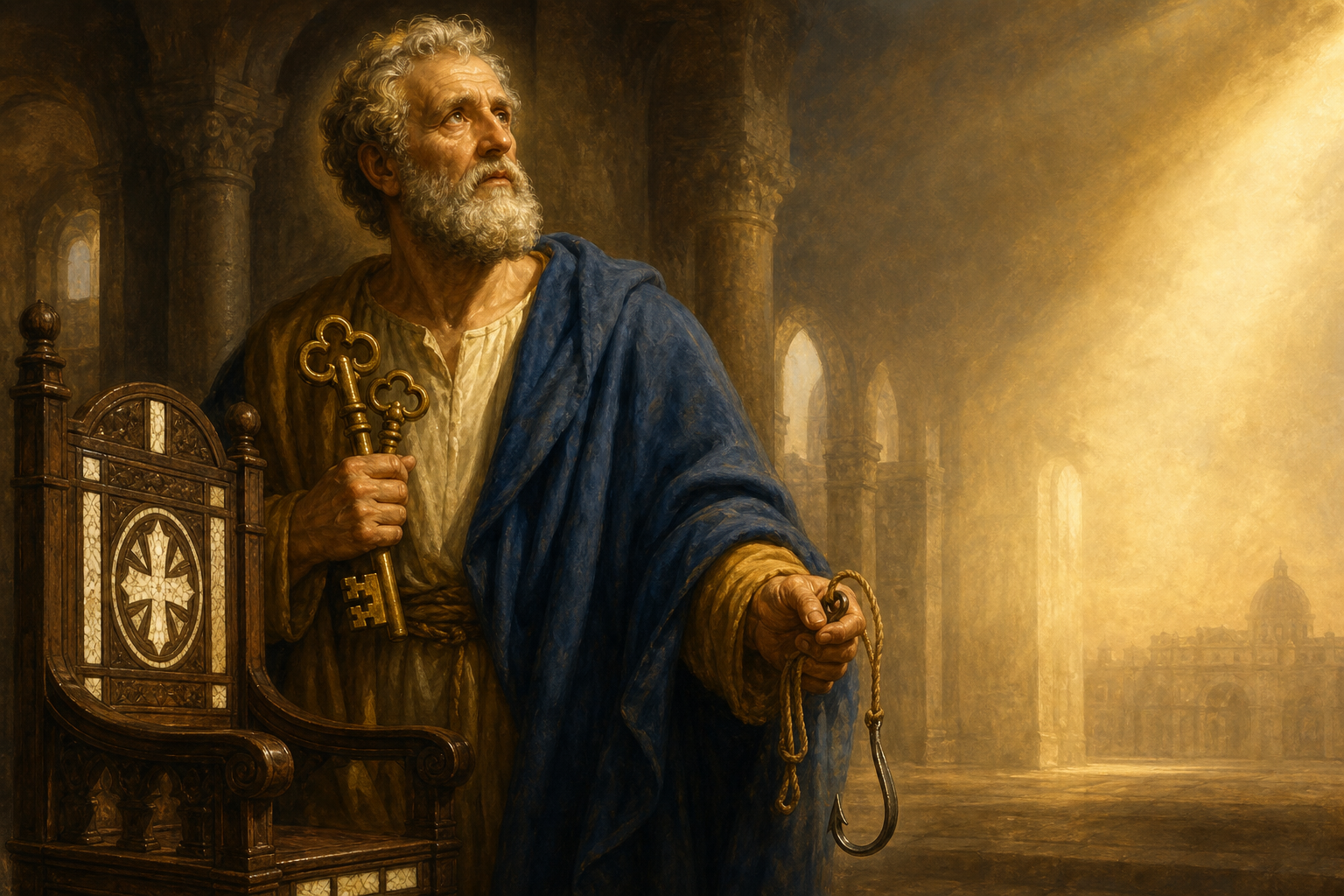
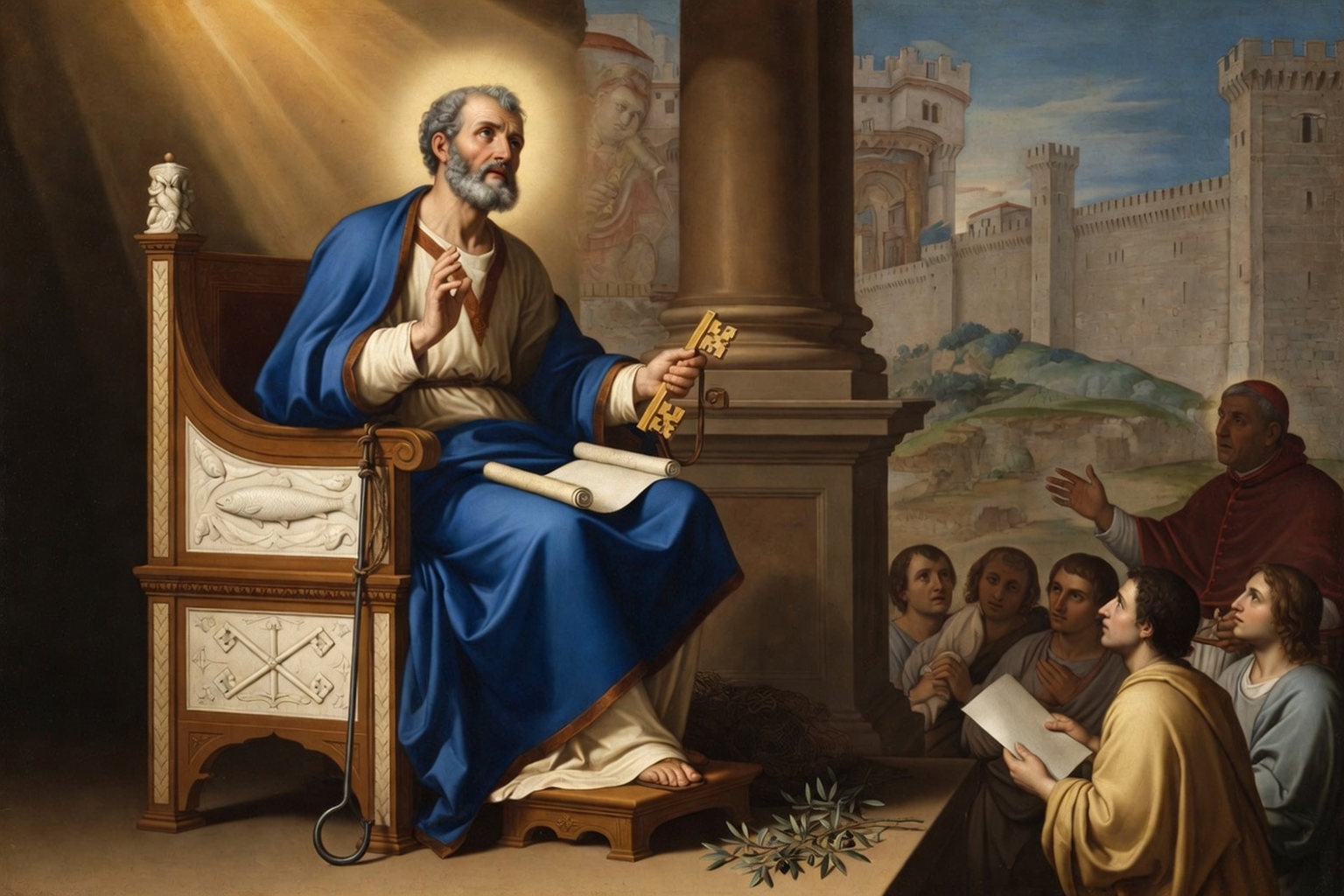
The feast of the Chair of Saint Peter in Rome celebrates the establishment of the Prince of the Apostles as the first Pope in the capital of the world in the year 44. After having presided for seven years in Antioch, he fixed his see in Rome for twenty-five years, transmitting to his successors the power of the keys received from Jesus Christ. This solemnity honors the unity and perpetuity of the Roman magisterium.
Guided reading
8 reading sections
THE CHAIR OF SAINT PETER, IN ROME
The establishment of the Apostolic See in Rome
After having held his see for seven years in Antioch, Saint Peter settled in Rome in the year 44 to establish there the center of the universal Church.
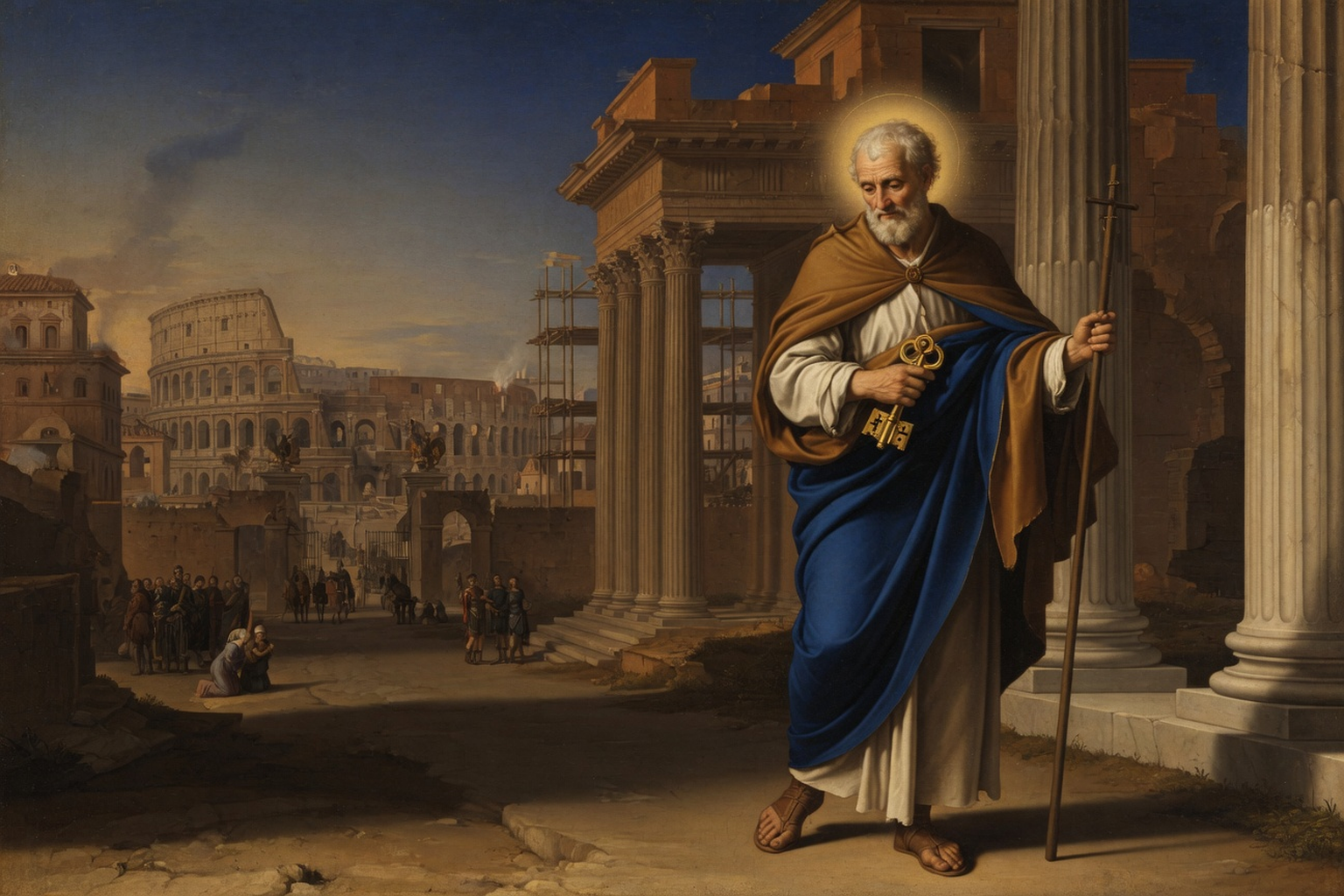
Today the Catholic Church celebrates, in a sense, its Dedication; for it celebrates the anniversary of the preaching of the Gospel by Saint Peter in Ro saint Pierre Apostle and first pope, mentioned as the father of Petronilla. me, and of his installation as the first Pope. Now, the Catholic Church is not only apostolic, it is also Roman; for it is in Rome, the capital of the Catholic world, that its visible head resides, the Vicar of Jesus Christ, the Sovereign Pontiff, the Pope.
In this long course of nearly nineteen centuries, since Saint Peter, how many dynasties have died out or been overthrown! The surface of the globe, torn by the hand of diplomats, is quite different today from what it was then. Only one power has remained standing: it is the power of him who sits on the throne founded in Rome by the Prince of the Apostles.
The holy Church therefore instituted the feast of the Chair of Saint Peter in Rome to celebrate this memorable day on which the Prince of the Apostles, aft er having held his Prince des Apôtres Apostle and first pope, mentioned as the father of Petronilla. apostolic see for seven years in Antioch, came to R ome, in Antioche Ancient city where Saint Publia and her community resided. the year 44 of salvation, and established it in this city, which was the capital of the world, and which, by converting to the light of the Gospel through the preaching of the Apostles, was to be recognized as the mistress of truth.
The confession of faith and the power of the keys
The text recalls Christ's promise to Peter, making him the foundational stone of the Church and the holder of the power to bind and loose.
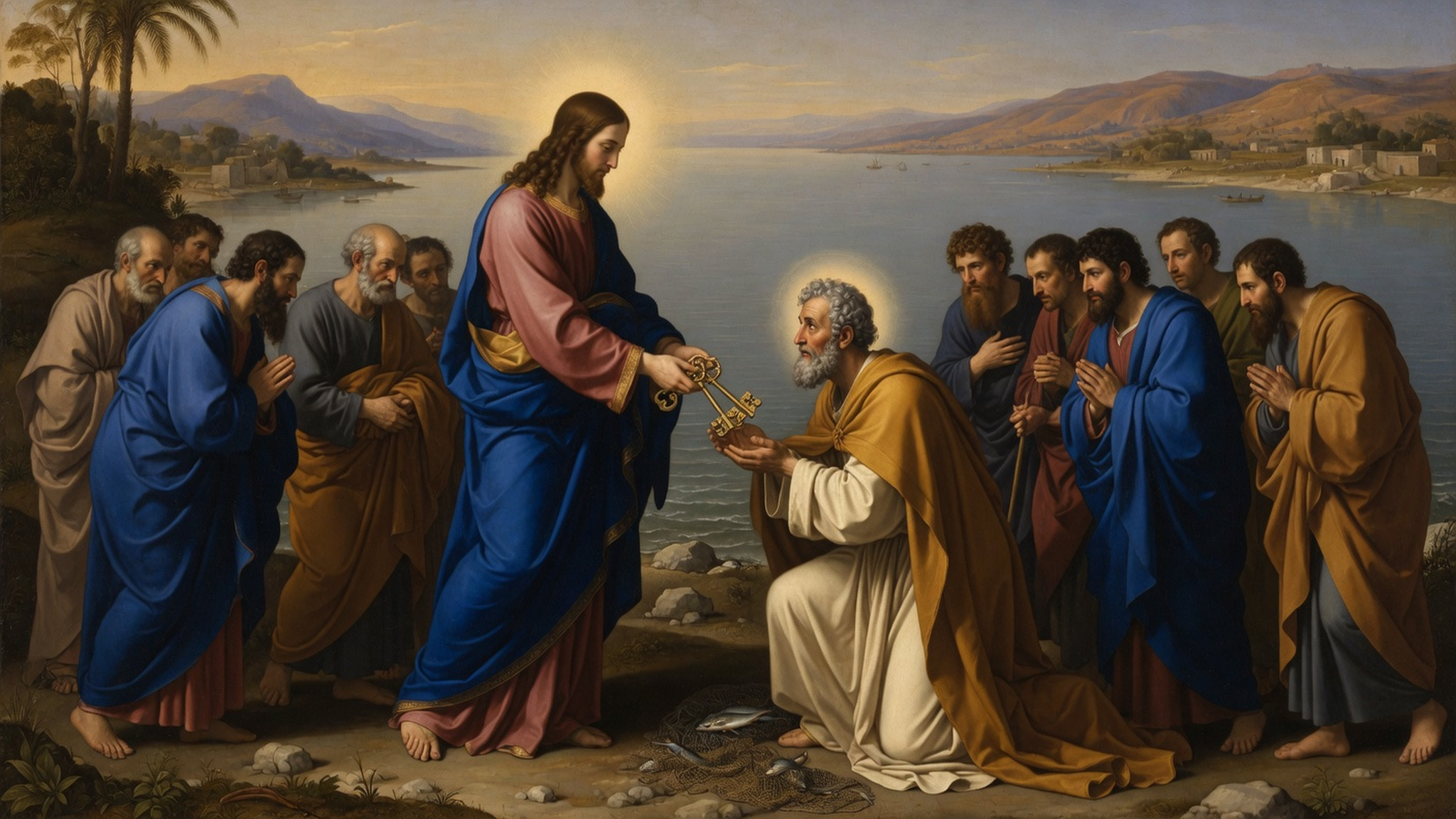
Added to this solemnity is that of the confession of faith which was made by this Prince of the Apostles when, being instructed not by flesh and blood, but by the revelation of the eternal Father, he recognized and confessed Jesus Christ as his Son by nature and as the Savior of the world; and that Jesus Christ, in reward for his faith, said to him: 'You are Peter, and upon this rock I will build my Church, and all the power of hell shall never prevail against it; and I will give y ou the keys of the kingdom clefs du royaume des cieux Supreme spiritual authority entrusted by Christ to Peter. of heaven; and whatever you bind on earth shall be bound in heaven, and whatever you loose on earth shall be loosed in heaven.'
By these words, He established him as His vicar on earth and the foundational stone of His Church, and taught every faithful person that, to be incorporated into this mystical body, one must be united with this first stone which serves as its foundation, and live in the faith and doctrine of the Roman Church taught by the successors of Saint Peter. This is the benefit that is represented to us today under the name and by the feast of the Chair of Saint Peter in Rome. We must therefore understand that the Catholic Church has on earth a visible pastor who governs it, as vicar and lieutenant of its Spouse; Jesus Christ, before ascending to heaven, left here below this visible head to lead it externally with the light, influence, and spirit that would be communicated to it by Himself, the invisible head.
The unity of spiritual government
Justification for the necessity of a single and perpetual head for the Church, in the image of celestial hierarchies and human social structures.
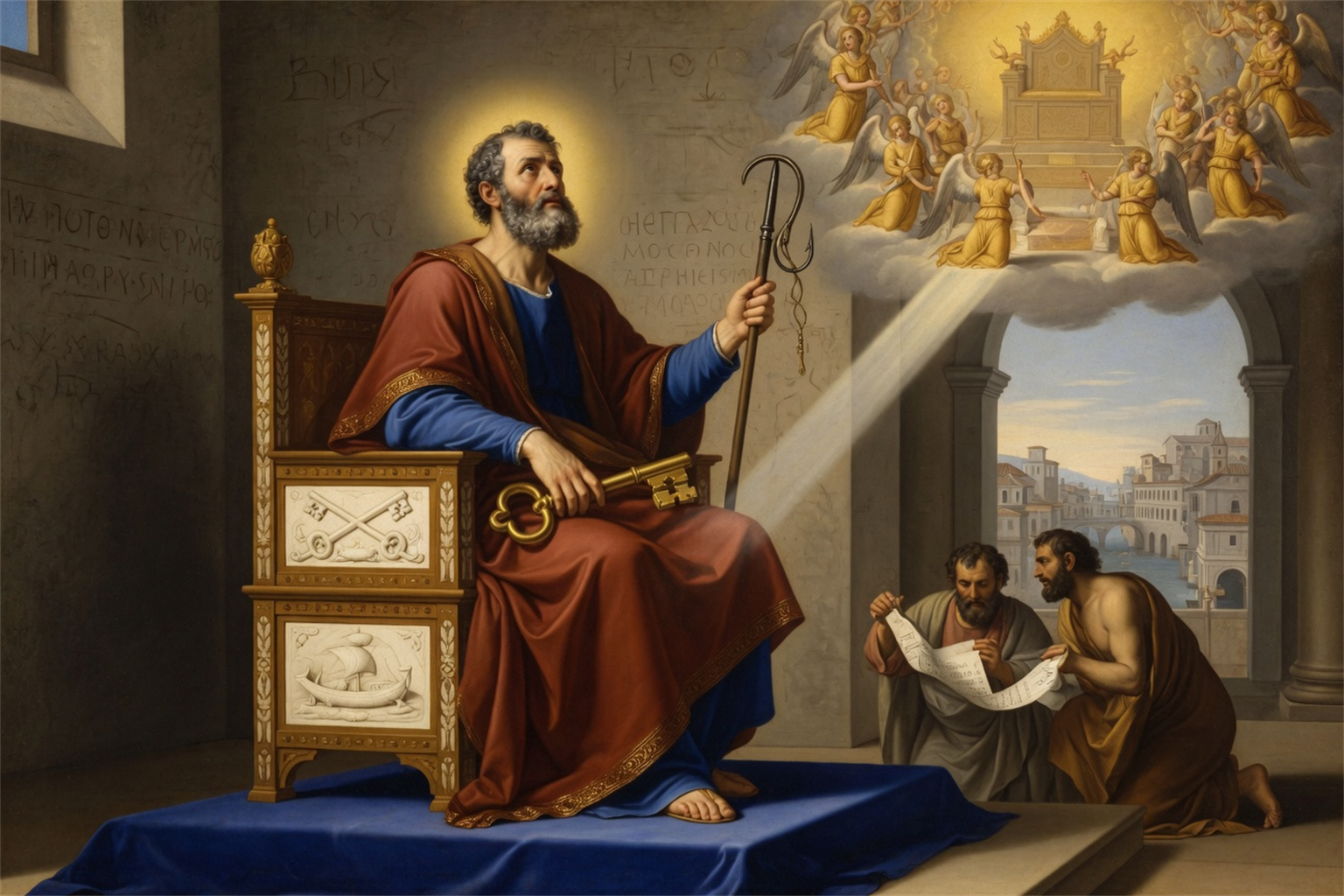
This shepherd is unique and without equal, because, as the faith of the Church is one, the judge of the causes of that same faith must also be one, so that there may be neither division nor diversity of opinion within it. Furthermore, as in every well-ordered family there is a head and a father of the family, as a flock has but one shepherd, a ship but one pilot, an army but one general, a kingdom but one sovereign prince, and as, if there were more, it would only be confusion, likewise, in the Church (which is called the family, the flock, the ship, and the kingdom of God), it is fitting that there be only one sovereign shepherd, one governor, one head, and one spiritual monarch by whom it is governed; that the spiritual kingdom of the Church not lack that which is most excellent in empires and temporal sovereignties, which direct their conduct toward a single head from whom subjects receive the law and feel the protection.
It is also reasonable that the ecclesiastical hierarchy be similar to the celestial hierarchy; now, in the latter, although we recognize various choirs of Angels, there is nevertheless one angel whom they all recognize as the most excellent and who is commonly esteemed to be Saint Michael. And if, in every parish saint Michel Archangel who appeared to Joan to reveal her mission. , there is a parish priest, in every cathedral church a bishop, and in every province a metropolitan; and if there are primates and patriarchs above the archbishops, it is more reasonable that, above all these degrees and all these dignities, there should be in the Church a Pope, that is to say, a Father of all Fathers, who may communicate to the inferior Fathers the power that is proper to him and that is necessary for them for the good of his sheep, and who, as universal shepherd, watches over the flock of Our Lord spread throughout the entire universe.
Furthermore, this sovereign shepherd must not only take care to feed this flock through inferior shepherds; but he must also call back to him the strayed and lost sheep, in order to change wolves into lambs and to convert the Gentiles to Christianity, sending good preachers to enlighten them with the light of the holy Gospel, as we see that he has always done, and that the Holy Apostolic See continues to do even now. This is why it was appropriate that this universal shepherd not only be one, but also perpetual, and that he should endure through a legitimate succession until the end of time: since the Church must be perpetual, and there must always exist sheep of Jesus Christ; otherwise divine Providence would be defective (if it is permitted to speak thus), since it would have founded the Church, which must last forever, upon the life of a mortal and fragile man.
The perpetuity of the Petrine mandate
Explanation of the transmission of Peter's powers to his successors, the bishops of Rome, to ensure the leadership of the Church until the end of time.
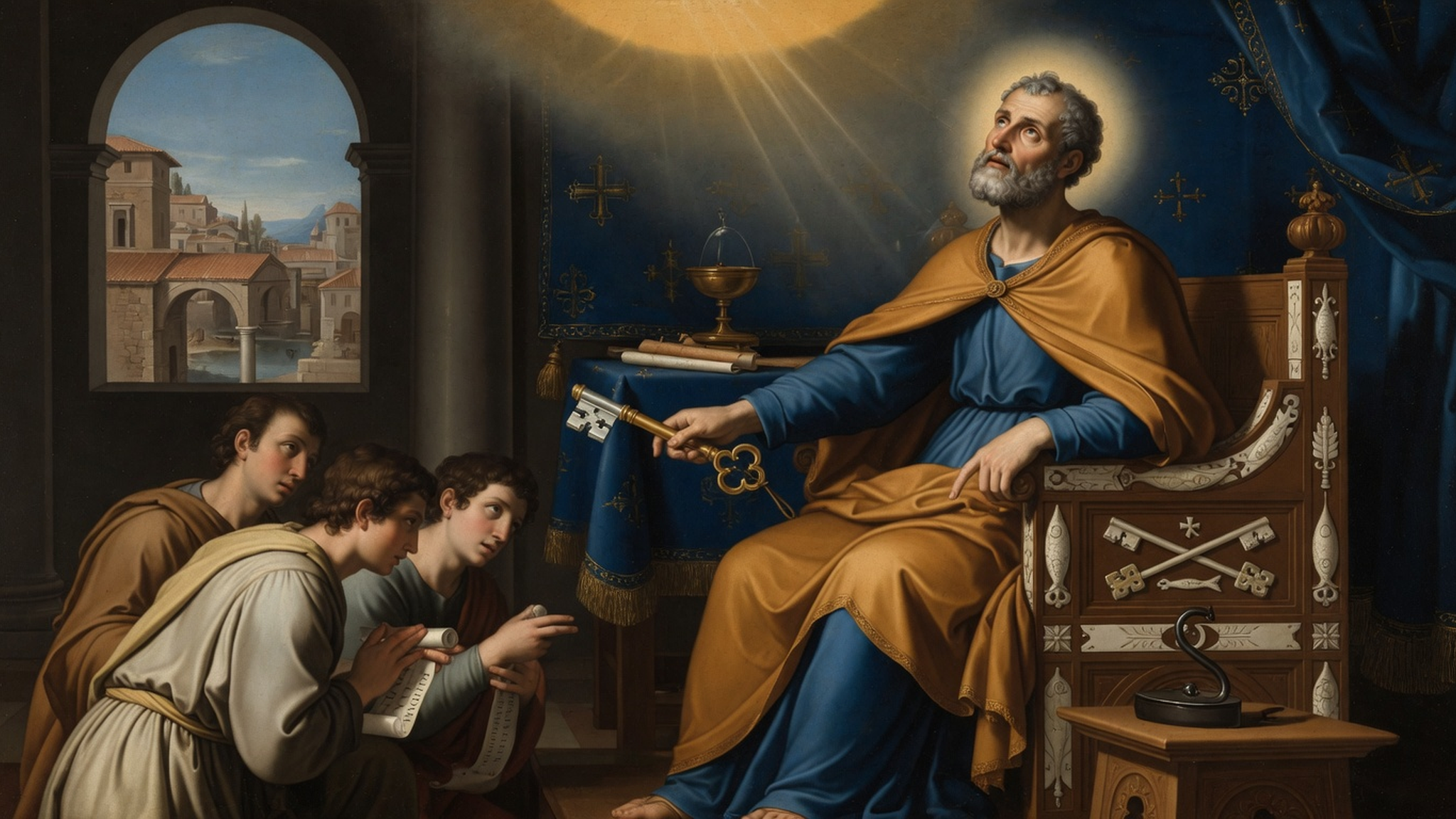
Thus, when Jesus Christ said to Peter: I will give you the keys of the kingdom of heaven, he was not promising them to him alone, but to all his successors, just as when God said to Adam: You are dust and to dust you shall return, he did not mean it only of the person of Adam; but he also included in this curse all the children of Adam. Likewise, when he promised Abraham to give him the land of Canaan, saying to him: I will give you this land, he meant that he would give it to his children and to all his posterity. In the same way, I say, Jesus Christ, in promising Saint Peter the keys of the kingdom of heaven, assured them not only to him, but also to all his successors: otherwise, his promise would have been of too small an extent; and, as we have said, the Savior would not have sufficiently provided for the government and the needs of his Church, not giving it a perpetuity of keys that would have the direction of it until the end of the world. This was even more necessary after the death of Saint Peter than during his life; for, while this holy Apostle lived, the number of the faithful was smaller; moreover, the Christians, in these beginnings, according to the terms of the Apostle, having the first fruits of the spirit and still drinking at the apostolic fountain, were more perfect and more ardent in the love of God. They therefore had less need of an external master who taught them this doctrine and who watched to defend them from many heresies, than those who came later, when a crowd of errors were raised against the word of God.
This universal and perpetual pastor is the bishop of the city of Rome, in which Saint P eter remained ville de Rome Birthplace of Maximian. for twenty-five years and where, by the order and eternal disposition of God, he established his chair not only for himself, but also for all his successors forever. Just as the generals of certain Congregations are not only generals and superiors of the whole Order, but, besides that, abbots or particular priors of some convent, so that he who is superior of this house is also general of his whole religion (the prior of the Grande Chartreuse of Grenoble, in France, is the general of all the other Charterhouses, and the abbots of Prémontré, Grandmont, and Cîteaux were also generals of the whole Order); likewise, the bishop of Rome is also general of the whole Church.
The triumph of Rome over the empire
Analysis of the choice of Rome as a spiritual center, transforming the former imperial capital into the seat of the spiritual monarchy by a humble fisherman.
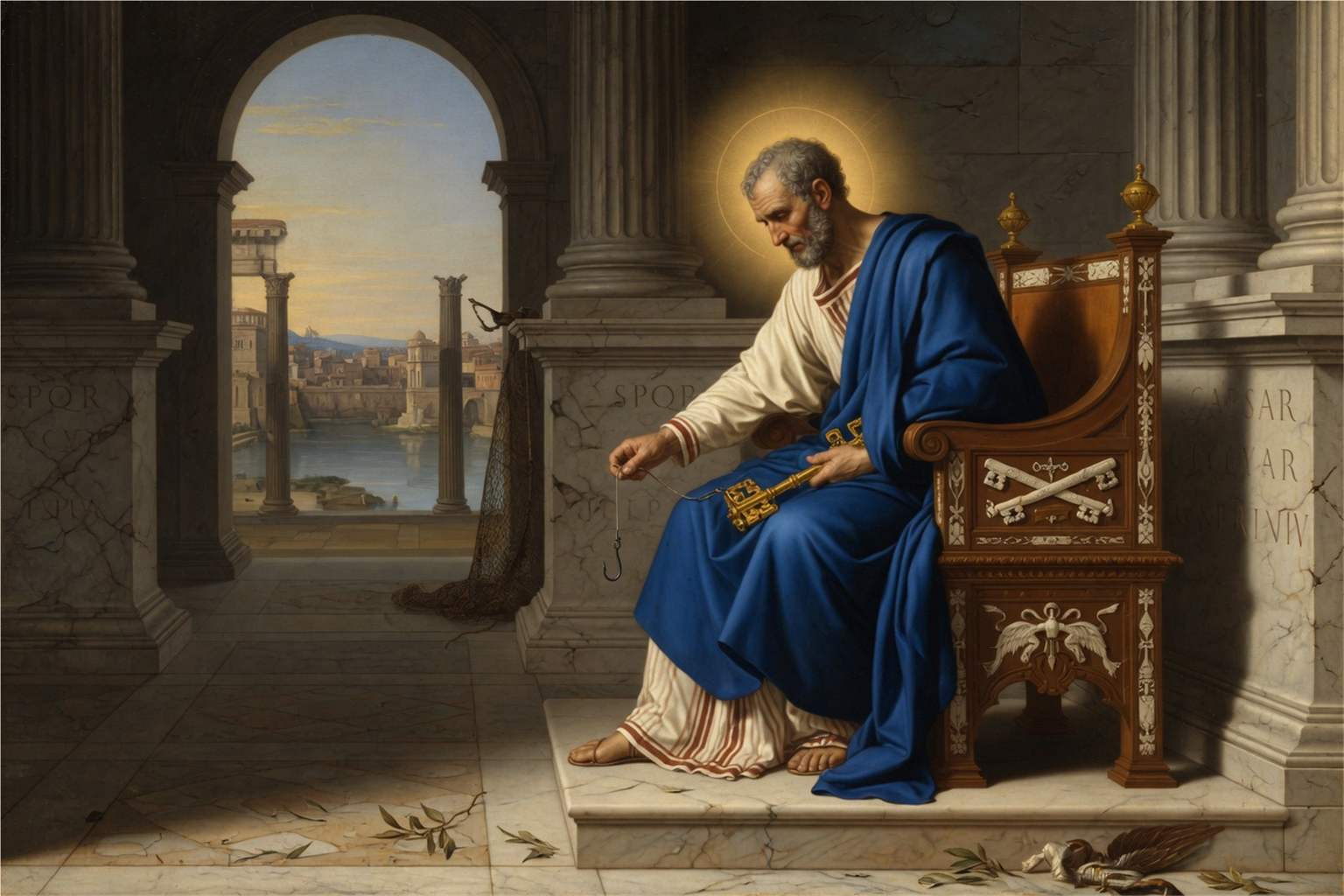
The Son of God willed to triumph, by the hand of a poor fisherman, over the ambition of this city which had subjected to its empire all the grandeurs of the universe, following the prophecy of Isaiah, and even that of the Erythraean Sibyl who, speaking of the disciples of Jesus Christ, says thus: He shall choose twelve fishermen, among whom there shall be a demon (this was Judas), and, without arms or swords, he shall tame the city of Rome with the fisherman's hook. He further willed to honor this city above all others in the world and to place the spiritual monarchy in the same place where the temporal had previously sat, so that they might help one another and join hands; the temporal serving the spiritual, as the inferior to the superior; and so that, being between the East and the West, it might more easily embrace and govern all the provinces of the world.
The Extent of Papal Authority
Detail of the Pope's prerogatives: convocation of councils, canonization of saints, canonical legislation, and authority over pastors and princes.
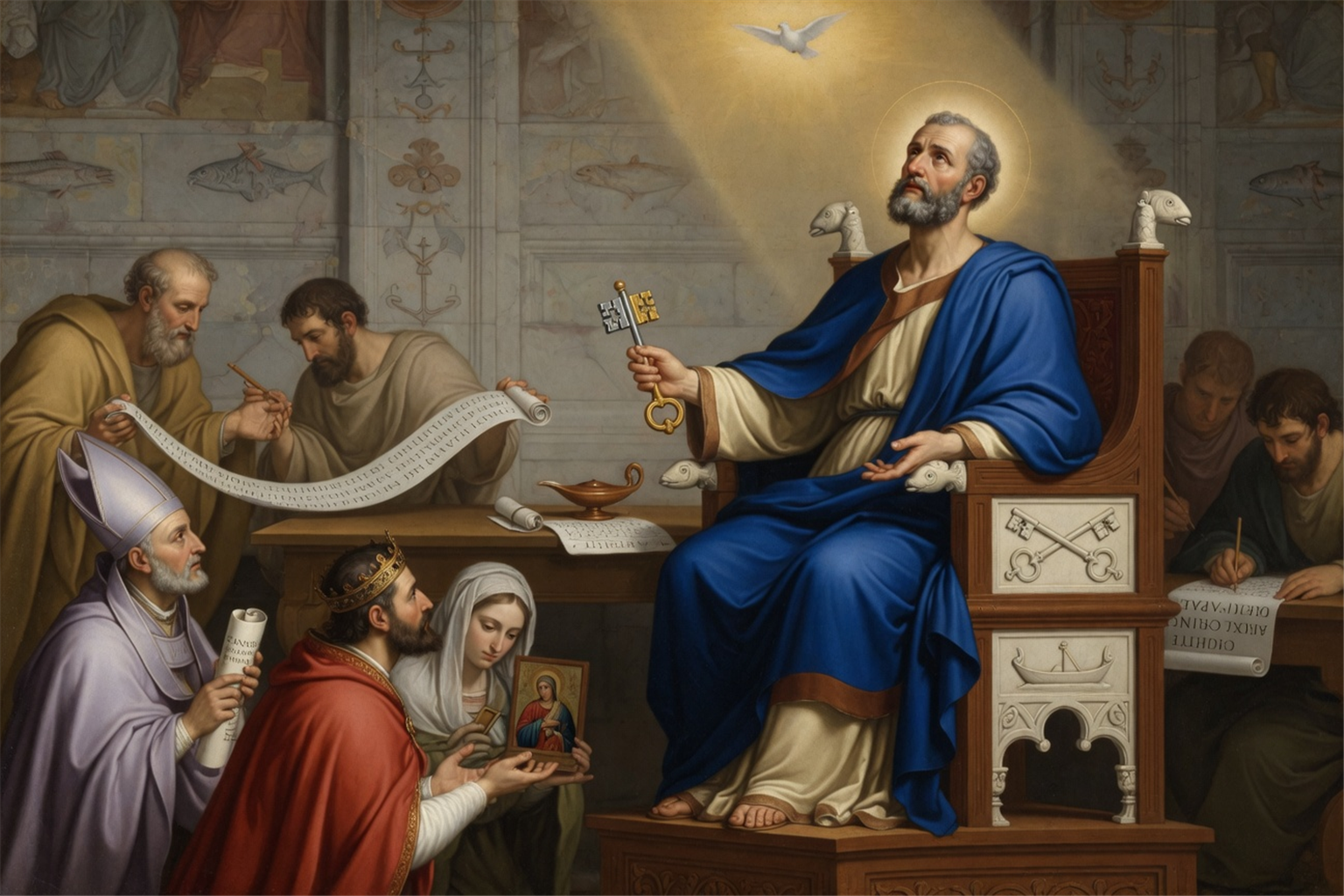
Saint Peter also received the keys from the hand of his Master, namely th e key of knowledge and the key of power; beca clef de la science et la clef de la puissance Supreme spiritual authority entrusted by Christ to Peter. use both were necessary for the good government of the Church: knowledge for the instruction of the ignorant, and power for the direction of the weak and for the punishment of the wicked. In both, He gave him fully everything necessary to lead souls to God, and, as the Apostle says, for the edification and not for the destruction of the Church. He gave him the power to assemble and celebrate Councils, to preside over them, to confirm their decrees and definitions, to institute new religious Orders, to approve their constitutions, and to propose them to the whole Church as sure paths to attain eternal life. He also gave him the power to examine the life, miracles, death, and merits of the saints, to declare them as such and to canonize them to make them more venerable throughout the Church; as well as to make laws that bind in conscience all the faithful; to interpret divine laws and to dispense from human laws, at least from ecclesiastical laws, and finally, to regulate all the law that is called canonical. He gave him the power to consecrate bishops, to institute Churches and to unite, divide, transfer, extend, and curtail them, as would be most suitable for the good of the faithful. He gave him authority over all other bishops and pastors, over all Christian kings and princes of this world, because they are among his flock; and as Christians, they owe him obedience regarding the salvation of their souls and that of their subjects. He gave him the power to distribute the treasures of the Church, to grant indulgences, and to forgive sins, which is the greatest of all goods and a singular benefit of God toward His Church.
On the occasion of this great and divine power which was conferred upon Saint Peter, the Pope, his successor, is called "the Father of all fathers, the Pontiff of Christians, the sovereign Priest or the prince of priests, the Vicar of Jesus Christ, the head of the body of the Church, the foundation of the ecclesiastical edifice, the Shepherd of the flock of Our Lord, the Father and Doctor of all the faithful, the Governor of the house of God, the Guardian of His vineyard, the Spouse of the Church, the Prelate of the Apostolic See, the universal bishop."
These are the names that the holy Councils and the Doctors of the Church give to him who sits on the chair of Saint Peter, which is the chair of truth, the mother of all religious orders, the infallible arbiter of all questions of faith, the certain rule of good morals, the light of heaven, the organ of the divine will, the touchstone of the holy books, the interpreter of Holy Scripture, the glory and ornament of the Saints, the consolation of the just, the terror of the wicked, the ruin and scourge of heretics, the asylum of the afflicted to which, as to a sure port, all the holy Prelates who were unjustly persecuted have had recourse, such as Saint Cyprian, Saint Athanasius, Saint Chrysostom, Theodoret, and many others.
The relic of the Chair and the celebration
Description of the physical chair preserved in the Vatican, originating from the house of the senator Pudens, and the liturgical rites associated with its feast.
It is to acknowledge this benefit that the Church celebrates today the feast of the Chair of Saint Peter, in order to stir us to give thanks to God for it. On this subject, Saint Gregory, Pope, in his Missal, in the book of Sacraments, which is kept in the Vatican library, tells us these beautiful words: "Truly, my God, it is a just and worthy thing to praise you for being so admirable in your Saints, as in those who glorify you sovereignly, who make the most beautiful ornament of the mystical body of your Son and who serve as the foundation of your Church, which you revealed to the Prophets and established upon the Apostles. Among these Apostles, you chose the Blessed Saint Peter because of the confession he made of your only Son; and placing him as the foundational stone of your Church, you made him high priest and depositary of your Sacraments and gave him the power to have kept in heaven what he would ordain on earth. In consideration of this honor, we solemnize this feast today and offer you sacrifices of thanks and praise, through the same Lord Jesus Christ."
There is still kept and shown in Rome the wooden chair upon which it is said that the glo rious apostle chaire en bois Wooden and ivory chair used by Saint Peter, preserved in Saint Peter's Basilica. Saint Peter sat, and God has performed several miracles through it.
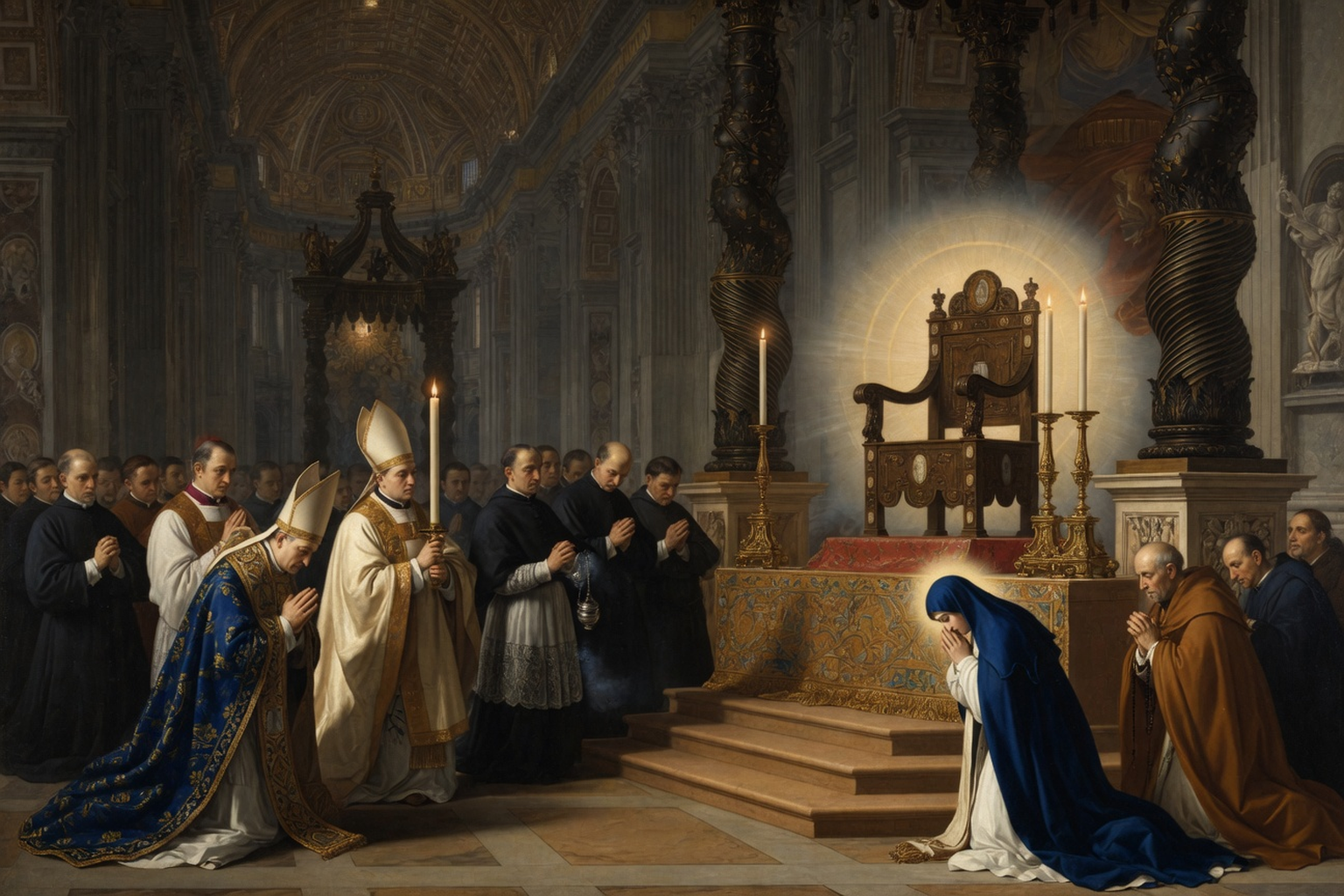
This Chair is nothing other than the curule chair of the senator Pudens, in whose p alace the Apostle taught the fir Chaise curule du sénateur Pudens Wooden and ivory chair used by Saint Peter, preserved in Saint Peter's Basilica. st Christians of Rome: it is made of wood inlaid with ivory and enclosed in a magnificent bronze and gold monument that occupies the entire back of the apse of Saint Peter's Basilica.
In memory of this gre at event, of the establis basilique de Saint-Pierre Primary place of preservation for the Holy Face in Rome. hment of the Holy See in Rome, which thus became the center of the faith, the Pope descends on this day into the basilica dedicated to the head of the Apostles. The Pope, carried on the sedia and surrounded by his entire court, goes to the back of the choir where his throne has been set up as for the great solemnities; only he does not officiate. A cardinal, the dean of the Sacred College or the cardinal-vicar, says, by exception, the mass at the Pope's altar. In the evening, there are solemn Vespers with music. At the end of Vespers, the Chair of Saint Peter is illuminated. The facade of the church, the monuments, and the houses of the city are also illuminated.
History and defense of the solemnity
Recall of the restoration of this feast by Paul IV in 1551 and historical defense of Saint Peter's presence in Rome.
In some very ancient breviaries, one finds an ecclesiastical office for the solemnity of the Roman Chair; it is fixed to this same day; one reads therein the following prayer: "Almighty and eternal God, who by an ineffable providence, have given to your apostle Peter the principate of the city of Rome, so that the evangelical truth might spread from there into all the kingdoms of the world, grant, we beseech you, that the Christian universe may receive and devoutly practice all that, from this source of preaching, has spread over the globe of the earth."
This sacred solemnity having fallen into disuse in several churches, P ope Paul IV Pape Paul IV Future pope who collaborated with Jerome in Venice. brought it back into force by an apostolic letter dated January 6, 1551. As for the establishment of the see of Saint Peter in Rome, if there have been men to contest and deny it, it is because with audacity and passion there is nothing that one cannot contest and deny. It was a generally accepted custom in antiquity to celebrate in each church the anniversary of the enthronement of the reigning bishop. We shall see on June 29 the history of the arrival and preaching of Saint Peter in Rome.
Annexes & related entities
Structured data for exploration: events, miracles, quotes, places, attributes, patronages, and important entities cited in the text.
Key Events
- Confession of faith before Jesus Christ
- Reception of the keys to the kingdom of heaven
- Apostolic see in Antioch for seven years
- Arrival in Rome in the year 44
- Establishment of the Apostolic See in Rome
- Twenty-five-year episcopate in Rome
Miracles
- Miracles performed by the wooden chair preserved at the Vatican
Quotes
-
You are Peter, and on this rock I will build my Church
Gospel (cited in the text) -
He will choose twelve fishermen... and, without arms or swords, he will tame the city of Rome with the fisherman's hook
Erythraean Sibyl