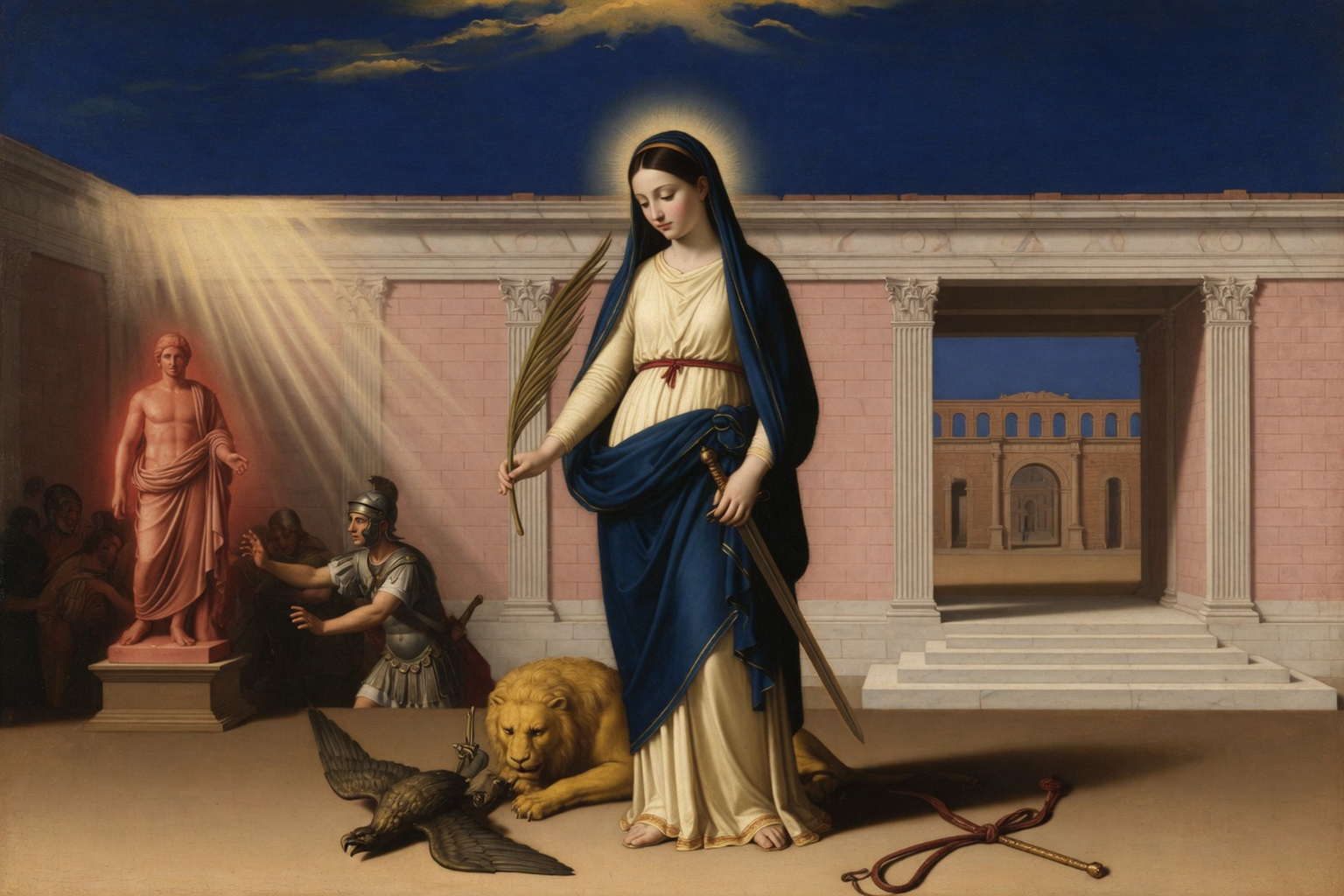
A young thirteen-year-old Roman and daughter of a consul, Saint Prisca is considered the protomartyr of the West. Under Emperor Claudius I, she endured numerous tortures from which she emerged miraculously unharmed before being beheaded in 54. Her cult is centered on the Aventine Hill in Rome.
Guided reading
6 reading sections
SAINT PRISCA, VIRGIN AND MARTYR
Historical context and status
Saint Prisca is presented as the protomartyr of the West, hailing from the Roman nobility during the reign of Emperor Claudius I.
Circa 54 A.D. — Pope: Saint Peter. — Emperor: Claudius I.
Saint Prisca is regarded as t Sainte Prisque Protomartyr of the West, executed in Rome at the age of 13. he protomartyr of the West. Thus, the first regenerating blood that flowed in ancient Rome was Roman blood, ill ustr Rome Birthplace of Maximian. ious blood, virginal blood.
*Les trois Rome*, 1, p. 432, 1804 edition.
Trial and initial tortures
At thirteen years old, Prisca refuses to worship Apollo and undergoes various tortures marked by divine interventions, such as a miraculous brightness and sweet perfumes.
This young girl, whose father had been honored three times with the office of consul, having been arrested as a Christian, was presented to the empe ror who, s l'empereur Roman emperor under whom Saint Prisca suffered martyrdom. eeing her so young and of such regular beauty, persuaded himself that he would easily make her change her resolution and purpose; for she was barely thirteen years old. To this end, he had her taken to a temple of Apollo so that she might worship this idol, but the holy girl replied constantly that she would never bend the knee except before the one and true God who made heaven and earth, and before His only Son, Our Lord Jesus Christ. The emperor, transported with anger at such a generous response, ordered that she be roughly slapped and taken to prison until the next day. He had her appear again, and finding her still unshakable, had her stripped, so that in this state she might be beaten with rods; but He who clothes the meadows with flowers provided her with a rich garment: it was an admirable brightness that made her shine like a sun; the more the executioners rained whip lashes upon her small limbs, the more her flesh appeared of a pleasant whiteness; so much so that she dazzled the eyes of the onlookers with her radiance. A certain Limenius, a relative of the emperor, advised him to rub her with oil so that she might lose this luster and beauty of her body which charmed the eyes of those who looked at her. This advice was followed; but it had a result contrary to the thought of this wretch, because instead of the fetid odor that these substances should have caused, they exhaled a very sweet perfume which was smelled even by the pagans, so much so that the emperor, losing heart, withdrew in confusion, giving orders to his prefect to have the body of the Saint torn with iron claws: which was executed. Then, she was brought back to prison in the state of nudity in which she was: the same brightness enveloped her body.
Condemnation and execution
After surviving the beasts, the rack, and the fire, the saint was finally beheaded near the Ostian Gate in the year 54.
This being reported to the judge, he had her taken from that dungeon and exposed in the amphitheater, to be devoured by a lion that was released upon her; but this animal, forgetting its natural cruelty, threw itself at her feet like a lamb. The emperor, outraged with spite, had her subjected to torture and stretched on the rack, in order to torture her arms and legs; from there, she was thrown into a brazier; but the fire had no more hold on her than the other torments had had. Finally, after having her head shaved, out of ignominy, and kept locked for a long time in a temple of idols, he had her head cut off outside the Ostian Gate, on January 19, in the year of Our Lord 54.
Cult and translation of relics
Her body, initially buried on the Ostian Way, was transferred to Rome and then partially to France and Belgium over the centuries.
The body of Saint Prisca was buried by the Christians on the Ostian Way, where she had suffered martyrdom, and was later transported into the city, to a church of that name, under Pope Eutychi an. Some of he pape Eutychien Pope who had the saint's body transported to his church. r relics were brought to France by Galon, 63rd Bishop of Paris, in the year of grace 1108; John, Count of Soissons and Lord of Chimay, in Hainaut, broug ht oth Chimay Town in Belgium where relics were kept before being destroyed. er bones in the year 1281; these latter perished in the fire of the city of Chimay when the French sacked it in 1552.
Iconography and apostolic links
Tradition links the saint to Saint Peter and identifies her church on the Aventine as the former home of Aquila and Priscilla.
The acts of Saint Prisca bear a strong resemblance to those of Saint Martina: so much so that she is also given as attributes the eagle that defends her body; the lion that lies at her feet; the sword with which her head is severed; etc. — One could distinguish her by depicting her being baptized by Saint Peter.
The tradition of Rom e is that Sa saint Pierre Apostle and first pope, mentioned as the father of Petronilla. int Peter consecrated an altar in the church of Saint Prisca, and that he baptized there in a stone urn which is still shown today. There is nothing incredible in this, if it is true, as is said, that this church was built on the site where the house of Aquila and Priscilla, of whom Saint Paul speaks, once stood. It appears, from the last chapter of the Epistle to the Romans, where the Apostle greets twenty-five people, that the house in question was the only one where there was a church; at least, no other is named. This church still ex ists on the mont Aventin Hill in Rome where the house of Euphemianus was located. Aventine Hill.
Distinction between the Saint Priscillas
The text clarifies the links and distinctions between the martyr Prisca, the couple Aquila and Priscilla, and another Priscilla linked to Saint Pudentiana.
Aquila Aquila Jewish Christian, companion of Saint Paul, associated with the house where the church of Saint Prisca was built. or Acylas, born in Pontus, and Priscilla Priscille Wife of Aquila, often confused or associated with the saint and martyr. or Prisca, his wife, both Jews by birth and tentmakers, had settled in Rome; but the edict of banishment that the Emperor Claudius issued against all Jews having forced them to leave that city, they withdrew to Corinth. It was with them that Saint Paul lodged, who had converted them, and who practiced the same trade. They risked their lives to save that of the Apostle, whom they accompanied as far as Ephesus when he left Corinth. They then returned to Rome. They were there when Saint Paul greeted them in his Epistle to the Romans. Finally, they returned a second time to Ephesus, where they were when Saint Paul wrote his second Epistle to Timothy, in which they are both greeted. It must be noted, however, that the Apostle gives the name Prisca to the one who is called Priscilla in the Acts, in the Epistle to the Romans, and in the first to the Corinthians. The Greeks celebrate the office of Aquila, as an apostle, on July 14. The feast of this Saint, as well as that of Saint Priscilla, is marked on the 8th of the same month in the Roman Martyrology. They are honored on this day in Rome, in the church of Saint Prisca, Virgin and Martyr, of whom they are, jointly with her, titular patrons. A considerable portion of their relics is under the high altar of the same church. See the Acts of the Apostles, XVIII, 2; the Epistles of Saint Paul; the notes of Baronius on the Roman Martyrology, on January 18 and July 8, and the notes of Chastelain.
Another Saint Priscilla appears in the Acts of Saint Pudentiana and Saint Praxedes. The book of the Shepherd speaks of a cemetery built by her care. One can still see, says Baronius, near the baths of Novatus, cells joined together by masonry vaults; they are in a remarkable state of preservation and almost still intact; they are believed to have served for the burial of martyrs taken away in secret. It is this one who is referred to in the Roman Martyrology on January 16, last mention; she was a disciple of the Apostles and mother of the senator Pudens, as attested by the Acts of Saint Pudentiana.
Annexes & related entities
Structured data for exploration: events, miracles, quotes, places, attributes, patronages, and important entities cited in the text.
Key Events
- Arrested at the age of thirteen under Emperor Claudius I
- Refusal to worship the idol of Apollo
- Scourging and miracle of the luminous light
- Exposed to lions in the amphitheater
- Torture on the rack and the brazier
- Beheading outside the Ostian Gate
Miracles
- Luminous clarity enveloping her body after the flagellation
- Sweet fragrance emanating from fetid oil
- Lion tamed at her feet in the amphitheater
- Insensitivity to the flames of the pyre