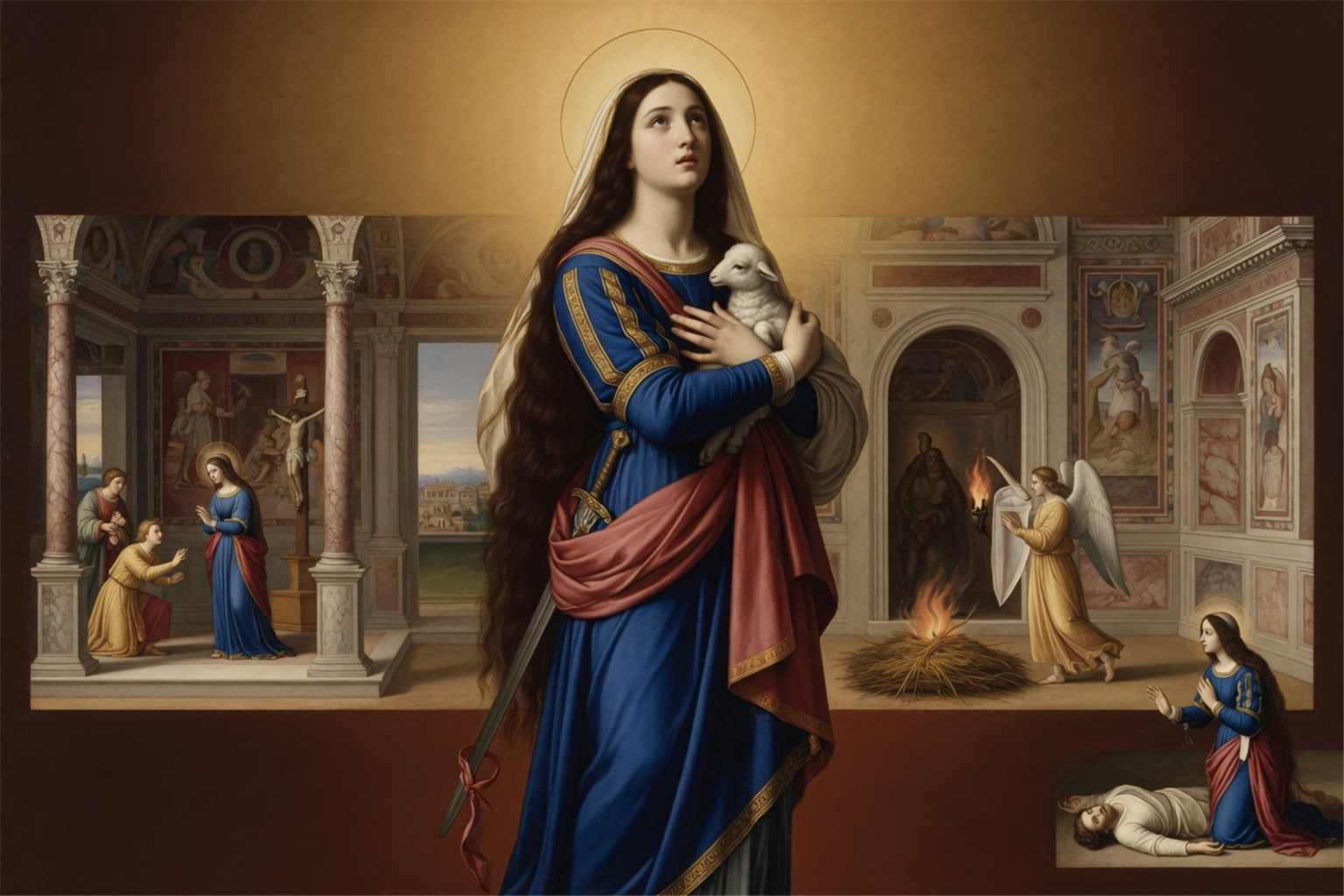
A young Roman girl of thirteen, Agnes refused to marry the prefect's son to dedicate herself to Christ. After being miraculously protected in a place of infamy and surviving the pyre, she was put to death by the sword in 304. Her cult is one of the most famous in Rome, symbolized by the annual blessing of the lambs.
Guided reading
8 reading sections
SAINT AGNES, VIRGIN AND MARTYR
Origins and early piety
Born in Rome to wealthy Christian parents, Agnes dedicated herself to Jesus Christ from childhood, drawing many companions to virtue.
Saint Agnes, the beloved of the Romans. *Les trois Rome*, vol. II, p. 139, 1864 ed. Saint Agnes is popular and cherished. *Parfum de Rome*, vol. II, p. 306, 1867 ed. Her name alone is a praise. Saint Ambrose, *Book of Virgins*, I.
Blessed Agnes, you were beautiful of face; but how much more beautiful you are through faith. You have despised the world, you shall rejoice with the angels. Intercede for us. *Dominican Liturgy.*
This holy girl was born in Rome to wealthy an d Go Rome Birthplace of Maximian. d-fearing parents, who took great care to raise her according to her rank and birth, but primarily to form her in the laws of Christianity which they professed. From her most tender years, she conceived a very ardent love for Jesus Christ and advanced so much in it, that the meditation on the sufferings and death of her Spouse was her most ordinary nourishment. From then on, God had filled her with such grace that she drew many people to virtue by her example; indeed, she converted several of her sex to the true faith and the Christian religion, so much so that one can legitimately give her this praise that the Holy Spirit gives to the Queen, spouse of the great King: « Many virgins shall be brought to the King after her, and her companions shall be presented to him with joy and gladness ».
The Refusal of Earthly Marriage
Agnes rejects the advances of Procopius, son of the governor of Rome, affirming her exclusive union with a heavenly Spouse of incomparable qualities.
However, the demons tried, by all sorts of means, to stop the course of these happy developments; for as Agnes approached her twelfth or thirteenth year, this enemy wished to use the beauty of her body to make her lose that of her soul. With this design, he excited a violent love in the heart of Procopius, son of the governo r of Ro Procope A spurned suitor whose death and resurrection mark the narrative. me; this young knight, having inquired about all of Agnes's qualities and seeing that he would not be marrying beneath his station, used every possible artifice to obtain her. But as the holy girl's parents were thinking it over at their leisure and not with the haste he would have desired, impatient to see the fulfillment of his desires, he sought the opportunity to see her and speak to her, hoping that this would be the shortest path to achieving the goal of his pretensions. As he had influence and, consequently, great connections in the city, he soon found a way to make his passion known to Agnes; but God, who had this holy girl under His protection, had also filled her soul with a virtue so elevated that she could easily confound all the wisdom of the world. This first step not having succeeded to Procopius's liking, after several other expedients he attempted in vain, he resolved to be the mediator of his own affair and managed to meet Agnes to reveal his thoughts to her. He saw her, therefore, and after saying everything his passion put into his mouth and imploring her not to refuse his alliance if she did not wish to be an enemy to her own well-being, he offered her the gifts he had brought for this purpose, so that their great value might finish persuading her. But the holy girl, rejecting all his proposals, said to him in a resolute manner, full of Christian modesty:
"Withdraw, brand of hell, goad of sin, stone of scandal, and bait of death! Do not think that I will ever be unfaithful to my Spouse, to whom I have so united myself that my soul lives only by His love. Do not flatter yourself with the thought that there is any merit in you that could justly make you claim to be His rival; for He possesses six qualities that make Him incomparable and uniquely worthy of love: He is noble, He is beautiful, He is wise, He is rich, He is good, He is powerful. If you wish to know His lineage, He recognizes a God as His father who produced Him without a mother, and the mother who brought Him into the world was no less a virgin for having had this son. He is so beautiful that His splendor surpasses the brightness of the sun and all the stars, and the heavens themselves are enraptured in admiration of His beauty and say, in their own language, that they are but darkness in comparison to Him. He is so wise and has so captivated me with His love that I cannot think of anyone but Him; and now that I speak of His excellence, I feel such great pleasure that, although I hold you in horror, I am quite glad to see you so that I may tell you of it. He is so rich that He has given me a treasure worth more than the entire Roman Empire, and no one serves Him without being filled with riches. What shall I tell you of His goodness, which has no measure? To make it appear with more brilliance, He has marked me with His blood. He has given me His faith and His word that He will never abandon me. He has taken me for His spouse, He has given me beautiful robes and beautiful jewels of inestimable price. He is so powerful that He cannot be defeated by all the forces of heaven and earth; the sick are healed by the heavenly perfume that escapes from His person, and the dead return to life by the brilliance of His voice: that is why I am entirely His, I love Him more than my soul and my very life, and I would be very happy to be able to die for Him. When I love Him, I am chaste; when I approach Him, I am pure, and when I embrace Him, I am a virgin. This being so, see if I should abandon Him in the hope of some reward or for fear of some punishment."
May young girls follow this example of Saint Agnes and may they take great care, cries Saint Maximus, not to take gifts from the hand or on behalf of men, even under the guise of piety. "For whenever someone does not give you something to fear God more," says the Saint, "do not receive anything from him that makes you love the world more."
The ordeal of the infamous place
Accused of Christianity, Agnes is condemned to be exposed in a place of debauchery, but her purity is protected by the miracle of her hair and the presence of an angel.
Le fils du préfet, entendant ces discours d'Agnès, crut qu'elle était éprise d'amour pour quelque autre grand seigneur, et, qu'étant enivrée de cette passion, elle parlait en frénétique, appelant celui qu'elle aimait son Dieu, son idole, sa vie et son âme (ce sont les noms dont les amants qualifient quelquefois ce qu'ils aiment); mais il en ressentit une telle jalousie, qu'il en demeura au lit malade. Son père appelé Symphrone Symphrone Prefect of Rome and father of Procopius. , en sachant la cause, fit venir la sainte fille et s'efforça de lui persuader, par tous les artifices possibles, d'épouser son fils qui était le meilleur parti qu'elle put souhaiter; mais il la trouva inébranlable dans sa résolution et elle lui dit que, pour tous les biens du monde, elle ne changerait jamais l'Époux qu'elle avait déjà pris. Il voulut savoir qui pouvait être celui pour qui Agnès avait un si grand amour, et alors quelqu'un lui dit: « Seigneur, cette fille est chrétienne; elle a été nourrie, dès le berceau, en l'art magique auquel les chrétiens s'appliquent fort, comme l'on voit par ce qu'ils font tous les jours; ainsi, soyez certain que cet Époux dont elle parle n'est autre que le Dieu des chrétiens ». Le préfet fut bien joyeux de savoir cela, pour avoir sujet de maltraiter Agnès et de se venger d'elle sous une si belle apparence; car il ne pouvait pas la maltraiter de ce qu'elle ne voulait pas épouser son fils; comme elle était de grande condition, il n'avait que ce prétexte pour se venger de son refus. Il résolut donc de faire tous ses efforts pour gagner la sainte fille, premièrement, par de douces et de belles promesses, puis, si cela ne suffisait pas, l'intimider par des menaces et des tourments. Pour cet effet, il la fit comparaître devant son tribunal et l'attaqua vivement de tous côtés, usant de toutes les adresses et de tous les artifices que la malice armée du pouvoir emploie ordinairement pour venir à bout de ses prétentions. Et comme il vit que rien ne pouvait ébranler ce cœur uni à son Époux céleste, il lui dit enfin: « Marie-toi, ô Agnès, ou, si tu veux être vierge, sacrifie à la déesse Vesta et la sers toute ta vie, comme font toutes les autres filles romaines, sinon je te châtierai selon que tu le mérites et te ferai conduire en un lieu où tu souffriras toutes sortes d'indignités, sans te pouvoir retirer des mains de ceux qui te tiendront une fois ». — La sainte répondit: « Ne vous échauffez pas davantage, ô préfet; car il n'y a rien au monde capable de me faire quitter l'Époux que j'ai choisi; si je refuse le mariage de votre fils, que j'estime d'ailleurs beaucoup, je ne me laisserai pas abuser jusqu'au point d'adorer des statues insensibles, qui n'ont ni oreilles, ni langue, ni vie. Vous me menacez de me faire traîner en un lieu infâme, pour y exposer ma pureté: c'est ce que je ne crains pas; parce que j'ai un ange avec moi, qui est l'un des serviteurs innombrables de mon Époux, par lequel je suis gardée et qui prendra ma défense d'une façon merveilleuse, et mon Seigneur Jésus, que vous ne connaissez pas, m'environne de toutes parts, comme un mur que l'on ne saurait forcer ».
Cette répartie mit le juge en telle fureur qu'il commanda qu'Agnès fût dépouillée et traînée toute nue jusqu'au lieu infâme auquel il l'avait destinée, et que le trompette allât devant elle, criant que c'était Agnès, la sorcière et la magicienne, que le préfet de Rome avait condamnée aux maisons d'infamie pour avoir blasphémé contre les dieux, afin que ceux qui en voudraient abuser y puissent aller librement. C'était là un procédé fort ordinaire parmi les Gentils qui faisait voir par là que les dieux qu'ils adoraient étaient impurs et déshonnêtes; cependant les filles et les femmes chrétiennes estimaient cela plus horrible que la mort même, car, comme dit Tertullien, elles aimaient mieux être exposées aux griffes des lions qu'à des mains impudiques. Au reste, l'ordre qu'ils tenaient en cette infâme exécution était celui-ci: ils prenaient une fille chrétienne et l'enfermaient dans l'une des chambres de ce lieu abominable, écrivant sur la porte le nom de la personne et le prix du péché, et alors les loups y venaient en sûreté pour déchirer la brebis innocente qui s'y trouvait enfermée.
La justice divine souffrait cette détestable impiété pour faire éclater les admirables effets de sa providence en faveur des âmes pures, qu'elle empêchait par sa grâce de brûler au milieu des flammes, et afin de faire connaître au monde la pureté et la sainteté de la religion chrétienne, montrant qu'il n'est point de bras assez puissant pour s'opposer à la force du sien, comme il parut en la bienheureuse Agnès. Car les bourreaux ayant dépouillé ce beau corps de tous ses habits, ses cheveux grandirent en un moment par miracle et en si grande quantité qu'elle en eut assez pour cacher tous ses membres; de sorte que son corps ne put être vu, ni servir de spectacle aux yeux sensuels de ses bourreaux. Lorsqu'elle fut contrainte d'entrer en ce lieu d'infamie, elle y trouva un ange pour la défendre et une belle robe plus blanche que la neige qui lui servit pour se couvrir, et même le lieu fut éclairé d'une très-brillante lumière; de quoi la sainte fille, étant toute consolée et transportée de l'amour de son Époux, se mit en oraison, rendant grâces à celui qui faisait tant de prodiges pour la protéger.
Ainsi la chasteté d'Agnès ne se flétrit point par l'impureté; mais le lieu, au contraire, demeura ennobli par sa pureté; ce cloaque de turpitude devint un paradis de chastes plaisirs, et cet antre d'impureté fut converti en un séjour angélique et en un temple de la Divinité, laquelle est honorée, en cette même place, dans une église qui y fut bâtie et qui est demeurée jusqu'à présent le souvenir éternel d'une si illustre victoire remportée par la sainte résolution d'une jeune fille. Il faut donc que le prince des enfers cède aux serviteurs du Tout-Puissant, puisqu'il a été vaincu par une jeune fille de treize ans, et qu'au milieu d'un abîme de corruption, la chasteté a trouvé un port assuré pour conserver son intégrité. Les jeunes hommes lascifs entraient dans la chambre de la Sainte et tout étonnés de ce qu'ils voyaient, ils en sortaient chastes et convertis; ils y entraient impudiques et déshonnêtes, et ils en revenaient purs et sanctifiés; ils y accouraient pour satisfaire l'appétit déréglé de leur chair et ils y recevaient l'esprit de continence et de modestie, lequel dépend de la bonté de Dieu qui le donne quand il lui plaît.
Death and resurrection of Procopius
Procopius dies while attempting to assault the saint, but Agnes obtains his resurrection through prayer, prompting the young man's conversion and the fury of the pagan priests.
Procopius, who was the primary motive for the cruelty exercised against the Virgin, wishing to accomplish his wicked design, entered the chamber like the others, and without looking at what appeared admirable there, he sought to attack and force her; but he was forestalled by the angel who guarded her, who, striking him in the heart, threw him down stone dead at her feet. The other young men, his companions who were waiting at the door, seeing that he was taking too long, entered after some time, and finding him stretched out on the floor, they began to cry out while weeping: "Come, O Romans, come; for Agnes the sorceress has killed the prefect's son with her charms." This rumor, spreading immediately throughout the city, reached the ears of Symphronius, who ran like a desperate man to the place where his son's body lay: seeing him lifeless, he addressed Agnes and said to her what rage and fury make one say when they carry away reason; he called her a fury sprung from hell, a witch and an enchantress, a monster born for the desolation of his life, asking her with many imprecations why she had robbed him of his son, what injury she could have received from him to commit this crime, and if she felt offended by the love of a man of the quality and merit of Procopius. Agnes received these invectives without being moved and replied with modesty: "I have not taken the life of your son; his impudence and temerity alone caused his death. Those who entered here before him left freely, because seeing this chamber full of light, they rendered to the great King of heaven the honor that is due to him; they knew that when I was stripped, he clothed me; that when I was alone and abandoned, he preserved me from the insults of my persecutors, and that he has preserved my virginity which I consecrated to him from the cradle. But your son, transported by fury, without having respect for my God, wished to violate me; that is why the angel who guards me caused him to die miserably."
Then the prefect said to her in a more moderate voice: "I pray you then to restore life to my son, so that everyone may know that you did not take it from him by charms and by the magic art." The Saint replied to him: "Doubtless your blindness makes you unworthy of this favor; but so that the glory of my Spouse may be better recognized, and that the whole city of Rome may know the happiness of those who serve him with fidelity, leave this chamber, you and those who have come with you, while I make my prayer to obtain from him what you desire." Symphronius having left the chamber, Agnes threw herself to the ground, and with her cheeks bathed in tears, she prayed to her beloved Spouse to restore life to Procopius, who was no longer a man, but an infamous corpse. During the ardor of her prayer, an angel of heaven appeared to her, and exhorting her to take courage, he resurrected the one for whom she was praying. There was no need for any other herald of truth than this same son of Symphronius; for, leaving the house, he began to cry out: "There is no other God in heaven or on earth, in the sea or in the abyss, than the one who is the Almighty, adored by the Christians; to him alone is all honor due; he alone must be adored; idols are only deceptive spirits that abuse us, in order to drag us with them into hell." As soon as these speeches of the resurrected Procopius reached the ears of the idolatrous pontiffs, they began, with all the people seduced by them, to make their cries resound to the clouds: "Let the sorceress die! Let them put to death the witch, the impudent, the infamous one who by her charms makes men lose their minds, makes them become beasts, and like another Circe, transforms them into animals devoid of reason!" The prefect was very astonished by these cries, because having seen such great wonders in the Saint, he would have liked to save her life. But seeing himself overwhelmed by popular fury and carried away by the violence of the idolatrous priests, like a cowardly man, he let himself be overcome by fear, and entrusting the judgment of this cause to his lieutenant Aspasius, whom some a lso ca Aspase Lieutenant of the prefect who condemned Agnes to the stake and then to the sword. ll Paternus, he withdrew, according to the custom of timid and fearful judges who, knowing the truth, do not wish to commit themselves to defending it, as they are obliged to do. Aspasius commanded that Agnes be brought into his presence, and having had a great fire lit, he had her thrown into it. But the justice of heaven not wishing to suffer that she who had never been touched by the fire of concupiscence should be consumed by material fire, the flames divided, left her sound and whole without doing her any harm, and turned their fury against the idolaters, some of whom were reduced to ashes, while the others cast a thousand kinds of imprecations against the innocent virgin. As for her, all filled with joy and gladness, she turned toward her Spouse and said to him: "O my almighty God, worthy of all praise and all honor, I praise you and glorify your holy name because, by the virtue of your only Son Jesus Christ, I have conquered the violence of tyrants and passed through the path of impurity without being defiled. As a crowning wonder, I see that your heavenly spirit softens the ardor of this fire, making its flame gentle and its heat sweet, and that the executioners who torment me experience themselves the violence of this element. Blessed be your holy name, O Lord, since I already see what I desired, I enjoy what I hoped for, I hold in my arms what I loved: my heart, my tongue, my entrails, my soul, praise you and glorify you. I go to you, O true eternal God, who reign with your only Son Jesus Christ for ever and ever."
The final martyrdom
After miraculously surviving the fire of a pyre, Agnes is put to death by the sword on January 21, 304.
No sooner was this prayer finished than the fire was extinguished in such a way that neither mark nor vestige of it remained. But finally, Aspasius, to appease the popular tumult which was growing more and more, had her struck with a sword in the throat, and such an abundance of blood flowed from this wound that the Virgin's body was entirely covered by it. When the executioner raised the sword to strike her, he trembled and changed color as if he had been condemned to death, while Agnes awaited this blow with such great courage that it seemed, to see her, that she wished to blame the executioner's slowness and say to him: "What are you doing? What are you waiting for? Who is holding you back? Put to death this body which can be seen by the eyes of men, by whom I do not wish to be looked upon, and let the soul live, which is pleasing to the eyes of God. May that Lord, who chose me for his spouse and whom I wish to please, be willing, by his goodness, to receive me into his arms!" It was thus that she received the blow during the transports of her spirit, and that she won the crown of martyrdom on January 21, in the year 304. "Before receiving the blow," says Saint Ambrose, "she wraps herself in her garments. She is dead and modesty still watches; she has fallen to her knees and her hand veils her face."
"Her brilliant soul darts free through the air; a group of angels accompanies her on the luminous path."
"O happy virgin, o noble inhabitant of the heavens, incline toward us your head adorned with the double diadem of virgins and martyrs. The supreme God granted you to render pure the very place of impurity!".
Burial and posthumous miracles
Agnes is buried near Rome; her foster sister Emerentiana suffers martyrdom at her side. Later, she heals Constantia, daughter of Emperor Constantine.
The relics of her chaste body were deposited in an estate belonging to one of her relatives, outside the Nomentana Gate, today Saint Agnes, not with tears and sobs, but with the joy and gladness of all the Christians who flocked there with great devotion. The Gentiles, indignant to the point of rage, threw themselves upon this troop of the faithful with such impetuosity that several were mistreated, among others the blessed virgin Emerentiana, who wa s a companio Emérentienne Foster sister of Agnes, martyred by stoning at her tomb. n and foster sister of Saint Agnes. Despite all the violence of the pagans, she would never withdraw from this holy place, but opposed the fury of the idolaters with great courage; finally, as a reward, she was stoned and thus died baptized in her own blood, because, being still only a catechumen, she had not received the water of holy Baptism. Her body was deposited next to that of Saint Agnes, and the Church celebrates her feast on January 23, which was the day of her martyrdom.
So that the Christians would not be troubled in their devotions nor prevented from going to offer their vows at this glorious sepulcher, God terrified the infidels with an earthquake, with lightning and thunder which, falling upon them, caused some to die and put the others to flight, so that the faithful remained masters of the place. As for the parents of the Saint, they did not cease night or day to perform their devotion in this place. One day, while they were in prayer, they saw a great multitude of virgins adorned in robes of cloth of gold and precious stones, crowned with garlands, pearls, and beautiful diamonds: in their midst advanced Saint Agnes, triumphant and glorious, with a lamb whiter than snow at her side. The Saint stopped and asked her companions to stop as well; then, turning toward her parents, she said to them: "My dear parents, do not weep for me as dead, but rather rejoice with me that I have acquired in heaven the crown of glory in such a holy company, and that I possess the One whom, living on earth, I loved with all my heart, with all my soul, and with all my affection." After which she fell silent and passed on with the celestial choir of virgins by whom she was accompanied. This divine revelation took place eight days after her martyrdom: it was so famous that the whole city of Rome was informed of it; the Church commemorates it with a special feast on January 28. A few years later, Constantia, daughter of the Emperor Constantine, a wise princess but so infirm that she was covered with sore Constance Roman emperor during whose reign Domitian was born. s from head to foot, having heard of this vision from those who had seen it, resolved to go to the sepulcher of the Saint; although she was not yet baptized, she nevertheless prayed to her with great fervor to obtain her healing from God. Shortly after she had begun her prayer, she was surprised by a sweet sleep that lulled all her senses; during this rest, the blessed Agnes appeared to her and said these words: "Constantia, do not forget your name, embrace constantly the faith of Jesus Christ by whom all your sores will be perfectly healed at this very instant. You will no longer feel the bad odor of your body, the pain of your sores will no longer torment you, and you will be delivered from the fear of other new illnesses; remember what you were, and as you are now healed, recognize Our Lord Jesus Christ and thank Him for His benefits." Constantia awoke at these last words and found herself as healthy as if she had never had any ailment; in recognition of this favor, she had a beautiful sepulcher made to deposit the bones of the Saint, and built a magnificent church to render her the honors due to her merit. The people flocked there every day in great numbers, to be favored with the help of heaven through the intercession of Saint Agnes. Constantia persevered and always lived as a virgin; following her example, several young girls made a profession of this angelic virtue, to triumph gloriously over themselves and the deceits of the world, and to be finally crowned by the hand of their dear Spouse, with the diadem prepared for those who flee carnal delights and pleasures for His love.
Cult and relics
The history details the dispersion of the relics in Europe and the Roman tradition of blessing lambs for the making of the palliums.
The Church has always celebrated the feast of Saint Agnes, although her office was only made a double feast since the reform of the Rom an Breviar pape Pie V Successor to Pius IV, he supported Charles Borromeo in his reforms. y by Pope Pius V.
Her precious relics, or at least a portion of them, were brought t o the city Maëstricht City of which he was elected bishop. of Maastricht by Bishop Baudric under Pope Benedict V, and from there tr ansferred to the Abbey abbaye de Breuil-Benoît Cistercian abbey in the Diocese of Évreux that possesses relics. of Breuil-Benoît, of the Cistercian Order, in the diocese of Évreux; from where, finally, by the permission of Pope Paul III, a portion was given to the church of Saint-Eustache in Paris, where they were religiously preserved before 1793 in a rich reliquary entirely covered in gold. The famous Abbey of Saint-Ouen in Rouen boasted of having her head; the priory of Saint-Pierre in Abbeville, in Ponthieu, also claimed to possess it; it must therefore be said that these were parts that retained the name and received the honor of the entire head. It is stated in the life of Saint Hugh, Abbot of Cluny, that he placed an arm of Saint Agnes, virgin and martyr, in the Abbey of Marsigny, in the diocese of Autun, as can be seen in Surius and in the continuator of Bollandus, on April 29. This relic was profaned and lost during the sacking of the priory by the Protestants. In Rome, the relics of Saint Agnes remained on the Via Nomentana (where she was buried) in the church built by Constantia and repaired by Pope Honorius II in the seventh century. This church still exists today, outside the walls of Rome, and is served by canons regular. The relics of the Saint were discovered there under the pontificate of Paul V, who provided a very beautiful reliquary in which they were enclosed along with those of Saint Emerentiana. This church is a cardinalatial title. Every year, one of the most graceful ceremonies imaginable takes place there. On the feast day of Saint Agnes, the Abbot of San Pietro in Vincoli blesses two lambs there at High Mass. After this ceremony, they are taken to the Pope, who also gives them his blessing. They are then led to a monastery of virgins consecrated to the Lord (to the convent of San Lorenzo in Panisperna, and sometimes to the Capuchins), who raise them with care.
Their wool is used to weave the pall iums tha palliums Honorific insignia granted exceptionally to the Bishop of Le Puy. t the Pontiff must send, as an essential sign of their jurisdiction, to all the Patriarchs and Metropolitans of the Catholic world. "Thus the simple wool ornament that these prelates must wear on their shoulders, as a symbol of the sheep of the Good Shepherd, and which the Roman Pontiff takes from the very altar of Saint Peter to send to them, carries to the ends of the Church, in a sublime union, the sentiment of the strength of the Prince of the Apostles and the virginal sweetness of Agnes."
The Nomentana basilica is not the only monument in Rome that recalls the glory of Saint Agnes. "On the ancient Agonal circus, a sumptuous temple rises with its rich dome, and provides entry beneath these vaults once consecrated to prostitution and now entirely perfumed with the scents of the virginity of Agnes." Beneath this church, one of the most beautiful ornaments of place Navone A site in Rome where a church stands on the location of the former place of infamy. the Piazza Navona, built on the very spot where the chastity of the Saint was exposed, one can see, in a crypt, a magnificent white marble bas-relief representing the Saint being led by soldiers. Let us add, in honor of Saint Agnes, that her name is repeated every day, under all skies, in the sacred canon of the Mass.
Iconography and Liturgy
Description of the saint's iconographic attributes (lamb, sword, hair) and presentation of ancient liturgical texts.
Saint Agnes is represented: 1° standing with a diadem on her head and a book in her hand. At her feet are a sword and the flame of a pyre, which indicate the two types of torments she endured. Rich clothing; 2° standing holding a crown; 3° kneeling and holding a small lamb on a book; 4° kneeling with a lamb near her; 5° holding a lily branch; 6° defended by an angel in the public place where she was exposed. The celestial spirit strikes a young man dead; 7° covered by her hair, as if by a cloak; 8° burned alive.
Saint Agnes is invoked against the perils of the sea.
Lovers of the old liturgy will be grateful to us for placing before their eyes two proses from the beautiful period, recounting in their inimitable rhythmic language the trials through which the young Saint Agnes passed.
| Luns sit Regi gloriæ | Per quem Christus dum landatur | |---|---| | Cejus formam gratia | Plebe haie forma indignatur; | | Solis splendor obstupessit, | Agnam (sic) magnam protestatur | | Io hartos Ecclesiae | Tradens hanc incendii. | | Lilia colligere | Sed ignis obstupens redit, | | Tamquam sponsus dum processit. | Nec Agnam nec lanum ledit, etc. | | Ecce Aguas inventur | (Alsatian Missal, *Liber missarum specialis* s. loc. et anno, fol. xxxv, and Cologne Missal, 1529.) | | Et inventa colligitur | Nudam prostitut | | Lilium de liiis. | Proses flagritis | | Annulo cujus numitur | Quam Christus indult | | Et in sponsam eligitur | Comarum fimbriis | | Regi, Regis Filio. | Stylique melasti. | | Cejus fervens in amore, | Catenis nuntius | | Speruit mandam cœs decors s | Assistit propios, | | Blandimentis non tormentis | Cella libidinis | | Eumilita judicis. | Fit locus luminis; | | Quamque mentis in fervore | Turbantur incesti, etc. | | Spoream quavit sponsus more, | Agnes Agni saintaris | | Spoliata vestimentis | Stans ad dextram gliotaris, | | Densis latet capillis. | Et parentes consolaris, | | Tane induris lupanari, | Invitans ad gaudia. | | Cella fulget, ut solari | No te ferent ut defunctem | | Splendore, lucis copia. | Jam melasti sponsor junctam, | | Ab angelo consolari | His sub agni forma suam | | Meruit atque velari | Revelavit atque tuam, | | Cyclado euro contenta. | Virginumque gloriam. | | Hile virgo ne fangatur | (Paris Missal, 1516, in-4to, pros. Animemur ad agonem.) | | Impudiens suffocatur; | | | Pro quo Agnos dum precatur, | | | Reviviscit juvenis. | |
Annexes & related entities
Structured data for exploration: events, miracles, quotes, places, attributes, patronages, and important entities cited in the text.
Key Events
- Refusal of marriage to Procopius, son of the prefect
- Exposure in a place of infamy and angelic protection
- Resurrection of Procopius through her prayer
- Trial by fire from which she emerges unharmed
- Martyred by a sword thrust to the throat
Miracles
- Instantaneous hair growth to cover her nudity
- Apparition of an angel and a white robe in the brothel
- Resurrection of Procopius
- Harmlessness of the funeral pyre flames
- Healing of Princess Constance
Quotes
-
Get away, brand of hell, goad of sin, stone of scandal, and bait of death!
Words of Saint Agnes to Procopius -
When I love Him, I am chaste; when I draw near to Him, I am pure, and when I embrace Him, I am a virgin.
Words of Saint Agnes
Geographic Path
7 steps- 01 Rome
- 02 Rome
- 03 Voie Nomentane
- 04 Maëstricht
- 05 Abbaye de Breuil-Benoît
- 06 Église Saint-Eustache
- 07 Abbaye de Saint-Ouen