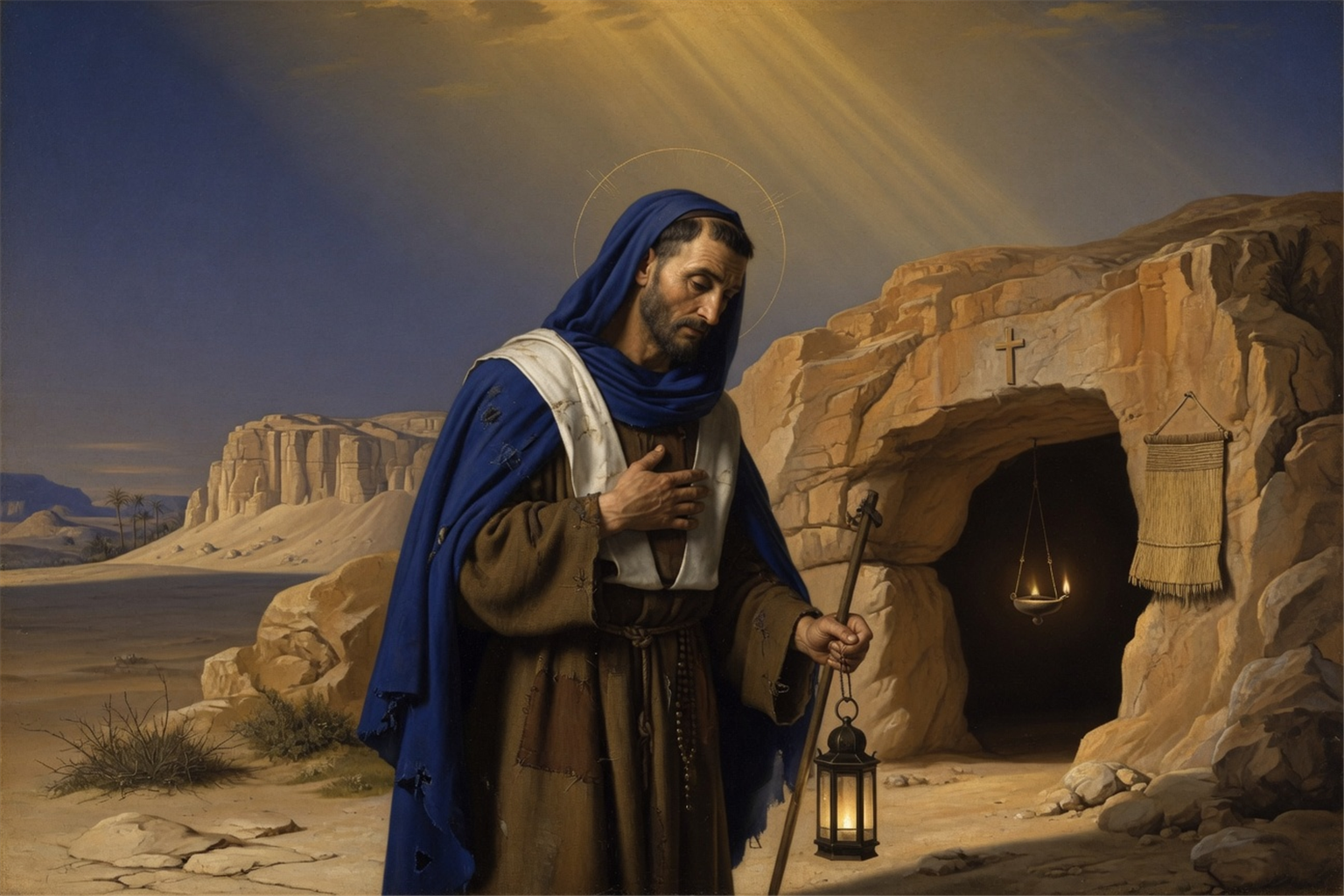
Born in Upper Egypt around 301, Macarius the Elder was one of the most illustrious disciples of Saint Anthony. After enduring slander with patience, he withdrew to the Scetis desert where he lived for sixty years in extreme austerity. A priest and wonderworker, he is famous for his humility in the face of demons and his spiritual wisdom.
Guided reading
9 reading sections
SAINT MACARIUS THE EGYPTIAN.
Distinction between the two Macariuses
Presentation of Macarius the Egyptian and his contemporary Macarius the Alexandrian, both disciples of Saint Anthony, and clarification of their feast days.
Woe to the path through which no one passes, and where the voice of man is never sent, because it becomes the receptacle of unclean beasts! Woe to the soul, if the Lord does not walk within it, as the Scripture says, and does not put to flight by His voice the animals of spiritual malice! Woe to the vessel without a pilot to steer it! Woe to the soul that does not have within it Jesus Christ, the true pilot!
(Hom. XXVIII, of Saint Macarius the Elder.)
Among several holy solitaries who have borne the name Macarius, which means happy, there are two more renowned, disciples of the great Saint Anthony, whom ecclesiastical historians, such as Palladius, Rufinus, Socrates, Sozomen, Cassiodorus, and Nicephorus Callistus, never separate and who, in fact, were very united by the bonds of a holy friendship and were very often together. The first and the most ancient is surnamed the Egyptian, because he was from Egypt. The second and the youngest is surnamed the Alexandrian, because he was from Alexandria or lived there before entering into solitude. It is true that, as Alexandria was a city of Egypt, to be Alexandrian was to be Egyptian; but it was found appropriate, to distinguish these two Saints, to leave to the most ancient the common name of the province and to give to the youngest that of the city from which he came. The Menologion of the Greeks marks both on the same day, namely: January 4; but the Roman Martyrology separates them and marks the first on January 15 and the second on the 2nd of the same month. Rollandus thinks that there was also another Saint Macarius, a disciple of Saint Anthony and older than the two preceding ones; Saint Anthony had made him steward of his monastery of Pispir, near the Nile, where there were more than five thousand monks, with the charge of reporting to him those who would come during his absence to consult him; he later led him, with the blessed Amathas, to a more remote mountain, and charged them both to assist him at his death and to bury him. Macarius inherited the staff of the holy abbot and was his successor. Many think, however, that this Saint Macarius is not different from Saint Macarius the Elder, otherwise called the Egyptian, who, having entered into solitude in the year 331, lived there, before the death of Saint Anthony, for the space of twenty-seven years. But, without dwelling further on this critique which is not necessary for the edification of the faithful, we will content ourselves with reporting here, in summary, what the ecclesiastical historians ha ve written about S Macaire l'Égyptien Hermit of the Scetis desert, disciple of Saint Anthony. aint Macarius the Egyptian and Sai Macaire l'Alexandrin Contemporary of Macarius the Egyptian, leader of the monks of the Cells. nt Macarius the Alexandrian.
Origins and Ascetic Beginnings
Born in Upper Egypt in 301 and first spiritual retreat near a village after a childhood marked by great moral sensitivity.
Saint Macarius the Elder was born in Upper Egypt at the beginning of the fourth century, that is to say, in the year 301. We may presume, from a fault he committed in his childhood, that he spent it with great innocence of manners; for, while leading oxen to pasture with other children of his age, they stole some figs, and he ate one that they had dropped while fleeing. He wept ever since with lively compunction whenever he recalled it to his memory; which shows that he had no more significant fault to reproach himself with. Thus, as soon as he was a little more advanced in age, he abandoned the world entirely to escape its contagion and serve Jesus Christ with greater security; and, imitating the beginnings of Saint Anthony, whose eminent virtue was making much noise, he withdrew into a cell near a village to exercise himself in the practice of the ascetic life. The ardor with which he applied himself to it caused him to advance in a short time in monastic perfection. He was considered from then on, not only as a young man who gave great hope for the future, but as a very experienced religious, and whose trials in the spiritual combat were almost the efforts of perfect solitaries. We may call this his first retreat from the world.
Lessons of detachment and patience
Accounts illustrating his material detachment when faced with a thief and his heroic patience during a false accusation of moral misconduct.
We learn from his historians that he had attained complete detachment and heroic patience, and that God honored him from then on with His most signal favors. One may judge this by the two episodes we are about to relate. Having left his cell, he found upon his return a man who was removing all his small belongings and placing them on a camel. Far from showing the slightest sorrow, he presented himself to him as if he were a stranger, and even helped him load his beast. But when the thief later tried to whip the animal to make it go, he could not make it rise; for it is known that camels kneel to receive their load.
Then Macarius, entering the cell and finding there a small log which the thief had not noticed, presented it to him, saying: "Here, my brother, is what your animal was waiting for," and placed it with the rest; after which he kicked the camel and told it to rise.
The animal, which had not obeyed its master, yielded to the voice of the Saint. It walked for some distance, during which the Saint led the thief, saying to himself with great tranquility: "We brought nothing into this world, and we can take nothing out of it. God gave it to me, God takes it away; only what has pleased Him has come to pass; blessed be His holy name." However, the camel did not walk for long. It sat down again when it had arrived at a certain distance, and it was impossible to make it move forward until the thief had unloaded it and returned to the Saint everything he had taken from him.
Another circumstance showed how much progress he had made by then in patience. He was accused by a girl from the village near his cell of a fault for which she would not name the true author. The parents of this girl came to seize the Saint, hung earthen pots, pitcher handles, and other such things around his neck, and led him throughout the village, beating him until he was near death and addressing all sorts of insults to him. Macarius said nothing: he even consented to submit to the conditions imposed upon him as if he had been guilty; but soon the girl had to confess her lie, and the whole village came to make reparation to the Saint. It was then that he fled into the desert of Scetis.
Settlement in Scetis and meeting with Anthony
Retreat to the desert of Scetis at the age of thirty and an initiatory journey to Saint Anthony the Great to test his virtue.
Macarius was about thirty years old when he withdrew to Scetis; he lived there for another sixty years in the labors of religious mortification. It is believed that Saint Macarius of Alexandria had already built a monastery in this desert. However, some historians have considered Saint Macarius of Egypt as the founder of the solitaries in this place, and regarded the other Macarius as the head of the religious of the Cells. They were contemporaries and may have begun their work at about the same time.
Our Saint, being thus established in the desert of Scetis, applied himself with all the more ardor to the harsh labors of the monastic life, as, being in the impetuosity of his youth, he felt more strength to sustain them. He rose thereby to a very high degree of discretion and wisdom; so that he wa s called the young le jeune vieillard Hermit of the Scetis desert, disciple of Saint Anthony. old man, having advanced in virtue beyond his age. His great reputation was already attracting many solitaries to his desert, when, to profit more, both for himself and for them, he went to see Saint Anth ony, whose mo saint Antoine Patron saint of hermits, first dedicatee of the chapel. untain was fifteen days' journey away. The Saint, hearing him knock at his door, opened it, and asked him who he was. He replied that he was Macarius; and immediately the holy old man, who wished to test his virtue, closed his door and left him waiting outside. Macarius remained until Saint Anthony, seeing his patience, opened it again, embraced him with friendship, and told him that he greatly desired to see him, having learned of his way of life. And as he perceived that he was tired, he exercised towards him all the duties of hospitality.
In the evening, Saint Anthony occupied himself with soaking palm leaves from which he made his mats, and Saint Macarius asked him to give him some to soak as well; which he did, even, as he was younger, in a greater quantity than himself. Then they sat down and conversed about matters concerning salvation, while working on their mats, which they lowered through a window into the cave where Saint Anthony usually dwelt. This Saint, having entered it the next day, noticed the quantity of mats that Macarius had made, and kissing his hands, he said to him: "These are hands in which there is much virtue."
Upon his return to Scetis, whether it was on the same journey or on another that he made, which his Acts do not explain, the solitaries came to meet him, and he told them that he had seen Saint Anthony, and that he had told him that they had no church to celebrate the holy sacrifice. They did not ask him at first what the Saint had replied, but they turned to other subjects, and he did not think he should tell them any more.
Ascetic Rigor and Sacramental Life
Detail of his extreme mortifications regarding food and sleep, and his forced accession to the priesthood at forty years of age.
To go into more detail regarding his austerities, he confessed himself to Eva Évagre Disciple of Macarius the Egyptian. grius, who was his disciple for some time, that he had spent twenty whole years of his life without eating, drinking, or sleeping as much as he would have liked. "For," he added, "I only ate a certain quantity of bread, which I weighed; I measured my water, and leaning only against the wall, I took as if by stealth the little sleep I could not do without." His ordinary rule was to eat only once a week. He wanted his disciples to accustom themselves to great mortification; and the same Evagrius recounted that, finding himself in his company at midday, as he felt burned by thirst, he asked him for permission to drink water; but he replied: "Content yourself, my son, with being in the shade; for at this hour, there are many people who, traveling either on land or on sea, are deprived of the relief that you have." They spoke about mortification on this occasion, and the Saint, to encourage him, reported to him what we have just said.
Palladius says regarding his abstinence that it is useless to speak of it, because although it was very great, it did not distinguish him much from the other solitaries; for, he says, the least austere monks, and those who are closer to inhabited places, are not subject to gluttony, and this vice is even more unknown among those who are in the depths of the desert, as much for the scarcity of all things as for the divine zeal that inflames and animates them to surpass one another through the different austerities they practice.
Saint Macarius cherished mortification and the deprivation of all the comforts of life so much that two solitaries who came to visit him found nothing in his cell but foul-smelling water. They were so moved by this that they offered to take him to a village to restore his worn-out strength. As they pressed him to do so, he said to them: "My brothers, do you know the place where the mill of such-and-such a man in this village is?" They told him yes. "And I know it too," he told them; "but do you know where his field is on the side of the river?" — "Yes, my father," they replied again. "And I know it too." He was telling them this to show them that if he had wanted to seek his comforts, he was known in the village where they wanted to take him: "But," he concluded, "I thank you for your kind offers; I know how to provide for my needs."
He hired himself out for the harvest as the solitaries of Nitria did, and he himself carried the baskets he had made from Scetis to the inhabited places. He once found himself so overwhelmed under his burden that, no longer able to go forward and still finding himself far from the river, he sat on the ground and addressed God, saying to Him with filial confidence, like a child speaking to his father: "Lord, You know that I can do no more"; and immediately he found himself on the bank of the river.
Another proof of his great mortification is that, when he was forced to take some relief, he tried to compensate for it by some other kind of penance. Thus it is said of him that when he ate with the solitaries and wine was present, he would drink what was offered to him, and then spend as many days without drinking water as he had drunk cups of wine. Solitaries who were unaware of his custom would hasten to offer him some, believing thereby to sustain his strength; and it was easier to receive it to then have the occasion to mortify himself more; but his disciple, having noticed this, instructed the brothers, who no longer dared to offer him any.
It was quite apparent on his emaciated face what the rigor of his abstinence was. This also came from the fear of God with which he was imbued. Thus he said to some solitaries who asked him why he was so haggard and weak: "If you put wood on lit brushwood, it is consumed with them; likewise, when the soul is consumed in some way by the fear of God, the body must be equally so."
The more this great Saint weakened his body through his austerities, the more his spirit had vigor and strength to rise to God. He was constantly as if enraptured out of himself, and he conversed more often with God than he thought of what happens under the heavens. He was forty years old when he was raised to the dignity of the priesthood. He was compelled to it by the pressing instances of the bishop, who did not want this lamp to remain hidden under a bushel, and who hoped to sanctify himself by laying hands upon him. The holiness of this new character penetrated his heart so deeply that, to try to respond to it more, he devoted himself to entirely new austerities. God also gave him from then on the power to command demons, the grace to heal diseases, and the spirit of prophecy. We will give the proofs of this after having said something about his love for retreat and silence, and his charity toward his neighbor.
Practice of Silence and Miracles of Charity
Use of an underground passage for solitude, teaching on silence, and miraculous acts of charity toward the sick and pagans.
As his reputation brought him many visits, he found a way to rid himself of them by digging, with great difficulty, an underground path from his cell to a cave that was half a stade away. Thus, he would escape the sight of the world when he was too much importuned, by fleeing through this path into this cave, which was very deep, without anyone being able to know where he was. One of his disciples said later that, when going there, he was accustomed to saying twenty-four prayers, and as many upon returning.
He recommended silence to solitaries as one of the virtues most essential to their state. One day, having dismissed the assembly of the brothers after the celebration of the holy sacrifice at the church that had been built in Scetis since his journey to Saint Anthony, he said to them: "Flee, my brothers." — "But where can we flee?" one of them asked him. "Is there any place more remote than this desert?" Then, putting his finger to his mouth: "It is there," he said, "that one must flee"; and at the same time he withdrew into his cell, closed the door, and remained alone.
To warn them against the troubles of solitude, and to encourage them to keep it faithfully, he cited an example that tended to prove to them that the demon dreaded it extremely. "A mother," he told them, "brought to my cell her child possessed by a demon. When this child arrived, he did not want to stay, and said to his mother: 'Get up and let us go.' And as she told him she could not walk: 'Well!' he replied, 'I will carry you myself.' In which I admired the malicious cunning of the demon, who was trying to drive him from here."
A trait of gentleness is reported of him that won to Jesus Christ a priest of the idols and several pagans with him; and he used this example to teach other solitaries that sometimes insolent and prideful words make the good become wicked, whereas humble and gentle words change the wicked and make them good. He was going from Scetis to the mountain of Nitria, accompanied by his disciple, whom he told to go ahead. On this, it should be observed that it w montagne de Nitrie Primary site of the monastic settlement of Ammon. as quite the custom of the solitaries, when they went two or three together, to separate a little from one another, to prevent themselves from discoursing vainly, or to better keep themselves in the presence of God.
This disciple, having preceded him by a fairly long stretch of road, met an idolatrous priest who was carrying a large stick in his hand, and who was running as was done in the bacchanals. His indiscreet zeal led him to shout at him: "Where are you running like that, demon?" The idolater, irritated by this apostrophe, came to him and beat him so severely that he left him half-dead, after which he began to run again. When he was near Saint Macarius, the Saint said to him with gentleness: "Good day, good day; I see that you are taking much trouble, and you must be very tired." The idolater, astonished by his greeting, approached him and said: "What good have you found in me to greet me as you do?" — "I did it," the saint replied, "because I saw that you were exhausted from fatigue and that you did not realize that it would be of no use to you." The idolater replied: "I am touched by your greeting, and I understand that you are a man of God. It is not the same with that wicked solitary I just met. He took it upon himself to say insults to me, but I made him pay dearly for them, for I left him half-dead." The Saint immediately understood that he was speaking of his disciple; and the idolater, throwing himself at his feet and embracing them, said to him, by an effect of grace that had changed his heart in that moment: "I will not leave you until you have made me a monk." They went together to the place where his disciple was, all bruised from blows, and they carried him to the church of the mountain of Nitria, because he could not walk. The brothers of Nitria were strangely surprised to see him arrive with this idolatrous priest. They gave him the monastic habit upon the account he gave them of his conversion and his good vocation, and several pagans embraced the Christian faith at his example.
He did not disdain to learn the way of practicing virtue from those who had entered the solitude long after him; and he forced, one day, a young solitary named Zacharias to tell him what the duty of a monk was. Zacharias, astonished, said to him: "Alas, my father, you ask that of me?" — "Yes, my son," he replied, "God wants me to learn it from you." Then the young solitary said to him: "It seems, my father, that he is truly a monk who does violence to himself in everything."
One also reports of him this generous act of charity. Having come to the cell of a hermit who was sick, and who had nothing at all, he asked him what he wished to eat. The brother told him that he would have liked some small cake. He immediately ran to Alexandria to bring him some, and he returned with such diligence, although there were no less than thirty leagues to travel, that the thing was regarded as a miracle.
He acted toward the brothers with such candor and simplicity that some of them reproached him for it on one occasion; but he replied to them: "I have insistently asked this grace of God for twelve years; why would you want to make me renounce it?"
Power over demons and humility
Accounts of confrontations with evil spirits where Macarius's humility is presented as his most powerful weapon.
We have said that God had given him power over evil spirits; his history provides more than one example of this. He cast them out of the bodies of the possessed; he dissipated their illusions; he forced them to declare to him the temptations with which they attacked the solitaries; he was feared by them, and he feared them not.
Palladius recounts that a woman brought him her son, possessed by a demon, led by two men who each held him bound on either side. The evil spirit that had taken possession of him made him so voracious that he would eat up to three bushels of bread a day and drink in proportion, and when his mother did not have the means to satisfy his hunger, he would fill himself with the filthiest things; but what was even more peculiar is that everything he ate turned into smoke that one could see coming out of his stomach. His mother, desolate, begged the Saint to heal him through his prayers; which he did. Then he asked her how much she wanted her son to eat per day, to which she replied that she wished him to eat only ten pounds. That is too much, replied the Saint; and he prayed again for him, adding to his prayer a fast of seven days, after which he regulated him to eat three pounds of bread a day, and to earn them by his labor.
The same Saint, looking one evening toward the path that led from the place of his retreat to the solitude where the other brothers dwelt, the demon appeared to him in the guise of a man covered in a linen garment, but pierced with holes, and in each hole there was a vial. He asked him where he was going, and what all these vials meant. "I am going," the phantom replied to him, "to awaken the brothers, and I am bringing them these different potions, so that if someone does not want one, I may present him with another that pleases him"; after which he went away. But the holy old man did not move from the spot, and waited, continuing to look down the path, to see if he would appear again. He returned indeed, and the Saint forced him to tell him if he had seduced any solitary. "All your monks are intractable," the demon said to him, "they show me nothing but hardness; there is not one who wants to follow me." — "What!" said the Saint, "you have not a single friend then?" — "There is one, however," added the demon, "who believes me, and as soon as he sees me he turns like the wind." — "What do you call that one?" the saint asked him. — "It is Theopemptus," said the demon; and he disappeared immediately.
Saint Macarius did not delay in going to the solitaries, who, learning of his arrival, came to meet him with palm branches, and each prepared their cells to receive his visit. But without stopping long with them, he asked for Theopemptus, and went to lodge in his cell. He was received there with great demonstrations of respect and joy, as being the common father of the solitaries, and when they were alone, the Saint said to him: "Well, my brother, how are you?" — "Very well, my father, by the means of your prayers," said Theopemptus. — "But your thoughts," added the Saint, "do they not cause you any pain?" Theopemptus, not daring to confess the truth, told him no. "As for me," replied the Saint, "who have already spent so many years in this austere life, and whom, as you see, everyone honors, I will not hide from you that I am often tormented by my thoughts." Theopemptus, encouraged by the humble admission of the Saint, replied to him: "Alas, my father, I confess to you that I also have some that cause me much pain." The Saint, seeing him disposed by these words to manifest the state of his soul to him, added that he himself was tempted by different passions; and Theopemptus finally declared to him everything he wished to learn from his mouth. He also learned that he only fasted until three o'clock, and gave him these rules: Fast until evening, occupy yourself with work, always meditate on some passages of the Gospel, or of some other book of Scripture, and when the demon puts some evil thought into your mind, always look upward through prayer, and never downward, and God will soon come to your aid. After he had thus instructed him in what he should do, he returned to his solitude.
Some time later, the demon appeared to him as the first time, and repeated that he was going to awaken the brothers. He returned then after having prowled around their cells to tempt them, and Saint Macarius asked him how they were. "They are," replied the evil spirit, "all harder and more savage; but what is worse is that the one who obeyed me before is now completely changed, I do not know why; not only does he refuse to listen to me, but he is more intractable than the others, far from being my friend as before."
The intrepidity of Saint Macarius toward evil spirits was admirable. It proves the greatness of his faith and his confidence in Jesus Christ, who triumphed over hell, and bound the prince of darkness by his passion. He came once to Terenut, and finding himself surprised by the night, he entered a sepulcher to sleep there. There were several corpses of pagans there, and he took one to serve as his headrest, as if it had been a bundle of reeds. The demons, piqued to see his assurance, wanted to frighten him. They pretended to call the dead man upon whom he was resting his head, saying to him: "So-and-so, come with us to the bath." And another demon, acting as if this dead man were answering from beneath the Saint, said: "I cannot go, because I have a stranger on me." But Saint Macarius, far from being frightened, gave great punches to this body, saying to it: "Get up if you can." Then the demons let out a great cry, saying: "You have conquered"; and they fled full of confusion.
Another time when he was returning early in the morning to his cell, loaded with palm leaves that he had been to fetch from the marsh, the devil appeared to him, holding in his hand an extremely sharp scythe, with which he tried to strike him; but God having taken away his power, he cried out: "O Macarius, you cause me extreme violence, seeing that I cannot harm you and that the strength to do so is taken from me, even though I accomplish more perfectly than you the things that you do; for if you fast sometimes, I never eat, and if you keep vigil sometimes, sleep never closes my eyelids. There is only one thing in which I confess that you overcome me." Upon this the Saint asked him what it was; he replied to him: "It is your humility; it is this virtue that makes it so that I can do nothing against you." The Saint, at these words, extended his hands to pray, and the demon vanished.
It was not without reason that this spirit of pride feared the humility of Macarius so much; for this great Saint, to whom God had given so much empire over him, who practiced such great austerities, and who shone in the midst of the solitaries by his supernatural gifts and by his eminent virtue, was so far from seeking the praises of men, and had such a low idea of himself, that on one hand he hid himself as much as he could from the eyes of his brothers, and he only employed the gift of miracles that God had communicated to him as much as he was forced to by compassion and charity, or that the glory of God was interested in it; and besides, he looked upon himself as the greatest sinner and lived in a holy fear of the judgments of God: which made him admit on one occasion, to some solitaries, that it was not so much his fasts that made his body so dry and so emaciated, as the fear of God with which he was penetrated.
Gifts of prophecy and discernment
Prediction of the fall of his disciple John and a miracle of a dead man testifying to exonerate an accused person.
God had also favored him with the gift of prophecy. One cites the one he made regarding the decadence of the monastic state in the desert of Scetis, which was only too justified by the event. He had two disciples, one of whom lived in a separate cell, and the other, named J ohn, Jean Successor of Alexander and predecessor of Marcellus. was with him to serve him in his old age, or to render the duties of hospitality to those who came to see him. The Lord having enlightened him on the inner feelings of the latter, he spoke to him in these terms to urge him to correct himself: « Listen to me, my brother John, and receive with docility an advice that I wish to give you, and which will be of great utility to you, if you wish to profit from it. You are tempted, and it is by the demon of avarice; for I have seen it. If you receive well the warning that I give you, you will accomplish with perfection the work of God in this place. You will become famous, and the judgments of God will not approach you; on the contrary, if you do not yield to my remonstrance, you will finally fall into the disease of Gehazi, whose sin you have already contracted ».
The disciple, instead of profiting from this salutary advice, did not think of amending himself, and what had been predicted to him happened; for the Saint having died, John was made priest after him; but the demon, who had blinded Judas with avarice, blinded him equally to the point of making him appropriate what belonged to the poor, and finally, fifteen or twenty years after the death of Saint Macarius, he found himself so covered with the leprosy called elephantiasis, that one could not find on his whole body the width of a finger that was not spoiled.
A man having been accused of a murder, of which he was nevertheless innocent, fled into his cell for fear of being arrested and punished as guilty. But those who were pursuing him arrived there soon after, protesting to the Saint that if they did not take this murderer to do justice, they themselves were in danger. The accused protested that he was innocent, and the very lively contest on both sides did not end. The Saint, seeing that by letting them dispute further he would advance nothing, asked where the dead man had been buried, and went there with those who wanted to take the man they were accusing. There, he put his knees to the ground and invoked the name of Jesus Christ, after which he said to those present: « The Lord will make known now if this man whom you accuse is guilty or not ». Then raising his voice, he called the dead man by his name, and said to him: « I conjure you by Jesus Christ to declare if it is this man who is accused who took your life ». To which the dead man replied from the depths of the sepulcher, in an intelligible voice, that it was not he who had killed him. All those who were present, terrified by such a great miracle, threw themselves at his feet and begged him to ask the dead man who was then the author of this murder; but the Saint answered them: « That is what I am careful not to do. It is enough for me to have shown the innocence of the accused, without making known the culprit, who perhaps will repent of his fault, will do penance for it, and will save his soul ».
Arian Exile and Final Moments
Persecution by the Arian bishop Lucius, a final visit to the brothers of Nitria, and a concluding exhortation to penance before his death.
Such were the effects of his living faith. As he confirmed it through miracles, he also had the happiness of defending it by courageously suffering persecution. He shared, with Macarius of Alexandria and other Fathers of those deserts, the glory of being relegated to a deserted island by the impie ty o Luce Intrusive Arian bishop of Alexandria who persecuted the orthodox monks. f Lucius, whom t Ariens Heresy opposed by Columbanus in Italy among the Lombards. he Arians had placed upon the chair of Saint Mark, of which he was so unworthy, and who among those of his sect was one of the most unbridled against the divinity of Jesus Christ.
Finally, this man, so famous for his miracles and no less so for his heroic virtues, being at the end of his course, the elders of the mountain of Nitria deputed brothers to him to beg him to come see them one more time before he left the earth, because it was too difficult for them all to go to Scetis. His charity could not refuse their invitation. He went to them, and all having gathered around him, the elders begged him to say a few words of instruction to all the assembled brothers. He did not give them a long speech; but he said to them these words, so touching and which showed that he had preserved until the end of his life an intimate feeling of the fear of God in his heart: "Let us weep, he said to them, my brothers, and may our tears not dry up before we go to that place where those that we shall shed, if we have not wept in this life, far from extinguishing the fire that will burn us, will only serve to inflame it." The brothers were so touched by this composition upon hearing such a holy and at the same time so humble man speak, that they all began to weep, prostrated themselves on the ground, and said: "You who are our father, we conjure you to pray for us." It appears that he did not live long after this visit.
Saint Macarius the Elder is represented as a hermit, praying or working in his cell or in his cave: from the vault is suspended a lantern, to indicate that he willingly sought the most obscure places with the goal of hiding himself from the sight of men. We have, moreover, spoken above of the underground path that led from his cell to a cave.
Annexes & related entities
Structured data for exploration: events, miracles, quotes, places, attributes, patronages, and important entities cited in the text.
Key Events
- Born in Upper Egypt in 301
- Initial retreat in a cell near a village
- Slanderous accusation of seduction and flight to the desert
- Settled in the desert of Scetis at the age of 30 (c. 331)
- Visit to Saint Anthony the Great
- Priestly ordination at the age of 40
- Exile to a desert island by the Arian bishop Lucius
- Died after 60 years of life in the desert
Miracles
- Miraculous obedience of a camel loaded by a thief
- Instantaneous transport to a riverbank under the weight of baskets
- Healing of a possessed and voracious child
- Temporary resurrection of a dead person to exonerate an accused individual
- Miraculously fast journey to Alexandria for a cake
Quotes
-
We brought nothing into this world, and we can take nothing out of it. God gave it to me, God takes it away; only what pleased Him has happened; blessed be His holy name.
Source text (words spoken during the theft of his furniture) -
Let us weep, my brothers, and may our tears not dry up before we go to that place where those we shed... will only serve to set it aflame.
Last instruction to the brothers of Nitria