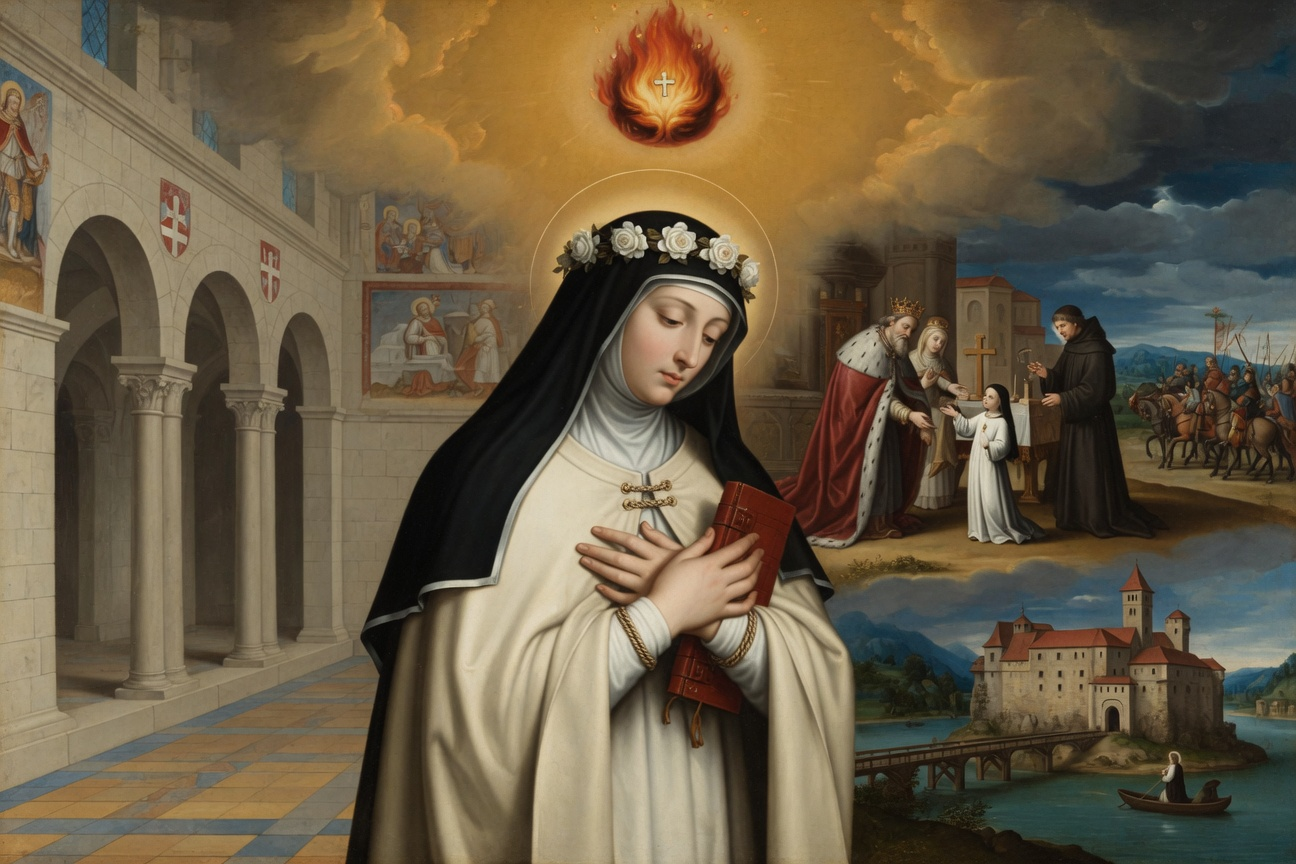
Blessed Margaret of Hungary
OF THE ORDER OF SAINT DOMINIC
Virgin of the Order of Saint Dominic
Daughter of King Béla IV of Hungary, Margaret was consecrated to God from childhood in fulfillment of a royal vow. A Dominican nun of profound humility, she refused earthly crowns to devote herself to a life of extreme austerities and prayer. She died in 1271 at the age of 28, leaving behind a reputation as a prophetess and wonder-worker.
Guided reading
6 reading sections
THE B. MARGARET OF HUNGARY, VIRGIN,
OF THE ORDER OF SAINT DOMINIC
Birth and initial consecration
Following a Tatar invasion, King Béla IV and Queen Maria vow their future child to God; Margaret is born and enters the monastery of Veszprém at the age of three.
If the Church is a tree, virginity is its flower. Saint Cyprian, De habitu virginum, c. II.
Béla IV, King of Hungary, brother of Saint Elizabeth, Duchess of Thuringia, seeing himself almost driven from his states by the incursions of the Tatars who had invaded his entire country, made a vow to God with Princess Maria, his wife, daughter of Baldwin II, Emperor of the East, that if it pleased Him to deliver them from these barbarians, they would consecrate to His service the child who would be born of their marriage. Their prayers were answered; for these infidels withdrew from Hungary, and some time later, the Queen gave birth to a daughter wh o was name Marguerite Hungarian princess whose vows were received by Humbert. d Margaret. When she was three years old, her virtuous parents, so as not to delay the execution of their vow any longer, placed her in the monastery of Vesz prém, of the Order of Sa Ordre de Saint-Dominique Religious order to which the saint belongs. int Dominic, and gave her as a governess the Countess Olympias, who herself took the religious habit, so that, while watching over the actions of the little princess, she could at the same time serve God in greater perfection. It was seen quite early, from that tender age, that as she was a fruit of prayer, she would also be a subject of wonders, where the grace of God would triumph in an extraordinary manner.
A childhood marked by devotion
From a very young age, Margaret manifested exceptional piety, refusing her royal rank and dedicating herself to early penitential practices such as wearing a hair shirt.
She was not yet four years old when she recited by heart the Hours of Our Lady, which she had learned simply by hearing them sung in the choir of the nuns, and she conceived such devotion toward this august Virgin, mother of the Son of God, that wherever she encountered her image, she would kneel and recite the Angelic Salutation. This fervor increased with age; for, as soon as she had entered the chapter of the nuns, she never failed, on the eve of the four greatest feasts of Our Lady, to ask with tears for permission to perform some penance in her honor, such as fasting that day on bread and water; and each time she performed the office, she recited in private a thousand times the Ave Maria, and prostrated herself to the ground each time. She fled all the games in which children take pleasure, preferring to pray to God rather than to amuse herself with others. When her mistress wished to withdraw her from prayer, for fear that such great application might harm her health, she would not cease to weep until she had been permitted to continue. She did not want to be called a king's daughter, and when it was done, she complained of it as an injury; that is why she did not want to see her parents, for fear that their conversation would cause her to be considered more.
At the age of five, she completely gave up the use of linen and began even, shortly thereafter, to use the hair shirt that her governess was compelled to allow her to satisfy her fervor; but when she had more strength, she increased her austerities with new mortifications of which we shall speak.
Religious Profession and Hidden Life
Margaret made her profession at the age of twelve in a monastery founded by her father on an island in the Danube, where she led a life of radical humility and service to the poor.
However, the King, her father, seeing that all the young princess's inclinations tended only toward the religious life, had a new monastery built expressly in honor of the Blessed Virgin on an island in the Danube, half a league from the city of Buda; it was named the Island of Saint Mary, but it is commonly called today the Island of S aint Margaret. Our Saint w l'île de Sainte-Marguerite Site of the saint's principal monastery near Buda. as transferred there and made her profession at the age of twelve, as was permitted for young girls before the holy Council of Trent; and then she began a life entirely of virtues, having no other desire than to always advance in charity and religious perfection. She spoke little and never said anything that smacked of vanity or grandeur. Far from flattering herself with her royal birth, she wished to pass and appear everywhere as the least of all the sisters. Throughout her life, she fulfilled all the regular observances more perfectly than any other. If it happened that a sister said something offensive to her, she would immediately throw herself at her feet and ask for forgiveness. She would anticipate those whom she believed had something against her. She had the money her father sent her distributed to the poor, and she prayed to God for those to whom she could not give alms. When she saw the blind, the lame, the paralyzed, and other people suffering from some infirmity, she said to God: "I thank you, Lord, that, being able to have all these defects, it has pleased you to preserve me from them." Instead of claiming, as founder of the house, any privileges, she treated her body with greater rigor, and not content with the ordinary austerities of the rule, she had arranged, with the permission of her confessor, a very harsh hair shirt which she often used in secret, particularly during the holy time of Lent, during which she never took it off. Besides the discipline she took with the other nuns, she had it given to her every night in private, but with such rigor that it would be difficult to believe, if one did not know, by experience, what the fervor of souls who perfectly love God can do. She never ate meat, unless she was very ill, and the fear that they might force her to do so and put her in the infirmary made her hide her ailments. When it was represented to her that she should not exercise such great rigor upon herself, since it was shortening her days, and that by living longer she could acquire more merits, she replied that, in the uncertainty of the time she had left to live, she did not want to lose a single moment, and that this valley of tears was not a place of rest for a body subject to death.
She practiced these three rules excellently: "To love God above all things, and one's neighbor for God; to despise oneself; and to despise or judge no one." She had learned them from a preacher of consummate virtue. This pious personage, speaking to her one day about religious perfection, told her that after having long asked God to let him know by what means the ancient Fathers had obtained from His goodness so many supernatural favors, he had seen, during his sleep, a book where the three rules we have just reported were written in letters of gold. By these three degrees, this blessed one arrived at such eminent virtue that we can assure without fear that she possessed everything that can make a perfect nun. One can even say that if martyrdom was lacking to her will, her will was not lacking to martyrdom, since she often regretted being born in a time when there were no longer any Martyrs. Indeed, she sought it with such ardor that, hearing of the irruption of the Barbarians in Hungary, who made everyone tremble, she was willing to pray to God that He might stop them for the sake of the people; but otherwise, she wished for herself that they would come, so that they might make her a martyr. "How happy I would be," she said, "to be torn to pieces and to be burned for the love of my Savior. I would wish that, to prolong my pains further, every part of my body would suffer, one after the other, some particular torment."
Mystical Favors and Rejection of the World
Endowed with the gifts of prophecy and miracles, she categorically refuses several royal marriage proposals to remain faithful to her heavenly spouse.
If Margaret had such fervor and love for her spouse Jesus Christ, He, for His part, did not fail to communicate to her the most extraordinary graces and favors that He bestows upon His beloved; for she had the gift of miracles during her life and after her death, as well as the gift of prophecy: she predicted to the King, her father, that he would win a glorious victory over Frederick, Duke of Austria, against whom he was leading a powerful army. Our Lord further favored her with such a perfect gift of prayer that the nights were not long enough for her to satisfy it. Hence it came about that her prayers were accompanied by such an abundance of tears that her handkerchiefs were not sufficient to wipe them away; her nun's veil was also completely soaked, especially when she heard the Passion of the Savior read or meditated upon it. Then she was no longer herself; but soon she would cry out loudly, and she would remain as if dead. On a Good Friday, her body was seen several times raised from the ground by more than a cubit, which also happened to her on other days, particularly on the feast of All Saints and the Assumption of the Virgin; another time, during Advent, a globe of fire appeared at night above her head while she was praying. These signal favors make it sufficiently known that this virtuous daughter, who lived thus hidden in her monastery, was the beloved of Jesus; however, by a permission of God who wished to test her fidelity, she did not cease to be sought in marriage, particularly by Ottokar, King of Bohemia. This prince, having wished to se e her because of her g Georges, roi de Bohême Suitor for the hand of Margaret. reat reputation, begged the King and Queen of Hungary to take him to the monastery on the Island of Saint Mary. But as soon as he saw the princess, he was so smitten with her beauty that he asked for her hand in marriage, on the condition not only of taking no dowry, but of giving her all his wealth along with his kingdom, assuring them that he would be very glad, with a view to cementing peace between their States, to obtain the necessary dispensation from the Pope.
The King, seeing these great advantages, spoke of them to his daughter; but she gave him this wise reply: "My father, I remember that at the age of seven, you made me a similar proposal for the King of Poland, and, you have not forgotten, I told you that I desired to belong solely to Him whom you had given me as a spouse even before I came into the world; how do you wish that now, older and more capable of receiving the graces of my God, I should change my resolution? Cease, I pray you, my father, to turn me further from the promise I have made to keep my virginity, and let me live for Him to whom you have so holily consecrated me. For, in the end, I set no value on the crown nor the riches, nor the other advantages that the King of Bohemia offers me; I prefer the kingdom of Jesus Christ and the delicious sweetness of His grace; I would therefore rather die than consent to the proposal you make to me." The King pointed out to her that, being her father, she was obliged to obey him, since, by a commandment of God, children must obey their parents; the Saint replied generously, addressing the King and Queen: "When you command me things that are pleasing to God, I shall make it my glory to obey you, as persons who have authority over me; but if you order me to do what is against His holy will, nothing will be able to constrain me; knowing well that the power which fathers and mothers have over their children does not extend that far." These words made the King and Queen realize that the constancy of their holy daughter was invincible, and so they let her live peacefully for the rest of her days in her monastery. She continued her exercises of devotion and penance there until the twenty-eighth year of her age, which she predicted to her sisters, a year in advance, would be her last. Finally, on January 9, although she appeared to be in perfect health, she told them positively that in ten days she would no longer be in the world, and that she would depart on the day of the feast of Saint Prisca. Indeed, three days before this feast, she fell into a high fever which gave her no other leisure than to prepare herself for this final passage by the reception of the Sacraments and by a continual conversation with her Beloved. Seeing that her last hour was near, she devoutly recited the entire psalm: In te, Domine, speravi, "In You, O Lord, have I hoped," until these words: "Into Your hands, O Lord, I commend my spirit"; and thus happily sent her soul to heaven, in the year 1271, on Saturday, January 18: she was barely entering the twenty-eighth year of her age.
Passing and ecclesial recognition
She died at twenty-eight years of age in 1271; her tomb became a place of miracles and her cult was progressively authorized by several popes.
After the departure of this beautiful soul, her body remained so beautiful and so rosy, and exhaled such a pleasant odor that the Archbishop of Strigonia, who came three days later to perform the funeral rites, said aloud to the nuns that they should no longer weep for this princess, since having been a Saint in her life, she was already glorious in heaven. More than two hundred miracles that occurred at her tomb and elsewhere at her invocation are even more certain proofs of this truth, and she is honored as a Saint throughout the kingdom of Hungary; although the popes, who had begun the process of her canonization, have not yet declared her a Saint with the ceremonies ordinarily observed on such occasions by the Roman Church.
Pope Pius II authorized her cult in Hungary. Pius VI, by decree of July 2 Pie VI Pope cited as having approved the cult of Julie in 1821. 8, 1789, extended to the entire Order of Saint Dominic the permission to celebrate her feast. Pius VII permitted the clergy of Presburg to recite her office, and fixed her feast on January 26, by decree of August 24, 1804.
Saint Margaret of Hungary is represented with a globe of fire above her head. She is invoked against floods, because more than once in her life, she calmed storms, made the waters of the Danube recede, and opened and closed, through her prayers, the cataracts of heaven. In Presburg, where the relic Presbourg Final resting place of the saint's relics. s of this holy daughter of Saint Dominic were transported, she is still invoked against pernicious or malarial fevers: the location of her monastery in the middle of an island in a river explains this devotion.
Sources and historiography
The life of the saint is documented by various Dominican authors and hagiographers, notably in the Acta Sanctorum and the Dominican Year.
The life of this Blessed was written in the year 1540, by Father Guérin, a religious of the same Order of Saint Dominic. Surius transcribed it in his first volume; and Bollandus, in the third volume of the Acta Sanctorum for this month (new ed.). The Rev. Fr. Jean de Sainte-Marie drew it from a manuscript that was kept in the royal abbey of Poissy, and inserted it among the lives of the successors of this Order; and, finally, the Rev. Fr. Jean-Baptiste Feuillet, sub-prior of the Jacobins, of the great convent, reports it in the first volume of the Dominican Year.
Annexes & related entities
Structured data for exploration: events, miracles, quotes, places, attributes, patronages, and important entities cited in the text.
Key Events
- Consecration to God by her parents following a vow against the Tatars
- Entered the monastery of Veszprém at the age of three
- Transfer to the monastery on Margaret Island on the Danube
- Religious profession at the age of twelve
- Refusal of royal marriages with the kings of Poland and Bohemia
- Died at the age of twenty-eight after predicting her end
Miracles
- Gift of prophecy regarding her father's military victories
- Levitation during prayer (raised one cubit from the ground)
- Apparition of a globe of fire above her head
- Calming of storms and receding of the Danube's waters
- Incorruptibility and sweet odor of the body after death
Quotes
-
I prefer the kingdom of Jesus Christ and the delicious sweetness of his grace; I would rather die than consent to the proposal you make to me.
Response to her father regarding marriage