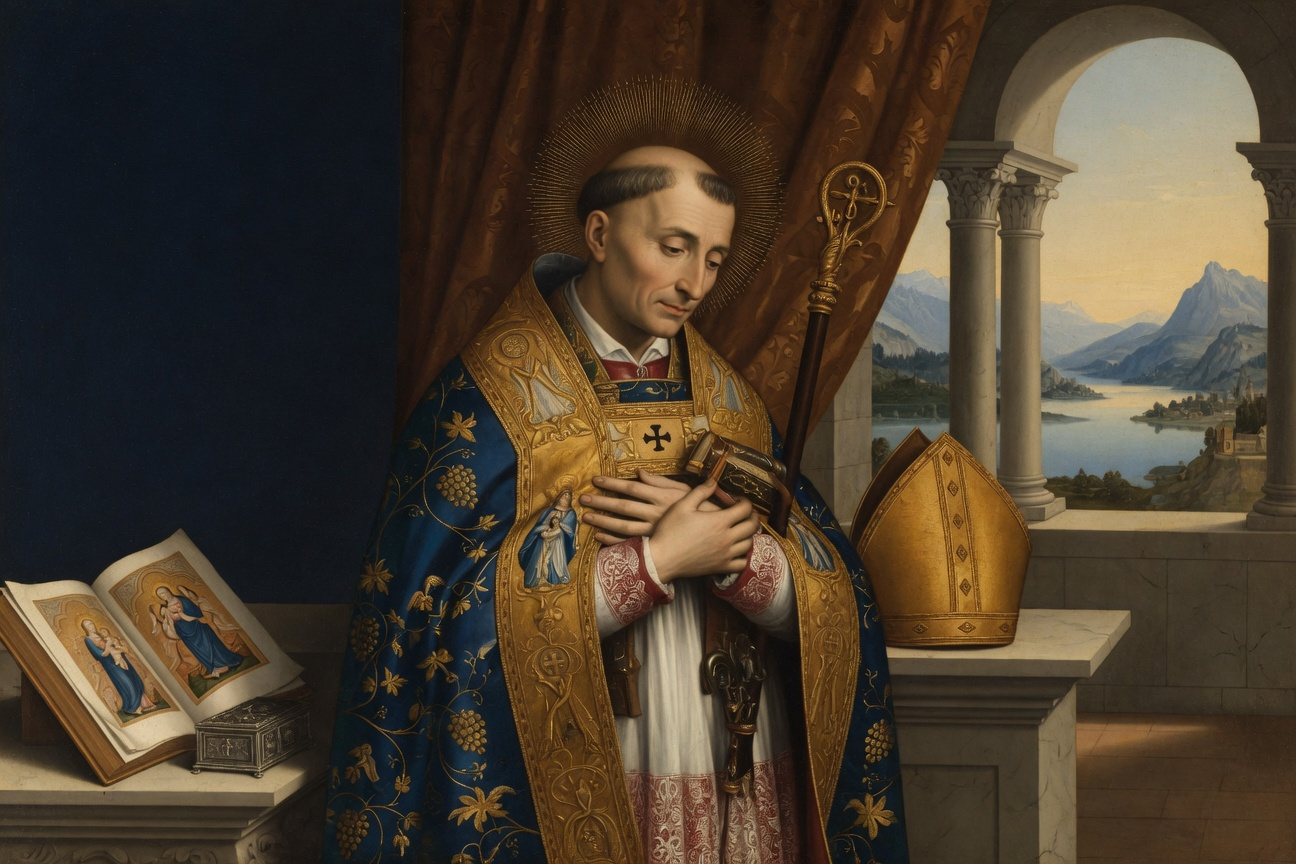
Born in the Dauphiné in the 12th century, Amadeus of Hauterive was a monk at Clairvaux under Saint Bernard before becoming abbot of Hautecombe and then bishop of Lausanne. Grand Chancellor of the Empire and tutor to the future Blessed Humbert III of Savoy, he distinguished himself by his pastoral zeal and his eight Marian homilies. He endured exile and persecution by the Count of Geneva before dying at around the age of fifty.
Guided reading
8 reading sections
BLESSED AMADEUS OF HAUTERIVE,
BISHOP OF LAUSANNE
Origins and early vocation
Amadeus was born around 1110 into an illustrious family from the Dauphiné and followed his father to the Abbey of Bonnevaux from a very young age.
Blessed Amadeus, whos Le bienheureux Amédée Subject of the biography, abbot of Hautecombe and later bishop of Lausanne. e life, simple and precious in the eyes of God, we are about to recount in a few words, was born in Chatte, in the Dauphiné, in the first years of the 12th century (around 1110). He belonged to one of the most illustrious families of the region; his father, also named Amadeus, Lord of Hauterive, was the brother-in-law of the Dauphin Guigues VII (1073-1125), whose sister Petronilla he had married, and a relative of Emperor Henry V. But, what was preferable to such a noble origin, was that the father could offer the son a worthy model of piety, and as an inheritance of all Christian virtues. Thus, we saw him, in 1119, embrace the religious state at the Abbey of Bonnevaux, in the diocese of Vienne, which had been founded only a few years earlier. His generous determination had been shared by sixteen other knights, his vassals, as well as by his young son, who also wished to consecrate to the Lord the first fruits of a life barely begun.
Education at Cluny and at the Imperial Court
Too young for vows, he studied at Cluny and was then entrusted to Emperor Conrad, his relative, who ensured his intellectual and moral education.
But the latter's age, still so young, did not permit him to be admitted to pronounce the sacred vows of religion. He therefore left the holy retreat of the sweet valley of Bonnevaux to go with his father to the famous abbey of Cluny, where letters were held in great honor and where they were cultivated with success. The good monks, persuaded that the instruction they could give this young child, however good it might be in itself, would nevertheless be far below what was suitable for him in all respects, believed they could do no better than to entrust the task to Emperor Con rad, a relative a l'empereur Conrad German Emperor and relative of Amadeus who oversaw his education. nd ally of his family. This prince welcomed him with eagerness and from then on took him under his high protection. He neglected nothing to raise him in a manner that corresponded to the nobility of his origin, and for several years he took the same care of him as if he had been his own child. His instruction was then entrusted to the most skillful and experienced masters; and, as his mind developed and acquired that maturity which forms the reasonable man, his soul, under the influence of divine grace like a celestial dew, also blossomed before the Lord, like a delicate flower opening to the first rays of the sun.
Monastic Commitment and Abbacy
He entered Clairvaux under the guidance of Saint Bernard before becoming Abbot of Hautecombe in 1139, where he distinguished himself through his discipline.
When his education was finished, burning with an ardent desire to return to his pious father in the austere life of the cloister, he abandoned without regret a sumptuous court, from which his heart, if one may speak thus, had always been absent and distant. Resolved to give himself to God without reserve, he took the religious habit at the great abbey of Clairvaux, in the presence of the last Father of the Church, the illustrious Saint Bernard. He spent some time there entirely given over to prayer and meditation. But he soon left this new monastery to go to that of Hautecombe, in Savoy, on the rugged shores of Lake Bourget. Scarcely was he installed when his eminent virtues had already designated him for the admiration of all the other religious, and in the year 1139, at the age of about thirty, he succeeded Abbot Bibien in his important office. His administration was at once gentle and firm; the maintenance of the rule and discipline, the repression of the slightest abuses, but, at the same time, the most magnanimous charity for others, and for himself the most rigorous severity—this is how he discharged the grave duties that had been entrusted to him, and this is also how he knew how to attract the sincere esteem and true affection of all those who approached him. However, this direction, so wise and so paternal, lasted but a short time, for Providence reserved him for a new destiny. In 1144, the episcopal see of Laus anne hav Lausanne Episcopal see of Boniface in Switzerland. ing become vacant by the death of its bishop, Gui de Matigny, our holy abbot was unanimously named to it. It was, no doubt, repugnant to his modesty and his profound humility to accept such a high dignity with such a heavy burden; but he had to yield to the repeated entreaties of the clergy and the Christian people, and he rightly saw in this the voice of God calling him to this new vocation.
Bishop of Lausanne
Appointed Bishop of Lausanne in 1144, he developed a pastoral zeal marked by preaching and Marian devotion.
Scarcely had he been consecrated a prince of the Church, when his aged father hastened to him, full of hope and joy, to enjoy one last time, on earth, the presence of a son he was soon to leave. Shortly after, in fact, his mortal existence reached its end; he died, at least, with the consolation of having given to the Church of Jesus Christ a holy religious, who would soon be a holy bishop. This thought must naturally have gladdened the soul of the good old man, and he too could say like Simeon: « Lord, now let your servant go in peace ». Let us add finally that the ancient monuments of the Order of Cîteaux place him in the ra nk of the saints Ordre de Cîteaux Monastic order to which Bertrand and the Abbey of Grandselve belong. that this Order has produced.
From his promotion, the new bishop of Lausanne gave free rein to his zeal. He exercised with talent the ministry of preaching, for he was eloquent and spoke with unction. He visited the numerous districts of his diocese, some of which, situated in the alpine regions, were difficult to access. In Grindelwald, in the Oberland, at 3,510 feet above sea level, he consecrated a church built of wood. Through prayer, he implored the divine blessing upon his labors, and he always had a tender devotion to the Blessed Virgin Mary. It is said in this regard that he obtained from his sister a pair of gloves that she had received fro m Our Lady in paire de gants Miraculous relics kept at the Cathedral of Lausanne. exchange for the unctuous homilies he had delivered in praise of the Queen of Heaven. These gloves were long preserved at the cathedral of Lausanne and were the instrument of numerous miracles there.
The solid virtues that had been noticed in Amadeus then shone with more brilliance than ever, and the great administrative qualities he had shown at Hautecombe, he deployed above all in the skillful direction of his church and his diocese. The education of youth and the formation of a pious and enlightened clergy always seemed to him, and rightly so, two capital works for the salvation and sanctification of the flock entrusted to his pastoral vigilance. While he fulfilled with such zeal and piety the important duties of his holy ministry, the honors of the earth came to him.
Counselor to princes and chancellor
He became the tutor of the future Blessed Humbert III of Savoy and Grand Chancellor to Emperor Frederick Barbarossa.
During his stay at Hautecombe, Saint Amadeus had acquired the particular friendship and esteem of the Count of Savoy, Amadeus III, and of the lords of the land, as proven by the important position to which he was later called. Departing for the crusade, Count Amadeus recommended his son Humbert to the Bishop of Lausanne and charged him to watch over the honor of his son's dignity and the integrity of his lands. Upon his return from the Holy Land, the Count died in Nicosia on April 1, 1148. His son Humbert III succeeded him; but as he was too young then to govern alone, he held council with the members of his family, and subsequently summoned Bishop Amadeus to him. Upon his arrival, he was informed of the purpose of this call: he was to be the counselor of the young count and the protector of his states. Amadeus refused; they insisted: "If we choose," they told him, "a duke, a count, or another secular person, instead of a faithful tutor, we may have only a wicked and greedy man, who will seek above all his own advantages and will leave his ward only a ruined inheritance." Pressed by these solicitations and by the friendship that had united him to the father, and which he then transferred to the son, Amadeus accepted this difficult charge and sought to fulfill its functions well. Later, Humbert III was placed by the Church among the blessed. The royal ward had shown himself worthy of his tutor. Sometime later, Emperor Frederick I crowned all these favo l'empereur Frédéric Ier Holy Roman Emperor with whom she corresponded. rs by naming him Grand Chancellor of the Empire himself. But, having reached such a high point of honor and dignity, he always kept the same simplicity and modesty; in the midst of this greatness and glory, it was always the faith and piety of the child of Bonnevaux and the monk of Cluny; his external life had undergone notable changes, and he could walk as an equal to the great lords, but his heart was far from the earth and its pompous festivities.
Conflict with the Count of Geneva and exile
A victim of the aggressions of the Count of Geneva, he endured exile and physical violence before restoring peace through his prudence.
Trials, that touchstone of holiness, were not to be lacking for Blessed Amadeus. During his episcopate, the Church of Lausanne was subjected to the attacks of the Count o f Geneva, the v comte de Genève Political adversary of Amadeus who attacked him at Lausanne and Moudon. ery man who, in his capacity as advocate of this church, was supposed to take up its defense. He erected, at the top of Lausanne, a fortified castle intended to dominate the city, openly revolted against the bishop, and drew subjects of the bishopric into his party. Saint Amadeus, no longer finding himself safe in Lausanne, left that city and t ook re Moudon Place of exile and aggression for Amadeus. fuge in Moudon; but there, too, he found himself in the midst of enemies. Acts of violence were committed against him, his life was threatened, his clothes were torn by weapons; one of his companions was struck even within his arms, and his blood spurted onto him. Wounded himself and stripped, he fled from the castle of Moudon and escaped barefoot. Condemned thus to exile, he was for some time removed from his church. Around the time of Easter, he wrote to his dear sons of the church of Lausanne a letter in which he recounts the evils he has suffered, casts his curse upon the city of Moudon which betrayed its bishop, makes vows for the conversion of the Count of Geneva, and ends with recommendations he gives to his dear sons, to prepare them to celebrate the Easter festivities holily. We do not know how long the bishop's exile lasted, and how he managed to overcome the Count of Geneva; the Cartulary of Lausanne tells us only that it was through his prudence and that he forced the count himself to destroy and raze to the foundations the fortresses he had erected (1156).
Passing and liturgical recognition
He died around the age of fifty, and his cult was officially confirmed by Popes Clement XI and Benedict XIV in the 18th century.
He was not to reach the old age of his father, for soon the Lord called back to Him this good and faithful servant. He died at the age of about fifty, after a life entirely devoted to God and to religion. By a remarkable coincidence, he was born on the day of Saint Agnes; then he became a religious, an abbot, and finally a bishop on the same day. Thus, he prescribed that the feast of this Saint be celebrated in his diocese under the double rite. Like his father, he is ranked among the saints of the Order of Cîteaux; and today, the Church of Grenoble, his mother, counts him among its powerful protectors before the divine mercy.
Saint Amadeus was buried in the nave of the Cathedral of Lausanne, in front of the crucifix, next to Bishop Henry. At his death, he gave his church a gold ring, adorned with a large and very beautiful sapphire, which his successors were to use when they officiated in the cathedral, but which was not to leave that church.
Because of his devotion to Our Lady, he has been depicted kneeling before a statue of Mary and receiving from the hands of his sister gloves sent to him by the one he had praised and exalted before his people.
## EULOGY AND WRITINGS OF BLESSED AMADEUS.
All the writers who have spoken of Saint Amadeus have praised his talents and his virtues; to the beauty of his body he joined the qualities of the mind and the perfections of the soul. Thus, public veneration placed him among the Blessed; it is with this qualification that he is mentioned in the Cistercian martyrology, in the Journal of the Saints of this Order, etc. The Congregation of Rites permitted the religious of Cîteaux to celebrate his office under the double rite, and this permission was confirmed by Pope Clement XI on Septem Clément XI Pope who authorized the public cult of Salvador of Horta. ber 25, 1710. At the request of Mgr Hubert de Boccard, Bishop of Lausanne, Pope Benedict XI V, by a br Benoît XIV Pope who beatified Jerome Emiliani. ief of December 12, 1753, extended to the Diocese of Lausanne the authorization to recite this office, and since then the feast of Saint Amadeus has been celebrated there on January 28.
Literary Heritage: The Marian Homilies
Amadeus left eight famous homilies in honor of the Virgin Mary, which have been edited and translated many times.
There remain to us from this holy bishop eight homilies in honor of the Blessed huit homélies en l'honneur de la sainte Vierge Major literary work by Amadeus dedicated to the Virgin Mary. Virgin. While they cannot be compared to the masterpieces of the early Fathers of the Church, they are nonetheless not inferior to the authors of his time, whether in the nobility and piety of the thoughts, or in the elegance and sweetness of the style. They do, it is true, reflect the defects of his century; thus, one might sometimes desire more simplicity and less artifice in the ideas and their expression. Despite these defects, they have been frequently reprinted. The first edition appeared in Basel in 1557; they were subsequently reprinted in Antwerp and Saint-Omer in 1613; in Cologne in 1618 and 1622 (Biblioth. des Pères, vol. xv); in Douai in 1625, with other Fathers; in the Hopius proculum, in Lyon in 1633 and 1652, and in Paris in 1639, 1661, 1671, and 1672; in Madrid in 1648 (Magnum Moriale, vol. 147); in Lyon in 1677 (Biblioth. des Pères, vol. xx); in Paris in 1855, in vol. CLXXXIII of the Patrology of Abbé Migne. Father Combeüs published four of these homilies in his Bibliothèque concionnatoria, vols. vi and vii (Paris, 1662). President Cousin translated them into French (Paris, 1698 and 1708). Some fragments were inserted into the old Lausanne breviary, as well as in the new one of 1787. This is how they were once read publicly in the cathedral of Lausanne.
Regarding Blessed Amadeus, consult: Le Mire, Chronic. cisterciens.; Marracins, Bibliothec. Mariana; Du Saussay, Martyrul. Galin., add. to Sept. 27; Henriques, Menolog. cistercique; Manriques, Annales, ad ann. 1158; Gail, Christ., Excies. Lausannais (provinces of Sexanque); Chester, Hist. génér. du Dauph., vol. ii, pp. 37-38 (Valence edition, 1868).
Abbé Gremand, professor of history at the college of Fribourg, published (1866) the Homilies of Saint Amadeus, with the Latin and a French translation side-by-side: he preceded them with a historical notice from which we have borrowed some details to add to the biography that Abbé Bellet, a priest of the diocese of Grenoble, had kindly provided us.
Annexes & related entities
Structured data for exploration: events, miracles, quotes, places, attributes, patronages, and important entities cited in the text.