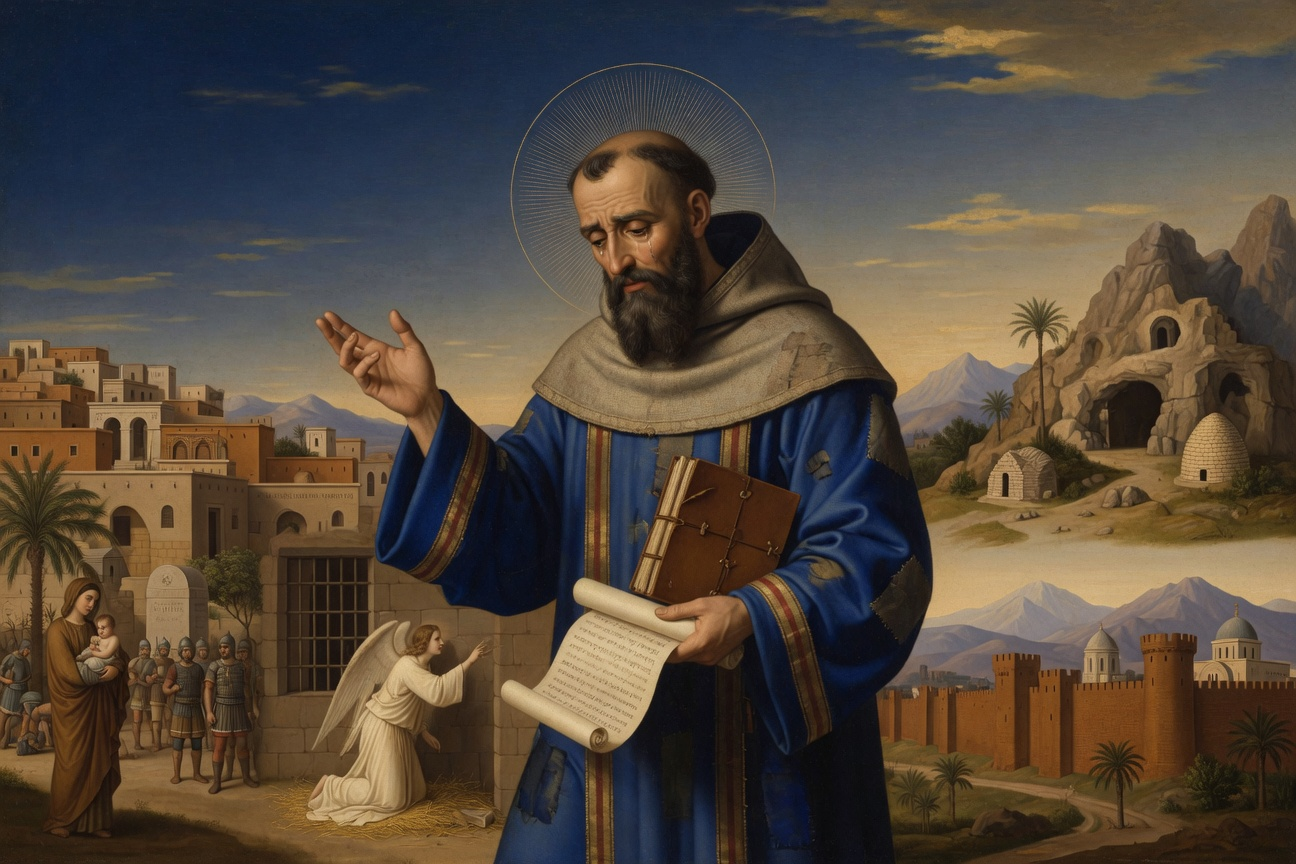
Born in Nisibis in the 4th century, Saint Ephrem was a Syrian deacon and poet famous for his humility and eloquence. After a youth marked by a profound conversion following an unjust imprisonment, he became a defender of orthodoxy in Edessa against heresies. Nicknamed the 'Harp of the Holy Spirit', he left behind an immense literary body of work and died in 378 after dedicating himself to the poor during a famine.
Guided reading
10 reading sections
SAINT EPHREM, DEACON OF EDESSA AND CONFESSOR
Edessa, City of Piety
Presentation of the city of Edessa, its biblical and royal history, and its role as a Christian refuge in the face of persecutions.
Edessa was distinguished among the cities of the East by the piety of its inhabitants and by the holy solitaries who flourished in its territory: such were Sai nt Ephrem, o saint Éphrem Syriac deacon, theologian, and poet of the 4th century. f whom we are about to speak, Saint Barses, Saint Eulogius, Saint Aphraates, Saint Julian surnamed Sabas, and so many others eminent in virtue.
Saint Isidore of Seville believes that this city was founded by Nimrod, and that it first bore the name of Jare, or Arach, as Saint Jerome says. It received the name Edessa when it was rebuilt by Seleucus, the first king of Syria, because of a city of the same name in Macedonia. It was the capital of Osroene, and for a long time had its own particular kings, who styled themselves princes of Edessa, or of Osroene. They all too k the Abgar Name of the kings of Edessa, one of whom is said to have corresponded with Jesus Christ. name Abgar or Abgare, which means the Great. The second of this name reigned in the time of Jesus Christ: Eusebius calls him a very powerful prince of the nations beyond the Euphrates. He says that it was he who wrote to Jesus Christ, and received a letter from him, in which he promised to send him one of his disciples who would heal him of his ailments, and would give life to him and his own. This is what was found in the public archives of Edessa. Indeed, after the ascension of the Savior, Saint Thomas sent there Saint Thaddeus, one of the seventy-two disciples, who healed this prince, performed many miracles, and instructed the inhabitants in the mysteries of the Christian faith.
If anything can certify this account of Eusebius, which not all scholars agree upon, it is that this city can be counted among those that embraced Christianity the earliest. Its inhabitants distinguished themselves by their zeal and constancy in the time of persecutions. Saint Chrysostom informs us that under the Emperor Diocletian, some holy women of Antioch retired there as to the place most worthy to serve them as a refuge and port. The Emperor Julian, having crossed the Euphrates to go to Persia, refused to enter it and left it to his left, giving as his reason that it was entirely Christian; and in the time of the persecution of Valens, an Arian emperor, there were counted as many confessors of the divinity of Jesus Christ as there were persons, both men and women and children.
But what further acquired great glory for this city, which Rufinus calls the city of the faithful peoples, is to have served for several years as a theater for the zeal and piety of the most famous Saint Ephrem.
Origins and faults of youth
Birth of Ephrem in Nisibis to Christian parents and account of his youthful errors, notably the incident involving a poor man's cow.
He borrowed no luster from his parents, if one judges by the maxims of the century; for he teaches us himself that his ancestors were foreigners who came to Nisibis, in M esopot Nisibe City in Mesopotamia where the saint's monastery is located. amia, where he was born, and that they lived there by the work of their hands and the alms given to them. His grandparents advanced a little further; they cultivated the fields, and his father and mother, who lived in the same condition, possessed some land in the vicinity of the city. But in this state, which presented no title of distinction in the eyes of the world, they had one that distinguished them excellently in the eyes of God; for they were united by blood to martyrs, and they themselves had confessed the name of Jesus Christ before the judges, during the persecution of Diocletian.
It was therefore from parents so respectable according to religion that Saint Ephrem was born, under the reign of the great Constantine, or even a little before. If he did not find in his house the perishable treasures of the earth, he was able to enrich himself greatly there with heavenly treasures, through the instructions and examples of piety he received from those from whom he had received life. He also found in his neighbors much to edify him in piety, and the accounts given to him of so many sufferings that the saints had endured in the persecution, and whose memory was quite recent, could only animate him to sustain himself in it, as well as the maxims of the Holy Scripture, with which his parents took care to nourish him spiritually.
However, in the confession he made of the faults of his youth, he accuses himself of many defects he had from that time, such as being a quarreler and envious, always ready to get angry over the slightest things. He also says that he had doubted Providence, and had almost been persuaded that the events of life happen only by chance. He further deplores an action that he attributes to his malice, and for which God did not delay in punishing him, to make him know that nothing escapes His wisdom and His justice.
"My parents," he says, "sent me one day, when I was still young, to the countryside. While going there I passed through the forest, where I saw in the evening a cow belonging to a poor man that was pregnant and ready to give birth, and which was grazing quietly. I took stones and began to chase it for a long time, until it fell and died; so that the beasts devoured it in the night. I then met the poor man to whom it belonged, who asked me if I had seen it; but I answered him only with insults."
Such were the faults of his youth of which he accused himself in the presence of the brothers when he had embraced the monastic life, and which he always deplored bitterly. But if one considers that he speaks of all the states of his life, as that of a very great sinner, and who had reason to fear more than any other the severity of the judgments of God, one will find that, although he was not innocent, especially in causing the death of that cow, it could also be attributed rather to a simple outburst of youth, and a desire to amuse himself by making that animal run, without thinking of what would happen, than to an affected malice to harm him.
The Trial of Imprisonment
Falsely accused of theft, Ephrem discovers in prison, through the intervention of an angel, that his sufferings are a divine punishment for his past faults.
Be that as it may, the Saint then tells us how God punished him for it, and how He made him understand that He chastises men for the crimes they may sometimes hide from other men, but which are never hidden from His divine eyes. Indeed, about a month after he had committed this fault, his parents having sent him again to their country house, night overtook him, and a shepherd invited him to stay at his place; but this shepherd having become intoxicated, wolves entered the sheepfold while he slept and scattered the flock. Those to whom it belonged seized Ephrem as well as the shepherd, bound them, and brought them before the judge, accusing him of having let thieves into the sheepfold during the night who had taken their flock; and it is likely that the shepherd had made them believe this to exonerate himself.
Notwithstanding the oaths taken by Ephrem, who felt himself innocent, the judge had him put in prison with the shepherd, but separated from one another, until the matter could be cleared up. He found in the prison where he was locked up a townsman and a peasant who were being held there as guilty of two crimes of a different order, but both grave. They were, however, innocent of these crimes; but they were not innocent before God of other crimes they had committed, and for which His justice was pursuing them; for the townsman had given false testimony for fifty crowns against a very pious young widow, accusing her of misconduct to favor the greed of her two brothers, who wanted to have her deprived by this black slander of the portion that legitimately belonged to her from her father's estate, and they had unfortunately succeeded; and the peasant, having seen a man drowning, had let him perish, although this poor man called for his help, and he could have saved him by merely giving him his hand.
God permitted that Saint Ephrem should find himself in the same prison with these two men, and later with others who were brought in some time after, and who were in much the same situation, in order to convince him ever more by these examples that nothing escapes His Providence. He spent seven days in this way, and on the eighth he saw in his sleep a personage of a terrible aspect, but who asked him with great gentleness what he was doing in this prison. He told him the reason while weeping; and this personage, who could only be an angel, said to him with a smile: That in truth he was innocent of the crime for which he had been arrested; but that he should remember what he had done a few days before, and the thoughts he had had against Providence. He also made him understand that those who were with him were not guilty either of the crimes of which they had been accused; but that God wished to punish them for others unknown to the judges, and which they had not been able to hide from His eyes.
Ephrem, having awakened, had no trouble remembering the cow of which we have spoken. He reported this dream to the others, who could not deny their hidden crime, and what they told him made him understand even better that it was not an ordinary dream he had had, but an instruction that God had given him through the ministry of an angel on the equity of His judgments. The same personage appeared to him the following night, and said these words: "You will see tomorrow those who make you suffer by their slanders." This made him very sad, not knowing what would happen to him. Those who were with him questioned him about the subject of his sadness, and when he had told them, they feared no less than he did.
Day having come, the governor sat on his tribunal and had Ephrem brought to him with the two others, who were presented to him loaded with chains. These two were put to the question with five others who had been seized, among whom were the two brothers of the young widow of whom we have spoken, and against whom the imprisoned townsman had borne false testimony, God manifesting ever more to Ephrem, by these various multiplied examples, the equity of His Providence. He was a spectator of the tortures they were made to suffer and he melted into tears, believing that he would be tortured as well. As an added affliction, the bystanders mocked him and told him that it was no longer time to weep, that his turn would come, and that he should have feared committing the crime instead.
However, they made him suffer nothing, and he was taken back to prison with the others. As a new governor was to come, this change caused them to remain all together for about two more months. The angel appeared to him a third time and said to him: "Well, Ephrem, do you recognize now that God governs the world by a very equitable judgment?" — "Yes, Lord," he replied, weeping; "but since you have done me the grace of knowing it, have pity on your servant, and take me out of this prison, so that I may become a monk and serve Jesus Christ my Lord." — "You will be questioned one more time," the angel told him, "and then delivered." Ephrem represented to him that he could not withstand the threats of the judge, nor the pains of the question. But the blessed spirit replied that it would have been much better to do nothing against his duty. He reassured him, however, and told him that the governor who was to come would restore his liberty.
At the end of seventy days, the new governor had the prisoners brought to him and judged them all according to what they deserved. Ephrem was presented to him being almost naked and loaded with chains, and it turned out that the judge, who was from his country and knew his parents very particularly, recognized him immediately. He would have liked to show him signs of affection; but as he had to act according to the laws, he questioned him and learned from him how he had been put in prison. Upon his answer, he had the shepherd put to the question, where the lashes of the whip forced him to confess the truth: thus the innocence of Ephrem was recognized, and the judge sent him away absolved.
The following night the same spirit appeared to him and said: "Return home and do penance for your sin. Learn from what has happened to you that there is an eye that sees everything." He then made terrible threats to him, and this was the last time he spoke to him. The Saint recounted all this in greater detail to his religious, and God, who was preparing very great graces for him, and who had destined him to carry His word of salvation to men, wished by these events to establish him in deep humility, and to imprint deeply in his heart the fear of His judgments, so that he might live in compunction, and that he might inspire its salutary sentiments in others.
Retreat and Asceticism
Ephrem embraces the monastic life, practicing absolute poverty, exemplary chastity, and profound humility.
He did not delay for a moment in carrying out the order he had received and the promise he had made. He withdrew to the mountain to a holy old man who lived there in solitude; and having prostrated himself at his feet, he told him everything that had happened to him, and obtained from him to be taken under his guidance. He had not studied the philosophy of men; but he acquired that of God. He shut himself up in his solitude to acquire there, by the favor of the rest of retreat, that perfect life to which he aspired with all the affection of his heart. He lived in such great stripping away of all things that, although his humility led him to always speak ill of himself, as sincere in his words as he was humble in his feelings, he could assert in truth, as he declared to his disciples later, when he was near death, that he had never had a purse, nor a staff, nor a wallet, nor gold, nor silver, nor any other possession on earth, as he had learned from what Jesus Christ had said to his disciples; thus, his poverty is compared to that which the Apostles had practiced, and he was looked upon as a perfect model of this virtue.
He joined to this deprivation of all things the combat against himself, subduing his body with great austerities to subject it to reason, and taming, through fasts, vigils, and other labors, his disordered affections.
God blessed his penance with the gift of chastity with which He particularly favored him; for it is known that it is a gift that comes from Him. His love for this angelic virtue caused him to be compared to the patriarch Joseph, and it appeared as much in his body as it adorned his soul. He did not, however, fail to watch over his senses, and to distance himself from dangerous occasions. The demon nevertheless stirred some up for him, as we shall say later; but he always had the good fortune to deliver himself from them to the shame of that enemy.
The zeal with which he undertook to renounce himself also made him overcome the defects that came from his character. He was naturally subject to anger, but he succeeded in overcoming it; and it was remarked that since he had become a solitary, he never let himself go; on the contrary, he was always considered to be gentle, patient, and peaceful. Sozomen and the Lives of the Desert Fathers report this trait of his moderation. He had fasted for several days, and as he then wanted to take some food, the one who was carrying the earthen pot where what had been prepared for him was, let it fall and broke it. The Saint, seeing him all ashamed, said to him to console him: "Do not be distressed, my brother; since the supper does not come to us, let us go to it," and having sat down beside the broken pot, he ate with a cheerful air what he could pull from it.
Passing through a city one day, some people who saw him, wanting to test his virtue, told a woman of ill repute to approach him. She did so brazenly, and said some indecent words to him. He answered her without being moved: "Follow me"; and when they were in a place where there were the most people, he gave her a lesson in a few words that filled her with astonishment: she withdrew, all confused, without having been able to cause him the slightest movement of anger.
Although he practiced all virtues to an eminent degree, the one in which he excelled the most was humility. All his hope was in God, and through the trust he had in Him, there was nothing on earth that touched him but His pure glory. He fled that of men so much that one could not praise him without him suffering strangely in his heart. Saint Gregory of Nyssa, who reports this, says in this regard that when a person p raised him in his prese Saint Grégoire de Nysse Hagiographer and primary source for the saint's life. nce, the pain he felt from it appeared first on his face: one saw him change color, lower his eyes to the ground, remain speechless and covered in confusion, and sweat all over his body. Sozomen also informs us that having been elected bishop of a city he does not name, as they were looking for a way to take him to be consecrated, he had barely learned of it when he went into the middle of the square, feigning the walk of a madman, tearing his clothes, and eating in front of everyone: and he did it so well that those who wanted to take him believed that he had really lost his mind, which determined them to withdraw. When he saw that they were leaving, he also took his time to flee, and kept himself hidden until he knew that they had elected and consecrated another.
But to be convinced of his profound humility, one only needs to read his works, where he has forgotten nothing to persuade everyone that he was a very great sinner; and this appears even in particular from the one we have of his confession and his conversion to God, where he goes into the detail of his defects and his faults, at the very time when he was honored by everyone, and when he had already written much for the good of souls, as if he had wanted to destroy by that the advantageous ideas that he had so justly earned. He sustained himself in the same feelings until the end of his life; and his testament, of which we shall speak in its place, is a proof of this no less evident than edifying.
One can look upon his sighs and tears as an effect of his humility, the gift of which he had received with such abundance that they were inexhaustible. Saint Gregory of Nyssa says on this subject: "One cannot speak of his tears without shedding some oneself. It was as common for him to shed them as it is natural for men to breathe. He wept night and day, and there was not a single moment without weeping, except for the little time he gave to sleep. Sometimes he wept for the sins of men, and sometimes for his own. His sighs followed his tears, or rather they were the effect of the abundance of his tears. There was in him a kind of marvelous circuit of his sighs which made his tears flow, and of his tears which excited his sighs; so that one could not well discern which of the two was the cause of the other, because they followed one another without interruption.
"One will be easily persuaded of this," adds Saint Gregory, "by reading his works; for not only does one recognize this precious gift in what he wrote to lead others to regulate their morals and to embrace penance, but even in his praises of the Saints. One sees him always weeping, and he always returns to his feelings of compunction. These were like the riches of his penitent soul that he presented to everyone."
The Diaconate in Edessa
Settlement in Edessa after the siege of Nisibis, elevation to the diaconate, and the beginning of his public preaching ministry.
He was still in Nisibis when, in 350, Sapor, King of the Persians, besieged that city, as seen in the life of Saint James; and it was he who had that holy bishop climb the wall to curse the enemies. It is likely that he was a disciple of this great Saint, or at the very least, being in a position to see him often, he took advantage of it to form himself more and more in Christian virtues. We might also believe that the death of Saint James and that of Saint Julian, his neighbor in the cell and his confidant, were an occasion for him to leave Nisibis to go to Edessa, if one were to rely on conjectures; but Saint Gregory of Nyssa gives us another reason.
"He did not change his place," he says, "by his own spirit, but according to what the Spirit of God, who instructed him inwardly, inspired him to do for the good of souls. Then, faithful to His voice through perfect submission to His orders, he went where the Lord called him; and it was thus that, imitating the obedience of Abraham, he left his homeland to go to Edessa, it not being right that such a brilliant sun should remain hidden any longer."
In this journey, the Saint also proposed to honor holy things, Saint Gregory adds, apparently the relics of the apostle Saint Thomas which were venerated there, and to confer with a great personage to benefit from his lights, just as he was to communicate his own to others. Saint Gregory does not name this personage; but there were very illustrious ones in Edessa and its surroundings, such as Saint Barses who died in 379, and who could well have been a bishop in 350, and Saint Julian Sabas, etc.
Upon approaching the city, he prayed to the Lord that the first person he met would be someone who would speak to him of the Holy Scriptures. But he was very astonished when, instead of a person of science and piety, he found a wicked woman at the very gate. He turned his eyes away with some sorrow and complained inwardly to Jesus Christ that He had not answered his prayer, as there was no appearance that this creature would enter into discourse with him on subjects from the holy Books. This person, however, stopped and looked at him fixedly. Ephrem noticed it and rebuked her for it; but she answered him: "I am doing what I must by looking at you, since I am a woman and I was taken from you who are a man: but you, instead of looking at me, look at the earth from which you were taken." The Saint admired this retort and praised the incomprehensible power of God, who sometimes grants us through the ways that seem least appropriate the graces we ask of Him; and he confessed that he had found much to profit from this answer. Sozomen, who also recounts this story, says that the Saint wrote a book about it which was one of those that the Syrians esteemed the most; but it has not reached us.
The house where he lodged was opposite that of another similar creature, and he did not know it. After he had spent several days there, this woman said to him: "My Father, give me your blessing." He turned his eyes toward the window to see who it was, and having caught sight of her, he answered her: "I pray to God that He may bless you." — "But," replied the woman, "is something missing in your lodging?" — "Nothing is missing," he told her, "except for a few stones and a little earth to block the window through which you see me here." — "You treat me very harshly," this woman said to him, "for the first time that I speak to you"; and immediately she spoke to him in a language such as one could expect from such a creature. The Saint asked her to act in the middle of the city as she acted in her own home.
She cried out about the shame there would be in doing so, and the Saint took the opportunity to represent to her that if she feared the sight of men, she should blush all the more under the eyes of God, who is present everywhere and who, on the day of judgment, will render to each according to his works. This woman was so touched by his remonstrance that she came to throw herself at his feet, melting into tears, and said to him: "Servant of Jesus Christ, put me, I conjure you, on the path of salvation, so that God may forgive me all the crimes I have committed." The Saint confirmed her, through several words he spoke to her from the Holy Scripture, in the desire to do penance. He placed her in a religious house, and thereby out of the occasions of sin.
As for him, he continued his exercises of the solitary life and retired into a monastery; but he could not remain hidden there, whether his reputation had preceded him to Edessa or his merit, when he had arrived there, was immediately known; for he was obliged to divide himself between the rest of the cell and the ministry of the word, not only to give private instructions to those whom the confidence so well-founded in his lights and his piety attracted to him, but also to preach publicly to the people. He was elevated to the diaconate and was attached to the church of Edessa, which fixed him there entirely: this is why he is always qualified as the deacon of Edessa. Although the ministry of preaching was not an ordinary function of his Order, the obedience he owed to his bishop obliged him to it, and besides, his charity did not permit him to excuse himself from it, even though he always feared being more condemned before God for having announced the evangelical maxims, which his humility made him believe he did not practice himself.
Inspired Eloquence
A description of Ephrem's miraculous gift of speech, nourished by the Holy Spirit and capable of converting the most hardened hearts.
The discourse on the priesthood, which has been placed at the beginning of his works, is a sermon delivered to the clergy. As preaching was his primary function, it is fitting that we elaborate here on the dispositions he brought to it, on the graces he received from heaven to discharge it worthily, on the zeal with which he applied himself to it, on the sentiments with which he accompanied it, and on the fruits of salvation it produced. We shall draw from good sources so as to advance nothing that is not indubitable. Saint Basil, Saint Gregory of Nyssa, Theodoret, Sozomen, and the works of the Saint himself shall be our authorities.
Saint Ephrem had not been raised in the human sciences. He was ignorant of the sciences of the Greeks; he spoke only his native language, which was Syriac; but he acquired all its purity: he even enriched it through various poems that he composed. He also studied logic and the rules of reasoning, yet fixing himself only on what could be useful to him, and leaving aside what appeared superfluous. But his principal study was that of the Holy Scripture, the dogmas of the Church, and the false opinions of the heretics, in order to refute them as he ought: this concerns his external aids.
What contributed to his success in his ministry was the purity of his heart, by which he merited to receive from God the gift of knowledge and the gift of speech in a miraculous manner, which caused him to be admired, as he has been admired in all times, and as we do still today in what remains of his works. His humility led him to say that he had not been able to learn the philosophy of men; but God showed that He had shared it with him advantageously by bestowing upon him His wisdom.
The purity of intention with which this great Saint exercised the ministry of the word deserves to be noted. Besides the obedience that had engaged him in his mission, it was an ardent love of God and a most pressing charity for the salvation of his neighbor that guided and animated him to do so. His humility, which accompanied him everywhere, made this ministry in some way burdensome to him, because he would have preferred to receive instructions rather than to give them, and he feared condemning himself while combating the vices of others. But his zeal for the glory of God and his compassion for souls, which he could not see perish without being penetrated by bitter sorrow, made him overcome his fear and rendered him holily courageous in announcing the evangelical truths.
It is further noted that he speaks in his discourses in a manner full of tenderness and affection, by beseeching, by urging, by conjuring; yet he does not fail to join to it at times strength and vehement rebukes.
Saint Gregory of Nyssa makes us admire this marvelous source of knowledge that the Holy Spirit had placed in his mind; "so that," he says, "some words flowed from his mouth like a torrent, they were too slow to express his thoughts. However prompt his tongue was, it succumbed to this crowd of ideas that his mind provided him: it equaled the speed of other minds, but not the rapidity of his own. That is why he prayed to God to moderate this inexhaustible fund that He had given him, saying to Him: 'Hold back, Lord, the floods of your grace'; for this sea of knowledge that sought to discharge itself through his tongue overwhelmed him in some way, the organs of speech being unable to suffice for what his mind presented to him for the instruction of others."
This admirable fecundity of knowledge that the Holy Spirit communicated to him had been manifested in a vision to an old man respectable for his piety. It is again Saint Gregory who reports it. "A very enlightened old man," he says, "perceived a troop of angels who, descending from heaven, held a book written within and without, and were asking one another: 'To whom must this book be given?' Some named one person, others named another from among those who appeared the most holy at that time; and after having examined them, they all said together: 'It is true that they are holy and true servants of God; but one cannot give them this book.' Finally, after having named many others equally holy, they all agreed to say: 'This book can only be entrusted to Ephrem, so gentle and so humble of heart'; and they gave it to him immediately. This old man, having seen this, hastened to go to the church, where he heard Saint Ephrem, who was then preaching with so much grace and fruit that he recognized the truth of the vision he had had. He could not doubt that the Holy Spirit was inspiring what he said, and he admired the grace so abundant that he had received."
But we cannot omit the effects that the exhortations of Saint Ephrem had on the hearts of those who listened to him. It is again Saint Gregory of Nyssa who informs us of this. "There was hardly any of his listeners," he says, "who could resist the force of his discourses, and who did not determine to convert sincerely, upon seeing this abundance of tears with which he accompanied his words of life. What heart, had it been harder than diamond, was not softened and did not weep for its sins through a true penance? What barbaric and cruel nature was not softened and changed by this honey so sweet and so salutary that came out of his mouth? Who was ever so far from penance and so given over to the pleasures of the senses, who, after having heard him speak of the punishments that God reserves for sinners after this life, did not think seriously of correcting his own and of erasing his faults through the tears of penance?"
One can also judge the impressions that his discourses made on the people by those that his writings made later. It is again Saint Gregory who remarks on this. "For," he says, "when one wants to make it understood that a thing cannot be done, one says in a proverb that it is as impossible as it would be to bend the hardness of a pebble. But experience has taught us in Saint Ephrem that he performed this miracle; for he softened and broke by the force of his words hearts even more hardened than pebbles. One cannot read what he says about humility without renouncing all the swelling of pride and without entering into sentiments of self-contempt. What he says about charity animates one to a holy fervor and encourages one to suffer everything for God. The praise he gives to chastity makes it appear so lovable that one feels moved to consecrate oneself entirely to God through this beautiful virtue. What a man, when he speaks of the last coming of Jesus Christ! He does it with so much force, and represents its frightening apparatus with so much energy, that it seems one is actually present before the throne of the sovereign Judge; and only reality itself could give us a more vivid idea of it."
We have elaborated on the work of Saint Ephrem as a preacher, because this was one of the most considerable works of his life. With what purity of heart he spoke! What uprightness in his intentions! What zeal for the glory of God, and what desire for the salvation of souls! How far he was from taking pleasure in himself for the greatness of the talent he had received from God! With what sweetness, what tenderness, and at the same time what vehemence he expressed himself! What sublimity in his thoughts, what greatness in his sentiments, what nobility in his expressions, what effusion of heart in his zeal! He had all the external qualities that make the perfect preacher, and all the internal virtues that must accompany the holiness of his ministry. He shook, he softened, he overturned, he broke hearts. Nothing resisted him. But he touched, because he was powerfully touched himself; and it is thus that God blessed the labors he sustained for His glory and for His love.
Defense of Orthodoxy
Combat against Arianism and the sects of Bardesanes and Harmonius through the composition of dogmatic hymns in the Syriac language.
Although we have said that Saint Ephrem had corrected his natural tendency toward anger in his youth through the great gentleness he acquired by working effectively to moderate himself, nevertheless, as this gentleness was in him a virtue of charity, which did not slacken the ardor of his zeal when it concerned the glory of God and the good of souls, he rose up with apostolic strength and vigor more particularly against the enemies of the faith. Thus, as long as he lived, he did not cease to pursue the heretics, who were numerous in his time, and he succeeded in rescuing from their snares a multitude of people whom they had seduced. Saint Gregory says that, when he attacked them, he appeared to them like an experienced and victorious athlete against a child who is without strength.
No human consideration, no fear could prevent him from declaring himself openly for Catholic doctrine. Although the impiety of Arius dominated in his time in the East, and was protected by the powers of the age, he always showed himself in his words and in his writings to be the intrepid defender of the dogma of the Holy, uncreated, and consubstantial Trinity, and of the divinity of Jesus Christ. He fought the ancient heretics and those who appeared in his time. He even ruined in advance the errors that were to arise after him, such as those of Nestorius and Eutyches, God having made them known to him by the light of prophecy. We shall see this again more particularly when speaking of his testament. He did not pursue the pagans with any less force; and finally, without needing the erudition of the Greeks, and by the grace he had received from God, he launched such terrible darts in his native tongue against all his adversaries of the faith that he overwhelmed them under his powerful blows.
A heretic named Bardesanes, who had given his name to his sect, and his Bardesane Syrian heretic whose errors were contested by Ephrem. son Harmonius, had made themselves famous in Osroene and had infected it with their errors. To better slip them into minds, Harmonius, instructed in the sciences of the Greeks, had used them to make, in their imitation, poems in the Syriac language, which he had set to music, and which had appeared all the more agreeable to the Syrians, as it is held that before this heretic one did not have the use of such songs. Saint Ephrem, seeing the prejudice that this could bring to the faith, used the talent for poetry that God had given him, and having well studied the measures that Harmonius had observed, he composed on the same airs hymns full of Catholic truths, as much in honor of God and His Saints as on various other points of doctrine; so that the people, finding there the same harmony and instructing themselves in the truths they were to learn, left the songs of the heretic and sang only those of the Saint; which served even subsequently to make the feasts of the martyrs more solemn and more joyful, as we learn from Theodoret and Sozomen.
Journey to Saint Basil
A visit to Caesarea in Cappadocia where Ephrem and Basil mutually recognize each other as instruments of divine grace.
We have said that Saint Ephrem had left Nisibis, his homeland, to dwell in Edessa, and that he did so only by the movement of the Holy Spirit; it is Saint Gregory of Nyssa who assures us of this, and he adds that it was by the same spirit that he made the journey from Edessa to Caesarea in Cappadocia, to s ee the great Saint Ba le grand saint Basile Father of the Greek Church who influenced Ambrose. sil, who was its bishop. Everything that happened to him during this visit proves manifestly that it was God who had inspired it. Saint Basil already knew him by reputation, either from when he had been in Mesopotamia around the year 357, or from what Saint Eusebius of Samosata, whom he visited in 372, had told him about him.
Saint Ephrem, who himself reports to us in part what happened to him, says that having found himself in the city (it was Caesarea) and God wishing to manifest to him the effects of His mercy, he heard a voice that said to him: "Arise, Ephrem, and go to receive thoughts and instructions with which you may nourish yourself." He replied at first with that eagerness that his ardent desire for the good inspired in him: "Lord, where shall I be able to find them?" And the same voice replied: "I have in my house a vessel that shines and is magnificent; it will provide you with this nourishment." At these words, seized with astonishment and admiration, he went to the church; and he was barely at the vestibule when the desire to see him made him immediately look through the door into the holy temple, and he discovered in the sanctuary Saint Basil, that vessel of election exposed in the presence of his flock, whose eyes were all fixed upon him, and who was presenting to them with the majesty of celestial eloquence the divine pasture, that is to say, the evangelical law, the doctrine of Saint Paul, and everything that can inspire respect for our sacred mysteries. But God, opening his eyes in a miraculous way to manifest more hidden things, or rather the source that provided this holy doctor with those waters of life that he poured out upon his happy sheep, he perceived a dove, white as snow and resplendent with light, perched on his shoulder, which was telling him in his ear the things he was preaching to his people. Ephrem then began to praise loudly the wisdom of this holy doctor, and the magnificence of God who knows so well how to glorify those who glorify Him.
As he was expressing himself in Syriac, one could hear his voice without understanding what he meant; but some of the assistants to whom this language was not unknown understood him and asked who this stranger was who was thus praising their bishop. God made it known at the same time to Saint Basil that it was Saint Ephrem, and, after the end of the assembly, having had him called, he asked him through an interpreter why he had praised him so before everyone; he added: "Are you then Ephrem who have so generously lowered your neck under the salutary yoke of Jesus Christ?" "Ah!" he replied, "I am rather that Ephrem who has strayed from the path of salvation."
Saint Basil then took him by the hand, embraced him, and presented him with a table laden, not with corruptible meats, but with eternal truths. He spoke to him of the means to make oneself pleasing to God, to avoid sin, to tame the passions, to make the sovereign Judge favorable, and to arrive at evangelical perfection. But he did so with such unction that Ephrem could no longer contain the effects that his words had had in his heart, and he cried out, melting into tears: "O my Father! Do not abandon a coward and a sluggard: put me on the right path; soften my heart of stone. God has led me to you so that you may take care of my soul, and that, as an experienced pilot happily guides his vessel, so you may guide me to the port of salvation."
They conversed thus for some time with that satisfaction and mutual joy that the Saints taste when they discourse together on heavenly things.
Devotion during the famine
One year before his death, Ephrem organized relief for the poor of Edessa, managing the alms of the wealthy to feed the starving.
God willed that one year before his death he should add to the crown that his humility and other virtues had acquired for him, the one He reserves for those who have practiced mercy. The city of Edessa was then afflicted by a very great famine, and the people of the countryside suffered from it more than the others. The compassion he felt for them compelled him to leave his cell, from which, as we have said, he only emerged for his ecclesiastical duties. He came into the city and severely rebuked the rich for neglecting to help the poor in this public need, showing them that it was on their part a hardness and avarice that would one day turn to the loss of their souls, the salvation of which they should prefer to the preservation of temporal goods.
The rich, who moreover had a great veneration for his piety, first wished to excuse themselves, giving as a reason that they were not attached to their riches, but that they did not know to whom to entrust their alms, because they feared that those they would charge with them would use them for themselves, instead of making a wise distribution. Then Saint Ephrem, this man as charitable as he was humble, taking advantage of the good opinion they had of him to make it serve the relief of the poor, said to them: "And me, for whom do you take me? What do you think of me?" They answered him according to their true feelings, that they held him for a man of God and of irreproachable probity. "Since then you believe me to be such," he replied, "entrust to me the care of the poor." — "Would to God," they said to him, "that you would take the trouble!" — "Yes," he added, "I will do it very willingly for the love of you: I take charge from this day of the administration and the feeding of the poor."
When he had received their money, he had three hundred beds arranged in the public galleries which he had had closed, where he fed the poor, dressed the sick, provided, from the money given to him, for the needs of all those who came there, both from the countryside and from the city, and buried the dead, lending himself to everything with untiring zeal and charity. He spent a year in this holy exercise, after which, the abundance of grain having returned, and everyone having returned home, he re-entered his cell, where he was soon to die of a short illness.
Passing and Literary Legacy
Death of the saint in 378, the writing of his Testament, and an analysis of his immense theological and poetic work.
He received a revelation that Divine Providence wished to call him from this exile to the heavenly Jerusalem. It was then that he wrote this admirable exhortation, filled with holy maxims, which is calle d the Testament of Saint Testament de saint Éphrem Final exhortation written by Ephrem before his death. Ephrem, because he composed it at the hour of his death. This work is assuredly his, despite what the heretics say: it is their custom to deny the books of the Fathers where their errors are condemned, as in this treatise which mentions prayer for the dead, which the Calvinists combat with their false dogmas. He ordered very expressly that his coffin should not be covered with a precious cloth, and, in case one had been prepared, that it should be sold and the money given to the poor. Nevertheless, a nobleman who had great veneration for the Saint gave one to wrap him in, thinking that God would be more pleased that it was for him than if it were given to the poor; but, because he had not followed the will of the servant of God, the unclean spirit seized his person at that very hour and tormented him until he recognized his fault, confessed it at the feet of the Saint, and asked his pardon. And Ephrem, sick as he was, stretching his hands over him, delivered him, warning him to fulfill what he had promised. He also did not wish to be buried in a tomb made on purpose, nor in the church, but in the common cemetery, with the other poor; then, exhorting those present to the love and fear of God and to the fulfillment of His will, he rendered his soul to his Creator; which happened, according to Cardinal Baronius, in the year 378, one month after the death of Saint Basil.
Saint Gregory of Nyssa delivered the panegyric of the Saint, at the request of a man named Ephrem. The latter had been taken prisoner by the Ishmaelites; but having commended himself to the holy deacon of Edessa, his patron, he had been miraculously delivered from his chains and from several dangers. Saint Gregory ended his discourse with this prayer to Saint Ephrem: "O you who are presently at the feet of the divine altar, and before the prince of life, where you adore, with the angels, the august Trinity, remember us all, and obtain for us the pardon of our sins."
The continual tears that Saint Ephrem shed, far from disfiguring his face, seemed on the contrary to increase its serenity and grace; so that one could not see him without being penetrated with veneration. The Greeks depict him in the figure of an old man of tall stature, having a gentle and majestic air, eyes bathed in tears, a look and an exterior that announce great holiness. He has been given a gesture that recalls his formidable eloquence when he paints the terrors of the last judgment.
## NOTICE ON THE WRITINGS OF SAINT EPHREM.
We cannot resist the pleasure of giving an idea of the eloquence of Saint Ephrem, by inserting here a fragment of his sermon on the second coming of Jesus Christ:
"Beloved of Jesus Christ, pay favorable attention to what I am going to tell you about the frightening coming of the Lord. When I think of this moment, I feel seized with excessive fear. Who can report these formidable things? Where to find a tongue capable of expressing them? The King of kings, raised on a throne of glory, will descend from heaven, and having sat as judge, will make all the inhabitants of the earth appear before him. At the mere memory of this truth, I am near to fainting; the members of my body are in violent agitation; my eyes fill with tears; my voice falters, my lips tremble, my tongue stammers, disorder and confusion enter my thoughts. I am obliged to announce these things to you, but fear will prevent me from speaking. A clap of thunder frightens us today; how will we then be able to sustain the sound of this trumpet, a thousand times more terrible than thunder, which will resurrect the dead? The bones of all men will no sooner have heard it in the bosom of the earth, than they will revive at the instant and seek to rejoin one another, and in the blink of an eye we will all resurrect and gather to be judged.
"Finally, the great King having given the order, the shaken earth and the troubled sea will render the dead they possessed, as much those who had been devoured by fish, as those who had been by birds or beasts. In the same moment all men will appear without a single hair missing from them."
The Saint then speaks of the fire that will set the whole earth ablaze, of the angels who will separate the sheep from the goats, of the standard of the cross, all shining with light, that the great King will have carried before him. He represents men overwhelmed by consternation and mortal anxiety; the just filled with joy, and the wicked delivered to despair; the angels and cherubim occupied in singing the praises of Him who is three times Holy; the heavens opened, and the Lord surrounded by such glory that heaven and earth will not be able to sustain his presence. He opens before their eyes the book where all our thoughts, all our words, all our actions are written; then he cries out: "What tears must we not shed night and day, in expectation of this terrible moment!" His sighs and sobs having cut off his speech, he could say no more. "Teach us then," cried the audience, "the frightening things that will happen afterward." — "All men," replied the Saint, "will have their eyes lowered before the tribunal of the sovereign Judge, between life and death, between heaven and hell, and each of them will be cited to undergo a rigorous examination. Woe to me! I want to instruct you on what will happen; but fear will prevent me from speaking. The mere account of these things freezes me with dread." — "We conjure you," repeated the audience, "to continue for our utility and for the sanctification of our souls." — "Beloved of Jesus Christ," said the Saint, "one will seek in all Christians the seal of baptism and the deposit of faith; one will ask them again for that renunciation they made, in the presence of witnesses, to Satan and his works, not to one, to two, to five, but to all in general. Happy is he who will have faithfully kept what he had promised!" His sighs and groans no longer allowing him to speak, the audience cried out to him again: "Ah! for mercy's sake, continue to instruct us." — "I will obey you," replied the Saint, "as much as it will be possible for me; but I will express myself only through tears and sighs. Such things are so terrible that one cannot speak of them without tears." — "O servant of God," added the people, "do not refuse us the instructions we ask of you." Then, Ephrem, striking his breast, wept even more bitterly, and said: "Ah! my brothers, what do you want to hear? O dreadful day! woe to me! woe to me! Who will dare to report, who will dare to listen to the account of what must happen in this lamentable moment? You all who have tears, weep with me; let those who have none learn to know the fate that awaits them, and let them not neglect their salvation. Then men will be separated forever from one another; bishops from bishops; priests from priests; deacons from deacons; subdeacons and readers from those who had the same orders; children from their parents; friends from their friends. The separation made, the princes, the philosophers, the wise of the world will cry to the elect with tears: Farewell forever, saints and servants of God; farewell, parents, children, friends; farewell, prophets, apostles, martyrs; farewell, holy Virgin, Mother of the Savior, you prayed for our salvation, but we did not want to be saved. Farewell, life-giving cross; farewell, paradise of delights, eternal kingdom, heavenly Jerusalem; farewell, all of you, we will see you no more; here we are plunged into an abyss of torments that will never flee."
The collection of the works of Saint Ephrem is composed of sermons or treatises of piety, prayers, commentaries on Scripture, works of controversy against the Arians, the Eunomians, the Manichaeans, the Novatians, and the Marcionites, lives of Saint Abraham, of Saint Julian, etc. His style, in his polemical writings, has nothing dry and off-putting; it is on the contrary filled with piety and unction; one notices there that the author, in refuting the heretics, burns with an ardent desire to see God praised and glorified.
Saint Gregory of Nyssa and other authors inform us that Saint Ephrem had commented on all the books of the Old and New Testament with as much clarity as erudition. We have left only his commentaries on the historical books and on the prophets.
The work that bears the title of Confession is certainly by Saint Ephrem, as M. Assemani has proven, Op. t. 144, p. 119; ibid. Proleg. c. 1, and t. II, p. 37; item. Bibl. orient. t. 147, p. 141. The disciples of Saint Ephrem wrote the same history, according to what they had heard from their blessed master: hence this great number of accounts that we have of the event in question. Gérard Vessins published one that M. Assemani had reprinted: Op. t. III, p. 23; but one must follow mainly the Confession of the Saint, which is found in the collection of his works, from the Vatican edition.
Ceillier, t. VIII, p. 101, has collected from the writings of Saint Ephrem a host of passages that demonstrate invincibly the real presence of Jesus Christ in the Eucharist. One can see on the same subject the judicious remarks of a skillful critic, which were inserted in the Mémoires de Trévoux, Jan. 1756, p. 155. — See also Doctor Wisemann, Horœ Syriacœ, t. 1st, dissert. primo.
Saint Ephrem and Saint Basil having conversed together by means of an interpreter, it is evident that the former did not understand the Greek language. The author of the ancient translation of the life of Saint Basil, which bears the name of Saint Amphilochius, claims that the holy archbishop of Caesarea miraculously obtained for Saint Ephrem the understanding of this language and that he ordained him priest. There are two errors in this account, and Baillet has fallen into the second. Saint Jerome, Palladius, and several other authors give Saint Ephrem only the title of deacon. Moreover, if one consults the translation of the work of the false Amphilochius, and examines the original text attentively, one will see that it was not Saint Ephrem, but his disciple and companion, whom Saint Basil raised to the priesthood.
Part of the works of the holy doctor was translated into Latin, and printed in Rome in 1589, by the care of Gérard Vessies or Voskens, provost of Tongres. Edouard Thwaites gave a Greek edition in Oxford, in 1768.
The most complete of all the editions of the works of Saint Ephrem is that which appeared in Rome in 1732-1743, 6 vol. in-fol., under the direction of Cardinal Quirini, librarian of the Vatican, and of M. Joseph Assemani, first prefect of the same library. One finds there the Syriac text of a large part of the works of the Saint, with the ancient Greek version of the other works. The Latin translation is by Gérard Vessius, and by P. Pierre Benedetti, a Maronite Jesuit. That of the last volumes is by M. Étienne Assemani, archbishop of Apamea, who published in Chaldean the acts of the martyrs, and who is the nephew of M. Joseph Assemani. It is unfortunate for scholars that the Greek text of the last volumes, and especially of the sixth, is filled with errors. See in the Mémoires de Trévoux, Jan. 1756, p. 146, a very curious letter on the last edition of the works of Saint Ephrem.
The Roman Martyrology makes mention of Saint Ephrem on the first of February, and the Greeks, in their Menologion, on the twenty-eighth of January. The testament of which we have spoken, and the other authors who have praised him, are reproduced in Bollandus, in the first volume of this month.
Annexes & related entities
Structured data for exploration: events, miracles, quotes, places, attributes, patronages, and important entities cited in the text.
Key Events
- Born in Nisibis under Constantine
- Unjust imprisonment and vision of the angel
- Monastic retreat on a mountain
- Siege of Nisibis by Shapur in 350
- Settlement in Edessa and ordination to the diaconate
- Journey to Caesarea to meet Saint Basil
- Combating the heresies of Bardaisan and Harmonius through poetry
- Management of the famine in Edessa one year before his death
Miracles
- Vision of an angel in prison explaining Providence
- Vision of a white dove on Saint Basil's shoulder
- Deliverance of a possessed person after his death (the lord with the precious cloth)
- Miraculous deliverance of a prisoner named Ephrem through his intercession
Quotes
-
Benedico te... quia castigasti me.
Tobit 11:17 (cited as epigraph) -
Hold back, Lord, the floods of your grace
Prayer of Saint Ephrem during his ecstasies