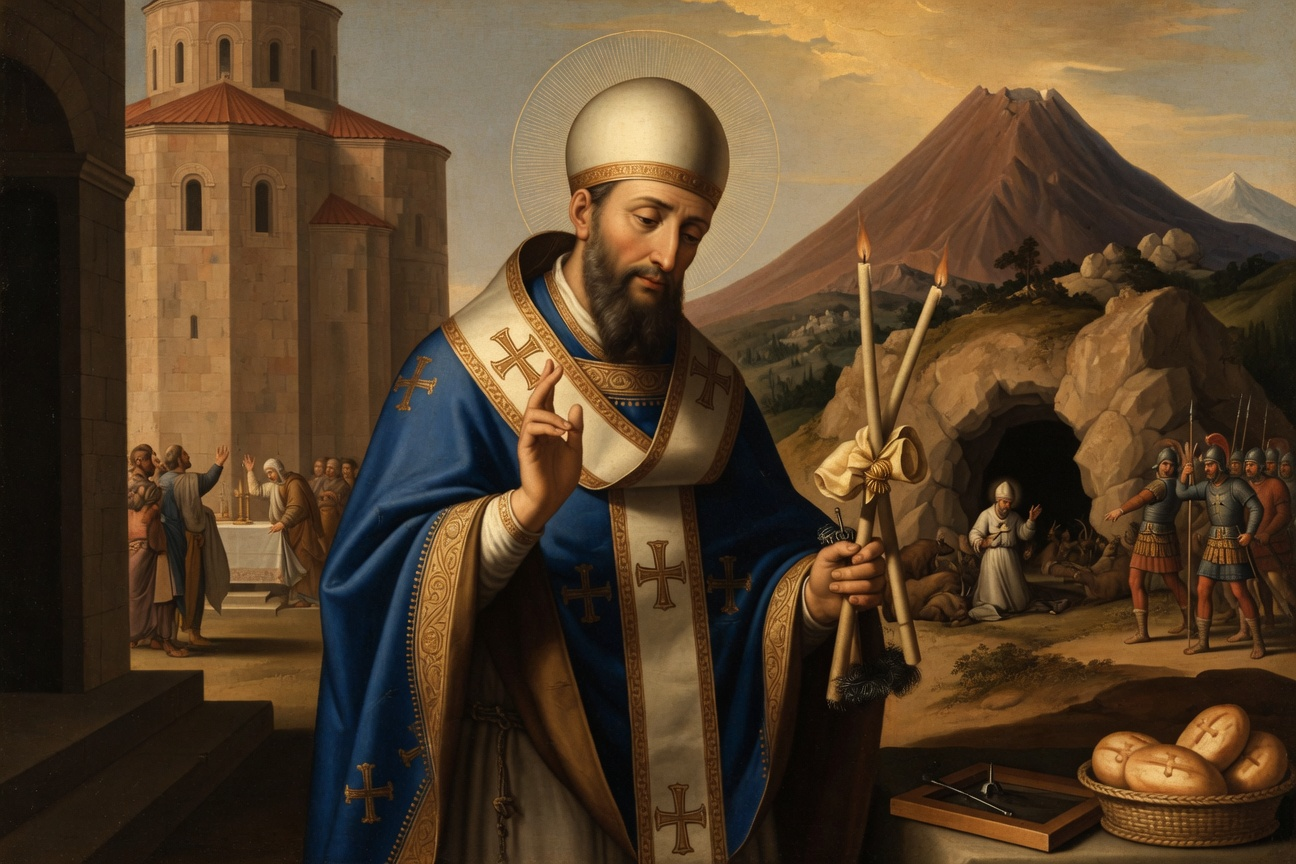
Bishop of Sebaste in Armenia, Saint Blaise lived as a hermit on Mount Argaeus among wild beasts before being martyred under Licinius. Famous for healing a child choking on a fish bone, he is one of the Fourteen Holy Helpers. His cult is marked by the blessing of candles and Saint Blaise bread.
Guided reading
8 reading sections
SAINT BLAISE, BISHOP AND MARTYR
Youth and eremitic life
Blaise, a physician who became Bishop of Sebaste, retires to Mount Argaeus where he lives in harmony with the wild beasts he heals.
Whoever wishes to save his life will lose it, and whoever has lost it for my sake will find it. Matth., xvi, 25. The history saint Blaise Patron saint of the parish of Saint-Versin, whose relics were kept with those of Veranus. of Saint Blaise teaches us that he appeared from his childhood to be of a good nature, and that he was modest in his youth: having reached mature age, he applied himself particularly to medicine, and was always imbued with the fear of God; so that, having won the affection of all the people through his virtues, he was Sébaste City in Armenia where the martyrdom took place. elected bishop of the city of Sebaste, which is in the province of Armenia. Later, by a movement of th e spirit of God, he r montagne nommée Argée Mountain where the saint retreated into a cave. etired to a mountain named Argaeus, where he lived for some time in a cavern towards which the wild beasts of the surroundings came every day to pay him honor and to receive, with his blessing, the healing of their ailments. If it happened that he was at prayer, they did not interrupt him, but they waited until he had finished, and did not return without having in some way received their leave, to show how much God favors his servants and what obedience is due to his majesty by all creatures. Thus, this holy prelate found delights in the hollow of the earth, submission among the beasts, safety in the midst of monsters, abundance in the deserts, and pleasure in solitude: which gives us reason to consider him as a second Adam in the earthly paradise, or rather as an excellent copy of Jesus Christ, of whom it is written in the Gospel that, during the forty days of his fasting and his solitude, he lived among the beasts.
Arrest by Agricola
Under Emperor Licinius, the governor Agricola has Blaise arrested after his men discover the saint surrounded by animals in his cave.
Agricola Agricola Praetorian prefect and governor of Mauretania. , governor of Cappadocia and Lesser Armenia, under Emperor Licinius, h aving co Licinius Prefect of Évreux who persecuted Saint Taurinus before converting. me to Sebaste, began to persecute the faithful there, according to the orders of his master, who tore at the sheep of Jesus Christ like a cruel and hungry wolf, while the true wolves kissed the feet of Blaise, their shepherd. This cruel judge believed that, since he was not to show mercy to the Christians locked in prisons, it was expedient to put them to death all at once by exposing them to wild beasts. To this end, he sent his men into the forests to capture lions and other fierce beasts; but it happened that, while surrounding Mount Argaeus, they pushed on to the cave where Blaise was, and found around him a great number of lions, tigers, bears, wolves, and other similar animals, which were keeping him company. Surprised by this adventure, they entered further into the cave, and, finding the saint seated and enraptured in the meditation of the greatness of the Divinity, they were even more astonished, and returned to the city to let the governor know what they had seen. This account prompted him to send soldiers toward that mountain, to search for Christians and bring back all those they could encounter. They went there and, having again found Saint Blaise, who was praying and praising Our Lord, they told him that the governor was asking for him. The saint replied joyfully: "My children, you are welcome; I have long sighed for your arrival; let us go, in the name of God." As soon as he arrived in the city, Agricola had him put in prison; and, the following day, he had him brought into his presence and said to him: "I am delighted to see you, Blaise, dear friend of the immortal gods." "God save you, O governor," replied Blaise; "but do not give the name of gods to those wretched spirits who cannot do you any good."
The miracle of the fish bone and the first torments
In prison, Blaise heals a child dying from a fish bone stuck in his throat, thus establishing his reputation as a protector against throat ailments.
The governor, surprised by such a free response, pondered within himself how he might win over this prisoner; then, giving way to rage, he had him beaten with sticks for the space of two or three hours. The saint remained ever joyful and constant in the midst of this torture, and he said only these beautiful words: "O foolish deceiver of souls! Do you think to separate me from God by your torments? No, no, the Lord is with me, and it is He Himself who strengthens me. Therefore, do with me whatever you will." Agricola had him taken back to prison, and, when he was there, a pious widow brought him food, and, throwing herself at his feet, begged him to accept the little she offered him. The holy bishop accepted her charities, and promised to provide her, and all those who belonged to her, with help and assistance in all their necessities.
They brought to this blessed prisoner the sick from all those quarters: among them was a young child who, while eating fish, had swallowed a bone that was choking him and reducing him almost to the point of death. His mother placed him at the feet of the Saint, and asked for his help with many tears and sighs; he prayed to Our Lord to grant him health, and to all those who, being afflicted with a similar ailment, would recommend themselves to him, and the child was healed immediately. Since the death of the holy Martyr, many people troubled by the same ailment have been relieved by his intercession. Let not the heretics tell us that this is a devotion invented recently, for Aetius, an ancient physician of Gr Aétius Roman general who relieved Orléans from the Huns. eece, among the remedies he teaches for this ailment, specifically includes the invocation of Saint Blaise.
The martyrdom of the seven women
Seven pious women are executed after refusing to sacrifice to idols and throwing the pagan statues into a lake.
A few days later, Agricola had his prisoner brought before him a second time, and, finding him firmer and more resolute than before, he had him tied to a post, where he was whipped with unheard-of cruelty. But the holy martyr endured the blows with joy, and praised the goodness of his God for the grace He granted him in giving him the strength to suffer something for His love.
After this torture, he was untied from the post to be taken back to prison. Seven pious women followed him, gathering the drops of his blood that fell to the ground; they rubbed their faces with it as if it were a precious balm, with a great sense of piety. They were arrested and led to the governor, who commanded them to sacrifice to the gods or resolve to die. These prudent women replied that he had only to send his gods to the edge of a lake that was nearby, and that they would go to wash them, in order to offer them a purer sacrifice. The judge, very joyful at this answer, immediately ordered that his idols be carried there; but these generous servants of Jesus Christ took Agricola's gods and threw them to the bottom of the water; he flew into such a fury that he had a great fire prepared with molten lead, and seven iron plates in the shape of shirts: then he told them to choose, either to worship the gods, or to experience the extreme heat of the fire, and the effects of the molten lead. No sooner had the tyrant uttered these words than one of these holy women, who had two small children, ran toward the fire, and these two innocents begged her, since she wished to die, not to leave them alive, to help them attain the heavenly light as she had given them the bodily light. Agricola was quite astonished by these words, and, completely outraged with pain, he cried out: «Alas! must women and children mock us so?» Then he had these women tied to posts, and commanded that their whole bodies be torn with iron combs; but, O infinite power of the living God! milk instead of blood flowed from their wounds, to confound the cruelty of the governor, and, at the same time that their bodies were torn with these iron combs, blessed spirits descended from heaven to console them, and, healing them of their wounds, they said to them: «Do not fear the torments; fight, for you shall conquer, and you shall be crowned». After this torture, Agricola had them thrown into the fire; but they were pulled from it by the hand of the Almighty, without having been touched by it. Finally, this judge condemned them to be beheaded; which was executed on the spot, while they gave thanks to God for this benefit, all saying together with one spirit and one heart: «We thank you, Lord, for the grace you grant us to be sacrificed on this altar like innocent sheep». As for the little children, they cried out to their mother to have courage, that the crown was prepared for her and that she was going to receive it from the hands of God.
Final Martyrdom of Saint Blaise
After walking on the waters of a lake, Blaise is beheaded around 316 by order of Agricola, alongside two children.
The governor still undertook to shake the heart of Blaise, his prisoner; but having seen that all his efforts were useless, he had him thrown into the lake where his idols had been drowned. The holy Martyr made the sign of the cross and walked upon the waters without sinking; and, having sat down in the middle of the lake, he invited the infidels and the ministers of justice to enter the water as he had, if they believed they had help from their gods. It is said that sixty-eight entered, who immediately went to the bottom and drowned, while a spirit of light appeared to the holy Martyr and said to him: "O soul enlightened by the Lord, O pontiff friend of God, come out of this water to receive the crown of immortal glory!" Immediately the holy Prelate approached the land, so radiant with light that he filled the pagans with terror and wonderfully consoled the faithful. Agricola, being confused by this and seeing that all these inventions were useless, had his head cut off. The Saint, being about to stretch his neck to the executioner, prayed to his sovereign Lord in favor of all those by whom he had been assisted in his combats, and also of those who, in the future, would implore his help. Then Our Lord appeared to him and said to him with a voice that was heard by all those present: "I have heard your prayer, and I grant you what you ask of me." After which he had his head cut off upon a stone, with the two children of whom we have spoken, and who had generously confessed Jesus Christ. Such was the glorious end of this holy Pontiff, who died at Sebaste on February 3, around the year 316, under the emperor Licinius, and not under Diocletian. Opinions are very divided on this, but we follow the most likely, our design not being to make critiques of chronology here.
Iconography and popular traditions
The saint is depicted with an iron comb or a candle, becoming the patron of carders and protector of livestock.
Saint Blaise is placed with a card or iron comb, or else a rolled candle; an iron comb, because he endured, among other tortures, that of iron nails, which led to his being chosen as patron by wool carders and even by stonemasons, because of a tool called a 'ripe' which the latter use and which resembles a card; — a candle, because he is said to have said, in the form of a testament, to the woman whose child he healed in his prison: 'Offer a candle every year in my memory and you will be well for it, as will all those who imitate you.' In some countries, two candles are blessed on Candlemas, which is the eve of the feast of Saint Blaise. Those who, following the example of the child healed by him, wish to be delivered from the throat ailments for which he is especially invoked, approach the priest who holds the two candles blessed the day before in his hand, brings them near the neck of the sick, and prays over them while invoking the Saint. — It is by assimilation of diseases that the porcine species, very prone to quinsy, is commended to him.
Let us add that Saint Blaise has often been painted with the child he delivers from strangulation; with the pig he forced a wolf to return to a poor woman, for whom it was all her wealth; as a hermit surrounded by the ferocious beasts that kept him company in the cave.
Translation of relics and expansion of the cult
The relics of Blaise are scattered throughout Europe, notably in France, and he is integrated into the group of the Fourteen Holy Helpers.
## RELICS OF SAINT BLAISE.
The body of Saint Blaise and those of the two little innocents were taken by a pious woman named Ilil ise, who Ililisée Pious woman who buried the saint's body. buried them in that same place, from where several of these holy relics were, at the time of the Crusades, brought to various churches in France: such as the sacred head of our Saint in the city of Montpellier; other bones in Mende, in Gévaudan; others in Melun-sur-Seine, at the monastery of Saint-Pierre; and in Paris, in the church of Saint-Jean-en-Grève; some at the famous priory of Variville, of the Order of Fontevrault, in the diocese of Beauvais; and others finally, very notable ones, at the convent of the Minims of Grenoble, which bore, for this reason, the title of Saint-Blaise. These relics and the miracles they have performed have made his cult very popular among us. — In the East, his feast is of obligation and is celebrated on February 11.
Saint Blaise is part of th e group of the fourteen saints k quatorze saints dits secourables A group of saints particularly invoked for their efficacy. nown as the Holy Helpers; this name is given to those among them who are particularly famous for the efficacy of their invocation. These fourteen Saints are distributed in pairs: Saint George and Saint Eustace; Saint Vitus and Saint Christopher; Saint Giles and Saint Cyriacus; Saint Erasmus and Saint Blaise; Saint Pantaleon and Saint Acacius; Saint Denis of Paris and Saint Margaret; Saint Catherine and Saint Barbara.
There are relics of the Saint in Corbie, in Forestmouliers, in Frettemolle, at Saint-Michel de Doullens, at Notre-Dame de Longpré, at Sainte-Austreberte de Montreuil, at Saint-Riquier, etc.
The church of Saint-Pierre de Melun, writes M. Laurent, parish priest of this city, has not existed for time immemorial. We have no relics here, neither of Saint Blaise, nor of Saint Valentine. But I know a small town in our vicinity, which is called Chamues, and whose church is under the patronage of Saint Peter. I believe it is in possession of the relics of Saint Blai Metz City where the saint received his theological training. se.
In Metz, in the church of Saint-Encaire, which possesses relics of Saint Blaise, a very popular ceremony takes place every year on the day of this Saint's feast. At five o'clock in the morning the office begins, and at the high mass, which is sung at eight o'clock, a large quantity of bread is blessed, which is sold more than ten leagues around, and which is kept from one year to the next. These breads are called Saint Blaise breads.
Several relics of Saint Blaise were brought into the diocese of Toul at a remote time, but which would be difficult to specify. Several churches are dedicated to him, and even some localities bear his name in the diocese of Saint-Dié.
An inventory of the relics of the former abbey of Vergaville, in 1640, mentions relics of Saint Blaise, contained in the ninth reliquary or monstrance. From the 15th century, the collegiate church of Vic, then in the diocese of Metz, venerated a fragment of the skull of Saint Blaise, which is still kept in the same place, having been recognized on February 28, 1805, by Mgr Osmond, Bishop of Nancy, on the testimony of the former canons of the collegiate church of Vic. This skull fragment measures approximately eleven centimeters in its largest dimension; it is "brown in color and of rare thickness".
European and Russian traditions
The cult of Blaise extends from Germany (wind mass) to Russia, with varied patronages ranging from sailors to peasants.
In Germany, the feast of Saint Blaise is called the Mass of Blaise, or the wind mass, the word *blas* also meaning wind and Blaise in German. Hence, in old calendars, February 3rd is marked by a horn into which one would blow. Formerly, Scandinavian sailors would avoid pronouncing the name of this feast, and even today, Danish peasants regard the winds that blow on that day as a portent of storms for the entire year.
Saint Blaise, to summarize, is the patron of Comiso, in Sicily; of Civitta di Penne and Naples, in the kingdom of that name; of Ragusa, of Mulhausen, in Thuringia, etc. Wool carders and weavers, and construction workers in Paris, have taken him as their patron. — He is invoked against wild beasts, against coughs and whooping cough, against all throat ailments in general, against goiter, and for the porcine species. We recall that devotion to Saint Blaise against throat ailments was dear to Saint Francis de Sales, and that in Russia he is invoked not only fo r swine, but for all li saint François de Sales A model of gentleness to whom the venerable is compared. vestock in general.
Annexes & related entities
Structured data for exploration: events, miracles, quotes, places, attributes, patronages, and important entities cited in the text.
Key Events
- Election as Bishop of Sebaste
- Retreat in a cave on Mount Argaeus
- Arrest by Agricola's soldiers
- Healing of a child choking on a fish bone
- Torture by iron combs
- Miraculous walk on the waters of a lake
- Beheading under Emperor Licinius
Miracles
- Healing of wild beasts in his cave
- Instantaneous healing of a child choking on a fish bone
- Restitution of a pig stolen by a wolf from a poor widow
- Walking on the waters of a lake
- Milk flowing from the wounds of the seven women martyred with him
Quotes
-
O foolish deceiver of souls! Do you think you can separate me from God by your torments? No, no, the Lord is with me.
Response to Agricola