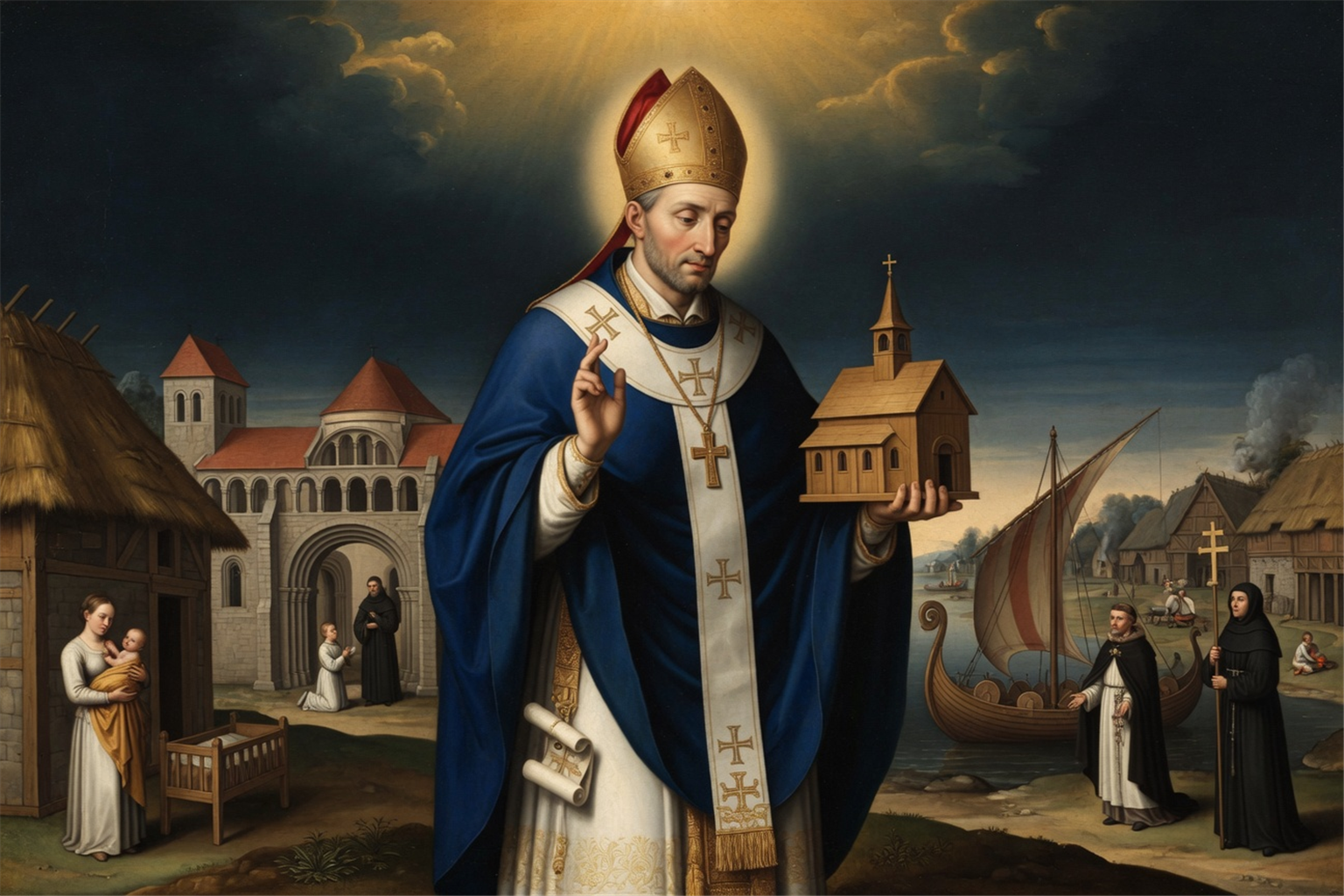
Saint Ansgar
Apostle of the North
First Archbishop of Hamburg, Bishop of Bremen, Apostle of Sweden and Denmark
Born in Picardy and educated at the Abbey of Corbie, Ansgar became the tireless apostle of Denmark and Sweden in the 9th century. As the first Archbishop of Hamburg and later Bishop of Bremen, he fought against paganism, redeemed many slaves, and founded the first Scandinavian churches. Despite the Norman invasions, he maintained the faith through his asceticism and charity until his death in 865.
Guided reading
8 reading sections
SAINT ANSGAR
FIRST ARCHBISHOP OF HAMBURG, BISHOP OF BREMEN, APOSTLE OF SWEDEN AND DENMARK
Youth and monastic vocation
Born in 801 near Amiens, Ansgar entered the monastery of Corbie after a vision of the Virgin Mary encouraged him toward piety.
Ansgar wa Anschaire Predecessor of Rembert and evangelizer of the North. s born on September 8, 801, i n Fouill Fouilloy Birthplace of the saint near Amiens. oy, an old suburb of Corbie, near Amiens. He lost his mother at the age of five or six, when he was already being taught the first elements of Christian doctrine and letters. One night, having fallen asleep with his mind full of the praises he had heard regarding his mother's piety, he had a vision in which the Blessed Virgin made it known to him that, if he wished to be with his mother in heaven one day, he must avoid the vain amusements of childhood and apply himself to serious things. He followed this advice to the letter and devoted all his time to study and piety.
When he was twelve years old, his father, often called to court by his high duties, placed him in the mo nastery of Corbie. monastère de Corbie Monastery that acquired the relics of Saint Précord. Saint Adalard, then abbot, took a keen interest in this child and entrusted his education to the f amous Paschasius Paschase Radbert Celebrated theologian and teacher of Ansgar at Corbie. Radbertus. He first distinguished himself by his progress in the sciences and virtue. Later, through an effect of human frailty, having fallen somewhat from his initial fervor, he recovered very quickly. Three things helped him in this: the advice that the Blessed Virgin had given him; the death of Emperor Charlemagne, whom he had seen five years earlier in all the state of his glory, a striking example of the vanity of human things; and finally, another vision in which it seemed to him that God promised him the crown of martyrdom. Not understanding that this was to be understood as the martyrdom of continuous mortification and the arduous labors of the apostolate, he believed that he would shed his blood among the infidels and prepared himself for such a great grace. He performed perfectly the duty of teaching letters, first in the old Corbie, in Picardy, where he was a student; then in the new one, in Saxony, founded by Saint Adalard in 823. It was also desired that he instruct the people and preach publicly in the church. He was the first who thus exercised, in the monastery, the office of teacher and that of preacher.
First missions to Denmark
Ansgar accompanies King Harald to Jutland in 826 and founds a school at Haddeby to train future missionaries.
In the meantime, Harald, King of Jutland, having been driven from his states by the children of Godefroi, King of the Northern Danes, called Normans, and having taken refuge at the court of Emper Louis le Débonnaire King of the Franks who made Aldric his advisor and commander of the palace. or Louis the Pious, received baptism there. When he was about to return to his states, he asked for some zealous missionaries to accompany him. It was a difficult and perilous post. No one was found more capable of filling it than Ansgar, and he was the only one who initially wished to accept (826). He nevertheless found a companion for his apostolate: this was Autbert, of noble family and procurator of Old Corbie, who fell ill after two years and was obliged to return to France. These two zealous missionaries converted a great number of infidels through their preaching and the example of their rare virtues. They opened a school at Haddeby, on the Schlei, opposite Schleswig, to train missionaries there. The first who were raised there were young people ransomed from slavery; some young men of free condition joined them, which brought the number of students to twelve. From this holy nursery came the first bishops of Sweden and Denmark.
The Evangelization of Sweden
At the request of King Biorn, he departed for Sweden where, despite a pirate attack, he founded the first church in Birca.
In the year 829, Birn or Biorn, King Suède Mission territory of Saint Sigfrid. of Sweden, requested preachers from Louis the Pious to evangelize his people. The Emperor recalled Anschar (whom he replaced in Denmark with another monk from Corbie, Gislemar) and entrusted him with this mission to Sweden, giving him as his principal colleague Witmar, a religious of Corbie. God permitted the vessel carrying them to be captured by pirates, who took everything they had, including the gifts intended by Louis the Pious for the King of Sweden and forty volumes that they regarded as one of their means of instruction and consolation in these barbarian lands. Some of the missionaries, nearly desperate, wished to return to Saxony. Anschar sustained their courage by pointing out that their designation made them resemble the Apostles, and that this was what Jesus Christ most recommended to the preachers of His Gospel. Indeed, God blessed their labors, and moreover, the harvest was ready. There was barely time to instruct all those who requested baptism. One of the most important conversions was that of Herigard, governor of Birca, near Stockholm. It was he who had the first chur Birca Site of the first Christian church in Sweden. ch built on his lands to be raised on Swedish soil.
Episcopacy and Trials
Appointed Archbishop of Hamburg and then Legate of the North, he had to face the looting of his city by the Normans in 845 before receiving the see of Bremen.
Five or six months later, Witmar returned to France with letters from King Biorn addressed to Louis the Pious: the latter, delighted by the progress that the faith of Jesus Christ was making in the North, and in order to give more stability to this propagation, with the advice of the bishops he had assembled, and doing so moreover only to execute the plan of Charlemagne, his father, established a metrop olitan s Hambourg Diocese united with that of Bremen. ee in Hamburg. Our Saint was chosen to fill it and, despite what he could allege to defend himself, was consecrated by Drogo, brother of the emperor and Archbishop of Metz, assisted by Ebbo, Archbishop of Reims, Hetti, Archbishop of Trier, and Otgar, Archbishop of Mainz.
Before taking possession of his see, the new archbishop went to Pope Gregory IV, who gave him the Pallium and made him legate of the Holy See in Denmark, Sweden, Norway, Funen, Greenland, Halland, Iceland, Finland, and neighboring countries, jointly with Ebbo, Archbishop of Reims, already honored with this dignity by Pope Paschal I. Gregory IV confirmed Anschar's mission in the year 834 and united the monastery of Torhout, in Flanders, to his church, so that if the Saint were driven out by the violence of the Barbarians, he would have a secure retreat, and also to ensure an income for the new see of Hamburg. Ebbo ordained Gauzbert, his relative, as bishop and gave him to Saint Anschar as a colleague in the functions of the legation of the North. Gauzbert, having had Sweden as his share, did much good there. Saint Anschar took charge of the churches of Denmark and northern Germany. He built a cathedral in Hamburg under the patronage of Saint Peter, formed a rich library, created a monastery which he populated with monks from Corbie, and developed the material well-being of his diocesans. He bought Danish and Slavic children to deliver them from captivity, consecrated them to the service of God, and sent a certain number to Torhout to train them in the preaching of the Gospel. A disastrous event came to compromise, in 845, the fruit of 15 years of labor. The Normans descended the Elbe and came to loot Hamburg. Anschar, abandoned by his priests and his religious, nonetheless continued, at the risk of his life, to console and support in the true faith his flock scattered by the Barbarians. In 849, the see of Bremen having become vacant, Pope Nicholas , at Brême Episcopal see founded by Willehad. the request of Louis the German, detached it from the province of Cologne, united it with that of Hamburg, entrusted our Saint with the government of both churches, and made him his legate in the provinces of the North.
Consolidation of the Northern Missions
He returns to Sweden under King Olaf and obtains by lot the right to preach, while leading a life of rigorous asceticism.
Ansgar, seeing his authority thus strengthened, performed new wonders of zeal; he soon caused the religion that was withering away throughout Denmark to flourish once more; he owed these successes in large part to the benevolence and protection of Horich, who had united under his rule the states of various petty kings of the country. Gauzbert having been driven from Sweden by a riot, Ansgar had the courage to go himself to re-establish that mission. In vain did his friends explain to him that he was risking his life; he, who desired only martyrdom, began by presenting himself to King Olaïs, or Olaf, successor to Birn. This prince received him very well, but he wished for fate to decide, according to the superstitious custom of the country, whether the free exercise of Christianity would be permitted in his states. The holy bishop saw with pain the cause of God submitted to the caprice of chance; he nonetheless remained full of confidence in the help of heaven, which he implored through fasting and prayer. The lot was favorable to Christianity, as was the king's council, a kind of parliament consulted on this subject. The Apostle immediately set to work, announcing the kingdom of heaven and penance. He preached by day and worked with his hands by night, like Saint Paul, so as to be a burden to no one. This disinterestedness was as eloquent as his speeches. The infidels converted in crowds and, after having established, in Sweden as well as in Denmark, various churches provided with good ministers to continue the work of the Lord there, Ansgar returned to Bremen. There, he united with the general inspection of the Northern provinces the particular care of the flock he had in that diocese and in that of Hamburg; the bishop in him had not erased the religious, and his pastoral duties did not diminish his austerities. He followed in this the example of the great Saint Martin, whom he had proposed to himself as a model. He wore a rough hair shirt day and night; he usually nourished himself only on water and bread, taken in small quantities. Humble and distrustful of himself, he watched over all the movements of his heart and constantly turned to God, from whom he drew his light to preach the truth, and his strength to practice it. He knew, in preaching, how to skillfully mix terror and consolation; he thus inspired in his listeners a salutary fear that kept them away from evil, and a tender devotion, a certain taste for virtue. As wise as he was zealous, he always took, to resolve an important matter, the time to consult God. He regularly heard three or four masses before offering the holy sacrifice himself. He had extracted from the Holy Scripture and the Holy Fathers a multitude of passages suitable for constantly reminding him of his own unworthiness and inflaming in his heart the love of God. He had written some of these passages after each psalm of his breviary. Of all the letters that Ansgar wrote to bishops, to Christian princes, to the kings of Sweden and Denmark, there remains to us only one epistle that he addressed to Louis the German and to various bishops, in sending them his collection of privileges granted by the Holy See to the missions of the North. He shows great modesty in it by attributing to Ebbo of Reims all the merit of the conversions operated in the northern regions; for in reality, Ebbo's two journeys to Denmark had been more political than apostolic, and their result had hardly benefited the propagation of the Gospel.
Charity and Supernatural Gifts
Renowned for his ransoming of slaves and his almsgiving, he benefited from prophetic visions and performed miracles, notably in Frisia.
His alms were extremely abundant and flowed in all directions. The tithes he collected were dedicated to helping the indigent and strangers in a hospital he founded in Bremen, which was later to become a collegiate church placed under his patronage. Almost all his income passed into the hands of widows, orphans, and anchorites! His alms-purse was always open to the requests of the petitioners he met. During Lent, he received guests every day and served four poor people at his table, two men and two women; he himself washed the feet of the former and had the same care rendered to the two women by a respectable matron. In the course of his pastoral tours, he would only take his meal with his hosts once he had seated a certain number of indigent people at a special table, to whom he had offered the washing of hands according to the Benedictine custom.
His greatest joy was to ransom slaves. Rembert recounts all the joy shown before him by a poor widow to whom the Saint had brought back her son, whom Swedish pirates had long kept captive.
His trust in God was often rewarded by visions and knowledge of the future. Thus he learned that Reginar, Count of Hainaut, who employed in his service the Norman and Slavic children who were to be prepared for monastic life in the abbey of Turholt, would one day be punished for this diversion: which was soon verified, since the intruders fell into the disgrace of Charles the Bald and lost the concession of the abbey previously made at the expense of Ansgar.
The contemporary biographer of the Archbishop of Hamburg points out another circumstance where the future revealed its secrets to him. Three years before his promotion to the bishopric of Bremen, he felt himself transported in a dream to a very pleasant place; there, he saw the Prince of the Apostles to whom the inhabitants of a neighboring city were asking for a pastor. Saint Peter proposed Ansgar to them; and, at the same time, the ground shook, and the Holy Spirit descended from the heights of heaven. As the same petitioners continued to demand a bishop, Saint Peter, indignant, cried out: "Did I not tell you that it would be Ansgar, and did you not see the Holy Spirit illuminate his forehead? Cease then all opposition to this decree." — Ansgar knew from then on that he was destined to govern the church of Bremen and that various people were striving to hinder the views of Providence on this point.
Full of solicitude for his flock, he embodied the portrait of the good Shepherd traced by Saint Gregory. His eloquent discourses, happily mixed with sweetness and severity, terrified sinners, warmed the lukewarm, and spread consolation in the souls of the afflicted.
One Sunday, while he was preaching in a town in Frisia, he spoke out mainly against servile work on feast days. Several of his listeners nonetheless wanted, that very day, to take advantage of the fine weather to gather their hay in the meadows and make them into stacks: but, towards evening, they were consumed by fire from heaven, which spared those that had been gathered on previous days. The inhabitants of the neighboring villages, upon seeing the smoke, imagined that it was the sign of an enemy invasion; but, after inquiry, they learned that it was the just punishment for the contempt shown for the word of Ansgar.
Among the Northalbingians, there were those who, although Christians, did not scruple to seize slaves who took refuge in their country; they employed them for their personal service or resold them to the pagans. The most notable people of the nation were guilty of this odious traffic, which Ansgar did not know how to prevent; encouraged by a vision, he resolved to face all the dangers of such an undertaking; he succeeded so well, by joining threats to exhortations, that not only was freedom restored to all the prisoners, but it was agreed that anyone henceforth suspected of such a crime would have to purge himself of this accusation, not by a simple oath, but by submitting to what was called the Judgment of God. Those who were witnesses to this conversion liked to say that they had never met a man as excellent as the Archbishop of Hamburg.
Ansgar did not hold such a judgment of himself: for, when people spoke to him of the miracles he had performed through his prayers and the anointing of blessed oil, he would cry out that, if he had any credit with God, he would ask Him for only one miracle, that of becoming a good man.
Death and Funeral
Ansgar died on February 3, 865, in Bremen after a long illness, surrounded by his disciples and his successor, Rimbert.
Ansgar was sixty-four years old, and had spent thirty-four in episcopal duties, when his already shaken health was completely compromised by a painful illness that lasted four months.
Our Saint had desired to die on the day of the Purification. On February 1, 865, he ordered the preparation of a more generous meal to be offered the next day to the clergy and the poor, and the making of three large wax candles; he had them placed, one before the altar of the Virgin, the second at that of Saint Peter, and the third at that of Saint John the Baptist, wishing thereby to commend the hour of his death to the intercession of these three protectors.
When his strength had abandoned him, he asked his disciple Rimbert to finish for him the ver Rembert Disciple, successor, and biographer of Saint Ansgar. ses of the Psalms he had begun: it was thus that, with his eyes fixed toward heaven, he rendered his soul to God on February 3, in the year 865.
The body of the Pontiff was embalmed and interred in the Cathedral of Saint Peter in Bremen, before the altar of the Most Holy Virgin. His funeral took place amidst universal mourning.
Cult and Posterity
His cult was maintained despite the Reformation, with relics preserved in Corbie, Hamburg, and Copenhagen, and celebrations for his millennium in 1865.
Protestant writers could not help but pay tribute to the Apostle of the North.
## RELICS AND CULT OF SAINT ANSCHAR.
Several churches in Germany, Sweden, and Denmark obtained some relics of Saint Anschar from Bremen.
Adalbert, Archbishop of Hamburg and Bremen, sent to Fulk, Abbot of Corbie, in 1048, an arm of Saint Anschar, and on this occasion renounced the ancient fraternity that united the monks of Corbie with the clergy of Hamburg. This precious relic was received at Corbie on March 1st; on Easter day of the year 1198, it was placed in a silver arm. It was saved during the Revolution and has been, since 1865, at the church of Fouilloy.
The so-called Reformation dispersed the relics of the Apostle of the North. They have been preciously collected over the last few years; some are kept in the Catholic churches of Bremen, Hamburg, and Copenhagen.
Thanks to the benevolent intervention of Mgr Tirmache, Bishop of Adras, Napoleon III donated, in 1864, to the church of Fouilloy, a reliquary intended to contain the arm of Saint Anschar. Since then, a fragment of it has been given to the parish of Corbie.
Anschar was numbered among the Saints, shortly after his death, by Saint Rembert, his successor to the see of Bremen. This canonization was soon confirmed for the whole Church by Pope Saint Nicholas I.
As early as the year 882, Saint Rembert dedicated to his predecessor the church of Bremen, which he had built there for a chapter of regular canons. Adolphe Cypress asserts that the Lutherans could never succeed in profaning this sanctuary with mercantile enterprises, and that they finally decided to turn it into an orphanage.
Until the Reformation, Anschar remained the most popular patron, not only of Bremen and Hamburg, but of all Northern Germany. His cult was widespread in various dioceses of Sweden, Norway, Denmark, Schleswig-Holstein, France, and Belgium (Droges). The memory of Saint Anschar has never faded in the northern regions. Mgr Melchers, Bishop of Osnabrück, Vicar Apostolic of the Northern missions, undertook to popularize his cult. From February 3 to 11, 1865, he solemnly celebrated in the Catholic church of Hamburg the thousandth anniversary of the death of Saint Anschar: on this occasion, he prescribed to the prelates of the Northern missions the recitation of an office of Saint Anschar, drawn largely from the ancient Scandinavian breviary, and which, the previous year, had been approved by the Holy See.
Mgr Melchers, Bishop of Osnabrück, writes to us that even today it is not known where the altar of Mary was located in the Protestantized church of Saint Peter, an altar that was destroyed at the same time as the tomb of Saint Anschar. His Excellency adds that there are statues of the Apostle of the North in the Catholic churches of Hamburg and Copenhagen, and that in 1863, the senate of Bremen had a remarkable statue of its saintly archbishop erected in the city square. — There is a completely modern one at Saint-Pierre de Corbie. Saint Anschar also appears in the new stained glass windows of the parish church of Villers-Bretonneux.
A Catholic church in Hamburg and another in Copenhagen are dedicated to Saint Anschar, and he is also the patron of various churches in Sweden.
In Hamburg, a street, a gate, and a causeway bear the name of Saint Anschar. A church in Bremen is called Ausgarius Kirche; a neighboring village, Wildenschwaren (silla Anschari); another, Aschar-endorf.
The feast of Saint Anschar is solemnly celebrated in Fouilloy, the place of his birth.
The only work of Anschar that has remained complete is a Life of Saint Willichald, first bishop of Bremen, who died around 790. The style is remarkable for the period: the best critics have praised its simplicity and judicious spirit.
The life of Anschar himself was written in the 9th century by Saint Rembert, who was his disciple and successor.
As for us, to compose the life that we offer here, we have followed Baillot, the Abbé Kar up, regarding saint Rembert Disciple, successor, and biographer of Saint Ansgar. a history of the Catholic Church in Denmark, published in French by M. Guémar of Brussels in 1861; and especially the Abbé Corbet, hagiographer of Amiens, whose work is the most complete.
Annexes & related entities
Structured data for exploration: events, miracles, quotes, places, attributes, patronages, and important entities cited in the text.
Key Events
- Born in Fouilloy in 801
- Entered the monastery of Corbie at age 12
- Mission to Denmark with King Harald in 826
- Evangelization of Sweden at the request of King Björn in 829
- Consecrated as Archbishop of Hamburg by Drogo of Metz
- Appointed legate of the Holy See for the North by Gregory IV in 834
- Union of the sees of Hamburg and Bremen in 849
- Re-establishment of the Swedish mission to King Olaf
Miracles
- Vision of the Blessed Virgin in childhood
- Vision of the crown of martyrdom
- The favorable outcome for Christianity before King Olaf
- Fire from heaven punishing servile work on Sunday in Frisia
- Healing through anointing with blessed oil
Quotes
-
If I had any merit before God, I would ask Him for only one miracle: to become a good man.
Words of Ansgar reported by his biographer