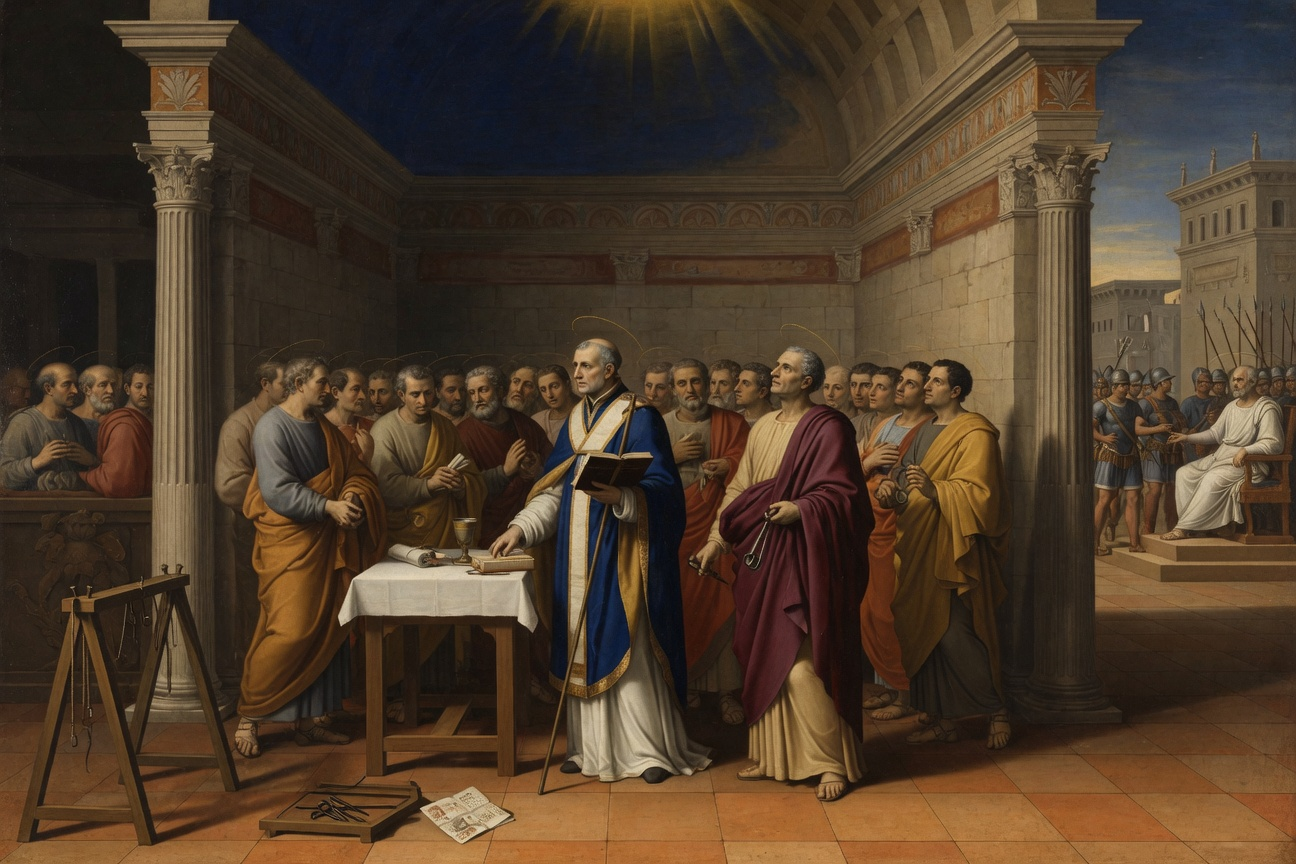
Saint Saturninus, Saint Dativus and their companions
AND THEIR COMPANIONS, MARTYRS IN AFRICA
Martyrs in Africa
During the reign of the Roman emperors, the priest Saturninus, the senator Dativus, and forty-eight companions were arrested in Abitina for celebrating Sunday Mass despite the prohibition. Transferred to Carthage, they endured atrocious tortures before the proconsul Anulinus, affirming that they could not live without the Lord's Day. Most died of hardship in prison, becoming models of fidelity to the Eucharist.
Guided reading
8 reading sections
SAINT SATURNINUS, SAINT DATIVUS,
AND THEIR COMPANIONS, MARTYRS IN AFRICA
Arrest and transfer to Carthage
The Christians of Abitina are arrested for having celebrated forbidden assemblies and are led to Carthage to be judged by the proconsul Anulinus.
of his four children; half were to share martyrdom with him, and he left the other half to the Church, as a pledge intended to recall his name and his devotion. The entire army of the Lord's soldiers followed them, with the brilliance and splendor of heavenly weapons, the shield of faith, the breastplate of justice, the helmet of salvation, and the two-edged sword of the holy word. Invincible under such armor, they gave the brethren the assurance of their coming victory. Finally, they arrived at the city's forum. It was there that they fought their first battle, in which, by the very judgment of the magistrates, they carried off the palm of a glorious confession. On this same Forum, heaven had fought for the divine Scriptures, when the bishop of the city, Fundanus, had consented to hand them over to be burned. Already the sacrilegious magistrate had thrown them into the flames, when suddenly, from a cloudless sky, an abundant rain had extinguished the fires, while hail raged in a terrible manner, and the unleashed elements ravaged the country far and wide, after having respected the Scriptures of the Lord.
It was therefore in this city that the martyrs of Christ received their first chains, which they had so desired. From there they were directed to Carthage, and throughout the journey, in bursts of lively joy, they sang hymns and canticles to the Lord. When they arrived at the tribunal of Anulinus, then proconsul, they kept the r anks of their holy militi Anulinus, alors proconsul Roman proconsul who judged and tortured martyrs in Carthage. a with courage and firmness; and the cruel attacks of the demon broke against the constancy that the Lord inspired in them.
The Combat of Dativus and Thelica
Senator Dativus and the martyr Thelica undergo the first tortures of the rack and iron claws, affirming their faith despite the torment.
But because all these soldiers of Christ, being gathered together, were too strong against the rage of the devil, he wished to call them one after another to single combat. It is not from ourselves, but with the words of the martyrs that we wish to trace for you the account of these combats, so that one may learn to know the audacious cruelty of the enemy, in the tortures that were invented and in his sacrilegious attacks, and that at the same time one may praise in the patience of the martyrs and in their confession the all-powerful virtue of Christ our Lord.
The officer, in presenting them to the proconsul, announced them as being Christians whom the magistrates of the Abitinians had sent to him, because, against the edicts of the emperors and the Caesars, they had held their Collects and celebrated the mysteries of the Lord. The proconsul first asked Dativus what his condition was in the world, and if he had held Collects. Dativus confessed that he was a Christian, and that he had attended Collects. The proconsul insisted on knowing who was the author of these holy meetings, and at the same time he ordered the officer to stretch Dativus on the rack, and to tear him with iron claws. The executioners carried out these orders with a cruel eagerness; already the martyr's flanks were laid bare and prepared for torture; the iron claws were raised above the victim, when suddenly the generous martyr Thelica broke through the crowd, and came to present himself for the tortures. He cried out in a loud voice: "We too are Christians, we have held meetings." At these words, the fury of the proconsul was inflamed; he heaved a sigh, and deeply wounded by the dart that tore his heart, he first had the martyr of Christ struck with vigorous blows, then he stretched him on the rack, where the iron claws tore his limbs to shreds. But in the midst of the rage of his executioners, the glorious martyr Thelica poured out his prayers before the Lord in these terms, with the homage of his gratitude: "Thanks be to God! In your name, Christ, Son of God, deliver your servants."
The proconsul, interrupting this prayer, asked him: "Who then was with you the author of your meetings?" And the martyr, without being moved, in the midst of the increasingly cruel furies of the executioner, replied in a loud voice: "The priest Saturninus and all of us with him." Genero Le prêtre Saturnin Martyr to whom a basilica was dedicated in Viocourt. us martyr! He gives the first rank to all! He did not name the priest to the exclusion of the brothers; but to the priest he associated the brothers in the honors of a common confession. The proconsul then asked for Saturninus; the martyr pointed him out. It was not betraying him, since he already saw him fighting at his side with him against the devil; but he wanted to prove to the proconsul that he had attended a solemn Collect of the Christians, since a priest was with them. Meanwhile, the martyr united his prayers to his blood; and, faithful to the precepts of the Gospel, he asked for pardon for his enemies who were tearing his flesh to shreds. In the midst of the most cruel tortures, he reproached his executioners and the proconsul for their impiety. "Wretches," he cried, "you are unjust; you act against God. O most high God, you will punish their crimes. Wretches! You sin, you act against God. Keep the precepts of the most high God! Wretches! You commit injustice, you tear apart the innocent; for we are not homicides, we have committed no fraud. O God! Have mercy. I give you thanks, Lord! Grant me to suffer for the glory of your name. Deliver your servants from the captivity of this world. I give you thanks, and I feel incapable of showing you my gratitude." Meanwhile, the iron claws, applied more strongly, imprinted deeper furrows on the martyr's limbs; streams of blood escaped, bubbling from the thousand sources that were opened to them.
At this moment the proconsul cried out: "You are finally going to begin to experience what you will have to suffer." Thelica, who heard him, immediately added: "Yes, what we will have to suffer to arrive at glory. I give thanks to the God of empires. I see it, the eternal empire, the incorruptible empire. Lord Jesus Christ, we are Christians; it is you whom we serve; you are our hope; you are the hope of Christians; most holy God! Most high God! Almighty God! For the glory of your name, we offer you the tribute of our praises, Almighty Lord!" In the midst of this prayer, the devil, through the voice of the judge, having said to him: "You should have kept the order of the emperors and the Caesars"; Thelica, despite the exhaustion of his body, replied with the courage and constancy of a soul that feels victorious: "I have learned only one law, the law of God; what do all the others matter to me? It is this one that I wish to keep, for it I wish to die, in it I will consume my sacrifice; for outside of this law there is no other." These words of the glorious martyr, in the midst of his tortures, were for Anulinus the most cruel of tortures. Finally, when he had sated his rage and ferocity, he cried: "Stop!" Then, having the martyr shut up in a narrow prison, he reserved him for sufferings more worthy of him and his courage.
The accusation of Fortunatian and the intervention of Victoria
Fortunatian accuses Dativus of having abducted his sister Victoria, but she intervenes courageously to affirm that she acted of her own free will out of Christian faith.
After him, the Lord called Dativus back to the combat, who, from the rack upon which he had remained stretched, had watched the generous combat of Thelica from close by. As he repeated often and in a loud voice that he was a Christian, and that he had held a meeting, one suddenly saw Fortunatian, the brother of the most holy martyr Victoria, emerge from the crowd. He was a great personage, clothed in the honors of the toga, but who until then had remained an enemy of the Christian religion. He had not ceased to attack with impious words the martyr stretched upon the rack. "Lord," he said to the proconsul, "it is he who, taking advantage of our father's absence, and when we ourselves were detained here for our studies, it is he who seduced our sister Victoria, and who led her away with him far from the splendors of Carthage, to the colony of Abitina, accompanied by the two virgins Restituta and Secunda. He had never entered our home, except when, by perfidious insinuations, he had sought to corrupt the minds of these young girls." But the illustrious martyr of the Lord, the great Victoria, could not suffer that a servant of God, her colleague and companion in martyrdom, should be unjustly accused. Immediately she breaks through the crowd, and with a truly Christian freedom: "No counsel," she said, "decided my departure, and I did not come with him to Abitina. I can prove it by the testimony of the inhabitants. I did everything of my own accord and in full freedom. I celebrated the mysteries of the Lord with the brothers, because I am a Christian." Then the impudent lawyer began to heap the most infamous accusations upon the martyr: but from the height of his rack the generous athlete destroyed them by the power of the truth.
However, Anulinus, inflamed with anger, orders that recourse be had a second time to the iron claws. Immediately the executioners lay bare the flanks of their victim; and, when they have prepared them for their iron claws, they begin to rage with bloody wounds. Their cruel hands seem to fly faster than the angry voice that commands them. They tear the skin, rip out the entrails, and, with atrocious barbarity, they lay bare the mysteries of the heart that the chest conceals. In the midst of the ordeal, the soul of the martyr remained immobile, his limbs were broken, his entrails were spilled, his flanks in tatters were exhausted, but his heart remained whole and unshakable. Dativus, formerly a senator, remembers his dignity, and under the bl Datif, autrefois sénateur Christian senator of Abitina, one of the principal martyrs. ows of a furious executioner he addresses this prayer to God: "O Lord, O Christ, let me not be confounded!" The blessed martyr deserved to be heard, and the effect was as prompt as the prayer had been short.
Soon the proconsul, violently moved, cries out: "Stop!" and he rushes from his tribunal. Immediately the executioners ceased; it was not just that the martyr of Christ should be punished in a cause that concerned only Victoria, his companion in martyrdom. However, a cruel informer, Pompeianus, brings infamous suspicions against him; he adds odious calumnies to the cause of the martyrdom: but the blessed one, pushing him away with contempt: "Demon," he said to him, "what do you come to do in these places? What new efforts do you come to attempt against the martyrs of Christ?" The authority of the senator, the power of the martyr triumphed over the influence and the furies of the lawyer. But it was necessary that the illustrious athlete be subjected to torture a second time for Christ. He was asked if he had attended the meeting; he replied constantly that he had arrived while the meeting was taking place, that he had consequently celebrated the mysteries of the Lord in the company of his brothers, with the zeal that religion requires, but that otherwise he had not been the sole cause of the meeting. This response excited the fury of the proconsul more violently than ever. In this resurgence of barbarity, the iron claws of the executioner took it upon themselves to imprint upon the body of the martyr the double character of his glory. But Dativus, in the midst of these new and even more terrible torments, repeated his former prayer: "I ask you, O Christ," he said, "that I may not be confounded. What have I done? Saturninus is our brother."
The Priest Saturninus and the Lector Emeritus
The priest Saturninus and the lector Emeritus defend the vital necessity of celebrating the Lord's Day, affirming that the Scriptures are engraved in their hearts.
While the harsh and pitiless executioners, with no guide but their rage, were tearing his flanks, the priest Saturninus was called to the combat.
Rapt in the contemplation of the heavenly kingdom, he had considered the torments of his brothers as something light and little to be feared. It was in this disposition that he began the struggle. The proconsul said to him: "Against the orders of the emperors and Caesars, did you not fear to gather all these men?" The priest Saturninus, with the inspiration of the Holy Spirit, replied: — "We have celebrated the mysteries of the Lord with all ease." — "Why?" — "Because it is not permitted to suspend the mysteries of the Lord." Scarcely had he finished when the proconsul immediately had him tied next to Dativus. Meanwhile, Dativus watched the shreds of his flesh flying, more as a spectator than as a victim capable of complaints. With his mind and heart applied to the Lord, he counted the pains of the body as nothing. He only addressed this prayer to God: "Come to my aid, I beseech you, O Christ! Have compassion on your children. Save my soul; guard my spirit, and let me not be confounded. I ask it of you, O Christ! Give me the strength to suffer." Then the proconsul said to him: "In this great city, you should have used your influence to recall men to better sentiments, and not violate without reason the edict of the emperors and Caesars." But Saturninus cried out with more force and constancy: "I am a Christian." At these words, the devil remained defeated; the proconsul said: "Stop!" At the same time, he had Dativus thrown into prison and reserved him for a martyrdom more worthy of his courage.
Meanwhile, the priest Saturninus, whom the blood of the martyrs had bathed until the day of wandering, felt himself fortified in the faith of those whose blood still inundated him. Questioned then if he was the author of the meeting, if he himself had formed it, he replied: "Yes, I was present at this meeting." Then the lector Emeritus rushed into the combat to fight with his pri le lecteur Emérite Lector of the Church of Abitina who hosted meetings in his home. est. "It is I," he said, "who am the guilty one; it is in my house that the meetings were held." The proconsul, already so many times defeated, trembled before the impetuous ardor of Emeritus; however, he had the strength to turn toward the priest, and he said to him: — "Why did you act against the decree of the emperor?" Saturninus replied: — "The Lord's Day must never be omitted; so the law wills it." The proconsul continued: — "However, you should not have despised the prohibition of the emperors; you had to observe it and do nothing against their orders." The sentence against the martyrs had been decided long ago; he gave the order to the executioners to strike, and was obeyed on the spot with a cruel eagerness. All together they rushed upon the body of an old man, of a priest.
Soon, in their rage which grew ever greater, they broke all his nerves; they then tore his limbs in hideous torments of a new kind, which only barbarity could have invented against the priest of God. You would have seen these executioners throw themselves upon their victim as upon a prey delivered to the insatiable hunger that provoked them to multiply the wounds. They laid bare his entrails, and the crowd saw with horror the bones of the martyr appear in the midst of streams of crimson blood. Then the priest himself feared that in the midst of the long delays of the torture, his soul might abandon his body during the suspension of the torments, and he made this prayer to God: "I beseech you, O Christ, hear me. I give you thanks, O my God! Order that I be beheaded. I beseech you, O Christ, have pity on me. Son of God, help me." But the proconsul who had heard him said to him: — "Why did you act against the edict?" And the priest replied: — "The law wills it so; it is thus that the law orders it." O admirable and truly sublime response of a priest and a doctor worthy of all our praises! Even in the midst of torments, he proclaims the holiness of the divine law, and for it he faces all the tortures. The name of law frightened Anulinus: "Stop!" he cried to the executioners. And he relegated him to the dungeon of the prison, reserving him for the torture he coveted.
Then he had Emeritus approach and said to him: — "Is it indeed in your house that the meetings were held against the edicts of the emperors?" Emeritus, all inundated w ith the Emérite Lector of the Church of Abitina who hosted meetings in his home. graces of the Holy Spirit, replied: — "Yes, it is in my house that we celebrated the Lord's Day." — "Why did you allow them to enter?" — "Because they are my brothers, and I could not prevent them." — "However, you should have." — "I could not, because we cannot live without celebrating the Lord's Day." The proconsul immediately had him stretched on the rack, then subjected to a cruel torture. They had renewed the executioners so that the blows would be more vigorous. As for Emeritus, he prayed thus: "I beseech you, O Christ, help me. Wretched men, you act against the precepts of the Lord." But the proconsul, interrupting him, said: — "You should not have received them." — "I could not not receive my brothers." — "The order of the emperors and Caesars was prior." — "God is greater than the emperors. I pray to you, O Christ! I pay you my tribute of praise, O Lord, O Christ! Give me to suffer." In the midst of this prayer, the proconsul threw this question at him: — "You have then some Scriptures in your house?" — "Yes, I have them, but in my heart." — "Do you have them in your house, yes or no?" — "It is in my heart that I have them. I pray to you, O Christ! To you my praises! Deliver me, O Christ! It is for your name that I suffer. I suffer for a moment, I suffer with a good heart; O Lord, O Christ, let me not be confounded!" At the words of the holy confessor, the proconsul said: "Stop!" and he drew up a memorandum on the profession of faith of the martyr, as well as that of his companions, adding: "You will all be punished according to your merits, and according to the profession of faith that you have made."
The martyrs struck with clubs
Several companions, including two named Felix, die under the blows of clubs or are imprisoned after confessing Christ.
However, the rage of the monster, already satiated by the torments of the martyrs, was beginning to subside, when a Christian named Felix, who was soon to find the truth of his name in his torments, presented himself for the combat. The entire legion of the Lord's soldiers was there, always unassailable, always invincible. The tyrant, his heart dejected, his voice without energy, his soul and body without vigor, said to them all: "I hope that you at least will be wise enough to choose life, by observing the edicts." The confessors of the Lord, the invincible martyrs of Christ, said to him with one voice: "We are Christians; we cannot but keep the holy law of the Lord, even to the shedding of all our blood."
Anulinus, confounded by this simple word, had Felix struck with clubs; and soon the martyr, completing his glorious passion in the midst of the torment, gave up his soul and flew to the tribunal of the great King, to be reunited with the choirs of the Blessed. But he was immediately followed by another Felix who was to be like him in everything, in name, in the profession of his faith, and in martyrdom. Having entered the lists with the same courage, he was broken like him under the club: like him he breathed out his soul in the torments, and thus deserved to share the glory of the first martyrs.
After him the struggle was continued by Ampelius, the guardian of the law, the most faithful preserver of the divine Scriptures. The proconsul having asked him if he had attended the meeting, he replied with joy, without fear and with an assured voice: "Yes, I have attended the meetings with my brothers, I have celebrated the Lord's day, and I keep the Scriptures with me, but engraved in my heart; O Christ, I give you thanks; hear me, O Christ!" Scarcely had he finished, when he was struck on the head, and he was led back to prison with the other brothers. He went there with joy, as if he had been introduced into the tabernacle of the Lord. Then came Rogatian, who, having also confessed the name of the Lord, was reunited with the brothers of whom we have just spoken, without first undergoing any torture. Then Quintus, who gave a noble and glorious testimony to the name of the Lord. After having been struck with clubs, he was thrown into prison and reserved for a martyrdom more worthy of his courage. Maximian followed him; generous like him in his confession, he shared his glory in the combats, and deserved like him the triumphs of victory. After him came Felix the younger, who proclaimed in a loud voice that the mysteries of the Lord are the hope and salvation of Christians. And while they were striking him, as they did the others, with clubs, he said: "I have celebrated the mysteries of the Lord with all the fervor of my soul; I have attended the meetings with the brothers, because I am a Christian." By this confession he deserved to be reunited with the other brothers.
The courage of young Saturninus
The son of the priest Saturninus undergoes torture with such strength that his blood mingles with that of his father on the instruments of torment.
However, young Saturninus, worthy son of the holy martyr the priest Saturninus, advances eagerly for the combat he desires; he is nobly impatient to equal the glorious virtues of his father. The proconsul, in a fury and yielding to the demon that inspires him, says to him: “And you too, Saturninus, did you attend the meetings?” “I am a Christian.” “That is not what I am asking you; but whether you took part in the mysteries of the Lord.” “Yes, I took part in these mysteries, for Christ is my Savior.” At this name of Savior, Anulinus became inflamed and had the father's rack raised for the son. When Saturninus had been stretched upon it: “Well! now,” Anulinus said to him, “what is your faith? You see the state to which you are reduced. Do you have the Scriptures?” “I am a Christian.” “I am asking you if you attended your meetings, if you keep the Scriptures?” “I am a Christian. There is no other name after the name of Christ that we ought to worship as divine.” “Since you persist in your obstinacy, you must be subjected to torture. Answer, do you have any of the Scriptures?” Then he said to the executioners: “Strike him.” They, already weary from the blows with which they had torn the father, nevertheless threw themselves with rage upon the flanks of this young adolescent, and they mingled the blood of the son with the blood of the father, still damp upon their cruel nails. Then you would have seen, along the deep wounds that opened the flanks of young Saturninus, streams of blood flowing that did not belie their origin; but that of the father was confounded with that of the son on the instruments of torture. In this sacred mixture, the young martyr seemed to recover new strength; he felt the pain less; the blood of his father was a remedy for his wounds. Then, in a powerful voice, he was heard to cry out: “I keep the Scriptures of the Lord, but in my heart. I beseech you, O Christ! give me patience; my hope is in you.” Anulinus said: “Why did you act against the edict?” “It is because I am a Christian.” The proconsul, hearing this word, said to the executioners: “Stop!” Immediately the torture was suspended; and Saturninus was led into the company of his father.
However, the night was hastening the hours, and the day was tending toward its decline. The torture had to cease with the sun; the dark rage of the executioners had fallen; it languished, just as the cruelty of the judge had languished. But the other soldiers of the Lord, upon whom Christ made the eternal light shine in its divine splendor, were still rushing forward with more courage and constancy. Then the enemy of God sees himself defeated by the glorious combats of so many martyrs; all his terrible attacks have prepared for him only defeats; the day abandons him, the night seizes him, the rage of his executioners itself yields to the fatigue that exhausts it: he no longer has the strength to begin again with each of the athletes a struggle that is too unequal; he will therefore try to address the entire army of martyrs at once, and to put their devotion to the test of a new interrogation. “You have seen,” he says to them, “what those who have persevered have had to suffer, and what they will still have to suffer if they persist in their profession of faith. All those, therefore, among you who wish to merit their pardon and have their lives saved, must openly renounce their faith.” At these words, the confessors of Christ, the glorious martyrs of the Lord, are seized with a joyful transport. It is not the promises of the proconsul that animate them, it is the Holy Spirit who has shown them victory in suffering. They raise their voices with more energy than ever, and all cry out together: “We are Christians.” These words alone have struck down the devil; Anulinus is shaken in his resolution; he is confounded, and has the blessed confessors thrown into prison; it is there that they will await martyrdom.
The Life and Firmness of Saint Victoria
Account of Victoria's consecration to virginity and her categorical refusal to yield to the pressures of her brother and the judge.
Women, always eager for sacrifice and devotion, the glorious choir of holy virgins was not to be deprived of the honors of this great combat; all, with the help of Christ, fought in our Victoria and triumphed w ith her. Victoria Consecrated virgin who refused to renounce her faith despite familial pressure. Victoria, indeed, the holiest of women, the flower of virgins, the honor and glory of confessors, great by her birth, even greater by her religion and holiness, the model of temperance, in whom the graces of nature were enhanced by the radiance of modesty, and in whom the true beauty of the soul, faith, and the perfection of holiness were allied to the beauty of the body, Victoria rejoiced to find in martyrdom the second palm that her heart coveted. From her childhood, the shining signs of purity had been seen to shine in her; in the years of inexperience, one had admired in her the chaste rigors of a generous soul, united in advance to that majesty which martyrdom gives. Finally, when she had reached the age where virginity receives its perfection, and her parents wanted, despite her refusals and resistance, to give her a husband, in order to escape the hands of the abductors, the young girl had taken refuge in the depths of the earth; but the breath of the Holy Spirit protected her, and the earth gave her asylum. She would never have suffered for Christ her master, if she had died in that circumstance, for the sole motive of saving her modesty.
Thus delivered from the torches of the wedding, after having thwarted the traps of her parents and her fiancé, in the midst, so to speak, of a numerous gathering assembled for her wedding, a pure and spotless virgin, she had flown towards the dwelling of chastity, towards the port of modesty, the Church. There she had consecrated her body to God in perpetual virginity, and had dedicated to him as a testimony her hair, as the holy offering of a modesty that nothing was to shake.
She therefore ran today to martyrdom, holding in her hand the palm of triumph united to the flower of chastity. Questioned by the proconsul as to what her faith was, she replied in a clear voice: "I am a Christian." Her brother Fortunatian, a personage clothed in the Roman toga, acted as her defender, and sought to show by vain arguments that his sister had lost her mind. Victoria replied: — "My mind is not altered; I have never changed." — "Do you want to return with Fortunatian your brother?" — "No, I do not want to; I am a Christian. My brothers are those men who keep the precepts of God." Upon hearing this answer, Anulinus laid aside his authority as judge, to descend to attempts at persuasion with this young girl: — "Think of yourself," he said to her; "you see the solicitude of your brother to save you." — "No, my mind is not altered; I have never changed. I have attended our meetings, I have celebrated the Lord's day with the brothers, because I am a Christian." At these words, Anulinus flew into a rage; he had the most holy martyr of Christ relegated to prison, with all the others, and reserved for them all the honor of the same sufferings as their master.
The heroism of Hilarion and the end in prison
The young child Hilarion defies threats of mutilation. The group eventually dies of deprivation in the darkness of the prison.
However, H ilarion Hilarion Illustrious cenobite and friend of Saint Epiphanius. remained alone; he was one of the children of the martyr priest Saturnin, who surpassed the weakness of his age with the ardor of his devotion. Eager to share in the triumphs of his father and brothers, not only did he not tremble before the cruel threats of the proconsul; he also knew how to confound them and reduce them to nothing. When he was asked: "Have you followed your father and your brothers?" immediately from this small body came a voice already full of energy. The child's chest expanded fully to let out this noble response: "I am a Christian, and it is of my own accord and my free will that I attended our meetings with my father and my brother." It was still the voice of the father, of the martyr Saturnin, that resounded through the mouth of his tender son; it was the tongue of a brother animated by the example of his brother, and who paid homage to Christ our Lord. But the blind proconsul did not understand that he had against him not men, but God Himself who was fighting in His martyrs; he did not sense, in the tender age of a child, the superhuman courage that animated him. That is why he flattered himself that he could terrify Hilarion with the punishments reserved for his age. "I will cut off your hair," he said to him, "and your nose and the tips of your ears, and I will send you back mutilated in this way." At these threats, young Hilarion, saintly proud of the virtues of his father and brothers, and who had already learned from his ancestors to despise torments, cried out, raising his voice: "Do whatever you want, I am a Christian." Immediately the order was given to throw him into prison, and one heard the voice of Hilarion crying out, at the height of joy: "Thanks be to God!" It is therefore there, in that prison, that the struggle of the great combat was completed, there that the devil was struck down and defeated, there that the martyrs began to rejoice in eternal thanksgiving, while thinking of the glory that the sufferings of Christ were going to procure for them.
They all died in this prison, except for two who had succumbed under the blows. Hunger, cold, thirst, the weight of the chains, the infection of the place, all kinds of misery had procured for them a martyrdom more obscure, but no less meritorious than the bloody martyrdom that one suffers in the amphitheater or in the public square.
Paronius, D. Balnart, Acta Sanctorum.
Annexes & related entities
Structured data for exploration: events, miracles, quotes, places, attributes, patronages, and important entities cited in the text.
Key Events
- Illegal celebration of the Collects (mysteries of the Lord) at Abitina despite imperial edicts
- Arrest of the Abitinian magistrates
- Transfer to Carthage before the proconsul Anulinus
- Interrogations and torture on the rack with iron claws
- Imprisonment and death by deprivation (hunger, thirst, cold) or by beating
Miracles
- Abundant rain and hail extinguishing the fire of the Scriptures burned by the magistrate
Quotes
-
We cannot live without celebrating the Lord's day.
Emeritus, during his interrogation -
I have learned only one law, the law of God; what do all the others matter to me?
Thélica