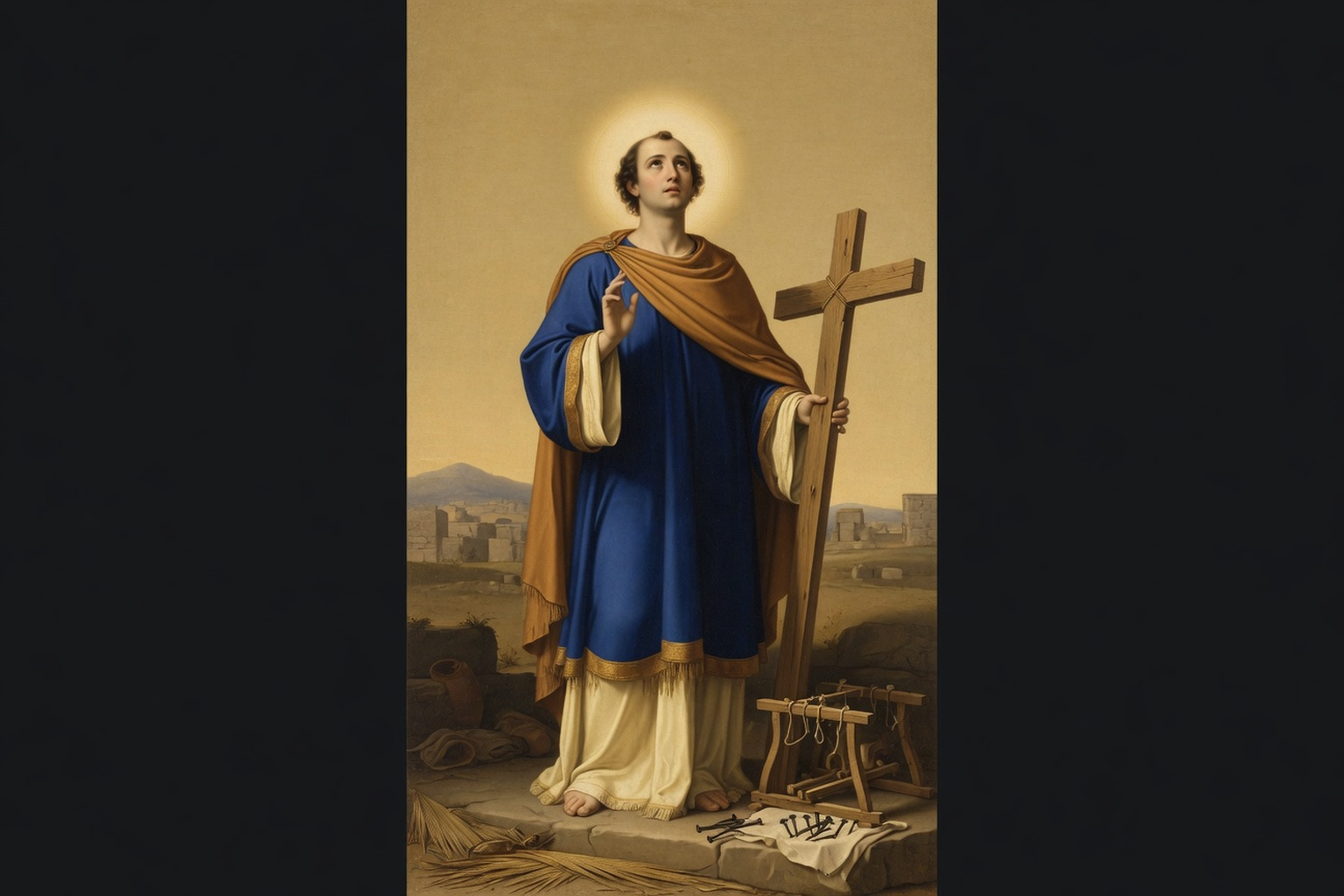
A native of Palestine, Peter Balsamus was arrested in Aulone during the persecution of Maximin. Despite the tortures of the rack and iron claws, he refused to sacrifice to idols, affirming his fidelity to Christ. He was condemned to die on a cross in the year 311.
Guided reading
8 reading sections
SAINT PETER BALSAMUS, MARTYR.
The Interrogation of Peter Balsamus
Peter Balsamus is arrested in Palestine under Maximin and refuses to sacrifice to idols before the governor Severus, affirming his exclusive fidelity to Christ.
I have asked but one thing of the Lord, that I may dwell in his house all the days of my life.
PETER BALSAMU S, a native of PIERRE BALSAME Martyr in Palestine, crucified for his faith. the territory of Eleutheropolis in Palestine, was arrested at Aulone during the persecution of Maximin. He was brought before Sev erus, Sévère Slave of Apollonius who denounced him as a Christian. governor of the province, who began the interrogation by asking his name. PETER replied: "My name is Balsamus, from my father's name, and I received that of Peter at baptism." — SEVERUS. "From what country, from what family are you?" — PETER. "I am a Christian." — SEVERUS. "What is your occupation?" — PETER. "Can I have a more honorable one, or what can one do better in the world than to be a Christian?" — SEVERUS. "Do you know the ordinance of the emperors?" — PETER. "I know the ordinances of my God, the sovereign Monarch of the world." — SEVERUS. "You shall soon know that there is an edict of the most clement emperors, which decrees that all Christians shall sacrifice to the gods or be punished by death." — PETER. "You shall also know one day that there is a commandment of the eternal King, which decrees that if anyone sacrifices to demons, he shall be exterminated. Which do you advise me to obey? Which of the two do you believe I should choose, either to die by your hand, or to be condemned to eternal misfortune by the great King, by the true God?" — SEVERUS. "Since you ask my advice, I will tell you that you must obey the edict and sacrifice to the gods." — PETER. "I cannot resolve to sacrifice to gods of wood and stone, as are those whom you adore." — SEVERUS. "You shall learn that it is in my power to avenge by your death the insult you do us." — PETER. "I had no intention of offending you; I only told you what is written in the divine law." — SEVERUS. "Have compassion on yourself, and sacrifice." — PETER. "It is by not sacrificing that I truly have compassion on myself." — SEVERUS. "I am still willing to use patience: thus I give you time to think of yourself, so that you may decide to save your life." — PETER. "This delay would be useless, I will not change my sentiment. Do now what you would be obliged to do in a little while, and finish the work begun by the devil, your father, for I will never do what Jesus Christ forbids me."
Torture and condemnation to the cross
Subjected to the rack and iron claws, the martyr sings psalms before being condemned to crucifixion in the year 311.
At these words, Severus had him stretched on the rack; and when he was suspended in the air, he said to him mockingly: "Well! Peter, what do you say? Are you beginning to know what the rack is? Will you finally sacrifice?" Peter replied: "Tear me further with the iron claws, and speak to me no more of sacrificing to your demons. I have already told you that I only wish to sacrifice to the one God for whose love I suffer." At these words, the governor had the torments redoubled; and Peter, far from uttering the slightest sigh, sang with joy these two verses of the King-Prophet: "One thing I have asked of the Lord, and this I will seek after, that I may dwell in the house of the Lord all the days of my life. I will take the chalice of salvation, and I will call upon the name of the Lord." Then, Severus, more furious than ever, ordered new executioners to relieve the first ones, who were tired. Immediately the spectators, who saw the martyr's blood flowing from all sides, cried out: "Obey the emperors; sacrifice, and deliver yourself from these horrible torments." — Peter replied: "What do you call torments? I feel no pain; but I know that if I lack fidelity to my God, I must expect true punishments, inconceivable torments." The judge said to him again: "Sacrifice, Peter Balsame, or you will repent of it." — PETER: "I will not sacrifice and I will not repen Pierre Balsame Martyr in Palestine, crucified for his faith. t of it." — SEVERUS: "I am going to pronounce the sentence." — PETER: "That is what I desire with impatience." Then Severus pronounced the sentence, conceived in these terms: "We order that Peter Balsame, for having refused to obey the edict of the invincible emperors, and for having stubbornly defended the law of the Crucified, shall himself be attached to a cross." It was thus that this generous athlete received the crown of martyrdom, at Aulone, around the year 311, on January 3, the day on which he is honored in the Roman Martyrology and in that of Bede.
Sources of the narrative
The text specifies that the acts are derived from the works of Dom Bulmart and Drouet de Manpertry.
This life is drawn from the sincere acts collected by Dom Bulmart Dom Bulmart Hagiographer who collected the acts of Peter Balsamus. and translated by Drouet de Manpertry.
The Tyranny and End of Galerius
A detailed description of the cruelty of Emperor Galerius and his atrocious death due to a putrid disease, interpreted as divine punishment.
## PERSECUTION AND DEATH OF THE CAESAR GALERIUS.
The time of Saint Peter Balsamus's death is not agreed upon. However, it is certain that it occurred duri ng the persecut Maximien Galère Roman emperor during the saint's lifetime. ion of Maximian Galerius, probably towards the end. It may not be out of place to say in a few words how far the cruelty of this tyrant went and how it was punished. "He governed tyrannically since his victory over the Persians; he highly praised their despotic government and their custom of treating their subjects like slaves. He therefore diminished the freedom of the Romans in every way. He had all sorts of people put to torture, without regard for their dignity; free women and even noble women were taken by force for his palace. He had large bears to which it was thought he bore a fair resemblance; he had them devour men for his entertainment, mainly during his supper. He took pleasure in burning people over a slow fire; and, having practiced tormenting Christians, he treated all others whom he considered guilty in the same way; so that it was a favor to have one's head cut off. Under his reign, eloquence was extinguished, lawyers and jurists were banished or killed; studies seemed pernicious to him, and he hated men of letters. The judges he sent into the provinces were coarse and ignorant soldiers; they had no assessors, and he gave them all sorts of licenses, without respect for the laws. He drained the provinces through the magnitude of the censuses and poll taxes, and through the rigor of his exactions... and so that no one might exempt himself from his impositions under the pretext of beggary, he had all the beggars he could find assembled, put into boats, and thrown into the sea: such was the tyranny of Galerius Maximian. He exercised it mainly against the Christians; thus this third year... (395) was the cruelest, but only in the East; there was no longer any distinction between clergy and laity; all Christians were put to death indiscriminately. The Caesar Maximin, who governed the province of the East under him, seconded him well..."
We shall have the opportunity to recount in greater detail the tortures invented against the Christians by Galerius and the ministers of his cruelties.
The death of this monster was worthy of his life: "Galerius had entered the eighteenth year of his reign, the 1st of March 310, having been made Galère Roman emperor during the saint's lifetime. Caesar by Diocletian in 293. In this eighteenth year, God struck him with an incurable wound: an ulcer appeared on his perineum, which spread quite far. Iron was applied to it; the scar was closed when the wound reopened, and he lost blood to the point of endangering his life. The blood was stopped; the scar closed and reopened again; he lost more blood than before; he became pale, his strength diminished. The blood was stopped, but gangrene was spreading all around. The most famous doctors were called from all sides: they could do nothing. They had recourse to the idols, to Apollo, to Aesculapius: Apollo gave a remedy that greatly increased the evil. The entire seat and the lower parts were falling into corruption. The doctors no longer hoped to overcome the evil, but sought at least to soothe it; but it retreated inward and reached the intestines; worms formed there. An unbearable odor spread, not only in the palace but throughout the city of Serdica where he was; the passages for urine and other excrements were confounded. His unbearable pains made hi m let ou Sardique City where the Emperor Galerius fell ill and died. t horrible cries. Animals were cooked and applied to him while hot to draw out the worms; and, indeed, a prodigious quantity came out; but the corruption continued to spread. His body was disfigured in two ways: the upper part, up to the wound, was so thin and withered that one saw only a livid skin sunken between the bones; the lower part was swollen like a bladder, and there was no longer any shape of feet. Emperor Galerius was in this horrible disease for a whole year. He put to death several doctors who could not provide remedies for his ailment nor endure its foul odor. One of them, seeing himself in danger, said to him: 'You are mistaken, Lord, if you believe that men can take away from you the evil that God sends you; this disease is not human nor subject to our remedies. Remember what you have done against the servants of God and against the holy religion, and you will see where you must have recourse. I may die like the others, but the doctors will not cure you.' Galerius then began to understand that he was a man; tamed by the disease and pressed by pain, he cried out 'that he would restore the temple of God, and that he would make satisfaction for his crime, and, being able to do no more, he had an edict drawn up in his name and in the names of Constantine and Licinius.' This edict, where Galerius is named consul for the eighth time, which marks the year 311, granted Christians the freedom of their worship. He suspended the persecution for an instant, which Maximin soon renewed. As for Galerius, he ended miserably, a few days later, his whole body being consumed and corrupted."
The Mystery of Enoch
A study of the patriarch Enoch, his preaching before the flood, and his mysterious translation by God without experiencing death.
-- ENOCH, HÉNOCH Biblical patriarch who shares with Elijah the privilege of not having died. SEVENTH PATRIARCH (Year of the World 622-987).
Seth had left descendants who walked as he did in the paths of justice and virtue. Adam, in a prophetic spirit, had announced to them that before perishing by fire in a final catastrophe, the world would be ravaged by the waters of a universal flood. But this voice was not heeded by the children of men. The patriarch Enoch, a worthy son of the Saints, made the threats of divine vengeance resound over the heads of the guilty, as seen in the Epistle of Saint Jude. This call to penance was heard by the world for three centuries, then the prophetic voice fell silent on earth; Enoch appeared no more in the midst of these corrupt generations: God had taken him from the midst of so much iniquity and crime, and no one, says Josephus, has ever written anything of his death. Modern rabbis, and Calvin after them, have maintained that Enoch,
In a peaceful sleep, fell asleep without pain, and that his soul was transported to heaven. This opinion is formally denied by Holy Scripture. "By faith," says Saint Paul, "Enoch was taken up so that he should not see death; and he was not found, because God had taken him. Now before he was taken he was attested as having pleased God." — "Enoch," says the author of Ecclesiasticus, "pleased the Lord; he was transported into Paradise, to return to preach penance to the nations." The Fathers of the Church all agree in this sentiment, and they apply to Enoch and to Elijah the passage from the Apocalypse where Saint John teaches us that in the last days of the world, these two witnesses of the Lord will reappear in the midst of men, to fight, in a supreme struggle, the Antichrist and his impious militias. By favoring the passage of Saint Jude, which reports the words of Enoch, skillful forgers circulated an entire book which contained, it was said, the prophecies of Enoch. Its falsity has been demonstrated.
Saint Daniel and his relics
Account of the martyrdom of Daniel in Padua and the miraculous discovery of his relics in 1064 following the healing of a blind man.
Saint Daniel Saint Daniel Martyr converted by Saint Prosdocimus, honored in Padua. is held in great veneration in Pa Padoue Place of his medical studies. dua. He was a Pharaelite convert whom the holy bishop Prosdocimus, patron of that city, attached to his clergy. The governor of Padua, having been unable to induce him to renounce Christianity, nailed him between two tables, one of marble and the other of wood. The location of his burial had long been forgotten when, in 1064, a blind man from Tuscany received word from heaven that he would be healed at the tomb of Saint Daniel, in the church of Saint Justina in Padua. He went there and recovered his sight in a place in the sanctuary where excavations led to the discovery of the martyr's remains. The body, the nails, the wood, and the marble were all found as if they had been placed there the day before.
Saint Florent of Vienne
Evocation of the episcopate of Florent in Vienne, marked by exile under Gallienus and the political instabilities of the Roman Empire.
SA INT FLORENT I, EI SAINT FLORENT Ier Eighth bishop of Vienne, died in exile. GHTH BISHOP OF VIENNE (235- VIENNE Episcopal see and principal city of the saint's activity. 252). Saint Florent was elected to succeed Saint Paracode. The Martyrology informs us that he was sent into exile during the time of the Emperor Gallienus, and that he died there after an episcopate of approximately seventeen years. Severus had lived for another nine years after his edict of persecution against the Christians: he died in York, in England, and his two sons, Caracalla and Geta, ascended the throne. Caracalla assassinated his brother to reign alone; after six years, he died a violent death. Macrinus, Elagabalus, and Alexander Mammaea, his cousin, successively held the reins of the empire and all perished in the same manner in military riots. The Church, under the latter, had no cause to fear the evils by which it had been so long afflicted. The good education he had received from his mother Mammaea, whose name served to distinguish him from Alexander Severus, had given him a great inclination toward the Christians. But having been killed in Mainz, in the twenty-ninth year of his age and the thirteenth of his reign, the persecutions began again under Maximinus, who was recognized as emperor. He was a man of gigantic stature and extraordinary strength. His father was a Goth by nation, and the hatred he bore toward the Christians redoubled his natural cruelty against them. If his reign was short, it was no less dangerous for the Church. With the design of destroying it radically, he ordered that its pastors be particularly pursued. Thus, it is to this time that one must attribute the exile of Saint Florent, who died in 252 and who is honored on January 3.
The Martyrdom of Saint Gordius
A former centurion turned hermit, Gordius interrupted a pagan festival in Caesarea to confess his faith and was subsequently beheaded.
Saint Gordi Saint Gorde Centurion and martyr at Caesarea in Cappadocia. us was bor n in Ca Césarée Episcopal see of Saint Leontius. esarea, in Cappadocia. He first served in the imperial armies and attained the rank of centurion. When Diocletian ignited the fire of persecution, he left the service and went to live in the desert. After a long preparation for martyrdom, he reappeared in Caesarea on a day when the pagans were celebrating the festival of Mars, the demon of war and dreams. He entered the circus and said in a loud voice these words of Isaiah: 'I am found by those who did not seek me; I have shown myself to those who did not ask for me.' These words and the strange appearance of this desert dweller attracted the attention of all those present. The governor who was presiding over the games interrogated Gordius, and, being unable to detach him from Jesus Christ either by the most advantageous promises or by the most terrible threats, condemned him to be beheaded; which took place immediately. Saint Basil, in his eighteenth homily, says in his panegyric that several of his listeners had been witnesses to the triumph of the holy Martyr.—The sword is his attribute.
Annexes & related entities
Structured data for exploration: events, miracles, quotes, places, attributes, patronages, and important entities cited in the text.
Key Events
- Arrested in Aulone during the persecution of Maximin
- Interrogation by Governor Severus
- Refusal to sacrifice to idols of wood and stone
- Torture on the rack and with iron claws
- Condemned to crucifixion
Quotes
-
One thing I have asked of the Lord, that I may dwell in his house all the days of my life.
Psalms (cited by the martyr) -
Can I have a more honorable one, or what better can one do in the world than to be a Christian?
Response to Severus