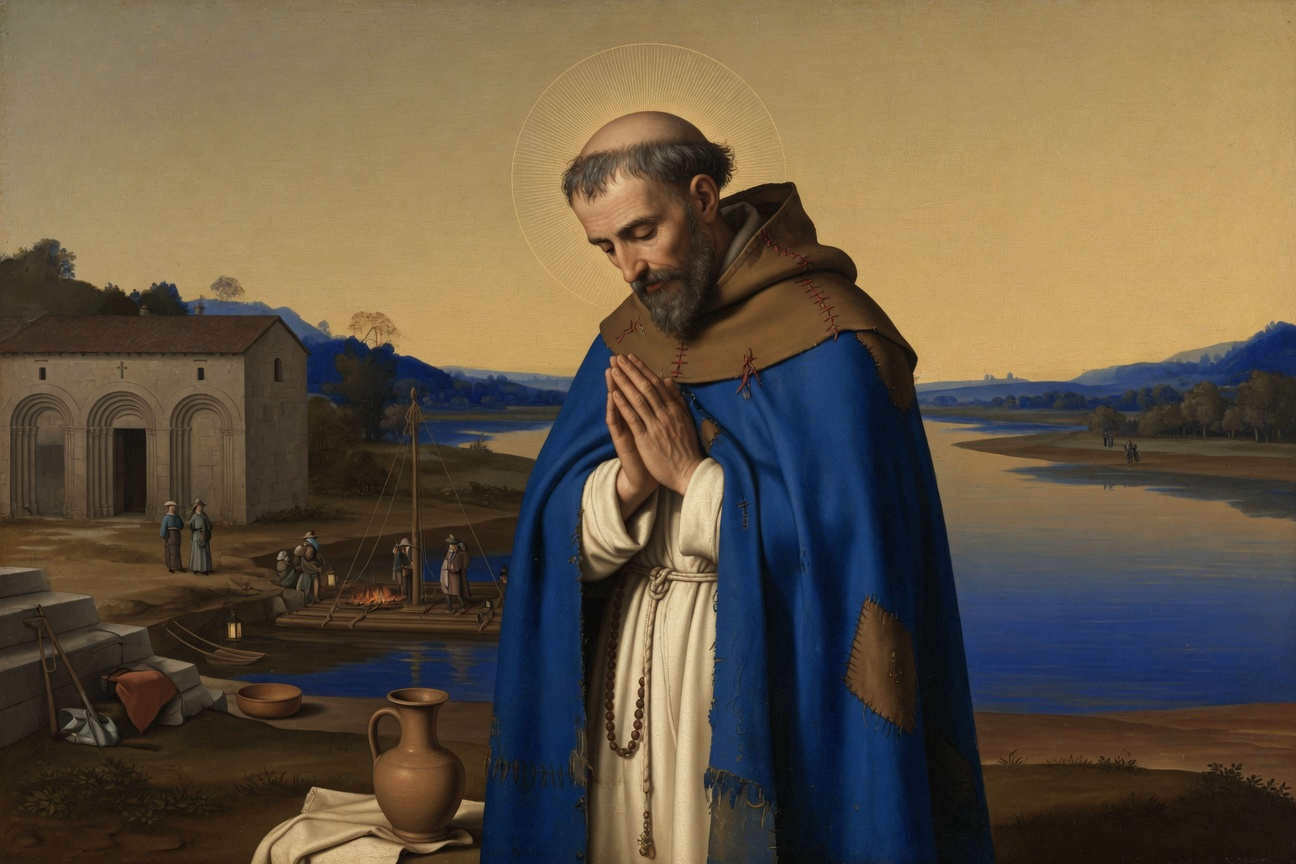
After killing his parents by mistake, thus fulfilling a prophecy he was fleeing, Julian retired with his wife to serve the poor and pilgrims near a river. His penance ended when he welcomed a transfigured leper who announced his forgiveness. He has since been the patron saint of travelers and hospitallers.
Guided reading
5 reading sections
SAINT JULIAN THE HOSPITALLER,
COMMONLY CALLED THE POOR
Origins and sources
The text highlights the uncertainty regarding the time and place of Julian's life, citing Spanish traditions and relying on the account of Saint Antoninus of Florence.
Do not neglect hospitality, for through it some have unknowingly entertained angels.
Heb., XIII, 2.
The place and time in which Saint Julian the Hospitaller, or the Poor, lived are unknown. The Spanish cla saint Julien l'Hospitalier, ou le Pauvre Saint cited for his similar involuntary parricide. im him as their compatriot and state that his parents were originally from Aragon. According to them, they were married following an abduction, and this would explain the fatality by which this family was pursued: our Saint was said to have been born in Naples, where his father and mother had retired.
We shall borrow from Sain t Antoninus, Archbishop of Florence, saint Antonin, archevêque de Florence Hagiographer who reported the miracle of the resurrected dead man. the details that follow.
The prophecy of the stag
During a hunt, a stag predicts to Julian that he will kill his parents; to flee this destiny, he goes into exile, enters the service of a lord, and marries.
Still living under the guidance of his parents, and pursuing a stag in the countryside, Julian heard a voice, as if coming from the mouth of that animal, which said to him: "Why do you pursue me, you who will take the life of those who gave it to you?" This young man, extremely distressed by this prediction, resolved from that moment to flee far from his father's house, for fear of falling one day into the misfortune with which he saw himself threatened. He therefore left secretly, and withdrew to a distant land, to a lord who, recognizing the prudence of this voluntary servant, took a great affection for him, and, to keep him always in his service, had him marry a young widow, and gave them a country house to manage, where they lived in good harmony and in exact observance of the commandments of God and the Church.
The tragic parricide
His parents find him in his absence; his wife lodges them in her own bed. Upon his return, Julian kills the occupants by mistake, believing it to be adultery.
It happened one day that Julian's father and mother, who were still living, could no longer bear the long absence of their son, of whom they had heard no news, and resolved to travel the world themselves to search for him. After some time, they finally encountered his house, from which, by chance, he was then absent. His wife received these two poor old people with great courtesy, as she was accustomed to doing for all other passersby; and, inquiring about the reasons for their journey, she learned from their words that they were her husband's father and mother: that is why she received them as well as she possibly could; and, having no more convenient place to put them to sleep, she gave them her own bed. The night having passed, she went off early in the morning to church to say her prayers, according to her custom.
Meanwhile Julian, who knew nothing of this, returned home and entered his room: perceiving a man in his bed with another person, he imagined that he had before his eyes two adulterers; seized with grief, he drew his knife and plunged it into the breast of one and the other, whom he left stone dead. This done, he went out quite terrified; but he was even more so when he perceived his wife returning from Mass, and learned of the fatal accident that had occurred, and how he had fallen into the misfortune he had fled with such diligence. He would no longer return to his house, but resolved to go at once into some desert to perform penance there.
Penance and miracle
After receiving absolution in Rome, Julian and his wife found a hospital near a dangerous river. He welcomes a leper who reveals himself to be Christ.
His wife could barely stop him to have the leisure to sell the little property they possessed. When they had made some money, they went to Rome to be absolved by the Pope, then retired near a river whose crossing was extremely dangerous, and built a hospital on the bank for the benefit of pilgrims. There, they both lived in continuous penance and in the service of the poor; especially Julian, who ferried them across the river out of c harity Julien Saint cited for his similar involuntary parricide. , and then gave them hospitality in his hospital. One night, in the middle of winter, he heard what sounded like the voice of a poor man calling him to cross the river. At this voice, he woke up, jumped out of bed, and went promptly to ferry this poor man, who appeared quite sick and covered in leprosy; he brought him into his house and placed him by the fire; but, seeing that he could not warm him, he decided to put him in his own bed. Then the sick man appeared shining like a sun, and, taking leave of his host, he assured him that his sin was expiated by these pious duties of hospitality that he exercised toward the poor. Some time later, Saint Julian and his wife, laden with good works and merits, passed from this life of misery to a happier one.
Cult and Patronages
Having become the patron of travelers and various guilds, his cult is marked by traditions of hospitality and an iconography linked to the boat and the stag.
In memory of his charitable life and his care for the poor, he was nicknamed Saint Julian the Poor or the Hospitaller. It was once a very widespread devotion for travelers in difficulty to recite a Pater in his honor to obtain good lodging. He was also in many places the patron of hospices where one only had to present oneself as a poor traveler to be hosted for three days. This ancient and praiseworthy custom still subsists in Antwerp.
He is depicted: 1s t, fer Anvers Place of printing for an edition of the sermons in 1546. rying Our Lord in a boat; 2nd, holding a small boat in his hand and accompanied by the stag that predicted his misfortune; 3rd, receiving lepers at the door of his hospice.
The minstrels of Paris had chosen him as their p atron Paris Place of birth, ministry, and death of the saint. ; which explains the presence of a mask in some modern paintings. Stained glass windows, those of Chartres, for example, have developed this legend. It was also painted on a 14th-century stained glass window at the Cathedral of Rouen.
The Church of Saint-Julien-le-Pauvre in Paris possessed a curious bas-relie f fro Paris Place of birth, ministry, and death of the saint. m the 14th or 15th century, representing Saint Julian and his wife crossing the water with Jesus Christ, whom they took for a leper. Saint Julian was chosen as a special patron by travelers, pilgrims, innkeepers, ferrymen, the roofers of Liège, and shepherds.
We have already said that minstre ls, j Liège Episcopal see of the saint. ugglers, and acrobats did the same; not that Saint Julian was anything of the sort, but because his charity must have more than once found the occasion to be exercised toward people of this profession who travel a great deal and are very exposed to encountering poor lodging.
The memory of Saint Julian is marked on February 13 by Ferrarius in his catalogue of Saints; he is omitted from the Roma n Martyro Ferrarius Hagiographer who mentions the saint's feast day on February 13. logy, although the tables of the Church of Aquileia mark his feast on January 29.
Annexes & related entities
Structured data for exploration: events, miracles, quotes, places, attributes, patronages, and important entities cited in the text.