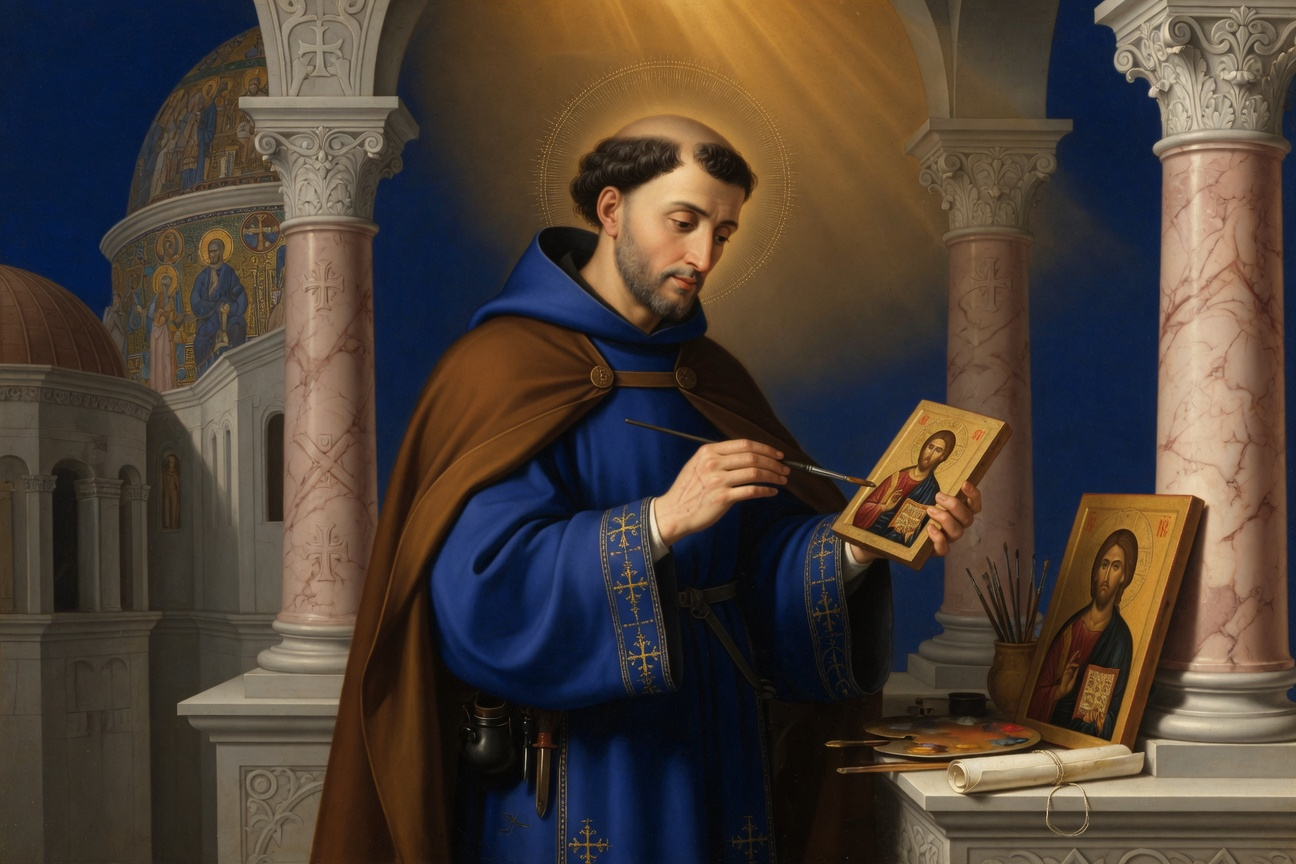
A religious in 9th-century Constantinople, Lazarus was a famous painter who defended the veneration of images against the iconoclasm of Emperor Theophilus. Despite atrocious torture to his hands, he continued his sacred art and later served as an ambassador to Pope Benedict III. He is considered one of the patron saints of painters.
Guided reading
6 reading sections
SAINT LAZARUS, RELIGIOUS AND PAINTER
Origins and formation
Originally from the Caucasus, Lazarus joined a monastery in Constantinople where he dedicated himself to the contemplative life and the study of painting.
Lazaru Lazare Byzantine monk and painter, defender of icons. s left the Caucasus, where he was born, at an early age to embrace the contemplative life in a monastery in Constantinople Constantinople City where the saint exercised his ministry and patriarchate. . During the hours he did not devote to devotion, he learned painting, a study that was generally pursued in convents ever since the Iconoclasts had declare d war on ima Iconoclastes Religious movement rejecting the veneration of images, which caused the persecution of the two saints. ges.
The persecution of Theophilus
Under the reign of the iconoclast emperor Theophilus, Lazarus is arrested and tortured for his refusal to profane sacred images.
Emperor Theophilus, L'empereur Théophile Byzantine iconoclast emperor, responsible for the torture of verses carved onto the faces of saints. a great supporter of these heretics (829), declared war particularly on all Christian painters, whom he resolved to put to death if they did not themselves spit upon the holy images and trample them underfoot. Our Saint, who excelled in the art of painting, was therefore one of those who were arrested for this reason. As soon as the emperor saw him, he endeavored to win him over with fair words, so that he might join his party; but, seeing that he was wasting his time and effort, he resorted to his usual violence and had this religious man tormented with such cruelty that, believing him no longer capable of living, he had him thrown into a sewer.
But, shortly after, the confessor of Jesus Christ, having recovered some strength and health, began again to work on his ordinary tasks and to paint images; Theophilus had red-hot iron plates applied to the palms of his hands, which consumed all his flesh and left him half-dead. Then divine Providence, which wished to reserve this good painter to serve His Church further, permitted that Theophilus, won over by the prayers of his wife, the Empress Theodora, and his favorites, had our Sai nt released from priso l'impératrice Théodore Eastern Roman Emperor (likely Theodosius II according to the historical context). n.
The Image of Saint John the Baptist
Despite his hands being mutilated by fire, Lazarus paints a miraculous image of the Forerunner while hiding in the church of the Terrible.
Being delivered in this manner, he remained hidden for some time in Constantinople, in a church of Saint John the saint Jean-Baptiste Saint whose feast day coincides with that of the blessed John. Baptist, which was called the Terrible; there, this pious painter, although crippled in his hands, did not cease to make an image of the holy Forerunner; it lasted for a long time, and God used it to perform many miracles.
The restoration of the cult
After the death of Theophilus, Empress Theodora and Michael III restored the veneration of images, allowing Lazarus to resume his art.
A few years later, this emperor died miserably of dysentery following a battle he had lost against the Saracens (842); and Michael III, his son, succe eded him t Michel III Byzantine Emperor, son of Theophilus and Theodora. o the empire. This prince having restored, through the care of his mother, the veneration of holy images, the religious Lazarus returned more than ever to working on beautiful works, among which one notes an excellent image of Our Lord Jesus Christ, which he placed on a bronze column. Begged by the holy Empress Theodora to forgive her late husband and to pray to God for his soul, so that He might show him mercy, he replied that it was no longer time to sway the justice of God.
Nevertheless, several authors report that this pious princess urgently requested Patriarch Methodius and the other bishops assem bled to celebrate th patriarche Méthodius Patriarch of Constantinople who worked for Orthodoxy. e anniversary of a feast called Orthodoxy, to pray to God for the emperor her husband, and that the prelates did so with such fervor that they obtained from divine mercy the remission of all his crimes. One may see on this matter Bollandus in the life of Saint Theodora, on the 11th of this month.
Embassy to Rome and end of life
Lazarus is sent on an embassy to Pope Benedict III and likely dies during a second journey to Rome around the year 860.
Michael, convinced of the merit of our Saint, in the third year of his empire, honored him with a famous embassy of obedience to Pope Benedic pape Benoît III Immediate predecessor of Nicholas I. t III, who had been newly elected, and charged him to present on his behalf a book of the Gospels, covered in solid gold and enriched with precious stones; a chalice of similar material and several other church ornaments made of very rare fabrics: which shows how much God knows how to honor his servants, and what reward he gives, even in this world, to those who have endured some hardship for his glory and for justice. On the other actions of Saint Lazarus, nothing is known, except that he spent the rest of his life in great rest. The Greeks, in their Menologion, say that he died on the way, during a second jou rney Rome Birthplace of Maximian. he made to Rome. The year cannot be determined: it is probable that it was around the year 860. It is mentioned, in the Menologion, on October 17, a translation of the relics of a Saint Laz arus, f Chietti Italian city from which some relics of Saint Lazarus are said to originate. rom the city of Chieti to Constantinople, under Emperor Leo VI. There are some who believe that these are the relics of Saint Lazarus, brother of Saint Mary Magdalene, and not those of our Saint.
Heritage and devotion
Recognized as the patron of painters, Lazarus is traditionally depicted in his prison, his hands burned by his executioners.
This martyr of the cult of images has been depicted: 1° painting in a chapel; 2° in his prison, having just painted Our Lady: the executioner burns his right hand with a red-hot iron. A soldier holds him by the shoulder; but one can clearly see from the Saint's calm that this precaution is useless. He is, along with Saint Luke and Sa int Catherine of Bologna, o sainte Catherine de Bologne 15th-century Poor Clare saint, mystic, writer, and artist. ne of the patrons of painters.
The Roman Martyrology speaks with honor of Saint Lazarus on February 22, as do Zonaras and Cedrenus; and Cardinal Baronius in his Remarks, and in the fourteenth and fifteenth volumes of his Annals (Bar-le-Duc edition).
Annexes & related entities
Structured data for exploration: events, miracles, quotes, places, attributes, patronages, and important entities cited in the text.