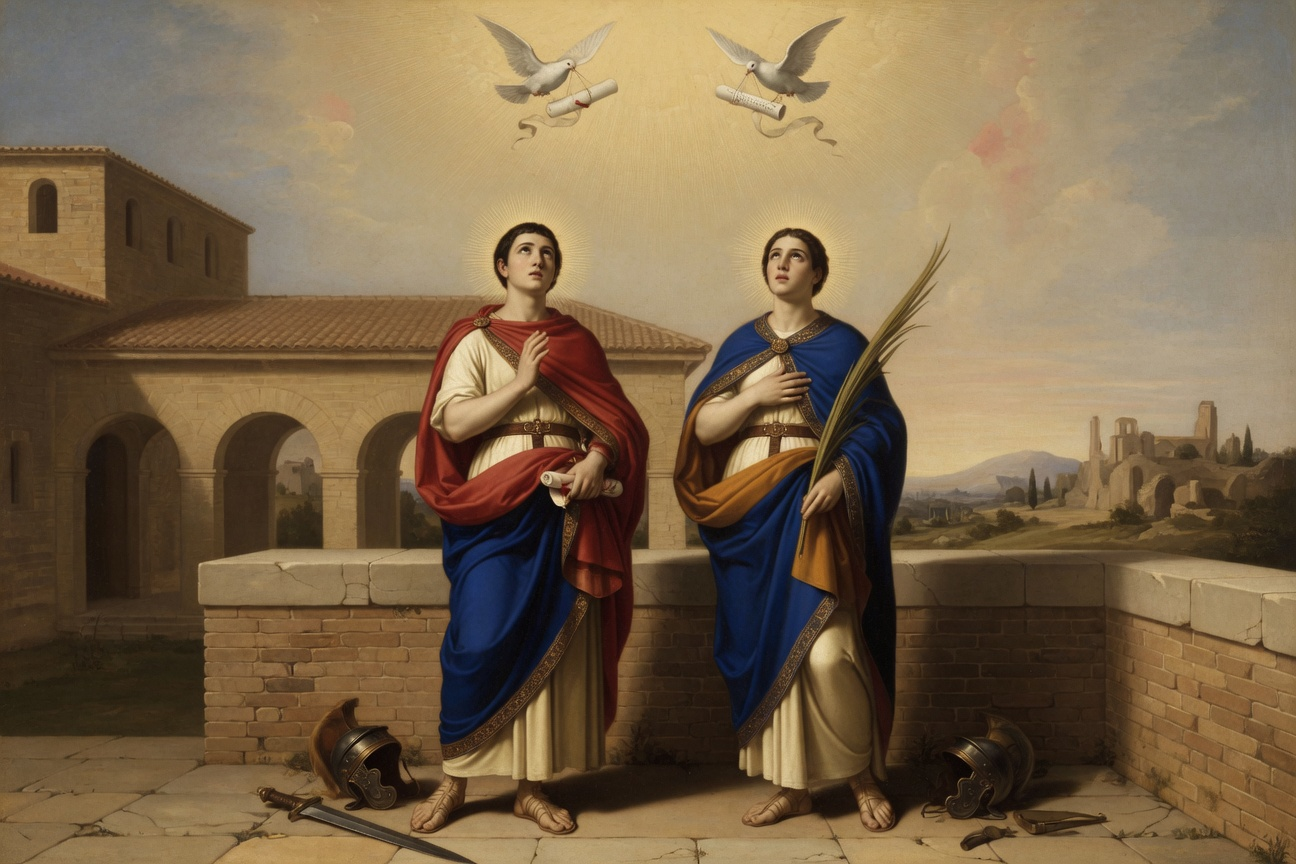
Roman soldiers and sons of the centurion Marcellus, Emeterius and Chelidonius left the army to profess their Christian faith in Spain. After enduring various secret tortures, they were beheaded in Calahorra around the year 300. A miracle marked their execution when their tokens of faith flew up to heaven.
Guided reading
5 reading sections
SAINTS EMETERIUS AND CHELIDONIUS, MARTYRS IN SPAIN.
Origins and Vocation
Sons of the centurion Marcellus, Emeterius and Chelidonius left the Roman army to dedicate themselves to Christ during a persecution.
Emeterius Héméthère 4th-century Spanish martyr, former Roman soldier. and Chelidon Célédoine Spanish martyr of the 4th century, brother of Emeterius. ius, also called Madir and Chelidonius, born in Leon, Spain, were sons of the centurion Marce Marcel Roman centurion and martyr in Spain and North Africa. llus, who died for the faith, and relatives of several other distinguished martyrs, whose blood was shed at various times and in various places.
After having long served as valiant soldiers under the Roman eagles, during a cruel persecution that arose against the Christians, they encouraged one another, and together took the generous resolution to abandon the secular militia to enlist under the banners of Jesus Christ. Inflamed by the ardor of their faith, while other Christians were succumbing under the trial, they ran courageously to martyrdom, knowing well that to lose one's soul is to save it, that to shed one's blood is to sanctify it, and that the Christian triumphs by receiving, and not by inflicting, wounds.
Confession and imprisonment
After publicly confessing their faith, they are imprisoned and tortured without renouncing their resolve.
They therefore publicly confessed Christ, cursed the idols, and preached the true God with complete freedom. For this reason, they were led to the military tribunal, and subsequently plunged, laden with heavy chains, into a foul and dark dungeon. There, despite the exhaustion they suffered, neither threats, nor chains, nor promises, nor the multiplied tortures to which they were subjected, could shake them in their holy resolution.
The tyrant had them tormented by various kinds of punishments, of which he did not even want the people to have knowledge; for he forbade under severe penalties that their acts, the account of their trials, and the miracles they performed be published. But, although the malice of the pagans attempted to abolish the memory of this glorious combat, the piety of the faithful has nevertheless taken it upon itself to preserve the remembrance of it.
The miracle of the celestial objects
Just before their execution, a ring and a handkerchief thrown by the saints miraculously rise toward the sky.
What was most memorable is that, a moment after the capital sentence was pronounced, when the Saints had reached the place of execution, before receiving the blow of death, they sent before them tokens of their faith, to the place where they themselves were soon to arrive. Emeterius threw his ring into the air, Chelidoni us his anneau Miraculous object that ascended to heaven before the martyrdom. orarium (a hand kerchie orarium Miraculous cloth that ascended to heaven before the martyrdom. f used to wipe the face); and, carried by a gentle zephyr, these objects rose toward the sky, in the sight of the spectators, who could distinguish the gleam of the gold and the whiteness of the linen. The executioner, admiring this prodigy, held back his hesitant and stunned arm for a few moments. But finally, he completed the triumph of the martyrs.
Martyrdom and cult in Calahorra
Executed by the axe near Calahorra, their relics are honored there, notably during their translation on August 31st.
They were struck by the axe near Calaho rra on Ma Calahorra Site of martyrdom and preservation of relics. rch 3rd: they were buried not far from that city. Subsequently, they were transferred to the cathedral church on the 31st of the month of August, the day on which these holy Patrons of the city, illustrious for their miracles, receive the brilliant testimonies of public veneration each year.
Sources and hagiographic tradition
Analysis of historical and literary sources, from Prudentius to the Bollandists, despite the loss of the primitive acts.
What has just been read is taken from the *Proper of Spain*. Here is the summary of the Commentaries with which the Bollandists precede the acts of Saint Emeterius and Saint Celedonius:
Prudentius sang of their gl ory and Gregory o Grégoire de Tours Bishop and historian who mentions the martyrdom of Antolian. f Tours celebrated thei r praise. Saint Isidore Saint Isidore de Séville Doctor of the Church who wrote their panegyric. of Seville delivered their panegyric, and the Mozarabic liturgy long recounted their struggles. Their primitive acts perished at the hands of the executioners, who did not wish to let the memory of their cruelties pass to posterity; so that the precise time of their martyrdom is not known.
Prudentius, who wrote his *Psychomachia* around 400, could have taught us the date, but numbers rarely find a place in poems. Bede fixes the date of Beda Hagiographer whose martyrology attests to the antiquity of the cult. their martyrdom to the year 300; but the Bollandists do not adopt this statement. According to tradition, they began their martyrdom at Leon, but were neither natives nor inhabitants of it. Their bodies rest today in the Cathedral of Calahorra, of which they are the patrons. Their venerable heads, found at Port Saint-André, are said to have caused this place to be called the port of Saint Emeterius. Cf. *Acta Sanctorum*, die III martii.
Annexes & related entities
Structured data for exploration: events, miracles, quotes, places, attributes, patronages, and important entities cited in the text.