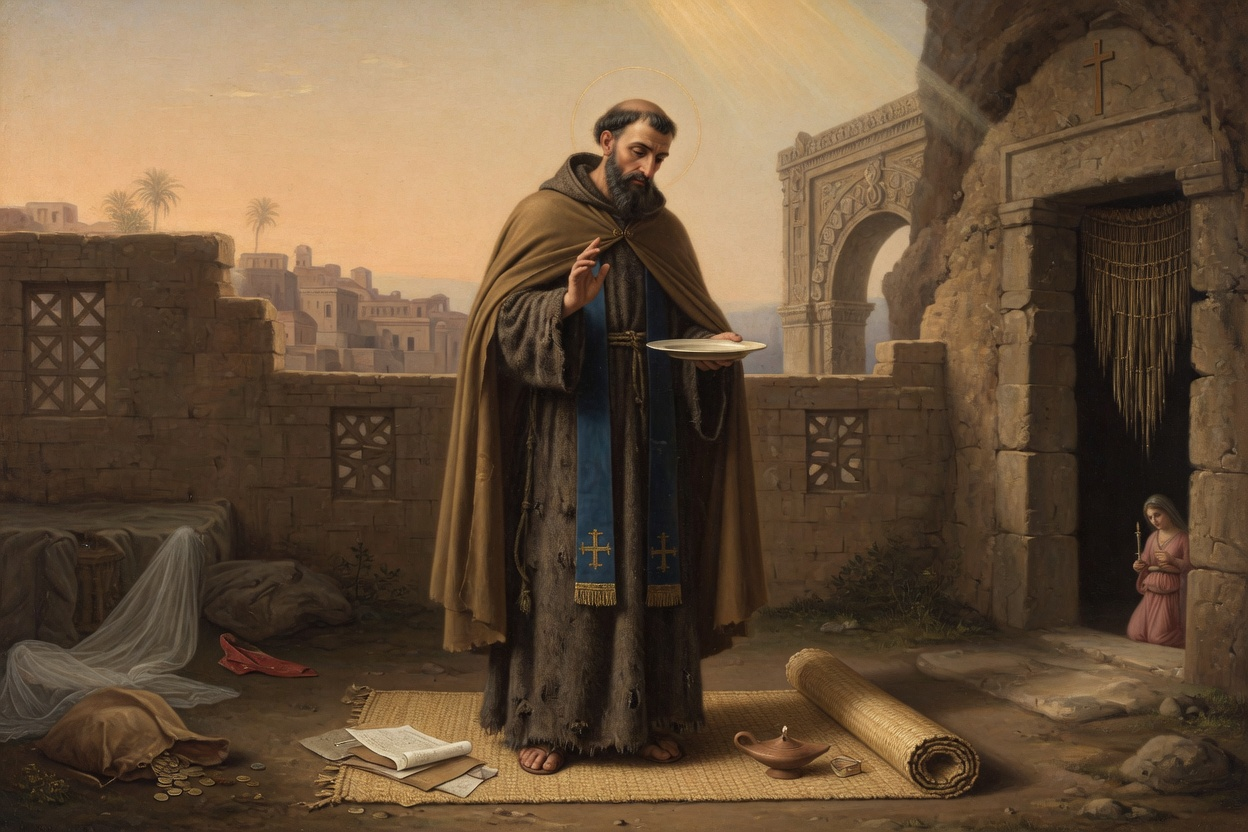
Saint Abraham of Chidane
AND SAINT MARY, PENITENT, HIS NIECE
Solitary and Priest
Born in Mesopotamia in 300, Abraham fled his marriage to live as a hermit near Edessa. Ordained a priest, he converted a village of idolaters through heroic patience after three years of persecution. He is also famous for rescuing his niece Mary from a life of debauchery to lead her back to penance.
Guided reading
8 reading sections
SAINT ABRAHAM, SOLITARY AND PRIEST
AND SAINT MARY, PENITENT, HIS NIECE
Youth and flight from the world
Born in Mesopotamia, Abraham fled his arranged marriage on the seventh day of the wedding to withdraw into a solitary cell near Edessa.
Abraham Abraham Mesopotamian hermit and priest of the 4th century. was born in the year 300 i n Chida Chidane Birthplace and place of retreat of the saint. ne, in Mesopotamia, near the city of Edessa Édesse Birthplace of Saint Simeon in Syria. . Scarcely had he reached the age of marriage when his parents, who were very wealthy and regarded him as the principal heir to their estate, presented him with a girl of noble birth and good dowry. He had little intention of marrying her; but, not daring to oppose their will, he allowed them to conclude the matter. The wedding was therefore celebrated, which took place with festivities and feasts that lasted seven days according to the custom of the time. But on the seventh day, when he was to consummate the marriage, he felt his soul penetrated by a vivid ray of grace, and he was so deeply touched by it that he left his wife, went out of his house, and went to hide in a cell he found empty, three-quarters of a league from the city. There, surrendering his heart freely to the interior anointing with which the Holy Spirit, who had served as his guide in his retreat, had filled him, he gave thanks to the Lord with holy gladness and thought only of glorifying Him. The surprise of his parents and all his neighbors cannot be expressed. They searched for him on all sides, and finally, at the end of seventeen days, they discovered him in prayer and were in an astonishment from which they could hardly recover. 'Why are you astonished to see me here?' the Saint then said to them, 'admire rather the favor that God has shown me in withdrawing me from the mire of sin, and pray to Him that He may grant me the grace to bear until the end the yoke so sweet of His service, which He has been pleased to impose upon me without regard for my unworthiness, and that I may faithfully accomplish all that He asks of me.' They did not press him further and consented to his following his vocation; but he asked them at the same time not to come and interrupt him in his exercises under the pretext of paying him visits, and when they had withdrawn, he had the door of his cell blocked up and left only a very small window, through which he received on certain days what was brought to him for his food.
Asceticism and Renunciation
Abraham distributes his inheritance to the poor and leads a life of extreme austerity, to which Saint Ephrem bears admiring witness.
He thus undertook the work of his perfection with admirable ardor, and, aided by the grace of the Lord, he made new progress every day through the entire renunciation of all sensory satisfactions, through vigils, prayer, the tears of holy union, as well as the practice of humility and charity. Thus, although he remained enclosed in his cell, the radiance of his holiness did not take long to appear to the outside world. The report of it grew imperceptibly, and those who heard of it hastened to come and see him to assure themselves of the good they had heard said of him, and to find with him the means to be instructed and edified at the same time. It appeared clearly that it was God who brought them to him; for having placed him in this place as a light which He wished to use to enlighten others, He granted him the gift of counsel and wisdom in abundance, which meant that one could never tire of hearing him speak of heavenly things.
He had been ten years in renouncing the world when he learned that his parents had died and that he had inherited their property, which was considerable. His heart was too well detached from the affection for perishable riches to think of taking them back. He therefore begged a friend, whose integrity he knew, to distribute them to the poor and the orphans, and relied entirely on him for this office of piety, so as not to be interrupted by this care in the exercise of prayer, after which he did not concern himself with it any further.
This sacrifice was for him like a new commitment he made to detach himself ever more from the things of the earth, and to animate himself with a new zeal to enrich himself with the treasure of virtues. He had nothing but a cloak, a tunic of goat hair, a dish for eating, and a reed mat for sleeping, and even then he often slept on the bare ground; and through such great stripping away, his soul took a greater flight to rise to God through the degrees of virtues. But one can say that he flew rather than climbed by degrees, so extraordinary was the progress he made in perfection.
One must read what Saint Ephrem says of him, this faithful and true witness of his eminent piety, and who was u nited to him saint Éphrem Deacon of Edessa and primary biographer of Saint Abraham. by the bonds of a holy friendship: "He never relaxed in anything," he says, "since he embraced the solitary life. He did not pass a single day without shedding tears. One never saw him smile. He looked upon each day as that of his death."
"But here," continues Saint Ephrem, "is what is even more worthy of admiration: it is that in such an austere life he always preserved a fresh face, a pleasant air, a healthy and vigorous body, although he was of a delicate temperament, as if he had done no penance, so much did the anointing of grace strengthen and support him in all his actions, and so much did it communicate spiritual joy to his soul. Finally, what one must still admire in him is that he never changed, for fifty years, the goat hair robe he was wearing, and that it even served others after his death."
We have said that the odor of his virtues attracted a multitude of people from all sides to his cell. Saint Ephrem also teaches us how he received them, instructed them, consoled them, and animated them to work for their salvation. "His humility," he says, "was of the deepest, and he had an equal charity for everyone. There was no respect of persons with him. He did not prefer the rich to the poor, nor the great to the small; but he had the same zeal and the same Christian tenderness for all, and revered them all equally in Jesus Christ. He did not rebuke anyone with bitterness, and did not know what it was to use harsh words; but all his discourses were seasoned with the salt of charity and sweetness. Thus, one never grew weary of hearing him; and in considering the holiness that shone on his face, one felt pressed by a greater desire to see him often."
Evangelization Mission in Edessa
Ordained a priest despite his humility, he is sent to convert a rebellious pagan village where he endures three years of violent persecution.
The incomparable Abraham, that man of penance, prayer, and charity, was thus exercising himself in these virtues, enclosed in his narrow cell, when Providence wished to manifest his zeal, his love, and his patience through a mission to which He called him, and which required nothing less than a virtue as ardent, as firm, and as unshakable as his own. There was in the diocese of Edessa a large village whose inhabitants were all idolaters, and so strongly attached to their superstitions that they had never wanted to listen to the priests and deacons whom the bishop had sent them, nor to several solitaries who had wanted to undertake their conversion. On the contrary, as they added cruelty to their blindness, the charity of these missionaries had only succeeded in exciting their fury and getting themselves chased away without having been able to gain anything over their hearts.
It was a great subject of affliction for the bishop of the city to have made such frequent attempts until then to bring them to the faith of Jesus Christ in vain. One day, when he had assembled his clergy, the conversation turned to the virtue of Saint Abraham, whom they began to praise as he deserved. Then God inspired the good thought in the bishop to send him to these pagans as one of the greatest servants of God he knew, and as the most fit to soften the hardness of their hearts through his charity and patience. All the ecclesiastics applauded this choice, so that he rose immediately and went with them to the cell of the servant of God. After greeting him, he spoke to him of these idolaters and declared his intention to ordain him a priest and send him to their village to work for their conversion.
Abraham was very far from fleeing hardship, he who found his delights in penance; but his humility hid his virtues so much from his own eyes that he could see in himself only miseries and weaknesses. Thus, the bishop's proposal frightened him and made him very sad. "I conjure you, my holy Father," he said to him, "to consider that I am but a vile man, very incapable of undertaking an affair of this importance; that is why I beg you rather to let me weep for my sins." "God will make you fit for it by His grace," the bishop told him, "so do not make any difficulty about submitting." — "I beg you," replied Abraham, "to have pity on my weakness and to suffer me to continue to weep for my sins." — "But what!" the bishop then said to him, "you have left everything, you have abandoned the world and everything you could claim in it, you are crucified to the world, and you have not yet acquired the virtue of obedience?" — "Alas! my Father," answered Abraham, shedding many tears, "what am I other than a dead dog? and what is the life I lead for you to have judged that I was fit for such a great undertaking?" — "Here," the bishop told him, "you are only occupied with your own salvation, and there you will be able, with the help of the Lord, to convert many souls and save them. Consider well within yourself, therefore, how you can obtain a greater reward, if it will be here, or there; if it will be by saving only yourself, or by saving several others with you?" Then this holy man replied, continuing to weep: "May the will of God be done; I am ready to obey you and to go where you order me."
The bishop therefore led him to the city, ordained him a priest, and had him taken to the village of the pagans. It was about the year 330. Abraham, while going there, kept his heart raised to God and said to Him: "O God full of goodness and clemency, cast your eyes upon my weakness and my insufficiency for such a great ministry, and send me your help from on high, so that your holy name may be glorified." And when he had entered the village, seeing everywhere only marks of idolatry and a people given over entirely to their abominations, he raised his eyes to heaven, heaving deep sighs accompanied by tears, and said to God: "You alone are impeccable, you alone are merciful, alone clement, alone goodness itself; do not reject the work of your hands."
As there still remained something from the distribution of his goods, he sent word to the faithful friend to whom he had entrusted them to have them brought to him, and used this money to build a very beautiful and well-adorned church. Whether God by a secret force prevented the idolaters from opposing it, or whether they did not dare to, because he was supported by the authority of the magistrates, and perhaps also by some rescript of the Emperor Constantine that the bishop had obtained, this church was brought to its perfection in a short time, and the pagans came every day to see it out of curiosity. When it w l'empereur Constantin Roman emperor whose conversion ended Christian persecutions. as finished, he offered long prayers there to God for the people whose care His Providence had entrusted to him.
Until then, he had passed among the idols without saying anything, contenting himself with groaning and praying; but finally, animated by a holy zeal, and authorized by the spirit of God as much as by the laws that Constantine the Great had already had published (for this took place under his reign between the year 330 and the year 334), he overturned all the altars and broke all the idols of the place. It did not take more than that to excite the fury of the inhabitants: they threw themselves upon him, whipped him, and chased him from the village; but he returned in the night, re-entered the church, and more touched by their hardness than by all that they had made him suffer, he continued to solicit for them with many tears the mercy of God.
The next day, the pagans were strangely surprised to find him in the church in prayer. They could hardly recover from their astonishment. He took the opportunity to exhort them to finally renounce their superstitions; but instead of listening to him, they threw themselves upon him like madmen, beat him cruelly, dragged him by the feet with a rope out of the village, overwhelmed him with stones, and withdrew, believing him dead. Indeed, he was almost without life; but he regained his senses in the middle of the night, and addressing God from the depths of his heart, he said to Him, groaning and weeping much: "Why, Lord, do you disdain my lowliness? why do you turn your eyes from me? why do you reject the desires of my heart? why do you despise the work of your hands? I beg you, O God of infinite goodness, to cast looks of mercy upon this poor people. Grant them the grace to know you, and to believe that there is no other God but you."
After this prayer, God restored his strength to return to the church and sing His praises; and the pagans, having returned there at daybreak, were more astonished than ever to find him there. Their rage was rekindled, and having taken him, they treated him as cruelly as the previous day. Finally, their persecution lasted three years, and during that time there is no ill-treatment that they did not make him endure. But whether they beat him, heaped a thousand outrages upon him, dragged him, overwhelmed him with stones, made him suffer hunger and thirst, and all the evils they could imagine to force him to withdraw, he appeared like a diamond, without ever being shaken or letting himself be cast down, without even showing any movement of anger or indignation against them; on the contrary, the more they persecuted him, the more his charity towards them, like a brazier that cannot be extinguished, increased. Sometimes he exhorted them with zeal; sometimes he warned them with gentleness; sometimes he gave them great testimonies of tenderness and affability: he treated the old men as his fathers, the less aged as his brothers, and the youngest as his children, although on their side they did not cease to despise him, to say insults to him, and to heap a thousand outrages upon him.
Mass conversion and return to solitude
Touched by his patience, the villagers convert in mass; Abraham baptizes them before fleeing secretly to return to his cell.
Finally the day of mercy arrived. God answered the prayers, tears, and sufferings of His servant, and compensated him for the pains he had endured until then with the complete conversion of this people. Here is how Saint Ephrem recounts this marvelous change: "All the inhabitants of the village being assembled one day, they began to speak of the Saint, and said to one another in a sentiment of admiration: You see that despite all the evils we have made him suffer, far from abandoning us, he has persisted in remaining here, without ever having said to anyone any unpleasant word, nor having any aversion toward us; far from it: he has suffered our persecutions with an unalterable patience, and has even shown joy in them. Surely he could not have endured these things if the true God were not with him, and if what he tells us of the kingdom of heaven and eternal torments were not true? And how could he alone have overthrown and broken all our gods, without them having avenged themselves against him with terrible punishments, if they had had the power? It must therefore be that this is the servant of the only true God, and that everything he has told us comes from Him and is true; thus we must believe in the God he preaches to us.
"This sentiment was received by all; and immediately they went to find the Saint at the church, crying out with all their might: 'Glory be given to the God of heaven who has sent us His servant to deliver us from error and to save us.' What was the joy of this holy man when he saw them coming and heard them crying out thus? Like flowers that have been nourished by the morning dew have brighter colors, so also appeared the face of the man of God.
"Seeing them so well disposed, he baptized them all in the name of the Father, and of the Son, and of the Holy Spirit, from the smallest to the greatest, to the number of one thousand people. From that time on, he read the Holy Scripture to them assiduously every day, and instructed them in the principles of the faith, of Christian justice, and of charity."
He spent another whole year with them after they had received holy baptism, instructing them day and night to strengthen them in piety; after which, presuming that they were well established in the faith, and that they loved God in the sincerity of their hearts, and seeing moreover the extraordinary affection and veneration they had for him, he began to fear that this might be an occasion for him to slacken in his way of life and to become too involved in the cares of the world under the pretext of giving them his care. This shows how pure his zeal was, and how sincere his humility, which led him thus to distrust himself: a great example for persons applied to the external ministry of the salvation of souls, which teaches them to seek therein only the glory of God, and to conduct themselves with a holy distrust of themselves.
These considerations therefore determined this holy man to cede to others the field of the Lord that he had so happily cleared and cultivated with so much labor, in order to return to his solitude, when he had judged that he had sufficiently fulfilled his mission. He rose in the middle of the night: after having prayed for a long time, he left the village secretly, gave it his blessing by making three signs of the cross, and withdrew to another place where he hid himself as best he could.
One can judge the sorrow of the faithful when, the day having come, they no longer found him in the church. They immediately spread out everywhere like wandering sheep, to discover where he might have hidden, calling their holy pastor by their sorrow and their tears, and making all places resound with their lamentations; but having been unable to find him, they had recourse to the bishop, and told him what had happened. The bishop was no less afflicted than they, and he immediately sent people everywhere to search for him as one would search for a precious stone. Finally, those he had sent having returned without having been able to discover him, he went himself to the village with his clergy, where after a discourse he gave to the assembled people to try to console them, seeing how they were strengthened in the faith and in charity, he chose those among them whom he judged most suitable for ecclesiastical functions, and ordained some priests, others deacons, and others readers.
Saint Abraham learned with great joy what the bishop had done, and rendered great thanks to God for it; after which, no longer fearing that obstacles would be placed in the way of his retreat, he withdrew to his cell. He had a second one built that touched his own, which, being like an outer cell, made his own more suitable for recollection and thereby favored more his love for the life of prayer and contemplation that he wished to lead. But the people of the village whom he had converted had no sooner learned of it than they came there to show him the joy they had in seeing him again, always looking upon him as their guide on the path of salvation, and recurring to him with a filial confidence, just as children to their father, to receive his instructions and be edified.
The upbringing of his niece Mary
Abraham takes in his orphaned niece, Mary, and raises her in a neighboring cell to make her a holy recluse.
"But I wish," continues the same Saint Ephrem, "to speak to you further of a trait of his life most worthy of admiration, which occurred in his old age, and which, by shedding new light on the greatness of his charity, may serve spiritual persons as a very useful example, and one very apt at the same time to inspire them with sentiments of a holy composition." It is the story of his niece, of the innocence in which he had preserved her, of the fall she suffered, of her return to God, of her penance, and of her blessed end.
He had had a brother in the world who, upon dying, left an orphaned daughter named Mary, whom his fr iends Marie Niece of Saint Abraham, known for her fall and great penance. brought to him when she was only seven years old. He therefore took charge of her with the sole intention of raising her in piety, by which he might make her worthy of heavenly goods, and desiring for her only this single possession, he had the riches that her father had left her distributed to the poor, and had her placed in a cell near his own, from which he instructed her through a small window he had pierced. He had her learn the psalter and the other books of the Holy Scripture; he had her keep vigil to praise God with him and had her sing psalms; he had her practice mortification, and formed her so happily in piety that she made marvelous progress, loving her state and making it the delight of her heart like her holy uncle, and adorning her soul with all virtues after his example.
Abraham, for his part, did not cease to pray to the Lord with tears that He might deign to preserve her in her innocence and prevent her heart from becoming engaged in the affection for earthly things. She also often implored him to ask God to preserve her from the snares of the devil and his evil suggestions. Thus she advanced with holy joy in the service and love of her God, and faithfully kept the rule that her uncle had prescribed for her. This holy man was filled with joy to see her persevere so constantly in her way of life, and at the progress she made in perfect charity. Saint Ephrem also joined his instructions to those of her uncle, and for twenty years she remained as a chaste dove and a spotless lamb.
The Fall and Straying of Mary
Seduced by a false monk, Mary sinks into despair and flees to a city to lead a life of sin.
But the demon could no longer suffer to see himself defeated by such beautiful virtue without finally unleashing his rage against her. He therefore set his nets to surprise her, or at least to distract his blessed uncle, through the affliction he would cause him, from the close union he had always maintained with God. Just as he used the serpent's cunning against our first parents to draw them out of the garden of delights and make them pass into a land that produced only briars and thorns for them, so he found an instrument of perdition to serve his pernicious design against this pious virgin. This instrument was a false monk, who sometimes came to see Saint Abraham under the pretext of learning from him the duties of his state, but who unfortunately cast evil glances at his niece and let himself be dazzled by her beauty, which was very great, so that he came only to see her, always covering his guilty intentions with the pretext of speaking to the man of God.
He had to struggle for an entire year against her virtue; but finally, he proceeded with such artifice that at the end of that time, Mary listened to him.
The demon, who had fascinated her eyes by softening her heart to prevent her from seeing the precipice where she was about to lose herself, then made her see all its horrors and depth, in order to finish overwhelming her with despair. The spirit of Mary, which rose to God with such ease, was suddenly covered with thick darkness; her beautiful soul, which tasted God with such peace and sweetness, found itself as if metamorphosed into a demon by the horrible ugliness it contracted and by the frightful trouble by which she felt herself cruelly agitated. Then, giving herself up entirely to her remorse and to the terror that her sin caused her, she tore her hair shirt and bruised her face with blows: her despair even went so far as to want to kill herself. "It is done," she said, crying out loudly, "I must look upon myself as dead; I have lost all the time I had spent until now in the practice of virtue; I have lost my labors; I have lost the fruit of my tears, of my vigils, of the holy canticles in which I spent part of the night; I have covered my soul with infamy, I have given it death, I have made it the subject of the demons' mockery. What an affliction for my holy uncle! Of what use were his counsels and those of Ephrem to me, when they told me so often to keep myself pure, and that I had an immortal Spouse, who is as jealous of modesty as He is holy? How shall I dare to present myself again at that window, from where he gave me his instructions? Would not a flame come out of it to devour me? It is therefore much better, since I am dead to God and no hope of salvation remains for me, that I go to a country where I am known by no one."
Such were the sentiments to which this girl, fallen from her virtue, gave herself up according to Saint Ephrem, and she executed them only too well; for instead of confessing her fault to her uncle, who would have helped her to rise from it and do penance, she thought only of fleeing him, and she went away to a city where she abandoned herself entirely to sin. At the same time, God made known to Saint Abraham in a vision the fall of his niece. He seemed to see a monstrous dragon that had come with horrible hissing to his cell and had swallowed a dove, after which it had returned to its lair. He first thought that it was the omen of some persecution against the Church, and prayed much to receive new light on the matter. He had none other, except that two days later he saw this dragon again in a dream, and that having crushed its head with his feet, he had forced it to vomit the dove, and had pulled it out alive.
The Redemption of the Lost Sheep
Disguised as a soldier, Abraham finds his niece in an inn and convinces her, through his tears and tenderness, to return to penance.
He awoke at this, and called his niece, asking her why he had not heard her singing the praises of God for two days; but having no answer, it was easy for him to apply the vision he had had, and he no longer doubted the misfortune that had befallen her. "Ah!" he cried out, groaning and shedding tears in abundance, "how unhappy I am! A cruel wolf has carried off my sheep; my daughter has been taken captive." Then, lifting his cries toward heaven: "Jesus, Savior of the world," he said, "give me back Mary, my sheep, and bring her back into your fold, so that in my old age I may not descend into the tomb with my sorrow. Do not despise, my God, the prayer I address to you; grant that I may soon experience the effect of your mercy, by withdrawing from the jaws of this dragon my daughter who still lives."
The two days of interval that elapsed between the first and the second vision represented, says Saint Ephrem, the two years that this unfortunate girl persisted in disorder. Her holy uncle spent them in continual tears and prayers that he offered for her conversion. It was only at the end of this time that he learned the place where she had retreated and the life she was leading there. He did not rely entirely on the first news he was given; but he asked one of his friends to travel to the place to better ascertain the truth. He did so, and upon his return, he certified everything that had already been told to him. The Saint asked him again to bring him a cavalier's habit and to bring him a horse; and having put on his head one of those large hats that also cover the face, so as not to be recognized, he left in this attire, and went to the inn where he had been told his niece was staying. He cast his eyes in all directions to see if he might catch sight of her; but as she did not appear, he said to the host, feigning a smile: "My master, they say you have a very pretty girl here; could I not see her?"
The host, astonished by this request from a man who appeared broken by old age, reproached him as if for a remark unworthy of his years. He confessed to him, however, that he had in his house a girl whose beauty was ravishing, and had her called. She presented herself, therefore, in a costume that sufficed to reveal her conduct, and the heart of the holy man was pierced with pain. He affected gaiety, however, and ordered a meal. As for Mary, says Saint Ephrem, upon finding herself near the Saint, she felt that sweet odor of purity that abstinence gives, which reminded her of the happy time when she practiced it so perfectly. "Ah!" she cried out, groaning and weeping, as if her heart had been pierced with a dart: "Ah! unhappy that I am!" The host was astonished by this and asked her the subject of her tears, since until then she had never given any sign of sadness. But she answered him without explaining further: "Oh, would to God that I had died three years ago!"
This was not a riddle for her holy uncle, who, continuing to dissimulate for a few moments, told her that it was out of place to speak of one's sins when one was in joy. Finally, finding himself alone with her in the apartment, he lifted the hat that covered almost his entire face, and said to her, weeping: "My daughter Mary, do you not recognize me? Am I not Abraham, who took the place of a father to you? Am I then unknown to you? Is it not I who raised you? What has happened to you, my dear daughter? Where is, my dear child, that angelic habit you wore before? Where is that beautiful purity? Where are those tears, those vigils, that compunction of heart? What has become of that time when you slept on the ground, and when you made so many genuflections to adore God? Oh, my daughter! how have you fallen from the height of heaven into this deep abyss? Why did you not reveal the temptation to me when the demon stirred it up in you? Would not my dear Ephrem and I have prayed for you so that you might be delivered from it by Him who can withdraw us from death itself? Was it necessary to abandon yourself even more to the demon after your first fault through a miserable despair? Judge the excess of the pain I have felt from it. But, my dear daughter, only God is impeccable."
The Saint spoke to her thus while holding her by the hand, which lasted until midnight, and she, seized with fear and confusion, was speechless like a stone, and dared not lift her eyes to look at him. Whereupon the Saint said to her, continuing to shed tears: "Why, my daughter Mary, do you not answer me? Have I not come here overwhelmed with pain to bring you back to the path of salvation? I take your sin upon myself, my daughter! I will answer for you at the judgment of God; I take it upon myself to do penance for it." These words, spoken with that sweetness that charity inspired in him, and accompanied by those tears that the state of his niece caused him to shed, began to bring her back a little from her surprise and her dejection; for the blow had struck her down, and she said to him: "If I dare not look at you in the shame with which I am overwhelmed, how, feeling myself covered in crimes, shall I dare to invoke the holy name of the Lord?"
"I have told you, my dear child, that I take your iniquity upon myself before God," replied the Saint. "Follow only my advice and let us return together to our first dwelling; our dear Ephrem is grieving and groaning to obtain for you from God the pardon of your sins. I conjure you, therefore, have pity on my old age and do not refuse to follow me." — "Yes," she said to him, "if I am still in time to do penance and if the Lord wishes to show me mercy, I will follow you as you command me. I submit entirely to your holiness and I kiss the holy traces of your footsteps, in recognition of what your paternal charity has made you do to withdraw me from the trap in which the demon had engaged me." Saying this, she prostrated herself, and resting her head on the feet of the Saint, she spent the rest of the night in this situation, shedding a quantity of tears and saying to the Lord: "What can I do, O my God! to recognize your graces and the effects that I experience of your very great mercy?"
Finally, the day began to appear and the blessed old man said to her: "Rise, my daughter, and let us leave to return to our cells." — "I still have here," she said to him, "money and some clothes; what do you want me to do with them?" — "Abandon all that," the Saint replied, "because you hold it only from the demon." Then he had her mount his horse, and like the good Shepherd who brings back the sheep he had lost, the holy old man made the journey with his niece, his heart filled with joy. He enclosed her in the inner cell where he himself had previously lodged and placed himself in the outer cell. Mary resumed her hairshirt with her first exercises of penance. She let her soul be penetrated with the liveliest compunction; she persevered in tears and in the humiliation of the heart; she punished her body with vigils and the harshest labors of penance; she even practiced them with a holy joy, grieving ceaselessly and groaning before God through a vivid feeling of compunction accompanied by a tender confidence in His mercy; and to sum it all up in a few words, her conversion had all the qualities of a sincere penance and a truly medicinal contrition to heal the wounds of sin.
End of life and cult
Abraham dies at 70 surrounded by miracles, followed a few years later by Mary, whose penance was validated by miraculous gifts.
God made it known to her, after three years of continuous tears and groans, through the gift of miracles He granted her, that her penance had been pleasing to Him and that her crimes were forgiven; for she restored health to several people through her prayers. As for the blessed Abraham, he spent another ten years glorifying God for the conversion of his niece, and persevered, without ever faltering, in the austere life he had led since he had committed himself to the monastic state. Finally, he died at the age of seventy, and departed from this world, says Saint Ephrem, like a deer escaping the traps set for it, with a face so full of joy and beauty that it was clear the angels had come to receive his soul.
All the inhabitants of Edessa rushed to his cell to be present at his burial. Everyone hastened to touch his holy body out of devotion and to take away something from his habit as a blessing; and it is assured that all the sick who touched him were healed on the spot.
As for Mary, the same Saint Ephrem says that she survived her holy uncle by five years; that she continued to spend that time in tears and exercises of penance; but it was with such fervor and contrition that many people who, in passing, heard her weeping and sighing, could not help but weep and sigh with her. She thus fell asleep in the death of the righteous, and there appeared on her face a splendor that caused all those present to glorify God; she was forty-four or forty-five years old when she died around the year 375-76. The Greeks celebrate the feast of Saint Abraham and his niece on October 29: it is marked in the martyrologies on March 16.
In the images that have been made of the hermit of Chidane, he is commonly seen having near his small house a cell in which his niece is enclosed. A popular engraving, in Germany, represents the good old man leaning on his staff, leading by the bridle the mount that brings his niece back into solitude: she holds her face hidden in her hands: luxuriant hair covers almost her entire body: it is a painting full of poetry and before which one cannot help but be moved.
Saint Ephrem, deacon of Edessa, who lived at the same time, wrote a specific work on Abraham and Saint Mary, his niece, from which all authors have since drawn what they have written about them. The confirmers of Bullardes push back the era of these two Saints by about two hundred years, and wish for the writer of their history not to be the great Saint Ephrem, but another of the same name, much more recent. We find their conjectures too weak to attribute this work to this holy deacon, and to change anything in the ancient chronology of Saint Abraham; and we see no appearance that this Abraham, of whom John Moschus speaks in his *Spiritual Meadow*, as a contemporary of Abbot Theodosius, and whom he calls *Governor of Saint-Mary-the-New*, is the Saint whose life we are writing. — We have replaced in part th e account of Pré spirituel Work by John Moschus cited in the chronological discussion. Father Gtry with that given by Father Ange Marin in his *Fathers of the Deserts of the East*.
Annexes & related entities
Structured data for exploration: events, miracles, quotes, places, attributes, patronages, and important entities cited in the text.
Key Events
- Born in Chidane in 300
- Fled on the seventh day of his wedding for the solitary life
- Distribution of his inheritance to the poor
- Mission to convert the idolaters of a village in Edessa (330-334)
- Construction of a church and baptism of one thousand people
- Rescue and conversion of his niece Mary
- Died at the age of 70
Miracles
- Preservation of a fresh face despite 50 years of austerities
- Instantaneous healings of the sick touching his body at his death
- Prophetic vision of the dragon and the dove concerning his niece
Quotes
-
I will take your sin upon myself, O my daughter! I will answer for it for you at the judgment of God.
Words addressed to his niece Mary