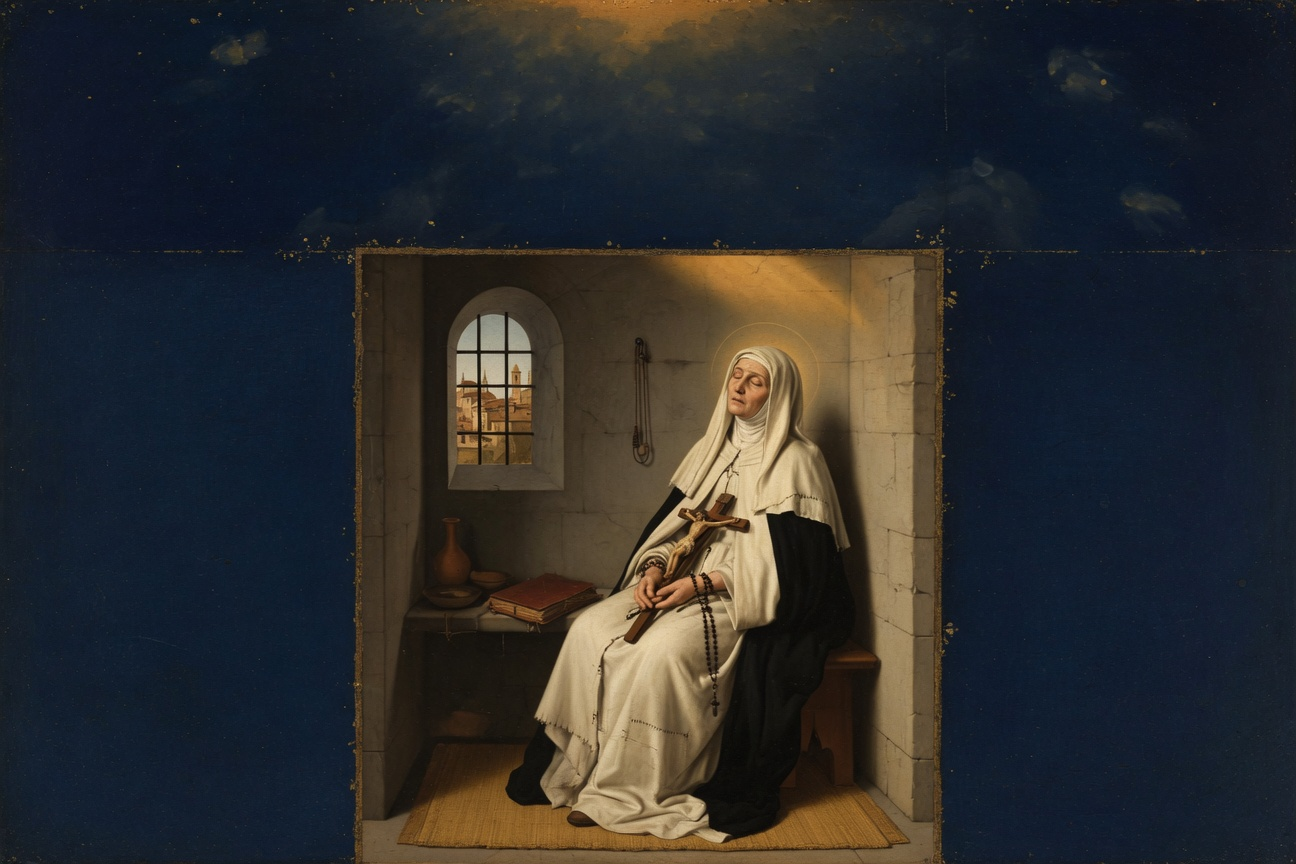
Blessed Sybillina of Pavia
AND BLESSED MARGARET OF METOLA, — TWO POOR BLIND WOMEN OF THE 14TH CENTURY
Virgin, Blind, and Recluse
Orphaned and blinded at the age of twelve, Sybillina of Pavia joined the Third Order of Saint Dominic. She lived as a recluse for over sixty years in a narrow cell, practicing extreme mortifications and dedicating herself to the meditation of the Passion of Christ. She died an octogenarian in 1367, renowned for her patience and heavenly visions.
Guided reading
7 reading sections
BLESSED SYBILLINA OF PAVIA
AND BLESSED MARGARET OF METOLA, — TWO POOR BLIND WOMEN OF THE 14TH CENTURY
A Parallel Between Two Souls
The text introduces the lives of Sybillina of Pavia and Margaret of Castello, two blind contemporaries of the Third Order of Saint Dominic who shared a mission of suffering and holiness.
Yes, in my flesh I shall see my Savior. This hope is stored up in my heart. Job, xix, 26.
In 1287, and perhaps on the same day and at the same hour, God called to the perfect life of the Third Order of Saint Dominic two souls of admirable beauty, and so similar that it is difficult to distinguish one from the other. Upon both He imposed the same mission, and favored them with the same gifts; only, He assigned to one a more painful and shorter trial, while if that of the other was less bitter, it was more lasting. But He marked them both with His cross, and sent them into this world, in order to bear witness before the eyes of men to the pious care that our heavenly Father takes of the unfortunate.
One was born in Upper Italy, on the smiling banks of the Ticino; the other stopped for a moment on the peaks of the Apennines, then descended to the humble hills of the Tiber. Finally, after both had accomplished the mission that had been entrusted to them, they rejoined each other in the eternal splendors, never to be separated again. They are Blessed Margaret of Castello and Blessed Sybillina of Pavia, both blind and both enlightened bienheureuse Sybilline de Pavie Blind religious sister of the Third Order of Saint Dominic in Pavia. by the light of that heavenly science which reveals its wonders to the humble and to those who have a pure heart.
The Abandonment of Margaret of Castello
Born blind and poor in Metola, Margaret is abandoned by her parents at the sepulcher of Father James in Castello before being taken in by a lady named Grigia.
On the highest peak of the Apennines, where they separate Umbria from the Marches and Tuscany, not far from the city that saw the birth of the king of painting, there are still today the ruins of ancient castles destroyed by time and the hand of man. One of them was that of Metola, the home of Margaret. Upon leav Marguerite Blind saint, contemporary of Sybillina, member of the Third Order of Saint Dominic. ing her mother's womb, she only entered a larger prison, and soon experienced the most bitter aspects of life: blindness, poverty, and the barbarity of her parents who, instead of being moved to compassion upon seeing her delivered to so many evils, formed the cruel design of abandoning her if she did not recover her sight. What appeared to be a terrible misfortune, however, happened only through a pious counsel of Providence, to spare her from the cruelty of parents who would have made her endure too long and too constant a torment.
It happened then that in 1292, when Margaret was five years old, Father James, of the Order of Friars Minor, who, according to the custom of the time, expressed great truths through sculpture, rendering his pious contemplations tangible, came to die in Ca stello. Castello City where the Capuchin monastery she lived in is located. Wonderful things were told, and there was talk of healings and other graces obtained through his intercession. Margaret's parents, having learned of this, took their little girl to the blessed one's sepulcher and begged God to be pleased, through the merits of his faithful servant, to open her eyes, just as He had opened those of the man born blind, whose admirable healing is recounted in the Gospel. The prayer of these wicked hearts did not rise to the feet of the Eternal as an incense of pleasant odor, but rather as a nauseating vapor which He repelled; God wished to be glorified by the sufferings of His beloved servant, whom He kept under the wings of His infinite goodness. Disappointed of all hope, instead of humbling themselves by adoring the wise decisions of the Lord, Margaret's parents became even more saddened and left her at the foot of the altars, alone and deprived of all help; they returned to their mountain in great haste, without further concern for their daughter.
Margaret, having remained for some time without hearing the dear voices of her father and mother, began to sob, reaching out her little hands to seek maternal arms, and calling for her cruel parents with heartbreaking cries. The echoes of the temple were struck by these lamentations long before anyone noticed she was there, groping on the floor. Finally, a lady of the city, named Grigia, sensing a terrible misfortune, lifte Grigia Lady of Castello who took in Margaret. d her up, pressed her to her breast, took her home, and with the consent of her husband, proposed to serve as her mother.
Under this hospitable roof, the poor child found affectionate care that she would have sought in vain in her own family; for, although her pious protectress was the mother of several children, her generous heart sufficed for all and embraced them all in equal charity. The development of reason, usually so slow in the blind, was admirable in Margaret, to the point that she seemed to receive life and growth from a celestial breath. It is true that in the unfortunate afflicted with her infirmity, reason is strengthened wonderfully, because, being gathered and concentrated in a small circle of ideas, it engraves them deeply within itself and preserves them so that they can no longer be erased. Imagination, which more often disturbs reason than it serves it, does not populate their mind with vain phantoms that one has so much trouble separating from reality later on. In the last century, we saw a remarkable example of this in Nicholas Sanderson, an Englishman, who lost his sight when barely a year old, so that he had retained no memory of light and colors. Despite this, by the sole force of his genius, he acquired perfect knowledge in mathematics, which he taught publicly at the University of Cambridge, which was astonished to hear a blind man demonstrate the learned theories of Newton on light and colors, and this with such lucidity and such great depth of thought that, on this science, he had no rival to fear.
But let us return to our blind girl of Metola. She soon showed a lively and penetrating mind, a happy and faithful memory; she learned in a short time the one hundred and fifty psalms of David, which later inspired beautiful reflections in her, and which she recited each day to maintain her piety. This early development only made her feel her truly incomparable misfortune more keenly. A poor young girl deprived of sight, miserably abandoned by her family, alone and without resources, what would have become of her if her adoptive mother had suddenly failed her? For our part, we like to think that she often groaned over her fate before God, and addressed to Him, while sighing, these words of Job: "Why, Lord, did you bring me out of the maternal womb? It would have been better for me to die before any man had seen me, and to have passed, as if I had never lived, from my mother's womb to a grave."
She also said: "Lord, I beseech you, let me not sink into the storm that rages around me; let it rather be given to me to cry out in the joy of my heart: My father and my mother have abandoned me, but the Lord, in His mercy, has gathered me and sheltered me."
God wished to test Margaret and purify her through new pains, so that, distrusting herself and others, she would abandon herself entirely into His arms. There are weak and cowardly souls that the slightest trouble disturbs and crushes, so that they fall into the mud like flowers shaken by the storm; there are others of such a vigorous temper that tribulations only serve to increase their strength. The nobility and beauty of these elite souls is never revealed better than when, enclosed in the citadel of religious consolations, they offer a courageous challenge to all that is most bitter in life, to all that is most frightening in death.
There was soon talk in the city of this poor blind girl, of her intelligence, and everyone wanted to see and hear her, esteeming her more an angel of heaven than a mortal creature. This desire came to certain nuns; but piety, which in well-born souls is a celestial fire that inflames them with ardent charity, is for base souls only a cloak with which they cover desires of avarice and ambition, or, at the very least, the distraction of a guilty idleness that excites envious and malicious reports. These nuns therefore came to find Grigia and begged her to be willing to entrust to them the blind girl of Metola, whom they would consider as their daughter, and to whom they would teach religion and all things. This pious lady, deceived by the lying faces and honeyed words of these hypocrites, abandoned Margaret to them, who, fearing to be too heavy a burden on the large family of her benefactress, and imagining she would find learned and affectionate mistresses, was herself satisfied with this arrangement. But things were quite different from what she had imagined, and little by little, these wicked women detached themselves from her, to the point of coming to hate her. They subjected her to the harshest and most outrageous treatments, until, no longer able to bear the sight of her, they drove her away pitilessly. The unfortunate girl returned to implore the charity of her adoptive mother, who took her in and loved her as in the past and never again consented to be separated from her.
Youth and blindness of Sybilline
Sybilline loses her sight at the age of twelve after the death of her parents in Pavia and joins the Sisters of the Third Order of Saint Dominic.
At that time, when, drenched in tears, she groaned without consolation at the feet of the Savior, a groan arose from the banks of the Ticino so similar that one would have said it was the faithful echo of the voice of Margaret, represented in that place where the same sacrifice was being renewed. This lamentable voice was that of another unfortunate blind orphan, abandoned. Born in Pavia the same year as Margaret, she found in her father, Humbert Biscossi, and her mother, Honorée de Vezzy, attentive and affectionate teachers who, if they were not endowed with the goods of fortune, were at least rich in that sweet kindness of heart which consoles life better than riches, an illustrious birth, and numerous and powerful protections could ever do. When Sybilline entered into life, it Sybilline Blind religious sister of the Third Order of Saint Dominic in Pavia. seemed to her that earth and heaven were smiling upon her, since in the caresses of her parents, she could glimpse at will the serene sky, the fertile fields of Lombardy, the walls and towers, the ancient temples and the sumptuous palaces of her illustrious city, and make for herself a treasure of noble ideas and dear memories capable of fertilizing her reason and bringing joy to her heart. As she advanced in age, her soul opened to hope, and she abandoned herself with confidence to that distant and indefinite future which appears to youth like a spring day. Happy time, in which the imagination goes about weaving golden dreams and ever-new illusions, which then vanish as life advances and one perceives the evening in the distance. But in an instant, this short dawn of Sybilline changed into a dark, threatening, and terrible night, just as an unforeseen storm steals the light of day from the traveler and plunges him unexpectedly into darkness and terror. She first lost her father and mother, and found herself without friends, poor and abandoned; then, a sudden and cruel malady attacked her sight, which she lost completely around the age of twelve. It is impossible to describe the pain and dread of this unfortunate child, feeling herself thus deprived of all help at such a tender age, and disinherited at the same time of the enchanting spectacle of that nature she had so admired in her childhood. But what was most painful to her, and she often complained of it, was not being able to help herself in any way, and seeing herself in the necessity of finding her living piece by piece, when alms were not lacking, which happened sometimes; it was not rare either that she was made to pay for them with reproaches and humiliations. However, God, who never abandons those who trust in Him, inspired the Sisters of the Third Order of Saint Dominic, known in Pavia for their piety, to take charge of this unfortunate girl. They therefore aggregated her to their association, lavished upon her all the care that her condition required, and especially sought to strengthen her in piety, so that she could draw from religion the strength necessary to endure the difficult trial that God had sent her. Then, they instructed her in the nature of the offices and the parts of vocal and mental prayer, and made familiar to her both the pious meditations of Saint Bernard and the soliloquies of Saint Augustine, so sweet, so tender, and which, after the divinely inspired books, have nothing superior to them. The poor child drew new courage from them, and it seemed to her that the weight of her ills had been lightened. But she had not lost the hope of recovering her sight one day, and trusted for its attainment in the intercession of her father Saint Dominic. She fasted and prayed for this intention for several months. Her faith was so lively that she was convinced that her vows would be answere d on the very d saint Dominique Founder of the Order of Preachers and mission companion of Peter. ay of the feast of her holy protector, that is to say, August 4th. The solemn day having arrived, Sybilline rose very early in the morning and began to pray, awaiting the effect so ardently desired. She prayed and wept for a long time, and her eyes did not open; then, thinking that she would obtain this grace around noon, she redoubled her prayers, her tears, and her groans in a way to touch the hardest souls: all was useless. However, she did not become discouraged, and continued thus until evening, seeking in vain, with her extinguished pupils, to discover that long-wished-for light: but her darkness was just as deep. Then, overcome by pain, she began with a childlike naivety to address these reproaches to her blessed intercessor: "Is it thus, Father without bowels, that you can reject the humble and confident prayer, I will no longer say of your daughter, but of your miserable servant! You have no pity for me, poor unfortunate fallen into an abyss of evils, wandering in the shadows of a perpetual night, and for whom life is not a gift, but the cruelest torture. Of whom then will you have compassion, if not of me? Since you do not care otherwise for my life, then, give me back my tears, my sorrows, my vigils, my anxious worry, and my long and useless waiting, so that I may offer them to another protector, either more powerful or more compassionate than you." The pious legend recounts that she continued thus to weep and complain as if the Saint had been present, until, seized by the hand and as if lifted from the earth, she was led in spirit into the presence of places so horrible that her heart was overwhelmed with pain and sadness, to the point that her darkness seemed desirable to her. Having prayed to the Saint to put an end to such a frightful spectacle, he consoled her by making her contemplate places of such new and marvelous beauty that she could not satiate herself with admiring them; it seemed to her she had left the earth for the joys of the heavenly Jerusalem. Then, with affectionate words, Saint Dominic urged her to endure the cruel trial of her blindness, which God sent her in order to hide from her the sight of the coarse and fleeting things of the world, and thus make easier for her the conquest of those ravishing places she had just glimpsed; moreover, the horror of this painful night was not to last long, and soon there would appear to her the sun of a resplendent and happy day which would have no evening, and in which she would enjoy the reward promised to those who suffer with resignation. Then, the vision disappeared. Sybilline thanked God for the salutary reprimands He had given her through the ministry of His faithful servant, and submitted to carrying her cross for as long as it would please God, since that was necessary for her salvation, and she carried it in fact for sixty-eight years with such courage that she seemed a miracle of strength.
The vision of Saint Dominic
After having prayed in vain to recover her sight, Sybilline receives a vision of Saint Dominic who exhorts her to accept her blindness as a path to salvation.
While Sybilline was donning the Dominican habit in Pavia, Margaret, despite the painful experience she had had in Castello with the hypocrisy of those nuns who had so cruelly deceived her, wished to join the Sisters of the Third Order of Saint Dominic, commonly called Sisters of the Mantellates or o f Penance. They l Sœurs en Manteaux Lay branch of the Dominican Order joined by Benvenuta. oved her sincerely and were always devoted sisters to her. Thus the holy Patriarch received at the same time into the number of his daughters these two poor blind and abandoned orphans, who were the most worthy first fruits that the Third Order offered to its Founder. Both of them, by associating themselves with the Dominican Congregation of Penance, were by that title alone instructed in the life to which they were dedicating themselves. Indeed, the holy Founder had organized the Third Order as a spiritual militia, which was to fight the battles of the Lord with the weapons of prayer and mortification, without it being necessary to break or loosen the natural bonds of the family, thus showing the world more closely those sublime perfections which seem to be the exclusive share of those who live retired in cloisters. The life of these two angels was so austere that one can hardly find the example of such a long and voluntary martyrdom among some great converted sinners, who wish to avenge upon themselves a life spent in the mire of vice and the atrocities of crime. They had, however, spent their youth in innocence and the practice of Christian virtues. Strangers to the foolish and tumultuous joys of the world, deprived of all human consolations, isolated in the midst of the crowd, unknown or despised, they suffered a torment that all consider the most frightful that man can endure. Biographers give details about Margaret's mortifications that make one shudder. Following the example of her holy Founder, three times a night she macerated her delicate body with disciplines administered with so little restraint that, after her death, the flesh of her back was found bruised, torn, and ulcerated. She joined to the flagellation almost daily fasts, often even on bread and water, and the fatigue of continuous prayers and groans; which made her life a sort of miracle. But while being harsh and pitiless toward herself, she was gentle and filled with tenderness for others. She took attentive care of all the unfortunate, was moved by their ills, consoled them with kindness, instructed them, and reprimanded them if they were wayward, not disdaining to visit wrongdoers in public prisons to attempt to bring them back to the path of virtue, with that powerful word that comes so naturally from a heart filled with love for God and for men.
Austerities and life as a recluse
Sybilline imposed extreme mortifications upon herself in a narrow cell near the Dominican church, living in rigorous solitude and penance for more than sixty years.
Sybilline far surpassed her companion in the austerities of penance. For three years, she was assiduous with the Sisters of the Third Order in the sermons, prayers, and other pious exercises that were customary at the Dominican church, and her memory eagerly received and faithfully preserved everything she heard taught regarding the evangelical word, to make it the subject of her meditations. She lived with another sister of her Order in a narrow and miserable cell, I would almost say another or a sepulcher, which, being very close to the Fathers' church, allowed her to receive the Eucharistic bread from their hands. An author who knew them both, directed their conscience, and left us a short and faithful history of them, says that all their lives they devoted themselves to mortifications so extraordinary that they are better to be admired than imitated. Each evening, to unite herself with the Passion of Our Lord Jesus Christ, and to drink, so to speak, from the chalice of His sorrows, Sybilline would flagellate her body in such a way as to tear her flesh and shed her blood with such great abundance that, in winter, it sometimes happened that this blood, gathered around her knees pressed against the ground, would freeze in such a way as to keep her stuck to the floor, so much so that she could only rise by pressing her hands firmly upon it. During the winter, which is very harsh in Lombardy, she did not use any fire and barely covered herself; thus her hands would swell and ulcerate to such an extent that, while breaking the hard bread that nourished her, she would soil it with blood and pus. Then, when overwhelmed by fasting, macerations, prayers, and continual weeping, she was forced to take some rest, she would sleep for a moment on a bare board. The companion of her martyrdom, unable to endure such a way of life, died after three years, and Sybilline, by a sort of miracle, lived alone in this kind of prison and even reached an advanced age. When she believed she had conquered the rebellion of the senses and had secured the peaceful empire of reason, she moderated her austerities a little, and enjoyed the fruits of victory in anticipation; and, as she thought she might have exceeded the rigors of penance, she advised the Sisters who came to visit her to be less harsh toward the flesh and more severe toward the spirit, which is an infinitely more beautiful and difficult victory. Consider what the character of this woman must have been, for whom the martyrdom of blindness was not enough, who wished to add to it that of solitude, which is almost as painful, and who, to the darkness and isolation, added the voluntary rigors of a painful penance. And when a single one of these torments endured for some time would have sufficed to test the virtue of a very strong man, she endured them all for more than sixty years.
Mystical Graces and Passing
Favored with visions of the Passion and the Nativity, the two saints passed away at different times, with Sybilline dying as an octogenarian in 1367.
But to suffer this triple martyrdom, a great abundance of heavenly consolations was required; thus, our two poor Dominican blind women asked for them constantly through prayers and tears (see the Soliloquies of Saint Augustine). Others refresh themselves with the gay spectacle of creative science; they enjoy the brilliant splendor of the sun, the azure of the firmament, the sweet melancholies of the night, the freshness of the meadows, the murmur of the waters, the current of the rivers, the calm of the lakes, the agitation of the seas; and what is even more desirable, their eyes become intoxicated with the affectionate gaze and the benevolent smile of those who are dear to them, which communicates to the heart that divine ray of love: may all this be taken from us, poor blind women, provided that it be given to us to contemplate you, Lord, you who are the sun of justice.
This light, so long invoked and awaited, shone eternal and splendid, surrounding them on all sides, and introducing them into the secret dwellings of heavenly science. They saw the mysteries of God, new heavens, new earths; the wonders of love, the triumphs of faith, the holy joys of immortal spirits, singing hymns to Jehovah. Their soul, purified by tears and washed in the blood of the spotless Lamb, could read in the book of life mysterious and surprising things that no human language could express. Thus filled and as if intoxicated with love, they were heard developing doctrines and prophesying the future. To Blessed Margaret were unveiled the mysteries of the life of Jesus Christ, and to Blessed Sybilline those of his sorrowful Passion. Scenes of joy or mourning presented themselves incessantly to their minds, and these visions were followed by reflections that it is not possible for us to render. The former meditated day and night on the mysteries of the love of the Word made flesh, and delved into that abyss of charity which caused Him to clothe Himself in our mortal remains, in order to redeem us from a terrible slavery. She could not separate herself from the grotto of Bethlehem; and it seemed to her that she was mingled with the shepherds, and that she was blending her voice with those of these poor people who blessed God for having regenerated fallen humanity. The latter, ascending to Calvary, lovingly embraced the cross, and wept while thinking of the ineffable pains of Jesus who shed all His blood, offering Himself as a holocaust to His Father in order to expiate our sins. One thrilled with joy, the other with bitterness; and loving and weeping, both immolated themselves in a similar sacrifice. Love, that marvelous power, by a divine artifice, engraved, imprinted in the heart of Margaret, the scene of her pious contemplations. Suffering gave Sybilline the crown of thorns and the whips, and so she bore in her virgin limbs the cruel marks of the passion of her divine Spouse. Love, more powerful than pain, consumed in a short time the strength of Margaret, who, barely in her thirtieth year, flew away toward the heavenly homeland, hastening with her desires the arrival of the companion of her martyrdom (1320). Sybilline, groaning and solitary, lived for many more years in her prison; finally, after having been for heaven and earth a sublime spectacle, on March 19, 1367, already an octogenarian, she went to join her companion in misfortune in the bosom of uncreated light and in eternal love.
Posterity and sources
The account is based on the works of Father Marchese and the Bollandists, specifying the iconography of Margaret and the feast dates.
May the example of these two dear blind women bring some courage to the unfortunate ones tried by such bitter tribulation; may this source of heavenly consolations, from which these unfortunate women drank so deeply, be opened for all, and may these waters flow from it abundant and continuous to refresh humble and pure hearts, according to what is written: Beati mundo corde, quoniam ipsi Deum videbunt.
Blessed Margaret is represented with three small stones in her hand, because, after her death, three small sculpted pebbles were found in her heart which bore the image of Our Lord adored, in the manger, by Joseph and Mary.
We have borrowed this account from Father Marchese, transla tion of the D Père Marchèse Author and translator of the Année dominicaine. ominican Year. The Italian author preceded it with a dissertation in which he examines the question of who are the most unfortunate, the congenitally blind or the deaf-mutes: he finds the former more to be pitied than the latter, comparing their soul to southern lands, buried in eternal ice and darkness. If education strives to spread the truth on this sterile and cold soil, the best fertility cannot manage to warm and sustain this seed. "In my opinion," adds Father Marchese, "it is very difficult to conceive how a congenitally blind person can attain the knowledge of the truth." — Cf. Dominican Year, vol. v, p. 263 et seq., 509 et seq. — The Bollandists give the life of Saint Margaret on April 18, and that of Sai nt Sybilline Bellandistes A society of Jesuit scholars who publish the Acta Sanctorum. on March 19.
Annexes & related entities
Structured data for exploration: events, miracles, quotes, places, attributes, patronages, and important entities cited in the text.