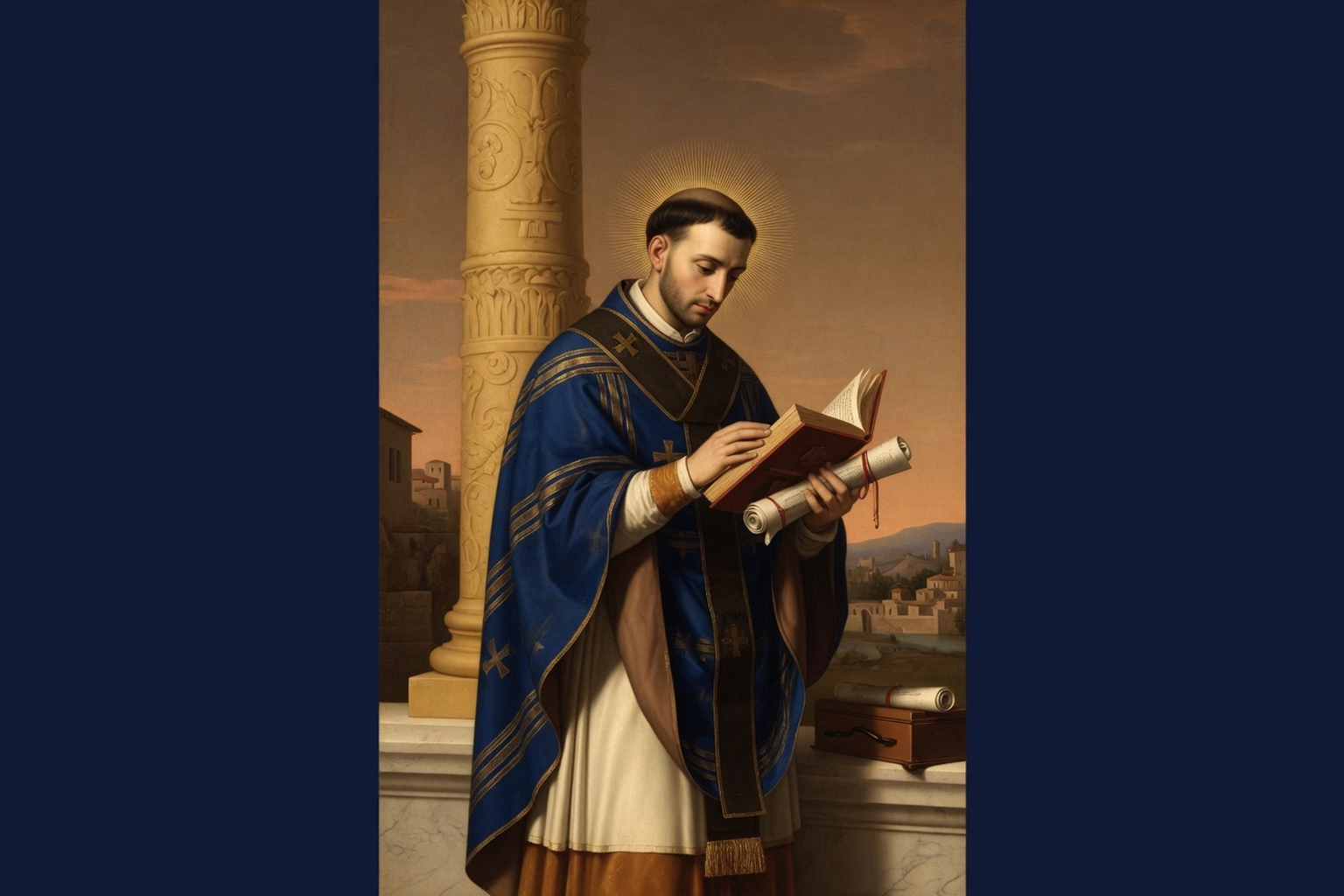
Saint Lucian of Antioch
Priest and Martyr
A 4th-century priest and martyr, Lucian the Syrian is famous for his scholarly revision of the Greek Bible, known as the Lucianic recension. Although his disciples fell into Arianism, his orthodoxy was confirmed at a synod in Antioch. He died a martyr under the persecution of Maximin after writing a famous apology of the faith.
Guided reading
5 reading sections
WRITINGS OF SAINT LUCIAN, THE SYRIAN.
Literary Heritage and Apology
Saint Lucian left behind an important body of work including a version of the Bible and an apology for the Christian faith written during the persecution of Maximin.
Saint Lucian Saint Lucien Priest and martyr, famous for his revision of the Septuagint Bible. left to posterity several excellent works which are as many relics of his spirit; besides his version of the Bible, there is a beautiful apology for the defense of the faith and the Christian religion, which is called the Profession of Faith of Saint Lucian, and which he made at the moment when Ma Maximin Persecuting emperor. ximin was persecuting the Christians with such rigor. (One can read this formula i n Dom Celli Dom Cellier Historian and ecclesiastical author cited as a source. er, p. 75.) Saint Lucian also composed various short works on the faith, and some very short letters of which very little remains to us. Ruin reports a fragment from which Fr. Colonia, a Jesuit, Lardner, and Bullet have made good use. It is as follows: "If you refuse," said Lucian, "to rely on my testimony regarding the divinity of Jesus Christ, you have only to consult your annals, and to delve into your faults and your archives, you will find there that, in the time of Pilate, while Christ was being put to death, the sun disappeared, and the universe was buried in darkness in the middle of the day."
Relations with Arianism
Although his disciples turned toward Arianism, the orthodoxy of Lucian was confirmed during a synod in Antioch and by the praises of great saints.
This holy Martyr was not so fortunate in his disciples, for most of them, abandoning the true faith, attached themselves to t he im Arius Heretic whose doctrine denied the divinity of Christ. pious followers of Arius; and their imprudence went even so far that, to further promote their sect, they called themselves Lucianists, as Arius qualified them when he wrote to them; but later, Marius Victorinus called them Arians. Their imposture was nevertheless discovered some time later, and it was ascertained that Saint Lucian had never been infected with heresy; this was recognized very evidently in a s ynod hel Antioche Ancient city where Saint Publia and her community resided. d in Antioch under the Emperor Constantine, where the profession of faith of the Saint was presented by the Arians themselves, who believed they could use it to authorize their errors. But it was verified, by this same writing, that Saint Lucian believed in the identity of the substance of the Father and the Son, and that he professed everything that Catholics believe regarding it, although he did not expressly use the term Consubstantiality, because it was not in use in the Church before the Council of Nicaea. Saint Athanasius himself, writing to Constans, Augustus, calls Lucian a holy, great, and religious martyr. One will find no lesser pr aises in the excellent saint Jean Chrysostome Patriarch of Constantinople whose support caused the exile of Anatolius. panegyric that Saint John Chrysostom composed in his honor.
The Revision of the Septuagint
An expert in Hebrew, Lucian produced an edition of the Greek Bible that became the reference for the churches of the East, from Constantinople to Antioch.
The work of Saint Lucian on the Old Testament was limited, according to some, to reviewing the text against different copies of the Septuagint, compared together; others say that he corrected it against the Hebrew, of which he had great knowledge.
We learn from Saint Jerom saint Jérôme Father of the Church and biographical source for Amand. e that there were formerly three famous editions of the Greek Bible: that of Saint Lucian, received in the churches of the East, from Constantinople to Antioch; that of Hesychius, adopted by the churches of Alexandria and Egypt; and finally that which Saint Pamphilus and Eusebius had provided based on the Hexapla of Origen, and which was used in Palestine. The same Father adds that the edition of Saint Lucian was the most exact, the best purged of
It is said, writes Dom Cellier, that it is still found today in manuscript form in the Vatican library and in that of Queen Christina.
falsifications attributed to Aquila, etc., and that consequently it was often called, in an absolute sense, the Bible of the Septuagint or the Bible des Septante Greek translation of the Bible corrected by Pamphilus. Common Version. See Saint Jerome, prophét. in Paradip. in explic. Daniel and ep. ad Suniam et Fretelam. Euthymius also says that the edition corrected by Saint Lucian was in conformity with the text of the Septuagint and that no interpolated passage was read in it. Everyone agrees today, as the learned Kennicott observes, when speaking of the edition of Saint Lucian, diss. II, p. 397, that it has more conformity than any other with the true text of the Septuagint, which is the common version; thus, critics measure the esteem in which a manuscript of the Septuagint should be held by the greater or lesser degree of its conformity with the edition of Saint Lucian.
Critical analysis of the manuscripts
The text compares the edition of Lucian with the Vatican and Alexandrian manuscripts, as well as with other famous editions such as the Complutensian.
This is the place to say a word about the two famous Greek Mss. of the Vatican and Alexandria, the latter of which is kept in the British Museum. They are the oldest known, as they are believed to date from the 5th century. The former was printed in 1587, by order of Sixtus V, but with corrections made from other Mss. This edition is known as the Sixtine. When Grabe published the Alexandrian Ms., he also made corrections to it. It is certain that the Vatican and Alexandrian Mss. follow different versions in many places. The second, as noted by Fr. Montfaucon, prolix. diss. in Hexaplo, p. 43, often agrees with the Hexapla, whereas the first rarely follows them. The same remark was made by Grabe, Proleg. 3 vol., and by Blanchini, in his Vinduses vet. cod., p. 256. The latter cited forty-six examples to prove that the Vatican Ms. is the most consistent with the edition of Saint Lucian; thus several scholars have given it preference over the Alexandrian one. See Walton, Proleg. Masius, proph. in Jos. Morin, Simon, l. II, c. 3; Wetstein, Proleg. in Non. Textum. grec.
We have three other famous editions of the Septuagint Bible: one called the English, because it was inserted into Walton's Polyglot, printed in England; the other, called the Complutensian, because it was printed in Alcalá (lat. Complutum) in Cardinal Ximénès' Polyglot (it has since appeared in Le Jay's Polyglot); the third, called the Venetian, because it was printed in the city of that name by the famous Aldus Manutius (it was formerly much followed in Germany). All critics agree that there are many things in the latter two borrowed from the version of Theodotion. The first deserves preference, according to Walton, Masius, Morin, Simon, etc. Vid. loc. cit.
Defense of his memory
Despite accusations of schism linked to Paul of Samosata, historians and Church Fathers confirm that Lucian died in the Catholic faith.
The faith of our Saint was suspected because of the unfavorable testimony given of him by Saint Alexander, Bishop of Alexandria. He says, in effect, that Lucian lived separated from the communion of the Church under three consecutive bishops of Antioch, namely: Domnus, Timaeus, and Cyril. The motive for this separation was the attachment of this Lucian to the party of Paul de Samosate Heresiarch condemned at the Council of Antioch. Paul of Samosata, a heretic condemned in the Council of Antioch (269). But first, Dom Ceillier (vol. III, p. 77, Vivès edition) thinks, along with some other critics, that the Lucian of whom Saint Alexander speaks was different from our Saint, since Saint Alexander gives him neither the title of priest nor of martyr. It must be added to this that Eusebius, Saint Chrysostom, and Saint Jerome do not say at all that he was ever separated from the communion of the Church, nor that he fell into the errors of Paul of Samosata. Furthermore, if one absolutely wishes to see our Saint here, we would say that in following Paul of Samosata he had been deceived by the artifices of that heresiarch. In any case, he died in the bosom of the Catholic Church.
Annexes & related entities
Structured data for exploration: events, miracles, quotes, places, attributes, patronages, and important entities cited in the text.
Key Events
- Revision of the Bible text (Septuagint)
- Drafting of a Profession of Faith during the persecution of Maximin
- Accusation of heresy (Lucianists/Arians) refuted by a synod in Antioch
- Martyrdom for the Christian faith
Quotes
-
If you refuse to accept my testimony regarding the divinity of Jesus Christ, you need only consult your annals... you will find there that, in the time of Pilate... the sun disappeared.
Fragment reported by Ruin