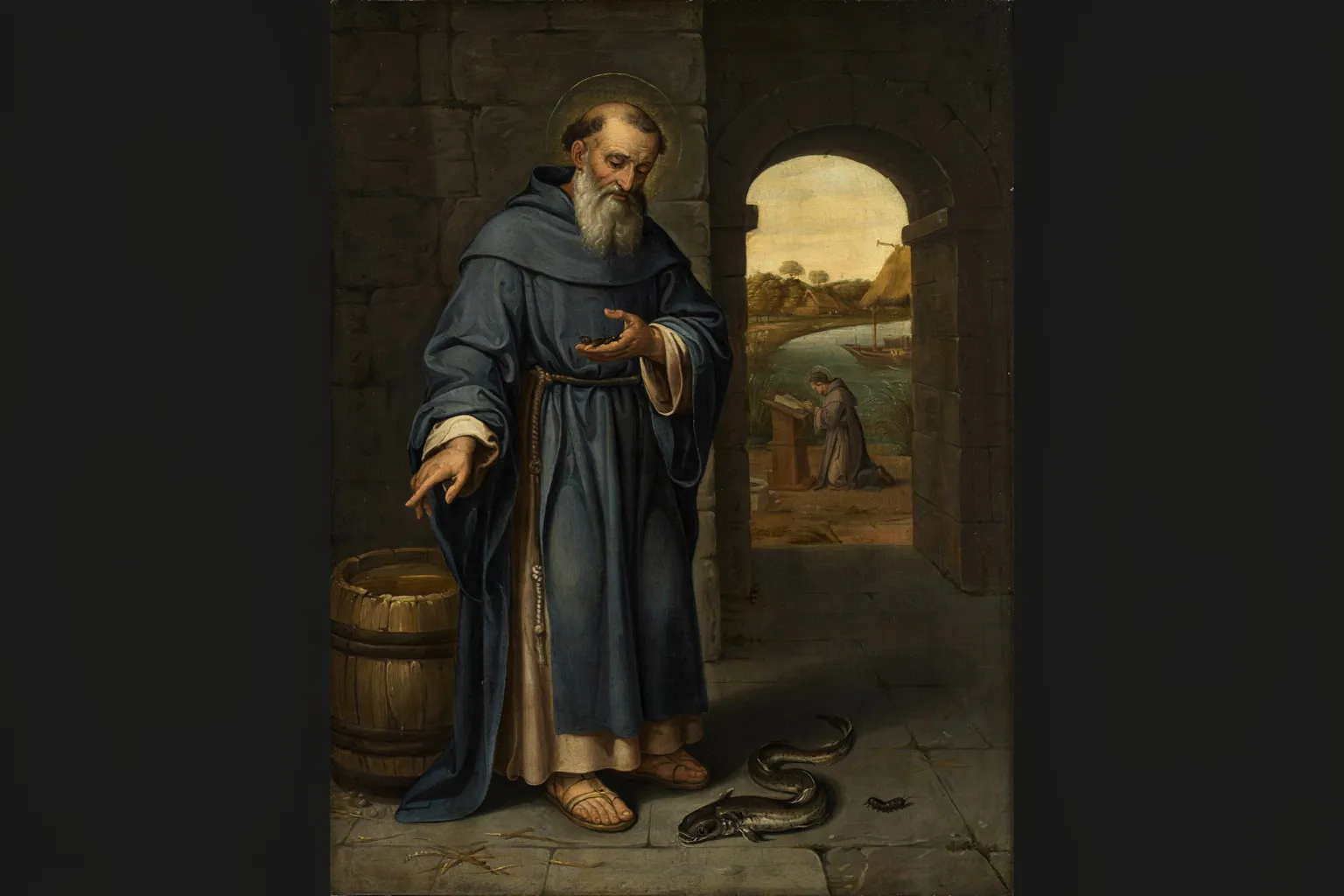
Formerly the grand cupbearer to King Clotaire III, Hermeland left the court to become a monk at Fontenelle. Sent to the diocese of Nantes, he founded the monastery of the island of Indre on the Loire. Known for his miracles of the multiplication of wine and his prophetic visions, he ended his days as a hermit after leading his community with wisdom.
Guided reading
7 reading sections
SAINT HERMELAND OR ERBLAND, ABBOT
Youth and life at court
Born in Noyon, Hermeland distinguished himself by his early piety before being sent to the court of Clotaire III, where he became grand cupbearer.
The holy Abbo Saint Abbé Abbot of Indre in the 7th century (mentioned here as a contemporary). t whose life we are about to recount was from an illustrious family. He was born in the diocese of Noyon. From his childhood, he showed what he would one day become; indeed, overcoming from that time on, through the ardor of his devotion, all the delicacies of the flesh, he made himself so admirable among his schoolmates that everyone looked upon him as a model of virtue and holiness.
The designs of his heart, at this young age, were to follow Jesus Christ in his abjection, in his poverty, and in the contempt of all the vain grandeurs of the earth; but his parents, opposing his pious resolutions and wishing to advance him in the world, sent him to court, where it was not long before he made his fine qualities shine forth; he so well won the good graces of Clotaire III that the king made him his grand cupbearer, in order to have him closer to his person.
Erbland accepted this office against his will, because he feared that it would engage him so deeply in the world that it would not be easy for him to withdraw from it when he wished, as was his intention. Indeed, his parents and friends, seeing him in great favor with the king, persuaded him to accept the hand of the daughter of one of the leading lords of the court, who would consider himself highly honored by his alliance. They pressed him so hard that, overcome by their importunities, he consented to the betrothal; but, while they were waiting with impatience for the day marked for the wedding, he conceived more than ever the resolution to renounce absolutely all the things of the earth, in order to follow, poor and naked, Jesus Christ to Calvary.
Entry into religious life at Fontenelle
After refusing a marriage, he obtained the king's permission to retire to the Abbey of Fontenelle under the direction of Saint Lambert.
He secretly revealed his design to the king, begging him most humbly not to hinder him, and to allow him to withdraw from the embarrassments of the world into some monastery to serve God there, and to pray for the rest of his days for the prosperity of his States. The king, who would have much wished to keep such a faithful servant by his person, at first showed great reluctance to the execution of this design; but seeing his perseverance, and fearing to offend God if he prevented the sacrifice that Erbland wished to make, he permitted him to withdraw.
Seeing then the fulfillment of his desires, he took leave of the king and the court with much more pleasure than he had entered it; and, with the same step, he went to the Abbey of Fontenelle, in Normandy, where the venerable Lamber vénérable Lambert Abbot of Fontenelle who sent Condède to Belcinac. t then held the place of superior. He asked him for the holy habit of religion: he received it, made his novitiate, and, at the end of the year, he pronounced his vows, according to the custom of the Order, to the great contentment of all the religious, but principally of the holy abbot, who rendered infinite thanks to God for having sent him as a disciple a man whom he could already respect as his master. To understand in a few words all his perfections, his history states that his charity was fervent,
his faith and his obedience admirable, his hope firm, his prayer continual, his patience invincible; he was discreet in his abstinences, constant in his vigils, exact in all regular observances: in a word, he was so perfectly adorned with all virtues that he appeared like a star among all his brethren. Abbot Lambert had him ordained priest by Archbishop Saint Ouen. Erbland discharged this holy ministry so worthily that, offering the divine Sacrifice every day at the altar, he made himself a living host through his continual macerations.
Mission to Nantes and foundation of Aindre
At the request of Bishop Pascaire, Hermeland founds a monastery on the island of Aindre, benefiting from episcopal exemption and royal protection.
At that same time, Saint Pascair saint Pascaire Bishop of Nantes who requested the foundation of the monastery of Aindre. e, Bishop of Nantes in Brittany, desiring to populate his diocese with holy religious, in order to confirm by their holiness and the good examples of their lives the truths that he himself preached by word of mouth to the Christians, sent to beg the venerable Lambert to give him twelve of his religious, promising to have a monastery built for them in the place that would be judged the most suitable in all his diocese. The holy Abbot did not consent until he had obtained that this place would be exempt from episcopal jurisdiction, and that letters patent and the privilege of the king would be obtained for this purpose, so that these religious would not receive any trouble once they were established there. This article being settled, Lambert cast his eyes on Saint Erbland to make him the head of this new house; he nevertheless asked for his consent before committing him to it. But the holy religious, well-founded in the virtue of obedience, gave an answer that should be written in letters of gold: "My Father, do not seek here, I beg you, my will, which I have absolutely abandoned to your good pleasure; I will go wherever you send me, as willingly as if God himself commanded me from his own mouth to go there."
Erbland therefore left Fontenelle with the blessing of his abbot, in the company of twelve religious; and, continuing his journey, he arrived in a few days at Nantes, at the cathedral church of the blessed apostles Saint Peter and Saint Paul, where the holy bishop Pascaire received him and his own with the same affection as he would have received angels from paradise, considering himself very happy to possess such holy personages in his diocese. Erbland reiterated to him the same proposal that his abbot had made, concerning the exemption of the monastery from the jurisdiction of the Ordinary. The bishop granted it to him and also gave him the choice of the place that he would judge the most convenient to bui Antrum Location on the Loire where Pasquaire established the monks. ld it. Our Saint chose an island (which he called Antrum, retreat, which was later named the island of Aindre), of a league and a half in extent or thereabouts, which was at the mouth of the Loire, in the Ocean, and inhabited only by shepherds and other people who keep herds: he judged this place all the more suitable for religious life, as seculars could not easily approach it except by the favor of boats, when the sea was high. Near this island he saw another, of the same shape, but smaller, which he called Antricinum, or little other: it is called today Aindrette. There was a very small church there, with an oratory dedicated to Saint Martin.
Erbland therefore had his monastery built on the island of Aindre with two beautiful churches, which the holy bishop Pascaire later consecrated, one under the name of the Prince of the Apostles, and the other under that of Saint Paul, his cooperator in the preaching of the Gospe l. He also kept hi roi Childebert III King of Neustria who visited Évroult and endowed its abbey. s word regarding the exemption; and King Childebert III ratified it, taking the abbey and all its dependencies under his royal protection: he sent letters patent for it to the blessed Erbland. There soon came out of this new house such a good odor of holiness that many people, touched by the desire for a more perfect life, despised the delights and greatness of the century to embrace the lowliness and contempt of the Cross under the monastic habit. Parents offered their children there, in order to learn the elements of virtue, and even belles-lettres: everyone blessed the heavenly Father for having raised up these holy religious to banish from the province the ignorance of the maxims of the Gospel.
Spiritual Life and Wonders
The Abbot performed numerous miracles, including the multiplication of wine and fish, and manifested the gift of prophecy.
It is impossible to express the care and vigilance of the holy Abbot in fulfilling his charge: he conducted himself with such zeal and prudence that he neglected neither the temporal nor the spiritual needs of his brothers, giving them all the time of the day to lead them toward perfection, and reserving for himself only the night, which he spent entirely, after a brief rest, in the praises of God and in the contemplation of heavenly things; and, to free himself from the influx of seculars who, under the pretext of bringing alms to the convent, paid him too frequent visits, he often withdrew, particularly during Lent, to the island of Aindrette with some of his brothers, employing himself there more than usual in the recollection of the spirit and the mortification of the body, by means of abstinence and other austerities; he prepared himself to offer his own self as a living host to the eternal Father on the holy day of Easter.
During these retreats, it happened one day that, as he was walking with his monks along the banks of the Loire, one of them began to speak of a fish called a lamprey, which he had seen at the home of the Bishop of Nantes. The holy man said to him: "Do you think that God cannot give you a similar one here?" While he was saying this, a lamprey leaped from the river and threw itself onto the sand; the man of God had it taken and divided into three, and, reserving one of the pieces for himself, he sent the other two to his monastery; although it was very little, by an admirable multiplication, there was enough for the entire community of brothers, which was very large. This is not the only miraculous action that God performed through him: he once relit, by the sign of the cross, the lamp of one of his monks, which an impetuous wind had extinguished, and, from then on, the wind no longer had the power to blow it out until the monk had arrived at the place where it was to lead him. Another time, the Count of Nantes and Rennes, named Ag athée, who doubted his holiness and wished comte de Nantes et de Rennes, nommé Agathée Count of Nantes and Rennes, witness to a miracle of the multiplication of wine. to test him, having come to see him, the Saint multiplied, by his blessing, a little wine that he had had presented to him in a glass, and compelled him, by this miracle, to throw himself at his feet, to ask his pardon for his suspicion, and to become docile to the very salutary instructions he gave him for his salvation. In a journey he made to Coutances, in Normandy, a rich inhabitant of that city, named Launé, who had received him into his house, although he had only about a pint of wine, did not fail to serve it to a large number of people who had rushed to see him, and even to many poor people and passersby who surrounded his dwelling for the same reason: however, the wine did not run out, and, after the meal, there was more in the vessel than there had been before: which made people in the region say that one could give nothing to this great servant of God without receiving, in this life, a very ample reward.
And if one lost nothing by giving to him, one also gained nothing by taking what belonged to his monastery: witness that villager who, having stolen eggs from him, was forced to return them when, after having walked all night, he found himself in the morning, with his animals, at the gate of the abbey. Witness also that other man who, having cut a part of the saddlecloth of Erbland's horse, was seized by such a great fire throughout his body that, feeling himself burning alive, he was obliged to implore his help with cries that sufficiently showed the excess of his pain.
God also gave him the spirit of prophecy to know absent things and the most secret thoughts. As he was one day saying his prayers in the church of Saint-Pierre, he saw the soul of Saint Mauronce, the first abbot of Saint-Florent-le-Vieux, ten lea gues away: it saint Mauronce Abbot of Saint-Florent-le-Vieux whose soul Hermeland saw ascending to heaven. was being led to heaven by the angels; he gave notice of it to his monks, who later recognized the truth of the revelation by the report of its date coinciding with the death of that holy personage. He also saw the soul of one of his disciples, whom he had sent to Aquitaine to govern another monastery, which he likewise directed and which was at least forty leagues away from his own, take the same path; and as some young brothers thought within themselves that their Abbot, already old, could well be mistaken in this, he, by the same light that had made him see that soul going to heaven, discovered their secret thoughts and severely rebuked them for their lack of faith.
Final years and succession
Hermeland retires to a hermitage, sees his unworthy successor Adalfrède punished by God, and then dies peacefully after appointing Donat.
All these favors from heaven were so many powerful motives for the holy Abbot to redouble his fervor and to walk with greater strides on the path of perfection. As he worked at it with all possible ardor, he had a revelation that his hour was near. To prepare for it, he resigned from the office of superior himself, giving the religious the power to elect another in his place; and, taking four of his children with him, he retired to a small hermitage of Saint Leger, martyr, which he had had built outside the gates of his monastery, on the eastern side, in order to spend the rest of his days there in a more perfect union with God.
The religious, seeing themselves deprived of their Father, elected Adalfrède to succeed him; but the latter, prideful of this new honor, began to appropriate the goods of the monastery and to mistreat his brothers. Saint Erbland, being warned of this, sent word to him to correct himself, if he did not want to soon experience the effects of the wrath of a vengeful God; but Adalfrède, making little of these warnings, the Saint said to his desolate religious, who were complaining to him about it: "My brothers, say nothing; a little patience, and you will soon see him punished for his crimes." Three days later, the unworthy abbot was struck at night as if by a blow from a staff, by the servant of God, and immediately, feeling himself devoured by a cruel fire in his entrails, he lost both his life and the abbey, from the very first year that he possessed it.
After the death of Adalfrède, all the religious begged their holy Father to name for them himself a superior who would be according to the heart of God and his own; he did so by giving them a religious named Donat, whom he had himself raised, from his youth, in virtue and good morals. Shortly after, seeing the hour approach when he was to receive the reward for his labors, he gave notice of it to his brothers, and exhorted them all, with much fervor, to persevere constantly in their vocation, then he gave them his final blessing; and, being provided with the divine sacraments of the Church, he exhaled his blessed soul into the hands of his divine Creator, without any appearance of pain, as if his body, which had always been so free from all movements contrary to chastity, had been exempt from suffering the agony of death.
Representations and local devotions
The saint is depicted with a lamprey or chasing away caterpillars; he is invoked in Brittany for the protection of livestock.
Saint Erbland is depicted extending his hand toward trees to chase away the caterpillars that covered the place of his prayers and fell onto his book. They all disappeared in one night.
He is also painted blessing a barrel, the wine of which he multiplies. The vessel used for the miracle he performed before the Count of Brittany was shown for a long time to pilgrims who traveled out of devotion to the monastery of Aindre.
At his feet, one also places the lamprey that came to be stranded before him at the moment when one of his monks was coveting one of these fish.
He is invoked as a protector of cows in certain parts of Brittany, perhaps because of the word *herbe* (grass), which forms the beginning of his name.
Saint Erbland is honored with a particular cult in Indre, in Indret, and in Saint-Herblain, in the Loire-Inférieure, and in Bagneux, near Paris.
Translations and relics
Fleeing the Normans, his relics traveled from Aindre to Loches and other cities, becoming the subject of divisions between Nantes and Touraine.
## RELICS OF SAINT HERMELAND.
He was buried in the church of Saint-Paul, near the oratory of Saint Vandrille, the first abbot of Fontenelle. God performed several miracles at his tomb, through his merits and intercession. A few years later, he appeared to a good religious man named Sadrevert, commanding him to tell the abbot to have his body transported to the church of Saint-Pierre; this was not done without wonders.
The greater part of his relics were transported in 869, to avoid desecration by the Normans, to the monastery of Beaulieu in Touraine, and subsequently to the castle of Loches. The pari château de Loches Site of the saint's major foundation and burial place. sh church of Saint-Hermeland in Rouen, the collegiate church of Saint-Mainbœuf in Angers, and the parish of Bagneux in the diocese of Paris formerly venerated a portion of the body of this holy Abbot. The church of Nantes celebrates the feast of this Saint on November 26, the day of some translation. In Paris, he is commemorated on October 15. The monastery of Aindre was destroyed by the Normans. There is now a famous cannon foundry on the island of Aindrette.
Here is what I find regarding the relics of Saint Hermeland in a notice written about my church six months ago by a vicar of Loches, Abbé Bardet:
These relics were given around the year 905 by the Count of Anjou, G eoffrey Greymantle, to the church of comte d'Anjou, Geoffroy Griseganelle Count of Anjou who donated relics to the church of Loches. Notre-Dame de Loches, which he had just had built at his own expense. They remained the object of public veneration there, and despite the revolutions, they were still there in 1548, at which time M. Nogret, pastor of Saint-Ours and today Bishop of Saint-Claude, ceded the greater part of them to the city of Nantes with the authorization of the Archbishop of Tours. We have only a *fiefin* left in the parish.
The church of Loches also possesses a belt of the Blesse d Virgin. Its authenticity i ceinture de la Sainte Vierge A notable relic preserved in Loches alongside those of Saint Hermeland. s supported by a donation made by Geoffrey Greymantle; he had received it from King Lothair. (*Gesta consulum Andegavorum*, p. 85-87. *Historia comitum Andegavensium*, p. 325.)
Since that time, it has been held in great veneration at Loches. It was exposed for the veneration of the people twice each year, on May 3 and August 15. The King, the Queen, the princes and princesses of the blood, as well as the Baron of Renilly, alone had the right to have it brought out under other circumstances. The old *Chronicles* of the former chapter of Notre-Dame de Loches make known the names of a great number of kings and princes of the blood who, coming to their castle, exercised this privilege.
The *Bollandists*, to this day; Mabillon, vol. 1; Balteau, book 1, ch. 37; Albert the Great; Dom Lubineau; Godescard; Baillet; — Extract from a letter from the pastor of Loches, dated December 7, 1532.
Annexes & related entities
Structured data for exploration: events, miracles, quotes, places, attributes, patronages, and important entities cited in the text.
Key Events
- Grand cupbearer to King Clotaire III
- Entered the Abbey of Fontenelle under Saint Lambert
- Priestly ordination by Saint Ouen
- Foundation of the monastery of Aindre at the request of Bishop Pascaire
- Final retreat in the hermitage of Saint Leger
Miracles
- Miraculous leap of a lamprey out of the Loire
- Multiplication of a lamprey for the entire community
- Relighting a lamp extinguished by the wind via a sign of the cross
- Multiplication of wine before Count Agathée and in Coutances
- Nocturnal disappearance of caterpillars from his books and trees
- Divine punishment of Abbot Adalfrède after a vision
Quotes
-
My Father, do not seek here, I beg you, my own will, which I have completely abandoned to your good pleasure; I will go wherever you send me, as willingly as if God Himself commanded me to go there with His own mouth.
Reply to Abbot Lambert