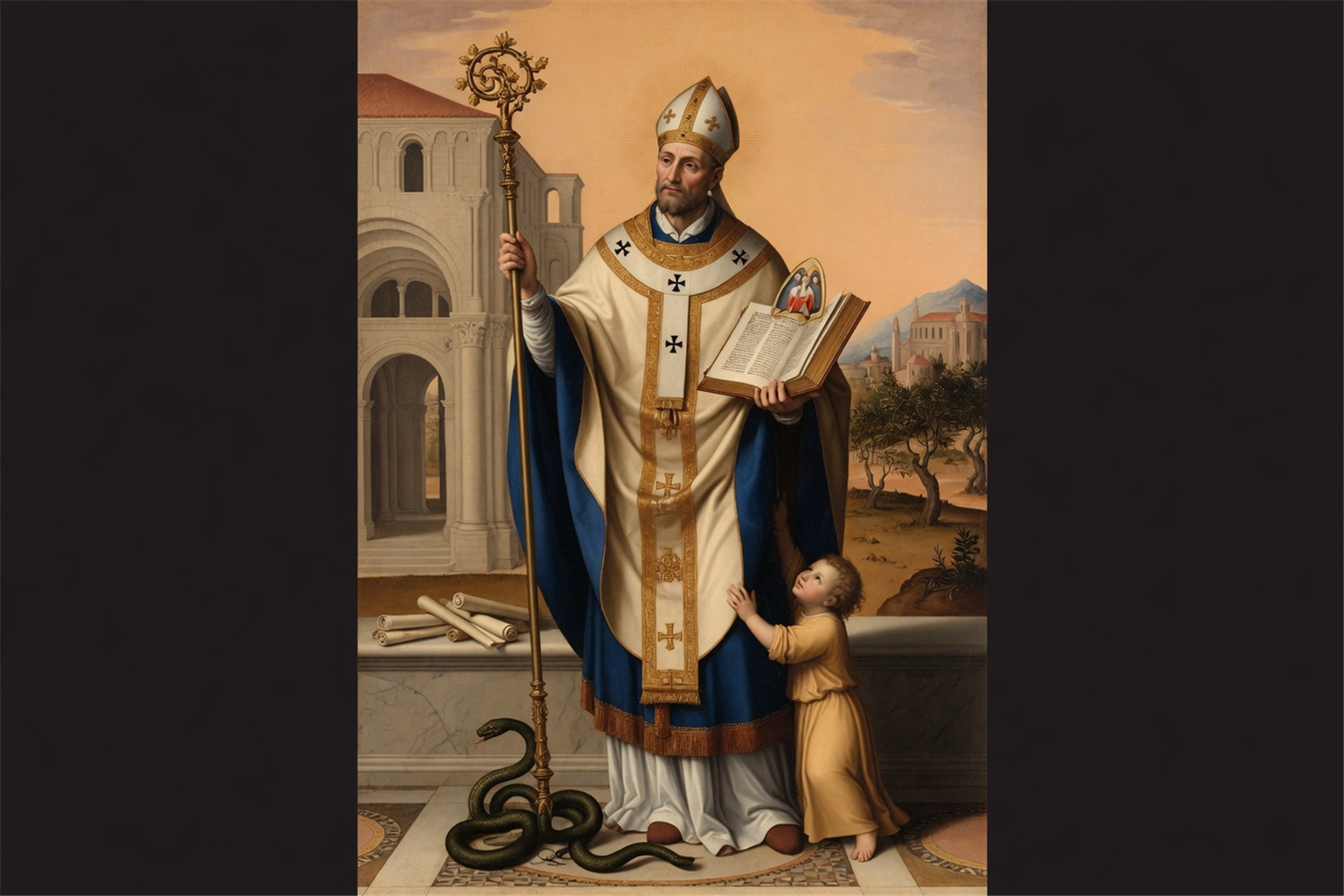
Saint Hilary of Poitiers
DOCTOR OF THE CHURCH AND PATRON OF THE ENTIRE DIOCESE OF POITIERS
Bishop of Poitiers, Doctor of the Church
Bishop of Poitiers in the 4th century, Hilary was the principal defender of Catholic orthodoxy against Arianism in the West. Exiled to Phrygia by Emperor Constantius, he wrote his major works there before returning triumphantly to his diocese. Nicknamed the 'Rhône of eloquence', he is one of the first non-martyr confessors to have received public veneration.
Guided reading
10 reading sections
SAINT HILARY, BISHOP OF POITIERS,
DOCTOR OF THE CHURCH AND PATRON OF THE ENTIRE DIOCESE OF POITIERS
Origins and philosophical conversion
Born into a noble family of Aquitaine, Hilary converted to Christianity at a mature age after an intellectual quest blending philosophy and the study of the Scriptures.
This brilliant star of the Church was born in the Gauls. It is no less certain that his homeland was the Second Aquitaine, which at that time surpassed all other Gallic provinces in urbanity. According to a manuscript of Cardinal Ottoboni, and an inscription found around the year 1500 in the parish church of Cléré, the father of our Saint was named Francarius. What is beyond doubt is that "Saint Hilary shone wit h all the bri saint Hilaire Bishop and Doctor of the Church, ally of Eusebius against Arianism. lliance of nobility among the Gallic families, and that no blood was more illustrious than his."
It is generally believed that he was first raised in paganism, and that he only became a Christian at a mature age. His honest and pure life, the study of philosophy, and then that of the Holy Scripture were, after the grace of God, the causes of his conversion. Here is how he seems to recount it in his writings: "I considered that the most desirable state, according to the senses, is rest in abundance, but that this happiness is common to beasts. I understood, therefore, that the happiness of man must be more elevated, and I placed it in the practice of virtue and the knowledge of truth. The present life being only a succession of miseries, it seemed to me that we had received it to exercise patience, moderation, and gentleness, and that God, all-good, had not given us life to make us more miserable by taking it away from us. My soul therefore moved with ardor to know this God, author of all good, for I saw clearly the absurdity of all that the pagans taught concerning the divinity, dividing it into several persons of both sexes, attributing it to animals, statues, and other insensible objects. I recognized that there could be only one God, eternal, all-powerful, immutable. Full of these thoughts, I read with admiration these words of Moses: 'I Am Who I Am.' And in Isaiah: 'Heaven is my throne, and the earth my footstool.' And again: 'He holds the heaven in his hand and encloses the earth therein.' The first figure shows that everything is subject to God; the second, that He is above all. I saw that He is the source of all beauty and infinite beauty; in a word, I understood that I must believe Him incomprehensible. I carried my desires further, and I wished that the good sentiments I had of God and good morals would have an eternal reward. This seemed just to me, but the weakness of my body and even of my mind gave me fear; when the writings of the Evangelists and Apostles made me find more than I had dared to hope, particularly the beginning of the Gospel of Saint John, where I learned that God had an eternal Son consubstantial with his Father; that this Son, the Word of God, had become flesh, so that man could become a son of God!"
To these texts from the writings of Saint Hilary, Dom Coustant opposes this passage from Fortunatus: "From the cradle, Hilary's childhood was nursed with such great primitive wisdom that one could have understood from then on that Christ was raising a soldier he needed to obtain victory in his cause." Do these terms not indicate that Hilary sucked in the Christian faith with his mother's milk? The writings of the holy Doctor, according to Dom Coustant, are not contrary to this opinion. Saint Hilary only wants to show how much the lights of revelation outweigh those of philosophy; how a true sage, who would read the Holy Books, would climb by degrees to the most sublime truths, or how he himself learned in these holy books to despise the vanity of human things and was better enlightened on mysteries he already knew. There is still a sentence in the Treatise on the Trinity which, according to the most common opinion, would indicate that our Saint received baptism at an advanced age. But one can see in his words simply the joy he felt in belonging to a religion where the soul was reborn to be eternally happy, where one had the hope that the body itself would resurrect to share this happiness, while philosophy gives us almost no assurance about the future destiny of the soul and body of man.
Some modern authors have believed that the young Saint Hilary had a slow mind, and that his father, to overcome this defect through work and the diversity of countries, sent him to study in Rome and Athens. But the ancients tell us with one voice, and the writings of the great Doctor tell us even more loudly, that he was born with a genius as ample as it was penetrating.
The culture his mind received does not prove that he frequented the schools of Rome and Athens, since those of the Gauls were very flourishing. He acquired such glory in eloquence that Saint Jerome regards him as one of the greatest orators of his time, and paints the vehemence of his style very well by naming him the Rhone of eloquence. He also applied himself to poetry: this art, which so many divert to evil and impure uses, our Saint used to celebrate the praises of God, to sing the conquests of the Apostles, the combats of the martyrs. He did not possess the Greek language thoroughly, if one believes Saint Jerome, whose proofs are quite well refuted by Dom Coustant. What may have given this opinion to Saint Jerome is undoubtedly that, in the treatise on the Synods, when Saint Hilary translates Greek into Latin, his style is embarrassed and obscure. But this can very well be explained by a vice of the time; for it was then believed that one was breaking the laws of translation if one did not put the words of the version in the same order as those of the original. These shackles necessarily had to make the translator heavy and obscure. As for philosophy, everyone admits that he excelled in it. Thus Saint Augustine, speaking of his passage from the world into the Church, compares him to the Israelites who, in leaving for the Promised Land, were laden with all the silver and gold of Egypt. He later adorned his writings with these riches borrowed from profane sciences and letters; but after having purified them so much that you encounter nothing profane, nothing unworthy of a priest. His philosophy did not remain confined to vain speculations; he brought it down to practice to regulate his actions. But what especially made his wisdom bear fruit is that it was fertilized by the faith that baptism abundantly conferred upon him, as his own words, cited above, indicate. It is not known when he received this sacrament: Dom Coustant says that it was shortly before his episcopate, and he bases this on this passage from the book of the Synods: "I did not hear of the faith of Nicaea until the eve of my exile." This does not prove that he was born and remained in paganism for a long time, since it was the custom at that time to receive baptism, often at least, only at a very advanced age. He himself teaches us what sentiments of faith he drew from this august sacrament. "Thus, I believed in you, Lord; thus, I was reborn in you; from then on, I am all yours... I am irremediably imbued with these sacred truths, nothing will ever be able to separate me from them; I will die with them..." And a little before: "I have learned these truths so well, I have believed them with such firm conviction, my mind holds them with such a lively faith, that I could not nor would I want to believe otherwise." And he gives the reason for this impossibility by saying that his faith is in accordance with the evangelical doctrine and the Symbol of his baptism. Letting himself thus be led by the light of the faith received in baptism, he could never be drawn into error by a fallacious philosophy. He constantly followed the precept of the Apostle: "Beware that no one despoils you through philosophy."
Against the darts of human reason, he armed himself with this maxim as with a shield: "A constant faith repels the captious and useless questions of philosophy; it does not succumb to the fallacious nature of human ineptitudes; it does not let truth become the spoil of error." For he saw, this true philosopher, "that what God does outside of human intelligence cannot fall under the natural senses of our mind: to measure an action of a boundless eternity, one needs a boundless mind. Now, the human mind has bounds. Moreover, by the very fact that human reason is created, it is necessarily imperfect: how could it understand the Creator? The imperfect cannot understand the perfect." He grants to faith alone this glory that, by its celestial virtue, it makes man arrive where he could never reach by his own forces. This is why he demonstrates that Christians, who have learned to submit their minds to faith, are wiser than the sages of the world who treat them as fools, since, besides natural knowledge, they also penetrate very far into secrets inaccessible to philosophers. Saint Hilary glories in this folly. An example will better explain how he trampled underfoot the pretensions of human science when it leaves its sphere and meddles in what does not concern it, although he was its disciple, although he esteemed it and used it skillfully for things that are within its province. The Gospel teaches him that Jesus Christ entered a room where his disciples were assembled, the doors being closed; but philosophy addresses a host of questions to him which he examines with ironic pleasure: "How could this have happened? Jesus then no longer had anything corporeal: the walls had therefore lost a property inseparable from bodies, impenetrability?" Then, when human Wisdom has, so to speak, spread out and drawn up its army of objections in battle, the great doctor overturns them with a single blow with the weapons of Christian folly: "I am an ignorant man, I am content to believe things as God said them; all I can state is that He said them, do not ask me for the explanation of the facts. God tells me, for the Gospel is his word, that this same God, having a body, entered a room without opening the doors. I believe it. How did He do it? That is his business and not mine: He does so many things that I do not understand. Would you, by any chance, learned as you are, dare to say that God can only do what you can understand? Hey! How many natural things you do not understand! How many supernatural, yet sensible, things also! If our reason cannot grasp the entry of Jesus Christ into a room with the doors closed, how much less will it grasp his eternal generation from the Father!"
Lay life and teaching
Married and father of a daughter named Abra, he taught eloquence in Poitiers and formed a friendship with the priest Heliodorus before his elevation to the episcopate.
Saint Hilary had such a great fear of losing the treasure of the faith that he avoided all commerce with Jews and heretics, such as greeting them or sitting with them at the same table. This, as we have just seen, did not stem from a harsh and intractable character; later he changed his conduct entirely on this subject, when he was a bishop and believed it to be more equitable and more useful to the Church and his neighbor. But as he was not unaware that faith is dead if it does not operate through charity and that men can be cut off from the body of Christ, not only for infidelity but also for sterility, he first applied himself to knowing well the rules of the Church and the maxims of the Gospel: he then submitted, although a simple layman, to a discipline so severe that one could see forming in advance within him an irreproachable priest for the temple of Christ. To see him exercise all the works of piety, one would have called him a holy pontiff. Finally, full of God, he tried to spread Him to others: he made some fear the punishments reserved for their sins; he excited others by the promise of the heavenly kingdom; in a word, exhorting everyone to the holy practice of the Christian religion, he did not cease to sow in the people words of truth that made the faith germinate and bear fruit everywhere.
Hilary had as a teacher Heliodorus, a priest of Poitiers, of Greek origin n o doubt, Poitiers City where the saint settled and lived as a recluse. who, while teaching eloquence and poetry there, was consulted by Saint Hilary on certain passages of Origen. He who was to be one of our most learned bishops was not familiar enough with the language of the famous theologian, and found in Heliodorus an enlightened helper, whose shared tastes soon made him his faithful friend as well as his assiduous guide. Saint Jerome believes he should attribute to them in common some of the literary works of the great prelate. What is certain is that one must attribute only to the professor the treatise *On the Origin of Things*, where he fights for the principle of the unity of God, author of all good and never of any evil, against the opinions of the Manichaeans of that time, and even, by concomitance, those of the Pantheists of our time. But what should be no less interesting in our eyes is that Hilary himself, before giving written proof of this sublime doctrine which was to dictate his books of controversy, had had to struggle publicly, as a teacher, in the school where the doctors of Poitiers practiced. It was not rare, in those times when letters were held in as great honor as fortune, to see the most elevated personages apply themselves to this beautiful work of teaching.
It is a doubtful matter whether he engaged in this teaching before or after his perfect conversion; the fact remains that it was after his marriage, for, this union having made him further "grow in goodness and renown, people came from all lands to Poitiers to hear his wisdom."
But everything leads one to believe that this laborious task must have seemed to him a work of proselytism very much in conformity with the Christian zeal recommended to everyone by the divine Master in whom alone he had found "the way, the truth, and the life." It was an active and fruitful means of guarding against the great heresy of the era an audience attracted by this learned and energetic eloquence whose activity had been formed at the most beautiful sources of his time; for it is certain that his youth, during which his position and his wealth little engaged him to seek positions and honors, was spent in serious studies that protected the gravity of his conduct and the purity of his morals.
Accession to the See of Poitiers
Elected bishop around 353, he defined a high conception of pastoral ministry combining science and holiness, and began his first biblical commentaries.
God had provided this holy man with a wife worthy of him, by whom he had an only daughter named Abr a; w Abra Only daughter of Saint Hilary, consecrated to virginity. hat shows us that this woman, whose name we do not know, was very well-versed in all that concerns piety, is that Saint Hilary, writing to his daughter from the depths of his exile to exhort her to remain a virgin, tells her to ask her mother about the thoughts she might not understand. These two spouses worked in concert to sanctify themselves and to give their daughter a kind of second birth, by inspiring in her pure morals and teaching her obedience to the law of God. Thus lived Saint Hilary, free for the service of God within the bonds of marriage, highly instructed in all kinds of science, of a life that was probity and purity itself, of an upright and constant faith, burning with zeal for souls, adorned with all the other qualities that Saint Paul requires for a bishop, when all the people, by common accord, or rather the spirit of God of which this people was but the organ, demanded him as bishop, in the place of Maxentius, brother of Saint Maximin of Trier.
It was around the year 353, a few years before his exile. His wife was still living, but the Church then often took its ministers from among married persons who otherwise would not have been numerous. They were always obliged to separate from their wives, particularly in Rome, in Egypt, and in the East: by still having relations with them, they became adulterers. What was, as it were, the soul of the illustrious episcopate of Saint Hilary were the noble sentiments he held regarding this dignity. Later, when he wished to remind the emperor that he deserved some consideration in his eyes, he found nothing stronger to say to him than these words: "I am a bishop": *episcopus ego sum*. He considered the bishop as the "perfect prince of the Church, who must possess in their perfection the greatest virtues." In a bishop, the innocence of life is not enough without science, and without holiness the greatest science is not enough either; indeed, as he is instituted for the utility of others, what use is he to them if he does not instruct them, and will his instructions not be sterile if they are not in agreement with his life? Saint Hilary therefore wants probity and science to lend each other mutual aid in the priest: "Let him adorn his life by preaching; let him adorn his preaching by living; for, being innocent, he is useful only to himself if he is not instructed and learned; his science has no authority if he is not innocent." But it is above all from bishops that he demands "a faith that is not naked and deprived of the weapons of reason, but that can fight constantly and surely" against the attacks of heretics who fight armed with all human sciences; a faith that can as much prevail over the wisdom of the century as divine things prevail over human things, "so that, as much distance as there is between divine and human things, so much does the celestial reason (of which the bishop is the defender) surpass all terrestrial sciences; a faith, finally, that knows how to instruct the peoples entrusted to its care in all the duties of the Christian, and to protect them against the mouths that preach evil." Such was the episcopate of Saint Hilary, as we are about to see.
What he believed for himself, when he was charged only with his own salvation, he preached to his people as soon as he was charged with the salvation of others. He began the instruction of his people with the exposition of the Gospel of Saint Matthew. This was not without reason, for the New Testament is hidden in the Old, and the Old is manifested in the New. If one wishes to go from the better known to the less known, it is good to begin with the New Testament, the first book of which is the Gospel according to Saint Matthew. Saint Hilary left us commentaries on the Gospel of Saint Matthew, which he first gave to his people of Poitiers from the pulpit before publishing them: for he follows there more the path of the orator than that of the interpreter; he does not explain every word, but he omits certain passages, passes rapidly over some to extend himself at length on others, he attaches himself less to explaining the meaning of the letter than to developing our mysteries, which he judged more useful and more agreeable to his people. There are several reasons, too long to report here, to believe that Saint Hilary composed this work in the first years of his episcopate and before the year 356. Saint Jerome esteemed this work highly; he sent it to some people who had asked him for commentaries on the Holy Scripture; he had apparently copied it with his own hand, while in Trier, along with the commentaries on the psalms by the same doctor. From Saint Matthew, Saint Hilary passed to Saint John, who wrote especially to affirm the divinity of Jesus Christ.
The struggle against the Arian heresy
Nicknamed the Athanasius of the West, he stood in direct opposition to Emperor Constantius and the Arian leaders during the councils of Arles, Milan, and Béziers.
But it is time to look at his greatest title to glory, the heroic manner in which he fought one of the greatest scourges to have afflicted the world, Arianism, the history of which we shall recount later from its origin to the time when Saint Hilary entered the lists. I must only say here that this heresy, after having cast discord in the East, after having several times caused the deposition and exile of Saint Athanasius, the bishop of Alexandria, that invincible champion of the Catholic faith, was then spreading in the West under the prot ection of Emperor Co l’empereur Constance Roman emperor who exiled Eusebius for his opposition to Arianism. nstantius. Almost all the bishops of the West showed much more courage than the Orientals: they proclaimed the innocence of Athanasius and excommunicated the leaders of Arianism, among others, Ursacius of Singidunum and Valens of Mursa; then they sent a deputation to Emperor Constantius to request that the bishops exiled for the faith be recalled, and that henceforth secular authority should no longer interfere in religious affairs. Emperor Constantius, ashamed of the role that the Arians and Semi-Arians (or Eusebians) were making him play, became more just and recalled Athanasius to his see (349). But as he was as weak as he was tyrannical, he allowed himself to be persuaded again by the Arians, who flattered him and told him incessantly that Athanasius, in defending the Church, was attacking the Empire. It was around this time that Hilary began to show himself as the Athanasius of the West. Constantius, finding himself at Arles (353), held a council there, in which he ordered subscription to the Arian heresy and the condemnation of Saint Athanasius.
Paulinus, bishop of Trier, having resisted these orders, was condemned by the Arians and exiled by Constantius. The other details of this conventicle are unknown; it was the beginning of the evils brought into the West by the Arian heresy, which had for its protector a despot, and f or its agents an Ursaciu Saturnin, évêque d'Arles Arian Archbishop of Arles who had Ursicinus condemned. s, a Valens, and a Saturninus, bishop of Arles; the latter, corrupt in mind and morals, impetuous and factional, tyrannized the Gauls with all the means of terror that Constantius left at his disposal.
In another council, at Milan (355), the emperor did everything in his power to destroy the faith of Nicaea and extort from the bishops the condemnation of Athanasius. The legates of the Holy See dared to represent to him that it was contrary to the "laws" of the Church to condemn an absent person without hearing him. — "The laws," replied Constantius, "are my 'wills'." But the legates, having more horror of this maxim than of all the tortures, allowed themselves to be condemned to exile rather than betray the cause of justice and innocence. Other bishops asked to be included in the same sentence. It is difficult to know if Saint Hilary attended this council: but nothing is more known and more striking than his opposition to violence, injustice, and error. He could have lived in peace in his church of Poitiers, amidst all the advantages of imperial favor; Constantius would even have honored such an eminent prelate with his friendship, he would have surrounded him with consideration and made him all-powerful; the holy doctor only had to submit to the imperial will and leave to others the care of defending the evangelical truth; perhaps it would even have sufficed for him to remain silent, and more than one pretext would have offered itself to him to color his conduct before his people. But all his hopes were in heaven, and charity uniting him to God by indissoluble bonds, there was nothing on earth whose desire or fear could separate him from it; he never hesitated on the path he had to take, he always said intrepidly: "I adhere to the name of God and of my Lord Jesus Christ, even if such a confession should bring upon me all evils; I reject the society of the wicked and the party of the infidels, even if they were to offer me all goods." Having taken this unshakable resolution, he undertook to stop the West on the brink of error: for many, frightened by threats, deceived by intrigues and ruses, had entered into communion with the Arians at the Council of Milan. The heresy was spreading like a contagion.
Our Saint addressed himself first to the emperor; this is at least the most common opinion, that his first book to Constantius must be attributed to this period.
It is an apologetic petition tending toward this prince granting Catholics the freedom to practice their religion with their bishops. He protests that the emperor has nothing to fear from the Catholics in the way of sedition, or even any dangerous murmuring; that only the Arians disturb the public peace by the violence they use to impose their errors. The Catholics ask only for common freedom; that their exiled bishops be returned to them, and that it be permitted for everyone to hear the word of God from the mouth of whomever they wish. If the emperor wished to use constraint to establish the true religion, as is done for Arianism, the Catholic bishops would dissuade him from it; they would tell him that God is the master of the universe, that He has no need of forced submission, and that He does not demand a confession that has violence as its principle. This petition did not have full success; however, according to Baronius, one of its fruits must be considered to be a law of Constantius, dated, in the Theodosian Code, from the 9th of the Kalends of October, under the consulship of Arbitio and Lollianus, that is to say, September 23 of the year 355: it refers the cognizance of the causes of their brethren to the bishops, and forbids bringing any of them before secular tribunals.
At the same time, Hilary and most of the bishops of the Gauls, of whom he was the leader, separated themselves from the communion of Saturninus, Ursacius, and Valens, and they granted to the others who had entered into the party of these Arians the pardon of their fault, provided that they repented and that the indulgence they granted them was approved by the confessors exiled for the faith.
Exile and the Great Treatises
Relegated to Phrygia, he took advantage of his exile to evangelize the East and write his major works, including the Treatise on the Trinity and the Treatise on the Synods.
Saturninus and those of his faction, unable to bear being tarnished by a decree that the bishops of Gaul had made public, forced them to attend a council they held at Béziers (356), over which it appears Saturninus presided. Saint Hilary went there with his usual intrepidity, and in this assembly of enemies and Arians, offered to refute their error on the spot and by word of mouth. But the heretics, fearing to be publicly confounded, would not allow him to be heard. Saturninus sent to Constantius a false report of what had happened at this council, and although Saint Hilary complained of it and Julian, Caesar of the Gauls, was a witness to the truth, the calumnies of the Arians prevailed. It is not known of what crime they accused him, but Saint Hilary indicates clearly enough in his second book to Constantius that it concerned an action unworthy not only of a bishop but even of a layman of good morals. He was exiled to Phrygia with Saint Rhodanius, bishop of Toulouse, who, naturally less vig orous t Phrygie Region of origin of Saint Florence in Asia Minor. han Hilary, only sustained himself against the enemies of the Church through his union with him. Our Saint, with the joy of the Apostles and martyrs when they had to suffer something for Jesus Christ, went to the place of his exile, where a beautiful mission and great victories awaited him: God was carrying this torch into the East to dispel the darkness of Arianism there. Moreover, he did not cease to be the soul of the churches of Gaul for all that: for the Catholic bishops of those regions did not allow anyone to be put in his place on the see of Poitiers; the great doctor continued to be in contact with them and to govern his church. He was very afflicted by the sad state in which he found the churches of Asia: he assures us, in one of his books, that he found hardly a bishop in the provinces where he had been relegated who knew God and preserved some remnant of the true faith. In these circumstances, he imposed upon himself two duties which indicate the wisest and most reasonable conduct: he applied himself first to remain very firm in the confession of Jesus Christ; then, not to reject any accommodation or any honest and reasonable means of pacifying things. That is why he used much restraint in the writings he produced then, fearing that if he displayed more force, it would be attributed more to resentment than to love of the truth. He even pushed condescension to the point of praying, speaking with the heretics, and offering them greeting and peace. This indulgence cost him little: for his exile, far from irritating him against his enemies, was on the contrary very agreeable to him, since it was the triumph of the truth. He rejoiced to see the prophecy of the Apostle fulfilled in him: "There will come a time when one will not be able to endure the true doctrine." Indeed, iniquity showed, by exiling these courageous bishops, that it could not suffer any contradiction, that it feared the light, that it consulted no other justice than its own desires. "May my exile last forever," he said, "provided that the truth is finally preached. The enemies of the truth may well exile its defenders, but do they believe they are exiling the truth at the same time? By exiling my body, have they also been able to chain and detain the word of God? If I am too far from my flock to speak to it with my mouth, I will be no less the bishop of my church. Distance does not prevent me from being in contact and in communion with the bishops of Gaul, and from the depths of Phrygia I still exercise my ministry in Poitiers; I still distribute communion to my diocesans by the hand of my priests. One is mistaken if one believes I have been silenced: I will speak through books, and the word of God, which no one can defeat, will fly free." The first work he composed thus in his exile, to unmask error and defend the truth, was his *Treatise on the Trinity*.
"It is divided into twelve books. The Saint proves therein in the most solid manner the consubs tantiality of the Fa Traité de la Trinité Major work in twelve books written during exile. ther, the Son, and the Holy Spirit. He teaches that the Church is one, and that all heretics are outside its bosom; that it is distinguished from their different sects in that, always preserving its unity, it fights and confounds them all, although alone against them; that it finds the matter for its most beautiful triumphs in the perpetual divisions that reign among the partisans of error. He then shows that Arianism cannot be the true doctrine, since it was not revealed to Saint Peter, chosen to be the unshakable foundation of the Church until the consummation of the ages; to Saint Peter, whose faith will be unfailing, because Jesus Christ prayed that it might never fail; to Saint Peter, who received the keys of the kingdom of heaven, and whose judgments God ratifies, even though rendered on earth." He presents the same arguments elsewhere as well. It is because they are indeed decisive, and it is difficult for heresy to elude their force. The article of the divinity of Jesus Christ is also treated with a superiority of light that leaves no resource to the Arians. The holy doctor demonstrates it by the miracles performed at the tombs of the Apostles and Martyrs, as well as by the virtue of their relics; he demonstrates it further by striking and miraculous facts that one cannot call into doubt without renouncing the first principles, especially by the frightful roarings uttered by the demons, forced to flee in the presence of the sacred bones of those who had shed their blood for Jesus Christ!"
Saint Hilary had written several times, from various places, to the bishops of Gaul, and he had received no reply. He feared that this silence was affected and that they had fallen into error like so many others; thus, he had resolved to remain silent on his side as well and to have no more communication with them, after having warned them several times, according to the precepts of Our Lord. What was his consolation, then, when he finally received their letters and learned that if they had not written to him sooner, it was because they did not know where he was. He learned with extreme joy that they had preserved the entire purity of the faith, that they had remained united to him in spirit and had rejected the communion of Saturninus, the author of his exile; that recently, as they had been sent the second profession of faith drawn up at Sirmium by the Arians in 357, they had not only rejected it but expressly condemned it. They also begged him to explain clearly to them what the faith of the Orientals was regarding the divinity of the Son of God and what was meant by so many different confessions of faith that they had drawn up since the Council of Nicaea.
The holy exile replied to the bishops of Gaul with his *Treatise on the Synods*, where he reconciles the East and the Catholic West; for the bishops of the West accused the Orientals of Arianism, and the latter accused the former of Sabellianism. Saint Hilary explains the different formulas of faith that the Orientals had made since the Council of Nicaea, in order to show the Westerners that they were good or at least tolerable, and that they should not regard as Arians those who received them. He begs them to judge for themselves these formulas whose explanation they had asked of him and to suspend their judgment until the end of his writing. It is not that he makes himself a guarantor of the orthodoxy of all these formulas: he transmits them while inviting the bishops of Gaul to judge them with moderation and to take into account the circumstances in which they were made; for, in the East, "everything is full of scandal, schism, and infidelity. How happy you are," he says to the bishops of Gaul, "to have preserved the apostolic faith in its purity, to have been ignorant until now of these written professions, and to have been content to profess with your mouth what you believe in your heart!" He then explains the terms whose ambiguity made the faith of the Westerners suspect to the Orientals, to invite both sides not to suspect one another over words, since all seem to agree on the matter.
Saint Hilary had also received a letter from Abra, his daughter, probably by the same route as those of the bishops of Gaul. This letter has not come down to us, and we do not know its content; whether she informed her father that she was being sought in marriage by a man of status, or whether Saint Hilary knew it otherwise, he felt he should urge her to take no other spouse than Jesus Christ. We have the letter where he gives her this advice, and it is without reason that some critics have wanted to pass it off as a supposed piece, little worthy of the gravity of this holy bishop. If the style is not as elevated as in his other writings, it is because the subject did not require it and because he was speaking to a young girl of twelve to thirteen years old, with whom the quality of father allowed him in a way to babble. Saint Hilary had the opportunity to send this letter with the *Book of the Synods*, addressed to the bishops of Gaul. He indicated to this dear child that if she were generous enough not to desire a mortal spouse, magnificent clothes, and everything that flatters the vanity of worldlings, she would receive from Jesus Christ an infinitely precious pearl of which she could not even form an idea. However, he gives her simple advice; he manifests to her only his desires, imposing on her no necessity on this point. But he asks her for a reply and wants her to do it without the help of anyone. He announces to her at the same time that he is sending her two hymns, one for the morning and the other for the evening, and he adds that if she finds something difficult to understand, either in these hymns or in his letter, she should ask her mother for the explanation. Fortunatus informs us that in his time (6th century), the original of this letter was carefully kept in the church of Poitiers. Abra followed her father's advice and died holily, as we shall soon report.
The Triumphant Return and Miracles
After defying the Arians in Constantinople, he returned to Gaul, performed miracles at sea, and resurrected a child in Poitiers.
However, two councils had been convened, with treacherous intentions, by the emperor (359). One was held at Rimini, in Italy, where several prelates, even among the holiest and best, following Saint Hilary, such as Phoebadius of Agen and Servatius of Tongeren, were deceived by the artifices and captious propositions of the Arians; the other, at Seleucia (360), the metropolis of Isauria, composed of a majority of semi-Arians, a certain number of Arians, and about fifteen Catholics. Saint Hilary found himself there by a particular disposition of Providence. Although there was no specific order for him, nevertheless, upon the general order to send all bishops to the council, the vicar of the praetorian prefect and the governor of the province compelled him to be there and provided him with the means to travel to Seleucia. During this journey, he stopped on a Sunday in a small town and entered the Catholic church at the hour when the people were gathered there. Suddenly, from the midst of the crowd, a young girl rushed forward who, enlightened by a supernatural light, recognized the holy Doctor, threw herself at his feet, and asked for his blessing, then for baptism, which she received a few days later. Her father, Florentius, her mother, and her whole family also took advantage of the passage of our Saint, who regenerated them in the water of baptism. Florence followed her spiritual father upon his return to France and became, under his wise guidance, a saint honored in Poitiers on the first of December.
Upon his arrival, he was received very favorably and attracted everyone's attention. He was asked first of all what the belief of the Gauls was, for the Arians had made them suspected of recognizing the Trinity only in name, like Sabellius. He explained his faith in conformity with the Council of Nicaea and bore witness to the Westerners that they held absolutely the same belief. Thus, having dispelled all suspicions, he was admitted to the communion of the bishops and received into the council. He had the pain of hearing horrible blasphemies issue from the mouths of the Arians, spirits without energy or decency, bold against God, slaves before the gaze of the masters of force, giving the emperor the attribute of eternal, which they refused to the Son of God. He shuddered with horror upon hearing one of them, who had come to sound him out, say that Jesus Christ is dissimilar to God because He is neither God nor born of God, and he refused to believe that this was their sentiment until they declared it publicly in the council. The semi-Arians even condemned these impious men and deposed them.
But the latter appealed to Constantius: both sides went to Constantinople, as if Our Lord had said to His Apostles: "When you are embarrassed on any point of the doctrine that I have charged you to teach, go ask for the solution from the Caesars." Saint Hilary accompanied this sad council to the court, not to share in its servitude, but to defend the truth and to know what they intended to do with his person. There he saw the truth oppressed by the Arians of Rimini united with those of Seleucia: these heretics, seeing themselves in numbers in the very capital of an empire that placed its sword and its tortures at their disposal, believed the occasion favorable to hold a council of their own fashion (360). They disputed the faith, that is to say, they shook it to its very foundations. But the great athlete of the faith was there: Saint Hilary addressed a petition to the emperor in which, justifying himself against the charges that Saturninus had formed against him and defending the authority of the Church, he asked for two things: first, to confer with the author of his exile, Saturninus, bishop of Arles, who was then in Constantinople, and he left to the emperor the choice of the place and the manner in which this conference should be held; second, that the emperor grant him an audience in which he would be permitted to treat the matter of faith according to the Scriptures, in his presence, before the entire council that was then disputing it, and in the sight of everyone. "I ask this," he said, "not so much for myself as for you and for the Churches of God. I have the faith in my heart and do not need an external profession; I keep what I have received; but remember that there is no heretic who does not claim that his doctrine is in conformity with the divine Scriptures." Speaking of the continual variations of the Arians, he wittily mocked this multitude of contradictory symbols that they were continually forging. "Last year," he added, "they produced four: the faith is no longer the faith of the Gospels, but the faith of the times, or rather there are as many kinds of faith as there are wills, as much diversity in doctrine as in morals, as many blasphemies as vices. The Arians bring forth every year, and even every month, new symbols to destroy the old ones and anathematize those who adhere to them." He indicated the remedy for this wound: "As during winter storms," he said, "the only way to be saved is to return to the port from which one departed, so also, there is no other way to extricate oneself from the embarrassment and disorder caused by all these different formulas of faith than to return to the port of the faith in which we were baptized." The Arians did not dare to accept the challenge of Saint Hilary: to rid themselves of this terrible adversary, they persuaded the emperor to send him back to the Gauls as a man who sowed discord everywhere and disturbed the peace of the East. Their wishes were granted: the holy bishop was sent back to his homeland in the year 360 of Jesus Christ. However, the sentence that had initially exiled him was not revoked. The emperor did not wish to appear to have recognized his innocence. It must be admitted that such incorruptible defenders of the truth embarrass despots and courtiers singularly; but nothing is more worthy of admiration than this invincible doctor, whom nothing can force to become discouraged or to surrender, and whose courage and enlightenment become more troublesome in exile than at home.
This decree of the emperor was received by the Saint with very mixed feelings; for, on the one hand, the joy of seeing his dear children and his flock once again dilated his heart, and on the other, he was extremely afflicted to see himself frustrated of the opportunity for martyrdom that he promised himself to obtain following his exile. Nevertheless, he had to obey the orders, not so much of the emperor as of divine Providence, which showed well, through miracles, how agreeable this return was to Him. Indeed, when he had landed by sea on the island called Gallinaria, which was then uninhabitable to men because it served as a lair for a multitude of extremely venomous snakes, all these animals retreated in the presence of the Saint as soon as he set foot on land, fleeing before him as if he had come to chase them in the name of Jesus Christ; for, having stuck his staff in a certain place on the island, which he gave them as a boundary, he commanded these snakes not to pass beyond it, which they obeyed. It was from this island of Gallinaria that Saint Mar tin, who was saint Martin Saint whose relics were honored by missionaries in Tours. already his disciple, went to look for him in Rome upon the rumor that he was returning to France; but learning that he was further away, he followed him to Poitiers, where he profited so well, a second time, under the discipline of such a good master, that he has since been seen to appear as a great prodigy of holiness in the Church of God.
It is not easy to describe with what joy the holy prelate was received by all the orders of the clergy of the Church of France: "It was then," says Saint Jerome, "that France embraced her great Hilary, returning victorious from the defeat of the heretics and with the palm in his hand." God Himself honored his return with very remarkable miracles. A child having died without baptism, the Saint, moved by the prayers and tears of his parents, restored the life of the body to him and added that of the soul, a miracle that is recalled by a sculpture monument preserved to this day by the grateful devotion of the city.
Restoration of Orthodoxy in Gaul and Italy
He organizes councils to restore fallen bishops and travels to Italy to combat the influence of Auxentius in Milan.
Scarcely had Hilary been restored to his see, when he set his hand to the work for which Providence had brought him back; the violent measures and traps employed with perseverance by the emperor had torn from the Catholic bishops of the Council of Rimini, even, the adoption of an equivocal symbol, to which Pope Liberius, Vincent of Capua, and Gregory of Elvira offered invincible resistance. Then, cries Saint Jerome, the world groaned and was astonished to find itself Arian. It was a matter of raising up these ruins: Hilary undertook it, not without anxiety as to the means that had to be employed. Most of his brethren absolutely wanted to cut off from their communion all those who had subscribed to the Rimini formula. But he preferred to follow, as Saint Cyprian of Carthage, Saint Cornelius of Rome, and other charitable pastors of the Church had done, the advice given by the Apostle to those who have remained firm, to correct with gentleness those who have fallen. He therefore held out his hand to all those who wished to rise again. He assembled for this subject various councils in the Gauls, where most of the bishops who had been deceived, intimidated, or corrupted, acknowledged their fault with humility. They condemned what had been done at Rimini and restored the faith of the Church in its purity, despite the opposition of Saturninus of Arles, who was deposed by the vote of all the prelates and driven from the Church, after having been convicted of several enormous crimes, besides that of heresy (361). Hilary earned in this circumstance the title of Savior, of Father of the Fatherland; for it is he who delivered the Gauls from the darkness and poison of error, and made our Churches as it were reborn to the true faith, all the more so as he has continued this protection to us after his death. When 146 years later, the first Christian king of the Franks, Clovis, marched to fight the Arian Alaric, king of the Goths, he saw a great light come out of the basilica of Saint-Hilary of Poitiers, advancing toward him; he understood then that the Pontiff, who had crushed heresy during his lifetime, was going to serve as his auxiliary against the heretical battalions; at the same time a voice warned the Catholic warrior to hasten, as soon as he had made his prayer in this venerable place, to engage in battle. Then Clovis advanced to meet Alaric, full of confidence in the heavenly protection that had been promised to him; success so well crowned his efforts that before the third hour of the day, against all human hope, he had won a complete victory. In celebrating this triumph, Fortunatus says that he feels well (and it is Saint Hilary himself who inspires this thought in him) that the holy bishop, in his tomb or rather in heaven, has no less solicitude for the Catholic religion than when he was still living. We must date from this period (361), when Saint Hilary made heroic efforts to banish Arianism from the Gauls, his book against the physician Dioscorus; we cannot speak of it, since there remains to us only the title transmitted by Saint Jerome.
He also published his book against Constantius; he had composed it in 360, when he was refused, as we have seen, at Constantinople, the audience he had requested with much submission and respect from the emperor before whom he offered to convince the Arians of error. He then believed that he had nothing more to spare with Constantius, and that he should even publicly unveil his impiety, so that he might cease to pass himself off as the protector of religion, while he was only the protector of heresy.
The remedy was violent, but necessary, given the misfortune of that time, and the Saint assures us that he employed it, not for his own cause which he had always defended with moderation, but for that of Jesus Christ; his design being less to inveigh against Constantius than to defend the doctrine of the Church. Indeed, solely attentive to the evils that this prince had done to the Church, he passes over in silence all his other disorders. There are those who have censured the harshness of his expressions where it would seem he had almost forgotten his obligations as a subject of the emperor; but it must be considered that his language was less the effect of an extreme and excessive zeal than of his love for the truth and the ardor of his charity for God and his people. Moreover, his words are no stronger than those that Jesus Christ and the martyr Saint Stephen employed against the Jews. One can say of Saint Hilary what Saint Gregory of Nazianzus said of several great personages of that time: «However peaceful and moderate they may be otherwise, there is a case where they can no longer be gentle and easy, it is when rest and silence would betray the cause of God; then, they are completely bellicose, and in the struggle they show themselves bold, intractable; they will rather rush beyond the proprieties, than remain short of their duty».
Death surprised Constantius before our Saint could have addressed his eloquent writing to him, Nov. 3, 361.
After having restored the Catholic faith in the Gauls, Saint Hilary passed into Italy (364) to also deliver this region from the scourge of heresy. He was seconded in this enterprise by Saint Eusebius of Vercelli and Philastrius of Brescia; these great lights managed to illuminate by the splendor of their rays Illyria and Italy, and to banish from the most remote countries and the most secret corners, the darkness of error. But the greatest part of this glory belongs to Saint Hilary, because naturally gentle and peaceful and at the same time very learned, and possessing all that is necessary to persuade, he succeeded faster and better. In the midst of these consolations, our Saint encountered two great subjects of sadness which were at the same time two great obstacles: Lucifer of Cagliari, until then his friend, and like him, an illustrious defender of orthodoxy, was not content to blame the gentleness of Hilary, of Athanasius, of Pope Damasus and of the other bishops who remained faithful to the faith, who pardoned the bishops who had fallen into Arianism, provided they rose again; he claimed that it was betraying the truth and that he could not remain in communion with those who communicated, he said, with heretics: he made a schism where some partisans followed him, and the efforts of Saint Hilary and his colleagues could not bring him back into the fold of the Church.
What did not afflict Saint Hilary less was the sad state of the church of Milan: Auxe ntius, Auxence Bishop of Milan and partisan of Arianism deposed by Damasus. one of the leaders of Arianism, who had usurped its government, held it under oppression. How to deliver it from this serpent, whose poison was all the more dangerous because he hid it? Indeed, when the Emperor Valentinian, who appeared resolved to repress the turbulence of the Arians, came to settle in Milan, around the month of November of the year 364, Auxentius prejudiced him against Saint Hilary and Saint Eusebius, by saying that they were seditious, slanderers who accused him of Arianism, although he taught only the Catholic faith. The emperor, who wanted to establish peace in his residence, let himself be persuaded by Auxentius, and forbade by a pressing edict, any person, to disturb the Church of Milan. Saint Hilary could not suffer that a Catholic emperor, under the pretext of peace and unity, should deliver an illustrious church to a heretic. At the risk of being importunate, he undertook to undeceive this prince by a petition, where he offered to show him that Auxentius was a blasphemer, that he must be held for one of the greatest enemies of Jesus Christ, that his belief was not such as the prince and all the others thought. Valentinian, touched by this remonstrance, ordered that Hilary and Auxentius confer in common with about ten other bishops, in the presence of the quaestor and the grand master of the palace. Auxentius, obliged to enter the lists with his terrible adversary, first had recourse to various expedients to avoid the question. But pressed by Saint Hilary, and seeing the danger there would be in declaring himself against the faith of Nicaea, he took the party of feigning that he recognized the divinity of Jesus Christ, in order to preserve by this means his dignity and the good graces of the emperor. He even gave a profession of his faith written in equivocal terms, with which he prejudiced Valentinian in his favor. Hilary had in vain represented that this deceiver was playing with God and men; the emperor, seeing that the bishop of Poitiers was disturbing the tranquility that he was very glad to enjoy, ordered him to leave Milan. He obeyed, not being able to remain in this city against the orders of the prince; as there remained for him no other means of fighting for the truth, he published a writing, addressed to all the bishops and to all the Catholic peoples, in which he discovers the bad sentiments and the deceits of Auxentius, and conjures the Catholics to separate themselves from his communion.
Final Labors and Passing
He completes his commentaries on the Psalms and dies in 368, surrounded by his disciples, after having seen his wife and daughter precede him to heaven.
It was time that the holy pastor, thus kept far from his people by the interests of the Church, should finally be returned to them, so that his presence might rejoice them, his insights instruct them, and his examples form them in true piety. Moreover, it was only right that he himself should enjoy, in the final years of his life, the peace that his labors and sufferings had so greatly contributed to procuring for the Church. Leaving Italy toward the end of the year 364, he returned to Poitiers and resumed his pastoral ministry. He continued to explain the Holy Scriptures to his people and, on this occasion, composed his Commentaries on the Psalms. The method he follows there is to develop both the letter and the spirit, the historical sense and the allegorical sense. Although, while working on this explanation of the Psalms, he had recourse to prayer to obtain understanding, and God heard him, as he acknowledges with modesty and thanksgiving, this did not prevent him from profiting from earlier works, especially the commentaries of Origen, which he knew how to appropriate.
As for the text of the Psalms, he followed the Latin version, but he often had recourse to the Greek and sometimes even to the Hebrew. This work, which attracted the attention of Saint Jerome and Saint Augustine, and of which the 25th chapter of the book on Predestination by Hincmar of Reims is almost exclusively composed, has not reached us in its entirety. In thus developing the meaning of the Psalms, he wanted their singing to be more useful and more pleasant; for he teaches us himself that it was the custom to sing these sacred odes, so that the faithful might find in these chants and in the holy ceremonies the relaxation and pleasure that others seek in the spectacles and vain rejoicings of the world; and elsewhere, "that the day, for Catholics who recite or sing Matins and Vespers, begins with prayers to God, and ends with hymns to God." He also made, concerning the celebration of the mysteries, a collection of hymns and pious rites that he had brought back from the churches of the East. One can say of him, applying to him the words of Saint Jerome, that "his hand prepared the food of the soul, and his spirit fed upon it through reading." He himself transcribed the sacred books, as we see by the testament of Saint Perpetuus, Bishop of Tours, who left in 474, to Euphronius, Bishop of Autun, a book of the Gospels that Hilary, Bishop of Poitiers, had once written.
All the branches of the Catholic religion were developing in admirable flowers and fruits, cultivated by a man whose life was as holy as his spirit was distinguished. We have already said it, Saint Florence on one side, Saint Martin on the other, were advancing with great strides on the path of perfection under his guidance. Saint Benedict, Bishop of Samaria, with the holy priest Vivencius and forty other disciples, driven from Palestine by a persecution, came to seek a guide and a consoler in Poitiers. Saint Hilary gave them one of his estates, located a league from Poitiers, and named by the most ancient historians Château Gravion. The exiles settled there; their caves and cells were the cradle of the Abbey of Saint-Benoît de Quincey. In order to pray more effectively at the tomb of his wife and daughter, Saint Hilary raised a church there, under the invocation of Saint John and Saint Paul, who had just gathered the palm of martyrdom in the persecution of Julian the Apostate, and of whom he had probably brought back relics from Italy. He often offered in this place, so holy and so dear, the divine sacrifice of the Mass, accompanied by Saint Martin who served him at the altar, first as an acolyte, then as a deacon. Among those present was undoubtedly Saint Triaise, another pious woman, who was preparing for heaven under his guidance, very close by, in a cell.
Saint Hilary thus prayed, meditated, and offered Our Lord upon his own tomb: for he commanded that his remains be deposited beside the cherished remains of his wife and daughter. The time when this wish was to be fulfilled having arrived, a revelation warned Saint Maternus, Bishop of Reims, who had long desired to see our saint: he therefore hastened to Poitiers, and enjoyed the happiness for which he was sighing. As for the final moments of Saint Hilary, here is how M. Auber, historiographer of the diocese of Poitiers, recounts them:
"The traditions of our Church report that the inhabitants of Poitiers, having learned, after much anxiety regarding the state of health of their bishop, that he was finally going to leave them soon, gathered around his house, located then near the cathedral already established on the ground it still occupies. This episcopal house, which the wife and daughter of the holy man had inhabited last, rose itself on the site later given to the small parish building founded under the title of Saint-Hilaire-entre-Église, that is to say between Saint-Pierre and its baptistery dedicated to Saint John. The faithful therefore crowded the adjacent streets, inquiring with anxiety about the slightest details of the illness and lamenting the loss with which they were threatened. Near the bed where the illustrious dying man awaited the renewal of his life, two of his disciples, the priests Saint Just and Saint Lienne, prayed kneeling and hid their tears from the gaze of their father, so justly loved. He, from time to time, inquired of them if the gatherings were still continuing. At midnight, he learned that everyone had retired, and at that instant a dazzling light surrounded his bed; the two disciples were at first as if blinded: but gradually it became more bearable, diminished, and finally disappeared after half an hour, at the very moment when the Saint rendered his soul to God in the peace of his last breath, and before having reached his sixtieth year."
Cult, relics, and doctorate
His relics, saved from invasions, are honored at Le Puy and Poitiers. He was proclaimed a Doctor of the Church by Pius IX in 1851.
It was, as is commonly believed, on January 13 of the year 368. Others place this glorious death in 367, but in that case, it must be said that it occurred at the beginning of November. The miracles he performed then were very numerous: Fortunatus, who wrote a book about them two centuries later, says that many were still occurring in his time, and Saint Nicet, Bishop of Trier, wrote that his miracles were too numerous for him to undertake to enumerate them; Gregory of Tours bears the same testimony.
The body of the holy bishop, whom God honored with so many wonders, was first placed in a marble tomb, between his wife and his daughter, in the basilica of Saint-Jean and Saint-Paul, outside the walls of Poitiers. This church was entirely destroyed in the 5th century by the Vandals and the Goths; and the holy body remained long forgotten under the rubble. But in 507, a globe of fire, rising from the ruins of the church where Saint Hilary rested, advanced toward the tent of Clovis, camped seven leagues away, and the next day the Catholic king put an end, on the plains of Voulon, to the domination of the heretical barbarians who had overthrown the church of Saint-Hilary. Some time later, the same Saint Hilary appeared to a holy abbot named Fridolin, who governed the monastery established in that place. He made known to him where he rested and commanded him to build, with the help of the King of France and the Bishop of Poitiers, Adelphius, a new sepulcher to transport his body; the abbot obeyed, and when the temple was finished, a solemn translation was performed which was, strictly speaking, only an elevation. They only changed the place of this body, without transporting it from one building to another. The new church where they wanted to place it was built on the site of the old one. Thus, when the crypt where the holy body rested was opened, a brilliant light and the most sweet odor came out of it; then it was seen to rise by itself, and, carried no doubt by the invisible hands of angels, it went to rest by itself in the place intended for it. This is how Cardinal Peter Damian expressly reports it in a sermon on Saint Hilary.
A few centuries later, the city of Poitiers, the church that bore the name of Saint-Hilary, and his relics had to suffer greatly from the Normans, who made themselves masters of this region up to three times under the weak successors of Charlemagne. The church was even entirely burned. It was to snatch the holy relics from these profanations that they were transported, around the 10th century, to the city of Le Puy-en-Velay, where they were found in 1655, after having remained forgotten for six or seven hundred years. At the request of the chapter of Saint-Hilary of Poitiers, Henri de Maupas du Tours, Bishop of Le Puy, having recognized the authenticity of these relics, was willing to cede to the famous collegiate church of Saint-Hilary "the largest, whole bone of the left arm of Saint Hilary, Bishop of Poitiers, a bone called the humerus, and which alone, or nearly so, among the other members of the same saint, escaped the damage of the fire, with a part of the saint's skull, blackened by the fire and half-burned." It is this bone of the left arm that the cathedral of Saint-Hilary of Poitiers still possesses. It is whole, except for a small part of an apophysis that was extracted a few years ago to be donated to the Sovereign Pontiff Pius IX, at the time of the declaration of the doctorate of Saint-Hilary. In the same reliquary, one venerates a relic (a radius) of Saint George, the apostle of the Velay, which the canons of Le Puy presented at the same time to the church of Saint-Hilary of Poitiers. As for the part of the skull mentioned in the same report, it was lost during the Revolution; but, in 1823, M. de Bouillé, Bishop of Poitiers, obtained from Mgr de Bonald, then Bishop of Le Puy and later Cardinal Archbishop of Lyon, a new portion of the head of the holy Doctor, which is kept in the cathedral treasury and which remains exposed each year in the sanctuary during the entire Octave of his feast. Other fragments are honored in different churches of the diocese of Poitiers. God used one of these relics, only a few years ago, in the church of Saint-Hilary of Loudun, to suddenly heal a poor woman who was lame.
In Faye-l'Abbesse in the Vendée, they show the marble of Saint Hilary, whose preservation during the Revolution of 1793 is attributed to a miracle: it is the piece of marble containing authentic relics placed in the cavity of the portable altar that Saint Hilary used in his apostolic journeys. The marble of Saint Hilary is still today the object of great veneration: pilgrims flock to Faye-l'Abbesse.
The Bocage is full of the memory of the great bishop: this is how the Roman road between Poitiers and Ajone is still called the path of Saint Hilary.
Saint Hilary was very popular in the Middle Ages and found a place in the Golden Legend.
A large number of churches are dedicated under the name of Saint Hilary and possess his relics in Lorraine, Franche-Comté, the Rhineland Palatinate, Alsace, Swabia, and among the Swiss Catholics. It was Saint Fridolin who spread this devotion during the course of his travels.
It remains for us to say that many Fathers and Councils have proclaimed Saint Hilary one of the greatest doctors of the Church. He was, from time immemorial, honored under this title in several dioceses, notably in that of Poitiers. Finally, in 1850, on the proposal of Mgr Pie, worthy successor of Saint Hilary, the Council of Bordeaux asked the Sovereign Pontiff Pius IX to confirm this title for the universal Church. On a report from the Sacred Congregation of Rites, this wish was granted, and from then on the Ma Pie IX Pope who canonized Josaphat in 1867. ss and the Office of the holy Doctors became mandatory on the day of his feast "which is marked on this day by the martyrology of Saint Jerome and generally by all the Latins. Saint Hilary has this in common with Saint Martin his disciple, that they are the first two known Confessors for whom the Church has performed a public office. We even see from a very ancient missal for the use of France, written after the beginning of the 6th century, but which passed from France into the library of the Queen of Sweden, that mention was made of these two holy Confessors in the canon of the Mass, after Saint Cosmas and Saint Damian."
Theological Heritage and Iconography
Depicted crushing serpents, he remains the defender par excellence of the Trinity and the divinity of Christ.
"Saint Hilary united in his person all the excellent qualities that make great bishops. To a gentle and peaceful nature, to a particular gift for insinuating himself into minds and persuading, he joined a holy vigor that served as a dike against nascent heresies. If he made his prudence admired in the government of the Church, he also displayed, when the occasion demanded it, an apostolic zeal and firmness that nothing could break."
Saint Hilary is ordinarily represented with the attributes of a bishop, crushing serpents.
To render the power of his eloquence in a sensible way, he has sometimes been painted standing on a mound that rises as he speaks: the painter supposed that heaven provided the holy Doctor with the pulpit that the Arians refused him.
The Golden Legend tells, in fact, regarding the mound, that in a Council, since no one wanted to make room for him, he suffered it peacefully and sat on the ground, saying: "The earth belongs to Our Lord." And then the earth upon which he was seated rose to the height of the other bishops.
Undoubtedly, the serpents that are placed under his feet or that move away from his staff also symbolically express the serpent of heresy put to flight by him.
He has also been represented with the child he resurrected; with his daughter Saint Abre, with Saint Florence, and with Saint Triaise.
One could suitably include in the representations of Saint Hilary the attribute of the Trinity, which he defended so valiantly by his word and his writings. — Saint Hilary is invoked against serpents.
## ANALYSIS OF THE SECOND BOOK AGAINST CONSTANTIUS BY DOM CEILLIER.
It begins thus: "It is time to speak, since the time to be silent has passed. Let us await Jesus Christ, since the Antichrist dominates, and let the pastors create, since the mercenaries have taken flight. Let us lose our lives for our sheep, because the thieves have entered and the furious lion prowls around. Let us go to martyrdom with these cries, since the angel of Satan has transformed himself into an angel of light." He then represents the affliction that Arianism causes to the Church as the greatest that has been since the beginning of the world, and he finds in the conduct of Constantius and the other protectors of this heresy the fulfillment of this prophecy of Saint Paul: that a time will come when men will no longer be able to endure sound doctrine; that having an extreme itching to hear what flatters them, they will have recourse to a crowd of doctors suited to satisfy their desires, and that, closing their ears to the truth, they will open them to tales and fables. "But let us await," he adds, "the execution of the promise of him who said to us: 'Blessed will you be when men load you with insults and reproaches, when they persecute you, and when because of me they falsely say all kinds of evil against you.' Comparisons, for the name of Jesus Christ, before judges and magistrates, because he who perseveres to the end will be saved. Let us follow the truth by the help of the Holy Spirit, for fear that the spirit of error may lead us to believe the lie. Let us die with Jesus Christ, to reign with him. To be silent any longer would be distrust and not moderation. It is as dangerous to be silent always as it is never to be silent." He then reports how he separated himself from the communion of Saturninus, Ursacius, and Valens, with several holy prelates of Gaul, while nevertheless granting to those who had entered the party of the Arians the pardon of their faults, if they wished to correct themselves, and provided that this indulgence was authorized by the judgment of the confessors. He says how, being obliged to be present at the Council of Béziers, assembled by the faction of the Arians, he offered to demonstrate clearly that they were in error; but they did not want to listen to him. Since that time, he continues, having always been kept in exile, he had behaved toward his adversaries with much moderation, rejecting no accommodation nor any means of pacifying things that was honest and reasonable, writing nothing very strong against them, nor that was worthy of the impiety of the Arians; even believing that one could without crime pray with them in the churches and give them the greeting, without however uniting with them by the participation of the mysteries, in order to make them return from the Antichrist to Jesus Christ, and make them obtain the pardon of their error through penance.
"To show that he does not write out of passion, but for the interest of religion, he alleges the silence he had kept for so long while he was being persecuted, and testifies to wishing he had had to defend the truth under Nero or Decius, 'because,' he says, 'being persecuted by enemies of the Christian name, the faithful peoples would have had that very thing as a reason to follow his doctrine. But we are fighting against a disguised persecutor, against an enemy who dares only through artifice and flattery, and who, without pretext of honoring Jesus Christ and procuring the union of the Church, destroys peace and renounces Jesus Christ.' He declares that if the facts he advances are false, he is willing to pass for an infamous slanderer; but he advances nothing but the truth, one should not reproach him for exceeding the bounds of apostolic liberty and modesty in the way he reproves disorders about which he has been silent for so long. He treats Constantius as an Antichrist, and maintains that it is neither rashness nor imprudence, but faith and reason that make him speak thus; he alleges, to authorize himself, the way in which Saint John spoke to Herod, and one of the seven Maccabean brothers to Antiochus. He compares him to Nero, Decius, and Maximian for his cruelties against the Church and the persecutions he exercised toward the Saints. Then, coming to the bad qualities he believed were particular to him: 'You pretend,' he says to him, 'to be a Christian, you who are a new Antichrist; you precede the Antichrist, and you perform his mysteries. You meddle in making decisions touching the faith, you whose life is contrary to the faith; and you teach profane things, because you are ignorant of piety. You give bishoprics to those of your party, and you take them away from good bishops to give them to wicked ones. You imprison priests; you put your armies in the field to cast terror into the Church. You convoke councils; you constrain those of the West to leave the faith to embrace impiety. You assemble them in a city to terrify them by your threats, to weaken them by hunger, to make them die by the rigor of winter, to corrupt them by your dissimulation. You foment the divisions of the East by your artifices. You employ in your designs persons who use caresses to win over others. You animate your partisans. You cast trouble into things that have been established for a long time, and you profane those that have been so only for a short time.' He then says that the Church has suffered much less from the part of the pagan persecutions than from the part of Constantius: and the reason he gives for it is that in their time the persecution was open, the miracles that God worked in favor of the martyrs animated to constancy those of the faithful who were witnesses to them; whereas the persecution of Constantius, being done only in a hidden manner, could only be regarded as a temptation. Among the miracles that he says happened during the great persecutions, by the virtue of the relics of the martyrs, he reports that demons were tormented in the bodies they obsessed, the sick were healed, and that one had seen women suspended in the air by their feet, without the help of any machine, without however their clothes falling back over their faces, so that modesty was not wounded.' Continuing his invectives against the emperor, he reproaches him for taking away from those he persecuted the glory of martyrdom; for taking away from the eternal Father the quality of Father, by denying that Jesus Christ was his son; for adorning the sanctuary with public gold, for offering to God the spoils of idol temples, or confiscated from criminals; for greeting the bishops with the kiss by which Jesus Christ was betrayed, for bowing his head to receive their blessing, and for trampling their faith underfoot; for receiving them at table like Judas, who went out from it to betray his master; for having condemned to the mines the ministers of the Lord, for having caused the death of Saint Paulinus, bishop of Trier, by changing him from one place to another and relegating him to countries where the Christian name was not known, so that he could not receive his food from the public stores, but was obliged to beg its price from the Montanists, for having put trouble into the Churches of Alexandria, Milan, Rome, Toulouse, by exiling those who were bishops there; for having had mothers and daughters beaten, and for having laid his hand even upon Jesus Christ, that is to say, as is believed, for having profaned the mystery of his body and his blood.
"Saint Hilary comes after that to what had happened at the Council of Seleucia, where he had been present himself with a great number of bishops. He rises against the formula of faith that had been drawn up there, in which it was said the Son is like the Father, but not God; he shows the falsity of the principle of Constantius, who wanted one to reject absolutely all terms that are not found in Scripture. He adds that it is not for Christian princes to prescribe to bishops what they must believe. Constantius, in arrogating this liberty to himself, overturned the rules established by the Apostles; he who did not want one to use terms that one does not read in Scripture, used those of immutable and like the Father, which are not read there. Moreover, although Saint Hilary reproves in Constantius and in the Arians the terms of like the Father, he recognizes that one can admit them, provided that before all things one also says the Son is like God, and that this resemblance signifies equality between the Father and the Son. He reproaches the emperor for his lightness and his inconstancy in the faith, which had occasioned so many different formulas of faith, since that of Nicaea. He reproaches him again with firmness for the war he waged not only against the living, but even against the dead, that is to say, against the holy bishops of Nicaea whose sentiments he had caused to be condemned, without sparing the great Constantine, who had had the same faith as them."
The life of Saint Hilary is found in Father Giry; but it seemed so short to us that we believed we would please the reader by redoing it according to Dom Constant (*Vita sancti Hilarii Pictaviensis episcopi ex ipsius scriptis ac veterum monumentis nunc primum concinnata*) and Dom Ceillier (*Hiérarchie générale des Ordres sacrés et ecclésiastiques*). We used, for everything that was more particularly local, the *Vies des Saints de l'église de Poitiers*, by the Abbé Auber. For more details on the writings of Saint Hilary, see Dom Rivet, *Hist. littér. de la France*, vol. 267, p. 147.
Annexes & related entities
Structured data for exploration: events, miracles, quotes, places, attributes, patronages, and important entities cited in the text.
Key Events
- Conversion to Christianity in adulthood after studying philosophy
- Election as Bishop of Poitiers around 353
- Opposition to Arianism at the Council of Béziers in 356
- Exile to Phrygia by Emperor Constantius
- Writing of the Treatise on the Trinity during exile
- Participation in the Council of Seleucia in 360
- Triumphant return to Poitiers in 360
- Struggle against the Arian bishop Auxentius in Milan in 364
Miracles
- Expulsion of the snakes from Gallinaria Island
- Resurrection of a child who died without baptism
- Miraculous elevation of the ground during a council
- Globe of fire guiding Clovis to his tomb
Quotes
-
To be silent when one ought to speak is pusillanimity, not modesty.
Book Against Constantius -
Episcopus ego sum (I am a bishop)
Words addressed to the emperor