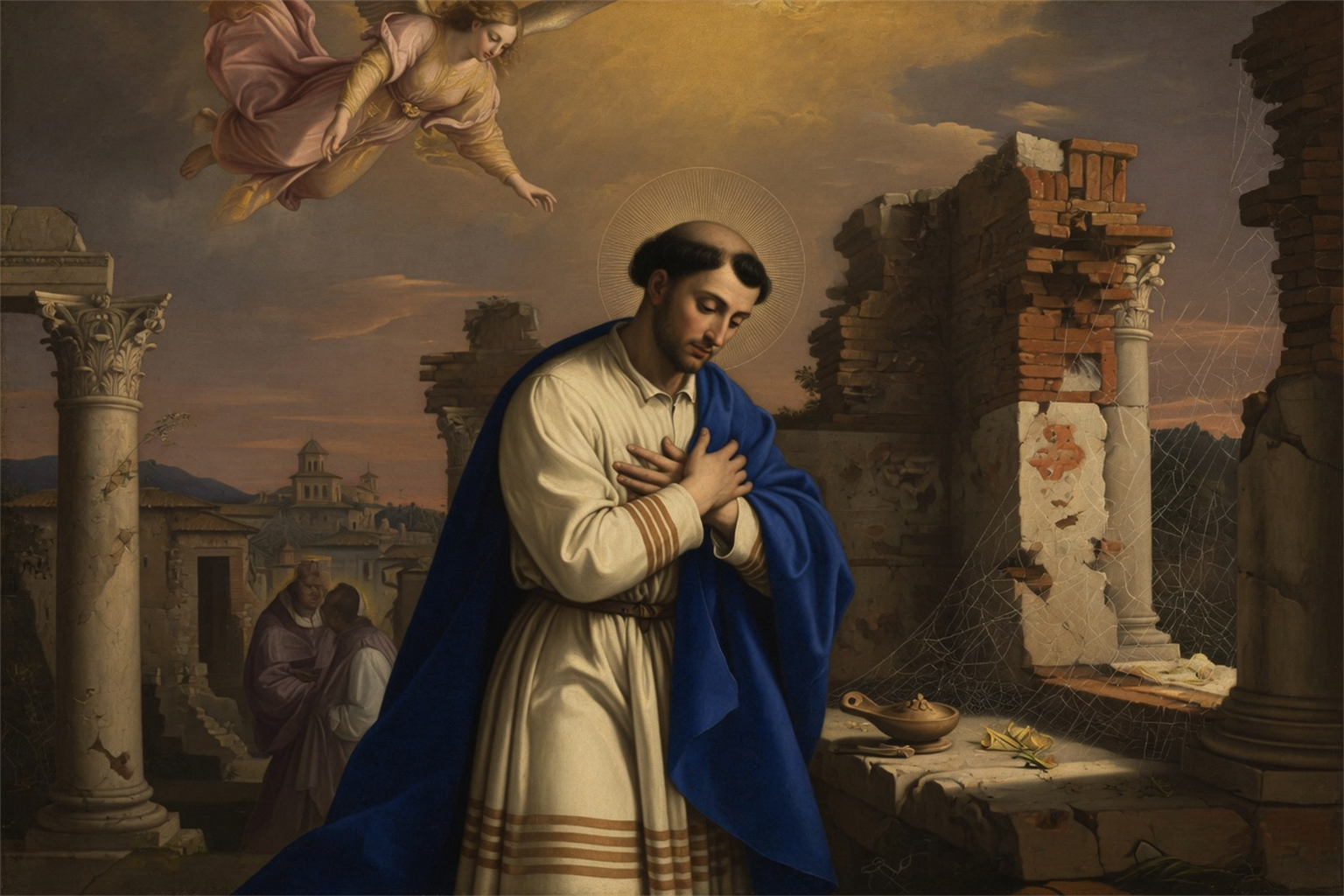
A priest in Nola during the 3rd century, Felix was an exemplary confessor of the faith during the imperial persecutions. Miraculously delivered from prison by an angel, he rescued his bishop Maximus before living in hiding among ruins protected by a providential spider web. Although he did not perish by the sword, the Church grants him the honors of the martyrs for his sufferings and heroic humility.
Guided reading
8 reading sections
SAINT FELIX, PRIEST OF NOLA, MARTYR
Ancient sources and eulogies
Presentation of the ancient authors (Paulinus, Augustine, Gregory) who documented the life and virtues of Saint Felix.
Qui ad te ueniunt, quæcumque petentibus omnia præstas, Noc quemquam pateris tristem repedare uicissim, Tu duce seruatus, mortis quod uincula rupti.
"You who refuse nothing of what they ask of you to those who come to you, who do not suffer that any of them should return, with a sad heart, the way to his country, it is through you that I was saved, you break my chains".
Saint Gregory, Poem on Saint Felix.
The virtue s of Saint saint Félix Priest of Nola, confessor of the faith famous for his miracles. Felix appeared so brilliant that very famous and very holy authors of antiquity took a particular pleasure in praising them; Saint Paulinus, Sain t Damasus, S saint Paulin Friend and spiritual disciple of Amandus, whose writings are a major source. ai nt Augustine saint Damase Pope who ordained the two brothers and sent them on a mission. , Saint Gregory of Tours, the Venerable Bede, and several others have left to posterity what we are now going to relate in substance.
Origins and early ministries
Felix, son of a Syrian settled in Nola, renounces his inheritance to serve the Church under Bishop Maximus.
This illustrious confessor of Jesus Christ was born in Nola, a small town located in the vicinity of Naples; his father was a Syrian by birth, and was named Hermias. He had two sons; our Fe lix w Félix Priest of Nola, confessor of the faith famous for his miracles. as the younger. The father having died, the brothers divided the inheritance and embraced different conditions; the elder took up arms, under the banner of the emperor of the earth; Felix, through a more generous ambition, placed himself in the service of Jesus Christ, the Emperor of heaven and the King of kings, and despising all the goods of this world, he resolved to seek only the true riches which are those of the other life. To arrive more easily at this happiness, he distributed the greater part of his patrimony to the poor and consecrated himself to the service of the Churc h, under the saint Maxime Bishop of Nola during the persecution, mentor of Felix. bishop of Nola, Saint Maximus, who first made him a lector and exorcist. The spirits of darkness, unable to endure the radiance of his holiness, vanished before him and left the bodies of the possessed; so that the bishop, recognizing the holiness of his minister in the exercise of the minor orders, raised him in a short time to the order of the priesthood, where Felix displayed a fidelity worthy of his character, as we are about to see.
Persecution and miraculous deliverance
Arrested during the persecution, Felix is freed from his prison by an angel to rescue his dying bishop.
A bloody persecution then arose against the Church, which the idolatrous tyrants believed they could destroy through the severity of tortures and the novelty of torments.
The emperor's commissioners having come to the city of Nola, they first sought there, according to their custom, the leaders of the Christians, so that the pastors being taken, the flock might be more easily scattered. Maximus, of whom we have already spoken, was governing this Church at that time; he was a person of great doctrine, of a life without reproach and innocent morals, but already old and broken by his labors; that is why, seeing that the storm was about to fall upon his person to then destroy his people, he believed himself obliged to yield for a time to its violence, and to practice to the letter this advice of the Savior: "When they persecute you in one city, flee to another." In this resolution, he entrusted his flock to his priest Felix, and withdrew to a remote mountain, to await there the help of heaven and implore the mercy of God for his sheep.
However, the ministers of the emperors, not finding Bishop Maximus, attacked Felix, who was the second pillar of this Church; they took him and loaded him with irons, and having made all their efforts against him in vain, both by promises and by threats, they threw him into a dungeon whose floor was covered with shards of broken pots, to deprive him, by this means, of all the rest he might have taken after all his labors. But the same night, an angel of light appeared in this prison, as formerly in that of Saint Peter, and, speaking to Felix, commanded him to follow him. The prisoner at first took this for a dream; but he soon saw that it was a reality: for, at the second word of the angel, the chains on his neck and hands broke, the fetter he had on his feet fell off, and the doors of the prison opened to give him passage, while the other captives remained chained. He therefore followed the angel who, going before, like the pillar of fire that preceded the children of Israel in the desert, led him to the mountain where the holy bishop had withdrawn; he found him there lying on the ground, frozen with cold, exhausted by hunger, and in such a state that he seemed more dead than alive. Saint Felix embraced him and warmed him as best he could; but, recognizing that all human efforts were useless, he had recourse to prayer; and then, by an effect of divine Providence, our holy priest, perceiving a bunch of grapes attached to a bush, took it, pressed it, and let the juice flow into the mouth of the holy old man, who little by little recovered his strength, began to speak, and complained lovingly that Felix had delayed so long in coming to relieve him.
After some conversations they had together, they resolved to return both to the city, to rescue and help the faithful there; but because the holy old man was so weak that he could not walk, charity, redoubling the strength of Felix, the latter carried him on his shoulders to the episcopal house where a good widow, who had remained there alone, took care of his person, while our Saint, for his part, hid in his own house, until the storm had subsided; then both, the bishop and the priest, appeared publicly to visit and console the faithful who were in need of their assistance.
The miracle of the spider web
To escape the soldiers, Felix hides in a hovel instantly protected by a providential spider web.
But this calm lasted very little time, because the emperor's officers, returning to the city and learning that Felix had also returned, applied all their efforts to searching for him, and finally encountered him in the square, where they spoke to him without recognizing him, whether because his face seemed changed to them, or because God had blinded them. The Saint, therefore, seeing that he was being sought, withdrew promptly into the corner of an old hovel; there, by an admirable providence of God, spiders spun in a moment a web so thick that the satellites pursuing him did not imagine that a man could be hidden there: to teach us, says Saint Paulinus, that when God is with us, spider webs serve us as strong walls, and that, when He is missing from us, the thickest walls serve no more to defend us than spider webs. Thus the persecutors returned in the evening quite confused, and the Saint remained singing the verse of the Psalmist: "Though I walk through the valley of the shadow of death, I will fear no evil, for you are with me." Then he entered further into the ruins of these old demolished houses, where he remained for six months deprived of the company of men, but consoled by the visit of angels and of the King of angels Himself, who found a way to assist His servant in this solitude. A good woman, a neighbor of those quarters, by a movement of the spirit of God and without knowing what she was doing, carried each day to the same place what was needed for the nourishment of a man. Saint Felix received this provision as coming from the hand of God, and furthermore, found each night the water he needed to quench his thirst. I cannot help but admire the wonders that divine Providence operates in favor of its Saints; for they are no less than those with which He favored the Israelites in the desert, and later still, the prophet Elijah in his flight.
Humility and end of life
After the persecution, Felix refused the episcopate out of humility and lived in evangelical poverty until his death in 256.
Six months passed, as we have said, in this solitude, until the storm having ceased with the death of the persecutor (December 251), Saint Felix appeared in public and came to exhort the people as before. At this same time, Bishop Maximus died of old ag l'évêque Maxime Bishop of Nola during the persecution, mentor of Felix. e, overwhelmed by the weight of the sufferings he had endured for Jesus Christ: in reward for his faithful services, he received from Him the crown of glory, as the Church acknowledges on January 15. Then everyone cast their eyes on Felix to name him bishop in the place of the deceased; but his humility provided him with so many reasons and excuses that he caused the election to fall upon an ecclesiastic of holy life, called Quintus, who ha d been Quintus Priest elected bishop of Nola in place of Felix. made a priest seven days before him.
Besides this example of humility, Saint Felix made himself no less commendable by his contempt for worldly goods and by his love of evangelical poverty; for the little he had left of his patrimony having been confiscated during the persecution, and everyone advising him to reclaim it upon the restoration of peace, as many Christians had done, this lover of the cross gave an answer worthy of who he was: "God forbid that I should ever re-enter into possession of the goods I lost for Jesus Christ, nor that I should desire the riches of the earth, which I have left to better possess the treasures of heaven." Thus he supported himself for the rest of his life by means of a small garden and three measures of land taken on lease, which he cultivated with his own hands, without the help of anyone; he even had some left over to share with the poor. His affection for holy poverty appeared no less in his clothing than in his food; for he never had more than one garment, and when a new one was presented to him, he immediately gave it to someone else who was in need.
Such was the life of this great Saint. It ended with much glory on January 14, around the year 256. We know that some authors, to further particularize the circumstances of his happy passing, have said that on a Sunday, after having celebrated Holy Mass and given the peace, according to custom, to all those present, he prostrated himself on the ground, as if he had wished to say his prayer, and that in this state he rendered his blessed soul; but because this is found more expressly in the life of another Saint Felix, a Roman, we do not believe that one should dwell upon it.
Iconography and Divine Justice
Description of the saint's attributes and the tradition of purgatory oaths at his tomb.
Among an infinity of wonders that it pleased Our Lord to perform to manifest the glory of this great Saint, one of the principal ones is that those who found themselves accused of a crime of which they claimed to be innocent were led to the tomb of Saint Felix, near Nola, where they would purge themselves by oath, because if they swore falsely, they were infallibly punished by some exemplary chastisement.
Saint Felix of Nola is represented in a dungeon, chained and lying on broken shells; an angel delivers him from prison to go and assist his bishop; he provides care to Saint Maximus whom he finds dying, and restores his life by causing the juice of a bunch of grapes, which God has just miraculously made grow on brambles, to penetrate between his teeth; he can also be represented, as on the seal of Mgr Dupanloup, Bishop of Orleans, simply holding this bunch of grapes; or having near him a large spider web, by means of which he was rendered invisible to the persecutors who were searching for him; Saint Felix of Nola being among the number of Saints called by the Greeks Myroblites, that is to say , whose to Myroblites Saints whose tomb produces a miraculous oil or balm. mb exudes a miraculous and beneficent balm, one could represent this particularity by means of a few droplets falling from a mausoleum and collected either by a priest or by the faithful; we do not know if art has ever reproduced the act of admirable charity of the holy priest transporting his bishop; one has undoubtedly feared the lack of nobility; but how beautiful this devotion is and how much, in thinking of it, one would be tempted to see in this scene something other than the heroism of charity.
Expansion of the cult and pilgrimages
Analysis of the popular fervor in Nola, particularly through the total commitment of Saint Paulinus.
## CULT OF SAINT FELIX OF NOLA.
We believed we would be pleasing our readers by concluding this life of Saint Felix with the history of his cult, borrowed from the Jansenist Baillet; for this author is not suspect, and his testimony carries more weight than our own when he recounts miracles as indisputable facts.
It was necessary to leave his body exposed to the veneration of the people for a long time before burying it. There was an extraordinary eagerness to go and kiss it and to seek his intercession with Jesus Christ. After the initial fervor of this devotion, which never wavered thereafter, his body was placed in a wooden tomb from which, as Saint Paulinus assures us, there issued a light and a divine virtue that made itself felt through a great number of striking miracles. These indisputable miracles, which his sacred ashes performed after his death for several centuries, and which are more than sufficient to attest to the truth of those the Saint had performed during his lifetime, made the name of Felix famous throughout the earth! One may see in Saint Paulinus descriptions that are equally edifying and pleasant. They all tend to prove that the faith of a servant of Jesus Christ as favored by God as was Saint Felix, purified by torments and by a long penance, supported by a firm confidence and animated by a great charity, is capable of raising man above nature and exempting him from the laws of death.
The greatness of his miracles, joined to the memory of the labors he had undertaken for the faith, led the Church to bestow upon him the honors of the martyrs, even though he had not lost his life in torments; and, for this reason, his feast was established at a time when simple confessors were not yet celebrated. It was very famous from its institution, preceded by a public fast and a vigil, during which a station was held at his tomb, as was done for the most illustrious martyrs! Saint Paulinus, who depicted for us the devotion with which this fast and vigil were observed, informs us that people flocked from all sides to Nola to celebrate his memory, and he reports more than twenty names, both of cities and of provinces of Italy, whose inhabitants came every year in great numbers with their wives and children on the fourteenth day of January, which was the day of his feast, despite the severity of the season and the difficulties of the roads. Paulinus himself, this man so significant in the empire, already touched by Go d, wished to ma Paulin lui-même Friend and spiritual disciple of Amandus, whose writings are a major source. ke the pilgrimage to satisfy the devotion he had for Saint Felix, because the storm of dividing or transferring the relics of the Saints not yet being well established, one believed oneself obliged to go to honor these Saints at the place where they had died and where their bodies rested. Among the wonders performed by the merits of Saint Felix, one counts the miraculous conversion and the surprising retirement of this great man, who, having renounced the first honors of the century and the greatest riches of the earth to embrace the humiliations and poverty of Jesus Christ, considered himself very happy and very honored to be able to take refuge at the tomb of this illustrious Confessor, and to become his servant and his doorkeeper, to speak as he did! From that time on, the cult he rendered to Saint Felix, in gratitude for the graces he testified to having received through his intercession, was a continual cult. He began it by lowering himself to the lowest ministry of his church, which he took care to sweep every day, providing a spectacle of humility quite astonishing to those who remembered having seen him as a senator, city prefect, and Roman consul. When he became bishop, his devotion toward Saint Felix only increased. He testifies that he paid a tribute to Saint Felix from his body and his spirit every day, but that he paid him another from his tongue every year, on the day of his feast, on which he was accustomed to sing some hymn or read some new poem of his own composition in his honor.
The exterior of this cult did not yet pass the limits of the bishopric of Nola toward the end of the 4th century. His name was nevertheless very well known in Rome since the peace of the Church, and he was very well distinguished there from some martyrs of the same name whose memory was celebrated. The crowd of those whom devotion drew out every year to be in Nola on the day of his feast was so great that it seemed, according to Saint Paulinus, that the whole city of Rome was emptying through the Capena Gate. It was not in Rome, but during a pilgrimage made to the tomb of the Saint, that Pope Damasus, who died forty-six years before Saint Paulinus, receive d through his le pape Damase Pope who ordained the two brothers and sent them on a mission. intercession the miraculous healing of which, in gratitude, he left the memory to posterity in some verses of his that remain to us.
Influence in Africa and Rome
Spread of the cult in North Africa under the influence of Saint Augustine and official recognition by the popes in Rome.
This public cult passed from Italy to Africa, where it was already established by the 5th century, as it appears from an ancient calendar of the Church of Carthage, drawn up during the Vandal persecution. We even see that his reputation there was great, due to the brilliance of his miracles, in th e time of Sain saint Augustin Cited for his definition of fraternal charity. t Augustine. This Father testifies on one occasion that one recognized well enough the holiness of the place where the body of Saint Felix of Nola rested. He says elsewhere that he had learned, not from uncertain rumors, but from the assurance of faithful witnesses, that Saint Felix had not only produced miraculous and tangible effects by an invisible hand, but that he had also appeared to several people during the siege of Nola by the barbarians, whom we believe to be the Goths l ed by Alaric King of the Visigoths who sacked Rome. Alaric. The authority that this Father has always had in the Church should also draw our attention to the surprising conduct he took in the year 404, regarding a priest of Hippo accused of an enormous crime, and which makes us judge how famous Saint Felix of Nola was in Africa, where many other saints from countries bearing the same name were also greatly honored, to whom, however, God, who says: "distributes his gifts to whom he pleases," did not grant the same virtue of miracles. For, as this great prelate could not find evidence to justify or condemn the one who was accused, and as he nevertheless wanted to put an end to this scandal that was troubling his entire Church, he ordered that the accuser (the monk Spes) and the accused (the priest Boniface) should go to Italy, and go to the tomb of Saint Felix at Nola, hoping that, through his merits, it would please God to miraculously make the truth known, and that both being obliged to justify themselves there by oath, the perjury of one of the two would be discovered there and followed by some divine punishment.
The feast of Saint Felix of Nola was celebrated in Rome a s early as the time of saint Grégoire le Grand Pope cited in the introduction. Saint Gregory the Great, and even as early as that of Pope Gelasius I.
Annexes & related entities
Structured data for exploration: events, miracles, quotes, places, attributes, patronages, and important entities cited in the text.