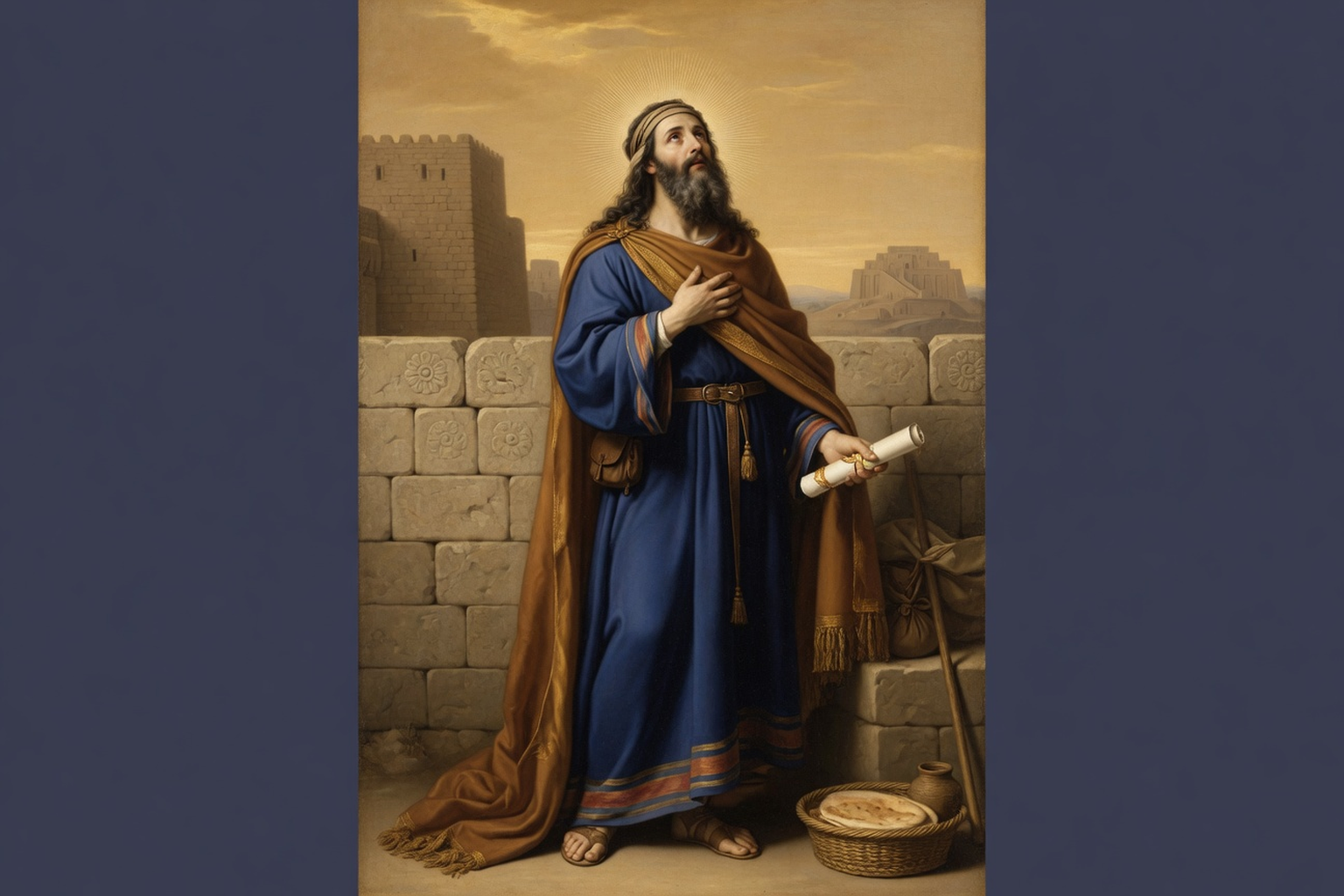
A prophet of the Old Law, Habakkuk foretold the invasion of Judea by the Chaldeans and the fall of Nebuchadnezzar. Tradition holds that he was miraculously transported by an angel to Babylon to feed Daniel in the lions' den. His tomb was revealed in the 4th century during the reign of Theodosius.
Guided reading
7 reading sections
SAINTS HABAKKUK AND MICAH THE YOUNGER
Context and prophecy against Jerusalem
Habakkuk warns the kingdom of Judah of the imminent invasion of the Chaldeans due to the moral and religious corruption of the people.
PROPHETS OF THE OLD LAW. (606 B.C.)
The time was no more when an entire people shook off the oppression of Egypt at the voice of Moses. The debased kingdom of Judah slept in the chains of Pharaoh Necho, and it valued its sleep at such a price that it condemned to death the importunate ones whose voices sought to interrupt it. When a people reaches such an excess that it prefers the degrading pleasures of sensualism to honor, duty, religion, and even its own nationality; when, above all, it responds only with contempt to the generous impulses of souls not yet reached by the contagion, it touches ruin on all sides. This is what the prophet Habakkuk, a worthy auxiliary prophète Habacuc Old Testament prophet, author of a prophetic book and a canticle. of Jeremiah and Joel, undertook no less uselessly to make the ungrateful Jerusalem understand. "Lift up y our eyes, Jérusalem Holy city where the Cross was lost and subsequently recovered. you race of scoffers," he said, "see, and let this spectacle freeze you with terror; for the event that is about to be accomplished in your days will surpass the faith of future ages. I, Jehovah, will raise up against you, from Chaldea, a nation with a cruel heart and swift feet, which will traverse the earth to seize domains that are not its own. Horror precedes it and dread follows it; it takes counsel only from its violence, and the ruins it sows in its path have no avengers. More agile than the leopard, swifter than the wolf that swoops down on the sheepfolds at evening, will be its horses and its horsemen; they will cross distances, they will spread everywhere at once; they will have the flight of the eagle that rushes to its prey. All will run to the pillage: one would say a hurricane in its fury. In the same way that the wind raises dust in whirlwinds, so they will drive nations before them like herds of slaves. Their leader will triumph over kings, princes will be his buffoons; the proudest ramparts will excite the smile of his pity; he will raise mountains of fascines above their level, and he will enter the fortresses as a victor. After so many victories, his spirit will be troubled; he will fall; and that is what the power of his God will be reduced to for him."
Nebuchadnezzar and the Fall of Judah
The prophecies of Habakkuk are fulfilled with the invasion of Nebuchadnezzar II, while announcing the future fall of the Assyrian oppressor.
Recent definitive discoveries confirm the veracity of Jewish history, and justify even in the smallest details the expressions of the Prophets. Nebuchadnezzar II, who was soon Nabuchodonosor II King of Babylon who besieged Jerusalem. to fulfill the predictions of Habakkuk through the success of his invasion of Judea and the terrible captivity he would impose upon the Hebrews, was a servant of the god Ashur. There was no lack in Jerusalem of cowardly and servile spirits, ready to worship success, even in spite of their outraged national sentiment, and disposed to prefer the god of the Assyrians who granted victory to the God of Judah who announced defeats. This is why Habakkuk insists on the fall that will follow the satisfied ambitions of Nebuchadnezzar, and on the impotence of the god whom Assyria presented as the victor over Jehovah.
The Canticle of Habakkuk
The poetic work of Habakkuk, integrated into the canon of the Scriptures, is celebrated by the Catholic Church for its messianic dimension.
Like Joel, Habakkuk celebrated the future reign of the Messiah: the canticle preserved in the canon of the Scriptures under th e title of: *Oratio Habacuc prophetæ pr Oratio Habacue prophetæ pro ignorantiis Biblical canticle of Habakkuk used in the liturgy. o ignorantiis*, is rhythmic in the manner of the Psalms, and possesses their inspiration and divine sublimity. The Catholic Church repeats it each week in its liturgical office, and each year, on the very day when Jesus Christ, whose triumphs he announced, willed to die at the hands of the Jews for the salvation of the world.
The succor brought to Daniel
According to the tradition reported by Saint Jerome, Habakkuk was miraculously transported to Babylon to feed Daniel in the lions' den.
It is believed that this Prophet survived long after the final departure of the captives following the ruin of the temple and the city of Jerusalem. Thus, Saint Jerome, followed by many others, does not hesitate to say that it was the same Habakkuk who received an order from God, thirty years later, to go from Judea to Babylon to bring food t Daniel Prophet cast into the lions' den in Babylon. o Daniel, who had been thrown into the lions' den.
Micah and the Announcement of the Messiah
The prophet Micah completes Habakkuk's vision by designating Bethlehem as the birthplace of the future ruler of Israel.
While Isaiah announced the spiritual reign of the Child-God, son of a Virgin-Mother, Mic ah of Moresheth de Michée de Morasthi Prophet who foretold the birth of the Messiah in Bethlehem. signated the place of His future birth. "The plow shall be driven over the ruins of Zion," said Micah, "as in a field that is plowed. Jerusalem shall be turned into a heap of rubble, and the hill of the temple shall be covered with the brambles of solitude." Zion, he cried out again, "daughter of brigandage, you shall be devastated; the enemies shall besiege your ramparts, their rod shall strike the judge of Israel on the ch eek. And you, Be Bethléem-Ephrata Place of the birth and anointing of David. thlehem-Ephrathah, the smallest among the thousands of cities of Judah, it is from your bosom that the ruler of Israel shall come forth, He whose generation has begun from the days of eternity. God will preserve His people until the day when she who is to give birth becomes a mother. The son who will be born of her shall remain in stability; He shall shepherd His flock in the strength of the Lord and in the sublimity of His august name. And the peoples shall be converted, because His glory shall be exalted to the ends of the world, and He shall be peace."
Let the Synagogue tell us who is the Child of God, born of a Virgin-Mother in Bethlehem-Ephrathah, whose name is now adored in all the regions of the universe? Does it know of any other than Jesus Christ, our God and the immortal king of peace?
Invention of the relics under Theodosius
The tombs of Habakkuk and Micah are revealed to Bishop Zebennus in the 4th century, leading to the construction of places of worship.
It is not known what the end of the prophet Micah was. The Greeks claimed that he had been thrown from the top of a rock by Jews shocked to hear their crimes reproached: but this assertion rests on no solid foundation.
He was buried near the place of his birth.
According to the historian Sozomen, the tombs of Habakkuk and Micah the Younger were revealed to Zebennus, bishop of Eleutheropolis, a city located about 7 leagues from Jerusalem, towards the west: this was during the reign of Theodosius ( 346-395) Théodose Roman emperor under whose reign the narrative begins. .
That of Habakkuk was found in a place called Kella, so well known from the history of David, and that of Micah, half a league from Eleutheropolis, in a place that the people designated by the name of Faithful Monument, without knowing why. In the time of Saint Jerome, there existed on the tomb of Micah of Moresheth a church that Saint Paula visited. It is not known if the tomb of Habakkuk was honored in the same way: however, in the course of time, a church was erected near Bethlehem on the site where tradition reported that the angel had taken him to transport him to Babylon. In the 13th century, there existed in the diocese of Jerusalem an abbey church of the Premonstratensian Ord er, under the name Ordre de Prémontré Religious order to which Father Aubertin, the saint's biographer, belonged. of Saint Habakkuk. It depended on the abbey of Floreffe, in B elgium, Floreffe Belgian abbey upon which the church of Saint Habakkuk in the Holy Land depended. and had been built by a crusader from Hainaut.
Cult and representations
Feast dates differ between the Greek and Latin Churches, while the iconography of Habakkuk focuses on the episode of the angel and the meal.
The Greeks celebrate the feast of Habakkuk on December 2, but they do not join Micah to him. All Latin martyrologies unite them on January 15: this is also done in the Levant by the Latin Church of Jerusalem, where their office is of the semi-double rite. Habakkuk is recognizable by the angel who transports him through the air by his hair; by the bread he takes for the prophet Daniel; by the vessel of pottage he had prepared for his reapers, and which he was carrying to them at the moment he was taken away. In the Middle Ages, each prophet was further characterized by a text from his prophecy placed on a scroll. The text chosen for Habakkuk is this one: Apparebit Dominus et non mentietur. Deus ab austro veniet et Sanctus de monte Pharaon. The Lord will appear and will not lie. God will come from the south, and the Holy One from Mount Paran. For Micah, it was this one: Erit mons domus Domini præparatus in vertice montium. The house of the Lord shall be prepared on the top of the mountains. Cf. Balliet, Darras, Histoire de l'Église; Fr. Cahier.
Annexes & related entities
Structured data for exploration: events, miracles, quotes, places, attributes, patronages, and important entities cited in the text.