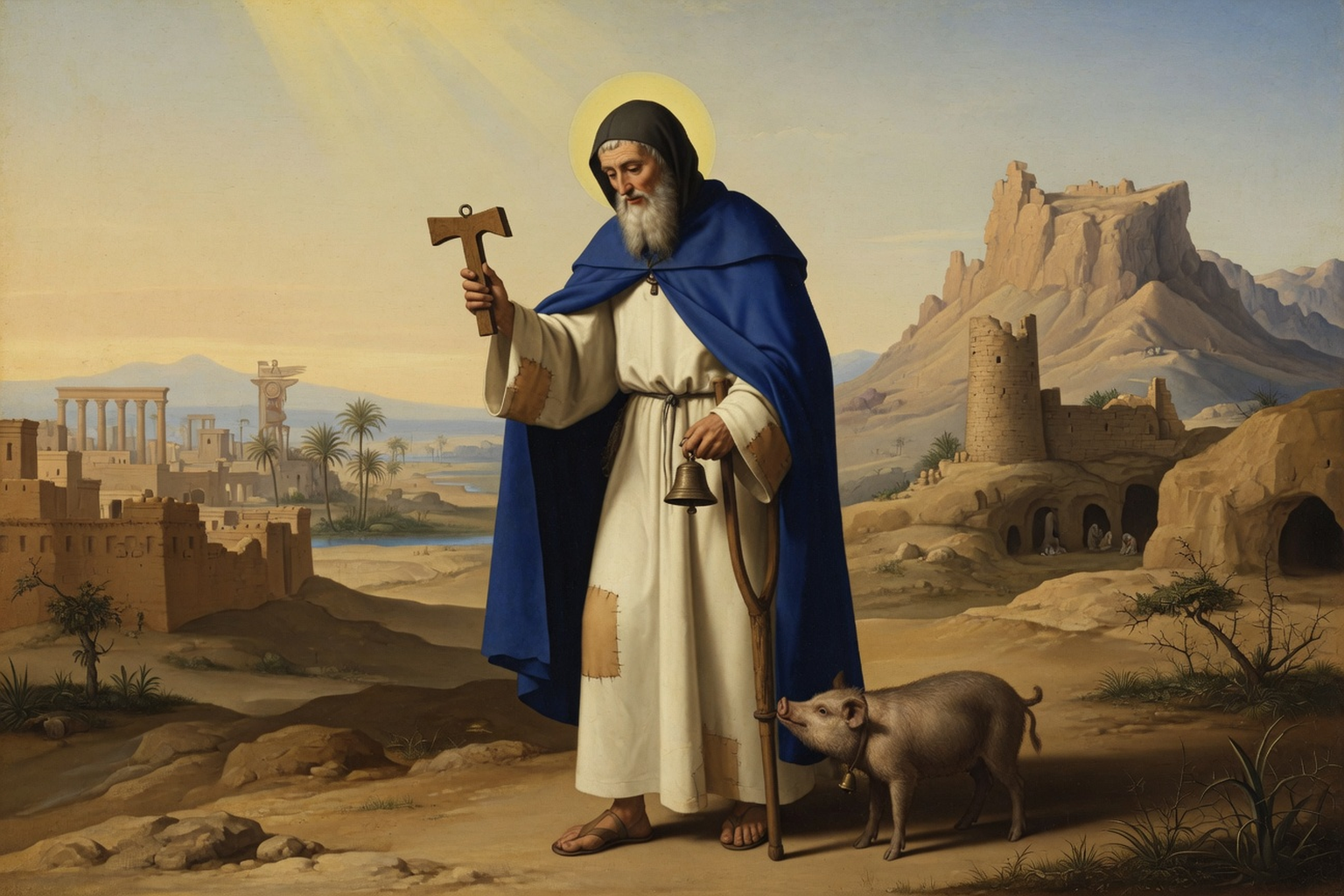
Saint Anthony the Great
First Father of the hermits of Egypt
First Father of the hermits of Egypt
Born in Egypt in the 3rd century, Anthony retired to the desert after distributing his wealth to the poor. Father of Christian monasticism, he endured famous demonic temptations before founding communities of hermits. He died a centenarian on Mount Colzim, leaving an immense spiritual legacy recorded by Saint Athanasius.
Guided reading
10 reading sections
SAINT ANTHONY THE GREAT,
FIRST FATHER OF THE HERMITS OF EGYPT
Youth and radical conversion
Born in 251 in Egypt, Anthony led a pious youth before distributing all his possessions to the poor following a reading of the Gospel.
Saint Anthony Saint Antoine Patron saint of hermits, first dedicatee of the chapel. was born in the year of Our Lord 251, in a small village named Coma or Coman, near the city of Heraclea, in Upper Egypt, under the empire of Decius. His parents, who were noble, wealthy, and Catholic, took great care of his education. They did not let him know any house other than their own, nor any people in the world other than them. He was not made to study literature in schools, so that he would have no communication with other children who might have corrupted him; thus, he spent his youth in great innocence: sober, religious, obedient, and loving, like Jacob, to dwell in his father's house.
At the age of eighteen or twenty, he found himself the master of his possessions upon the death of his father and mother. He had only a younger sister left, whom he raised for a period of six months. But as he had already conceived in his mind the desire for a more perfect life, such as that led by the Christians in the time of the Apostles, he entered, with this thought, a church where he heard these words read that Our Lord said to a rich young man: "If you want to be perfect, go, sell everything you have, give it to the poor, follow me, and you will have treasure in heaven"; he took them as if they had been spoken for him alone, and returning to his house, he disposed entirely of all his income; he divided among his neighbors three hundred measures of land that belonged to him; as for his furniture, he sold it and distributed the price to the poor, with the exception of something he kept to assist his sister. Having entered the church another time, and paying heed to these other words of the Gospel: "Do not be anxious about tomorrow," he gave all the rest of his property to the poor, and left his own house and even his sister, whom he entrusted to some virtuous girls of his acquaintance, among whom she lived in great holiness, following the example of her brother.
First combats and temptations
Anthony initiates himself into asceticism among hermits and undergoes violent demonic attacks, both psychological and physical, which he triumphs over through faith.
There were no true monasteries at that time, and the deserts were not populated with servants of God as they have been seen since, following the example of this great patriarch; one only saw in the countryside a few hermits who lived apart and who, for this reason, were called Monks, that is to say, Solitaries. Among them was a holy old man whom our Anthony proposed to imitate. Like an industrious bee, he went to visit the other hermits, his neighbors, in order to gather from them, as from various flowers, the honey of devotion to fill his heart: he learned humility from one, patience from another, compunction from this one, and chastity from that one. He worked with his hands to avoid idleness, and all that he could earn was destined for the poor, except for what was absolutely necessary for his subsistence. He prayed often and made himself so attentive to the reading of holy books that he rose in a short time to eminent perfection: the other monks spoke only of the devotion and fervor of Anthony. Some, out of honor, called him their father; others, out of tenderness, named him their child and their brother; and all, out of respect, gave him the title of Deicole, that is to say, one who loves and honors God.
However, the demon, enemy of men, foreseeing the great number of those who would convert through the example of Anthony, resolved to attack him by all sorts of means and artifices. Beginning with the cunning of the fox to continue then with the strength of the lion, he first suggested to him thoughts of regret for having left the world, either because he was losing his own satisfaction thereby, or because he was abandoning his sister. Then he excited in his mind extreme anxieties and in his body movements of impurity that could only be extinguished by the heavenly dew of grace; and although he saw himself assailed at the same time within and without, the demon tormented him at night with confused cries of dreadful voices. Nevertheless, the soldier of Jesus Christ, armed with His grace, remained invincible and firm as a rock amidst all these assaults; and the more the enemy strove to strike him down, the more he rose toward Him from whom he expected all his help. So that the enemy, defeated on that side, thought of a new ruse: it was to propose to him the pleasures of life and the deceptive sweetness of sensuality, with all the attractions capable of drawing our senses, but lively faith made Anthony triumph over all these attacks through the remedies that are proper to tame disordered appetites: I mean fasts, vigils, and other industries of mortification and penance.
That was not all; for the demon, borrowing the figure of a brazen woman, openly solicited this holy hermit to criminal actions; but the memory of those devouring flames that will never end in hell extinguished, by a divine ardor, the flames of concupiscence in his body and in his soul. Finally, the demon, despairing of ever defeating by all his ruses a man so well seasoned in this kind of militia, resolved to confess his weakness to him; to do so, he took the form of a small Negro or Moor, extremely ugly and horrible to see, and throwing himself at the feet of the servant of God, he said to him: "I have deceived many and I have overthrown several great personages; but I confess that you have defeated me." Saint Anthony asked him who he was: "I am," he replied, "the spirit of incontinence, which has lost so many people." The Saint, far from becoming proud, thanked the sovereign goodness that assisted him with such sensible favors; then, redoubling his courage against the enemy, he reproached him for his weakness, and told him that it was with reason that he took the figure of a dwarf, since with all his strength he could not overcome a poor man; and finally singing this verse of the Psalmist: "The Lord is my helper, and I will mock my enemies," he made this monster disappear.
Such was the first victory of Anthony against the demon; or rather, to use the terms of Saint Athanasius, the victory of the Savior in Anthony. But knowing that there is no perfect victory, nor any assured rest in this world, he kept himself more than ever on his guard. That is why, redoubling his fervor, he applied himself anew to the holy practices of mortification, for fear that the spirit, weighed down by the heaviness of the body, might lose some of its strength. He ate only a little bread seasoned with salt and drank only pure water, once a day only, after the sun had set; and even then he sometimes passed two or three days without taking anything. His bed was the bare earth or, at most, covered with a little rush and a hairshirt. He never recalled in his mind what he had done, but what remained for him to do, and in this way, he always kept himself ready for combat and such as he wished to appear in the presence of God, with a pure heart and prepared to obey His commandments.
The first combats of Saint Anthony against the demon had only taken place in the mind and in the imagination or, at most, in the external senses; but when God, to test his patience, had abandoned him like another Job to the power of the enemy, the latter made well appear in the person of the soldier of Jesus Christ the rage he has against men. For seeing that, to defy him, it seems, to combat, he had retired into a sepulcher where only one of his friends, who knew this place, brought him something to live on each day, he attacked him with open force and tormented him with such cruelty and with such sensible pains that he left him fainted and without any appearance of life. This, nevertheless, was not capable of breaking the courage of this invincible man; for having come to himself and seeing himself in the nearby village where his friend had transported him to have his wounds treated, he begged him to carry him back to the cave where he had taken him; and there, although he was so wounded that he could not move, he ceaselessly defied his enemy with these words: "Here I am, I am Anthony; I do not flee, I do not hide, I defy you, and your violence will never separate me from Jesus Christ." Then he sang this verse of David: "When I am surrounded by the squadrons of my enemies, my heart shall not fear!" The demon, frightened and confused, called his companions to his aid. They made such a great noise that one would have said the whole building was going to fall, and at that very moment Anthony saw appear horrible figures of lions, bulls, wolves, asps, serpents, scorpions, bears, tigers, and other wild beasts, which, each in rivalry, strove to frighten him and to harm him; indeed, he received several wounds on his body. But the soldier of Jesus Christ, lifting his eyes and heart toward God, always held firm, even to the point of mocking the weakness of these spirits clothed in fantastic bodies, who came several together to attack a single man whom the least of their band was capable of exterminating, if God had permitted it. Then, looking to heaven, he saw a brightness descend which, dissipating the darkness of his cave, made all these monsters, more frightful than the darkness, vanish. The servant of God, recognizing by this light the presence of his Lord, said to Him from the depth of his heart these loving words: "Where were you, good Jesus, where were you? Why did you not come from the beginning to heal my wounds?" To which a voice replied: "Anthony, I was here and I was waiting for the end of your combat; but, seeing now that you have fought courageously and that you have not yielded, I will always help you and will make your reputation fly throughout the world." Then Saint Anthony felt his strength renewed, his courage increased, and his resolution firmer than ever to love his God.
Retreat and foundation of the desert
After twenty years of total seclusion, Anthony attracts numerous disciples, transforming the desert into a city of monks and laying the foundations of monastic life.
He was, at that time, thirty-five years old, and, following the divine inspiration that called him to a more perfect life, he took leave of the good religious who brought him his daily bread, and withdrew to the top of a mountain, beyond the Nile, in an old castle inhabited only by snakes. These reptiles gave way to the man of God; but the demons pursued and persecuted him still. On the way, they made a silver basin appear to him, as if someone had dropped it by accident. But the Saint, perceiving the ruse of the enemy, made the sign of the cross, and with a heart full of faith, said these words to him: 'May your silver, wretch, perish with you; you will not hinder my journey for that.' Further on, he encountered a quantity of real gold, for he later assured his disciples, when recounting it, that it was not a fantastic gold; but far from stopping to contemplate it, he hastened his march all the more toward the place we have mentioned, and by blocking the entrance with stones, he shut himself in as if in a temple which he consecrated by continual prayer, having for all provision only bread and a little water for six months; one of his friends brought it to him twice a year and lowered it to him over the roof, without speaking to him or seeing him.
He thus spent twenty years in continual combats against the spirits of darkness, who gave him no rest either day or night; the pilgrims who came to this place to visit the holy man and receive some instruction from his mouth or else obtain the healing of their illnesses and the remedy for their ailments, are irreproachable witnesses, because they heard from outside the insults and reproaches that these spirits of hell made to the servant of God for coming to drive them from their ancient retreats, in order to lodge new guests there. Finally, Saint Anthony, pressed by the crowd of people who came to him, whether to imitate him in the practice of virtues, or to be relieved in their infirmities and delivered from unclean spirits, came out as if by force from this holy place which was a paradise to him. Everyone was delighted to see him with a face as cheerful and a complexion as rosy as if, during the twenty years of such a frightful and obscure solitude, he had always lived in abundance and had enjoyed all the pleasures of life there. Thus, this is a singular operation of God who nourishes his servants with his word alone and who, by the anointing of his heavenly spirit, causes the substance of man, not only not to diminish, but to become stronger and more vigorous.
The holiness of life of the blessed Anthony inspired such admiration that, from the place where he was, his reputation spread throughout the whole earth, crossing Africa, Italy, Spain, and France, as far as the most distant provinces; so that a great number of people touched by the spirit of God flocked to the desert to follow in his footsteps and live under his guidance. This is why several monasteries were founded, and the deserts were so filled that they seemed to be cities populated by heavenly inhabitants.
Wisdom and Teachings
The saint teaches his monks discretion, humility, and constant vigilance against the wiles of Satan, prioritizing charity over miracles.
When Anthony instructed his disciples, he told them "that one of the most important things for the spiritual life was to believe that one began every day; that paradise can be found in any place when the heart is attached to God; that the spirits of darkness fear the prayers, vigils, and penances of the servants of God, especially voluntary poverty, humility, contempt for the world, charity, and the mortification of the passions; that these are the virtues that crush and break the head of the serpent." He taught them "that the true weapons to fight him were a living faith, accompanied by a great purity of life; that here below, he who buys pays the fair price of the merchandise to the seller, but that the kingdom of heaven is cheap, and is given for much less than it is worth; for all the labors and all the sorrows of this life (even if it were to last eighty or a hundred years) are only for a time, and the happiness that is the reward for them is without end. Everyone, even if he has left everything to serve God, must think that this is nothing, even if it were all the kingdoms of the earth; because the whole earth is but a point, and, sooner or later, man will be forced to leave what he leaves behind. Just as he who serves the king does not refuse to do what is commanded of him, under the pretext that he has served much; in the same way, the true servant of God must not look at what he has done, but at what remains for him to do for his Lord. He who has finished well carries off the crown, not he who has begun. To banish laziness, the best thing is to always have before one's eyes the uncertainty of this present life, and, at night, not to count on the day, nor by day, on the night. Virtue is not as difficult as it seems. The princes of darkness are animated by a mortal hatred against all Christians, and especially against religious and virgins; they use many ruses, but all their artifices are undone by the distrust that the good religious has of himself, and by the confidence he has in Jesus Christ, who disarmed these rebellious spirits on the cross, and took from them the strength and the means to harm us, if we do not expose ourselves, by our own fault, to their cruelty."
He said to them in this regard: "Once I heard a knocking at the door of my cell; having gone out to know who it was, I saw a man of such prodigious size that his head touched the sky; I asked him who he was; this specter answered me that he was Satan. 'I come,' he added, 'to know from you why, not only the religious, but also all Christians, curse me; for, whatever misfortune happens to them, they load me with curses.' I replied to him that they did so with reason, because they were tempted and solicited to sin by his artifices; to which the spirit replied 'that he had no part in the crimes of men; that they alone made war on each other and caused their own misfortune, seeking the occasions to do evil; because, since God had become man, he had lost his empire over the provinces, over the cities, and over the villages, and that the deserts and the vast solitudes, which alone had remained to him, were beginning to be populated with religious houses and filled with holy personages who banished them from there by the power of the cross.' I was delighted to see that the father of lies was forced to say these truths, so much to his confusion. But I had hardly pronounced the name of Jesus, to bless God for it, when the phantom disappeared."
He also warned his religious "not to let themselves be touched by the vain desire to know things to come, because many had been seduced by it; to attach more value to living well than to performing miracles; and, if they performed them, not to boast or esteem themselves more, and not to despise those who did not perform them, because the miracle is a gift of God, which comes from his pure mercy and not from our misery, and that he through whom God does it is not assured of being pleasing to Him." He added "that the best weapons, to defeat the enemy, were the gladness and spiritual joy of the soul, which always has the presence of God in its thought, because this light dissipates the darkness, and makes the temptations of Satan go up in smoke; that we must always have present the examples of the Saints, to excite us to virtue; that, to keep from falling, it is very useful to disclose one's faults to the brothers, and to prevent a second fall by manifest shame and confusion." As he was often in conference with his religious, he gave them various lessons for the practice of virtues. Once, among others, he wanted to have their opinion on the virtues, and asked them which of all seemed to them the most necessary for the religious life; some gave the first rank to penance by which sensual appetites are mortified; others, to silence and solitude which cut off the occasions of sin; others to mercy to which Our Lord promises the eternal reward on the day of judgment; and others, to other virtues. But Anthony, as the most experienced in this holy practice, gave the first rank to discretion, as the guide and mistress of all the others, without which the spiritual life is blind, confused, and in disorder. It is thus that, by these counsels and others similar, Anthony formed his religious to the perfection of the monastic life, and that, by the fervor of his words, he led them to the contempt of all visible things and to the love of God; also he said of himself that he no longer feared God, but that he loved Him, because perfect love casts out fear.
Engagement against the Arian heresy
Anthony leaves his solitude to support the Catholics of Alexandria in the face of persecutions and the heresy of Arius, alongside Saint Athanasius.
But this is not yet the highest point of this great man's virtue: although he lived on earth like an angel of heaven, and was the father of so many holy children, he did not believe he had done anything if he did not die for Jesus Christ, and if he did not shed his blood for His service.
The Emperor Maximin had rekindled the fire of persecution in the year 311. Many Christians were captured, tormented, and taken to Alexandria to be executed; Anthony, burning with the desire for martyrdom, went there in order to die with them, if it pleased God to grant him this favor. He accompanied them when they were presented to the judges' tribunals, he encouraged them in their torments, and followed them to the place of execution. He persevered so constantly in this pious office that the judge, although he did not undertake to take him prisoner, ordered all religious to leave the city. Most hid themselves; he, on the contrary, having dressed himself the next day in a beautiful, clean white robe to attract more attention, placed himself at the highest point of the public square, dying of regret in his soul at not being able to die once in the body for Jesus Christ. But Divine Providence, which wished to use him to convert the deserts into a paradise, did not permit the death of one who was to give life to so many others.
As soon as this storm had passed, Anthony returned to his monastery; and as if he had newly entered the service of God, he began to fast, pray, and keep vigil more than ever, striving to be a martyr his whole life in solitude, since he had not been able to attain that glory in the public square of the city of Alexandria. He shut himself in his cell, without communicating with anyone except by necessity, and there he performed miraculous acts of virtue, especially of humility, which he founded primarily on the knowledge of himself; he thought only of lowering himself as God made him more glorious, and he always gave heaven the honor for his actions, reserving for himself only contempt and confusion. It is not possible to set forth here the number and quality of the miracles and graces conferred upon the faithful through the intercession of this holy personage. He had absolute authority over all kinds of illnesses, but God had given him particularly such great power over evil spirits that his name alone sufficed to torment them and deliver the possessed. Therefore, distrusting himself and fearing that the wonders God worked through him might acquire him too much reputation, he resolved to move away from those places where he was known; and, having provided himself with bread, he went to the Upper Thebaid where there were only wild men, among whom he hoped not to be known.
As he was on the banks of the Nile and waiting for some boat on which he could go up the river toward the south, he heard a voice that said to him: "Anthony, where are you going and what are you doing?" He replied: "I am going into the Thebaid because the world disturbs my rest here and asks for things that are above my strength." The same voice told him to leave that path and enter about three days' journey into the desert. He walked for three days and three nights toward the East, toward the Red Sea, instead of going down toward the south, and arrived at the place where heaven had fixed his dwelling for the rest of his days. It was Mount Colzim, which has since been named Mount Saint Anthony, a day's journey from the Red Sea. At the bottom is a stream bordered by palm trees. This mountain was so high and steep that one could not look at it without fear. It could be seen from the Nile, although it was twelve leagues away. Saint Anthony established himself at the foot of this mountain, in a cell so narrow that it contained in square only as much space as a man can occupy by stretching out. There were two other similar cells, carved into the rock, on the summit of the mountain, where one climbed with difficulty by a small path in the shape of a snail shell. The Saint often retreated there to escape the crowd. For his religious had soon discovered him and they sent him provisions, although with great difficulty. The holy Father, to deliver his children from this trouble, asked them to bring him a spade, an axe, and a little wheat, which he sowed in a small plot of land; this yielded enough for his maintenance, and he had extreme joy in no longer being a burden to anyone. And because many people began to come looking for him in this solitude, he made a small garden in which he sowed herbs to give them to eat. It is said that some beasts having ravaged this garden that the Saint had had so much trouble cultivating, he took one and said to it: "Why do you do me harm? I do you none; go away from here and remember that I forbid you to return." And they obeyed as if it had been a commandment of God.
Besides cultivating his garden, he made mats. One day when he was distressed at not being able, because of this work, to be always in contemplation, an angel appeared to him. This celestial spirit began to make a mat with palm leaves, and he would leave his work from time to time to converse with God in prayer. After having thus several times intertwined work and prayer, he said to the Saint: "Do the same and you will be saved." Since then, Anthony never omitted this practice; it was thus easy for him to keep his heart united to God while his hands worked.
Another time, the demon, to frighten him, assembled troops of wild beasts at night, and when he was in prayer, he lined them up before him, as if they wanted to devour him. But the Saint, who was not ignorant of his enemy's ruses, said to them: "If God has given you any power over me, here I am, eat me; but if you have come by the movement of the demon, get out of here, for I am a servant of Jesus Christ." At these words, they vanished without having been seen since. Another time, at the hour of None, before the meal, Anthony began to pray; being enraptured in spirit, it seemed to him that he was being carried to heaven by angels, and that the demons were standing in the way to prevent him from ascending; the good angels asked the bad ones why they opposed his exaltation since he was innocent and had committed no crime that made him unworthy of this happiness. They began to accuse him of all the evil he had done since the day of his birth; and as the angels replied that these sins had been erased and forgiven by penance, and invited the demons to allege what they had to say against him since he had become a religious and consecrated himself to the service of God, whatever lie they invented, they could say nothing to prevent his passage. When the Saint had returned to himself, he did not eat, but spent the whole night deploring the misery and nonchalance of men who, having such strong enemies to fight, live without worry, as if they had no one to fight.
He had another vision, which is related to this one. He heard, at night, a voice that called him and said: "Anthony, get up, come outside and you will see." He went out and saw a phantom, like a terrible giant, who, touching the clouds with his head, stretched out his hands to stop people who were flying to heaven; some were pushed back toward the earth and others reached heaven in spite of him. After that, he heard a voice that said to him: "Consider well what you see"; and God, then enlightening his mind, made him know that those who were flying to heaven were the souls of men; that the demon was striving to prevent their passage and that he was striking down to earth those who had attached themselves to sin, but that he had no strength against holy and innocent souls. Another time, he saw the whole earth covered with snares and traps that the demons had set there; as he asked himself who could avoid them, he heard a voice that said: "Anthony, it will be humility alone!". Furthermore, praying one day in his cell, he heard another voice that said to him: "Anthony, you have not yet reached the measure of a tanner in Alexandria." These words having astonished him, he got up early in the morning, and taking his staff in his hand, he came to the city to look for this person; he learned from him that he had every day, in the evening and in the morning, this humble thought: All the inhabitants of this city do their duty and earn paradise, and I alone, for my sins, can expect only hell. All these visions, as well as the temptations, served as a motive for Anthony to advance further in the contempt of the world and in the love of his Savior attached to the cross.
He had a heart so tender and so full of compassion that he defended the cause of the oppressed poor who could not have justice, as if he himself had received the injury that had been done to them. As for purity, he would have passed for an angel rather than a man.
His nature was peaceful, gentle, and extremely sweet. He was so enraptured in prayer that he spent entire nights on his knees watching, praying, and meditating on the passion and death of the Savior. When the sun was at its setting, he would begin to pray; and the next morning, when its rays shone in his eyes, he complained that it took away the sweetness and rest of his heart, although he had spent the whole night on his knees in prayer: "O sun!" he said, "why do you take away from me, by your light, the clarity of the true and eternal light?" Cassian, who reports this trait, adds that speaking of prayer, he said that that of a religious was not perfect when, while praying, he noticed himself that he was praying: which shows how sublime his prayer was. He was so rigorous in his penances that he did not seem to be composed of flesh and bone, and so invincible in combat that it was he who struck terror into the evil spirits, far from being frightened by their phantoms. He always had an even, joyful, and well-composed face, without being cast down in adversity, nor letting himself go to excessive joy in prosperity: which made him known at first glance among the other religious. And even those who had never seen him addressed themselves to him first; for, by the candor of his face which breathed sweetness, they judged the integrity of his soul and conscience. Three monks were accustomed to go see him once a year; two proposed questions to him, but the third never said a word. Saint Anthony asked him the reason, fearing that it was out of fear. He replied: "My father, it is enough for me to see you." He respected ecclesiastics and knelt to receive the blessing of priests and bishops; he fled the conversation of all those who were separated from the Church, and taught that the true Catholic should hold them in horror and flee from them more than from snakes and vipers.
There was an Arian judge, named Balac, who exercised horrible cruelties against the Catholics, particularly against the virgins and the religious whom he had stripped and whipped in the streets. Anthony wrote to him to exhort him to some moderation, and threatened him with the wrath of God if he continued his impieties. This apostate only laughed at it, and throwing the letter to the ground, he spat on it and trampled it underfoot; but the justice of God did not delay long in punishing him. Indeed, five days later, while riding with Nestor, governor of Egypt, the latter's horse, although very gentle, threw itself on Balac, knocked him to the ground, and bit him several times on the thigh. He had to be carried, all bruised and bloody, to the city where he died after two days.
Another time, Saint Anthony being on his mountain, very far from Egypt, saw in spirit the havoc that the Arians were to wreak in Alexandria; and prostrating himself on the ground, he began to weep, to groan, and to pray to Our Lord that He would not permit such a great calamity to happen to His Church. He had seen that unclean beasts and untamed mules would knock down the altars with kicks: these were the Arians by whom the churches were to be profaned and the sanctuaries demolished. God moderated his affliction, showing him that the Church would win the victory, and that after having triumphed over its enemies, it would sustain itself with more majesty than ever. It is thus that the holy personage made it known to his religious, who were consoled by the consolation of their father, as they had been in extreme affliction by his tears and his sorrow.
It was during this same persecution of the Arians that Saint Anthony was called to Alexandria, by Saint Athanasius, to oppose the fury of these heretics, and to strengthen and encourage the Catholics who were afflicted. His presence in this city had a wonderful effect on the hearts of the people. They were filled with joy to hear him pronounce anathema against the heresy; everyone rushed to see him. Even the priests of the pagans went to the church, asking to speak to the man of God; for that is what he was called. He performed several wonders there; and Saint Athanasius admits that during the short time he remained there, he conv saint Athanase Father of the Church who cited Leontius among the Catholic luminaries. erted more infidels to the faith than had been converted before in a whole year. And certainly, although this holy man had not studied in the books of the philosophers and sages of the world, nevertheless he had been inwardly taught by heaven, and enlightened by the true and celestial Wisdom, which the vain philosophy of the world cannot resist. This was seen in the disputes he had against great philosophers, who came to him to mock the simplicity of his words, because he did not have the reputation of being very learned; he answered them so pertinently that they remained astonished at the vivacity of his mind and the solidity of his judgment, and could not resist the voice of God that spoke through his mouth. Some of these philosophers asked him one day what he could occupy himself with in his desert, since he was deprived of the pleasure of reading. "Nature," he replied to them, "is for me a book that takes the place of all others." In the city of Alexandria, Didymus came to greet him, as Saint Jerome writes. He was a very learned man, held at that time to be a prodigy of wisdom, because, although blind, he had made himself very skillful in all kinds of sciences, and even in those that seem to be able to be acquired only by the use of sight. As they were discoursing together on the word of God, Saint Anthony asked him familiarly if he was not sorry to be blind; this doctor, finding himself embarrassed, had difficulty admitting it; Saint Anthony pressed him so much that he finally confessed to him frankly that his blindness caused him pain. Then A Didyme Blind scholar of Alexandria consoled by Anthony. nthony replied to him affectionately: "Could you regret the loss of a sight that was common to you with flies, ants, and the most despicable animals? You should rather rejoice to possess a light that is found only in the Apostles, the Saints, and the Angels, a light by which we see God Himself and which gives us a completely celestial science. The light of the spirit is infinitely preferable to that of the body. It takes only one impudent look for carnal eyes to plunge us into hell." By this, Didymus received much consolation in his infirmity.
When the Saint had spent a few days in Alexandria, he thought only of returning to his cell. The governor of Egypt pressing him to stay, he said to him: "It is with a monk as with a fish: one dies if it leaves the water, and the other if he leaves solitude." Saint Athanasius accompanied him respectfully to the gates of the city, where he saw him heal a young girl possessed by the demon.
Relations with the powerful
Despite his withdrawal from the world, Anthony maintained a respectful correspondence with Emperor Constantine the Great, exhorting him to justice and clemency.
What shall I say after this of the honors rendered to him by the emperors, monarchs, and princes of the age? They wrote him letters full of respect, implored the help of his prayers, and even begged him to reply to them and to give them some consolation through his writings; which Constantine the Great and his children did sever al times. He took a Constantin le Grand Roman emperor whose conversion ended Christian persecutions. dvantage of this once to instruct his religious and to lead them to the veneration they owed to the majesty of the living God. "The kings of the age have written to us," he told them, "but that is nothing for a Christian; for if their dignity is raised above ours, we know that birth and death make us all equal. What we must most esteem and admire is that God has written his law in the hearts of men and enriched his Church with his divine words. Of what use to a religious are the letters of kings, since he does not know how to answer them in their style?"
He wanted to excuse himself from replying to the princes; but the solitaries having represented to him that the emperors were Christians, and that they might perhaps be offended by his silence, he wrote to them that he rejoiced that they worshipped Jesus Christ; he exhorted them not to let themselves be dazzled by their dignity, to the point of forgetting that they were men and must render an account of their power to the King of kings. He recommended that they use clemency and humanity; to render justice to everyone; to assist the poor, and to remember that Jesus Christ is the only true and eternal king. Emperor Constantine received this letter with extreme contentment and held it dearer than a treasure.
Last days and death
Anthony died at the age of 105 in 336, after ordering his disciples to hide his burial place to avoid any superstitious cult of his body.
We have said that Anthony's disciples discovered his retreat. Many came to him; but they could never obtain permission to live on his mountain; he only granted them to settle twelve leagues away, in a monastery (Pispir), where, after the death of our holy patriarch, Saint Macarius governed up to five thousand monks. Antho saint Macaire Author of the monastic rule adopted by John. ny often came there; it was especially there that he received distinguished foreigners, who could not, with their retinue, reach the top of the mountain. Macarius, in charge of receiving them, had agreed with the holy abbot to announce them to him under the names of Egyptians or Jerusalemites, depending on whether they were worldly people or pious persons. When Macarius called Anthony to see Jerusalemites, the latter would come to sit with them and speak to them of the things of God; if they were Egyptians, he would give them a short exhortation appropriate to their needs, after which Macarius would entertain them and prepare lentils for them. As for his other monasteries, Anthony visited them less often. He undertook it one last time when he knew by revelation that his death was approaching. He told his brothers with great joy, and exhorted them to persevere constantly in virtue. One of the main things he recommended to them was to bury his body in some unknown place, to avoid the ceremonies common to the Egyptians who embalmed the bodies of those whose lives they had held in veneration. He had always feared that this custom, which he had moreover condemned several times as superstitious, would be applied to him. Thus, he expressly recommended to Macarius and Amathas, who remained with him for the last few years of his life to assist him in his old age, to bury him as the patriarchs had been, and to keep the location of his tomb a secret. Upon returning to his cell after visiting his monasteries, he fell ill shortly thereafter. He reiterated to his two disciples the orders he had given them regarding the burial of his body: "On the day of the resurrection," he said, "I shall recover it incorruptible from the hand of the Savior." Then he added: "Divide my clothes, and give to Bishop Athanasius one of my tunics along with the cloak he gave me brand new and which I have worn out (he wanted to show by this that he was dying in the communion of Athanasius); give to Bishop Serapion the other tunic, and keep my hairshirt for yourselves. Farewell, my children, Anthony is departing and is no longer with you."
He ended his speech with the kiss of peace which he gave them with paternal tenderness; and gently stretching out his feet, he faced death with cheerfulness, showing a marvelous joy as if he had seen his friends coming to meet him: which leads one to presume that the blessed spirits appeared to him at that moment, to lead him with them into the heavenly homeland. It was thus that he rendered his spirit to God on January 17, the day on which the Egyptians, Greeks, and Latins celebrate his feast, in the year of Jesus Christ 336, and at the age of one hundred and five.
It was a marvelous thing that with so many long and excessive penances that this Saint had practiced, he had not lost a single tooth, that his sight had not diminished, and that he still had firm legs and a robust body: which was a great proof of his virtue, and of what God operates miraculously in favor of his servants.
Iconography and popular traditions
Description of the saint's traditional attributes (pig, bell, T-shaped cross) and their origin linked to medieval hospital practices.
Who does not know the images and statues of Saint Anthony, this most popular of saints? Who has not seen him a hundred times represented in our city and country churches wearing a tawny robe of mixed wool, his chin adorned with a venerable beard, a crutch in his hand, on his garment a piece of a gallows or a T; a bell attached to his staff, a pig at his side, a fire lit at his feet, and finally an open book in which he prays? — Saint Anthony having reached the age of one hundred and five, it is easy to understand why he is seen leaning on a staff: what is less easily explained is the presence of a T on his garment. Some have sought to see in it the Egyptian importation of the Ankh cross or Chi-Rho adopted, as a religious rallying sign, by the Christians of Alexandria, when the destruction of the temple of Serapis revealed that the future life was expressed in the symbolism of the Pharaohs by a symbol featuring a T-shaped cross. Others think that this T has a purely Western origin and that this diminutive gallows was the coat of arms of hospitals in the Middle Ages: this is all the more plausible since, as we shall say below, the oldest institution of a hospital order was established in France under his patronage. — The pig and the bell are based on the same type of facts: in the Middle Ages, members of the porcine race could roam the streets of our towns as well as those of our villages. When the police of the former forbade these wanderings, those of the hospitals retained the right to continue seeking their livelihood as before: only they had to, in order to be distinguished by the inhabitants, wear a bell around their necks. The flames which, near him, seem to emerge from the ground, recall the disease known as Saint Anthony's fire, which the Antonine monks made a profession of treating.
He has also been painted tormented by demons and consoled by Jesus Christ. There are several famous compositions under the name of The Temptation of Saint Anthony; carried to heaven by Angels; walking on a serpent.
The cult of Saint Anthony has been very famous everywhere and is still very popular today. It would therefore be difficult to name all the countries of which he is the patron, all the churches of which he is the titular saint. He has been especially honored in the Dauphiné, which had the good fortune to recei ve and k Dauphiné French region that received the saint's relics. eep the deposit of his relics; in Minorca, because the island was recaptured from the Muslims on January 17th, in Naples, in Paris, etc.
He is invoked against contagion and skin diseases, for pigs and other domestic animals. We know of more than one country where, on Saint Anthony's Day, the various animals that populate the stables are led before his chapel to be blessed.
Saint Anthony is the patron saint of pork butchers, swineherds, and basket makers.
The Order of the Antonines and the Relics
History of the transfer of the relics to the Dauphiné and the creation of the hospital order of the Antonines to treat the 'holy fire'.
## RELICS AND CULT OF SAINT ANTHONY.
The faithful disciples followed the will of their master; they kept his tomb a secret; the body of Saint Anthony remained hidden for a long time, until, by divine revelation, it was found and transported from the Thebaid to Alexandria (561), and from there to Constantinople, around the year 635, when the Saracens seized Egypt; and finally, around 980, these holy relics were granted by the emperor of Constantinople to Jocelin, one of the principal barons of the province of Dauphiné. A church begun under his care at La Motte-Saint-Didier, near Vienne, completed by those of Guigues Didier, his brother-in-law and heir, received the precious treasure, and Benedictine monks from the abbey of Montmajour, near Arles, were called to guard it religiously. In 1090, a horrible disease, known as the holy fire, ravaged several provinces of France. As relief was found only in the protection of Saint Anthony, people flocked in crowds to invoke him in the church where his relics rested. A gentleman named Gaston thus obtained the healing of his son Girinde or Guérin; in gratitude, they both dedicated themselves, along with other gentlemen, to the service of the poor, the sick, and pilgrims, in a hospital they built near the Saint-Anthony church. Such was the origin of the Order of the Antonines. Urban II approved, in the Council of Clermont, this hol y society of hospi Ordre des Antonins Hospitaller order founded in the Middle Ages under the patronage of the saint. tal brothers, of which Gaston was the first grand master. Great disputes soon arose, and even later, between the Antonines and the Benedictines, which it is useless to report here. In the year 1298, Pope Boniface VIII, to end all these lawsuits, erected the priory of Saint-Anthony into an abbey, took i Boniface VIII Pope who appointed Louis to the bishopric of Toulouse. t from the Benedictine colony, which was sent back to Montmajour, and gave it to the Antonines, ordering that they live under the rule of Saint Augustine, that they be called *regular canons* of Saint-Anthony, and that their leader take the title of abbot; this was the general of the entire Order, which had a fairly large number of houses, both in France and abroad; each house was called a *commandery*, and the head a *commander*. This order, reformed in the 18th century by its twenty-third abbot, Antoine Tolosain, was suppressed and incorporated into that of Malta by bull of September 17, 1776, and May 7, 1777. When the revolution broke out, there were still sixty-six Antonines, of whom only three took the oath to the civil constitution of the clergy; the others preferred persecution, exile, and death. Today (1862), the abbey is a factory; the Saint-Anthony church has become a parish church, and the relics of Saint Anthony are still venerated there, which were not taken away by the Benedictines of Montmajour, as Mr. Dussy, oblate of Mary, proves very well. Mgr de Bruillard, Bishop of Grenoble, had the reliquary containing these precious remains opened in his presence on May 9, 1844, and recognized their authenticity. A parish of two thousand souls has formed around the abbey of Saint-Anthony, bearing the same name, fifteen kilometers northwest of Saint-Marcellin.
Provençal scholars maintain that Arles possesses the true relics of Saint Anthony. The work of Mr. Dassy was the subject of a complaint by the Archbishop of Aix, whose testimony the author had invoked and refuted by several detractors.
The cult of Saint Anthony is very ancient in Marseille. It was established there in the 13th century by Antonine monks who had a house in this city before 1180. The feast of Saint Anthony is currently celebrated in a special way in the parish church of Saint Cannat.
The medal cabinet of Marseille possesses a lead religious confraternity plaque from the 16th century, perhaps unique, representing in the field Saint Anthony standing, nimbate, holding the TAU and a rosary in his right hand, and an open book in his left; next to him is a church. Around it is the following inscription in the Provençal language: *San Antoni darle ieb!*.
Sources and literary legacy
Presentation of the Life of Anthony by Saint Athanasius and its major influence on Church Fathers such as Saint Jerome and Saint Augustine.
The life of the great Saint Anthony was first written in Greek by Saint Atha saint Athanase Father of the Church who cited Leontius among the Catholic luminaries. nasius, Patriarch of Alexandria, at the urging of the disciples of the same holy abbot, following the memoirs they sent him via the monks Amathas and Macarius, who had been witnesses to his noble deeds until his death. Athanasius had often visited Saint Anthony in the desert. Subsequently, this life was brought to Rome by Evagrius, who translated it into Latin at the request of Saint Eusebius of Vercelli and Pope Saint Innocent, to whom he dedicated it. It was so well received by Saint Jerome, an intimate friend of Evagrius, that he placed it among the other lives of the holy Fathers of the desert: which led some to believe that Saint Jerome himself was the original translator.
All of antiquity has bestowed magnificent praise upon the account of the life of Saint Anthony.
It is known that Saint Athanasius, although very occupied with the most important affairs of the Church, believed he was contributing greatly to the glory of God by employing his pen to write his Life. He addressed it to the solitaries to serve as a model for them, and he admits that what he says of him is little in comparison to what remained to be said.
Saint Jerome says that God revealed his death to Saint Hilarion; that heaven gave no rain for three years in those regions, which caused the inhabita nts to say tha Saint Augustin Cited for his definition of fraternal charity. t the very elements were weeping for his death. Saint Augustine writes in his Confessions that, while he was still hesitating to convert, his friend Potitianus came to see him and told him that two officers who were in Trier in the emperor's retinue, having read a few pages of the Life of Saint Anthony in a solitary's cell, were so moved that they resolved on the spot to renounce the world and embrace the religious life in that monastery. He adds that this account contributed not a little to making him look within himself and leading him to a perfect conversion. For, turning to his friend Alypius, he exclaimed: "What are we doing? What do you think of what we have just heard? Behold, the ignorant take heaven by force, and we, with all our learning, are foolish enough to remain buried in flesh and blood. Should we be ashamed to follow them because they precede us on the path of God, and should we not rather blush with shame for not following them?"
Saint Gregory of Nazianzus calls him nothing other than the divine Anthony. Saint Chrysostom exhorts his listeners to read his Life to learn true wisdom there. He says that he had almost equaled the glory of the Apostles; that he had shown by his example what Jesus Christ commanded by his precepts; and that he was himself an admirable proof of our religion, there being no sect where one could find such a great man. He was surnamed Saint Anthony the Great.
Annexes & related entities
Structured data for exploration: events, miracles, quotes, places, attributes, patronages, and important entities cited in the text.
Key Events
- Born in 251 under the empire of Decius
- Sold his possessions and entered into solitude around the age of 20
- Twenty-year retreat in an old fort beyond the Nile
- Foundation of several monasteries in the desert
- Journey to Alexandria in 311 to support the martyrs
- Final retreat at Mount Colzim near the Red Sea
- Dispute with philosophers and struggle against Arianism in Alexandria
- Died at the age of 105
Miracles
- Victories over demonic apparitions (lions, snakes, specters)
- Healing of the possessed and the sick by his name alone
- Vision of the ascension of souls and the snares of the demon on earth
- Obedience of the wild beasts ravaging his garden
- Apparition of an angel teaching him how to weave mats
Quotes
-
No one can flatter themselves that they will enter the kingdom of heaven without having passed through temptation.
Maxim of Saint Anthony -
The Lord is my helper, and I will look in triumph on those who hate me
Psalms (cited by Anthony) -
Nature is for me a book that takes the place of all others.
Response to the philosophers