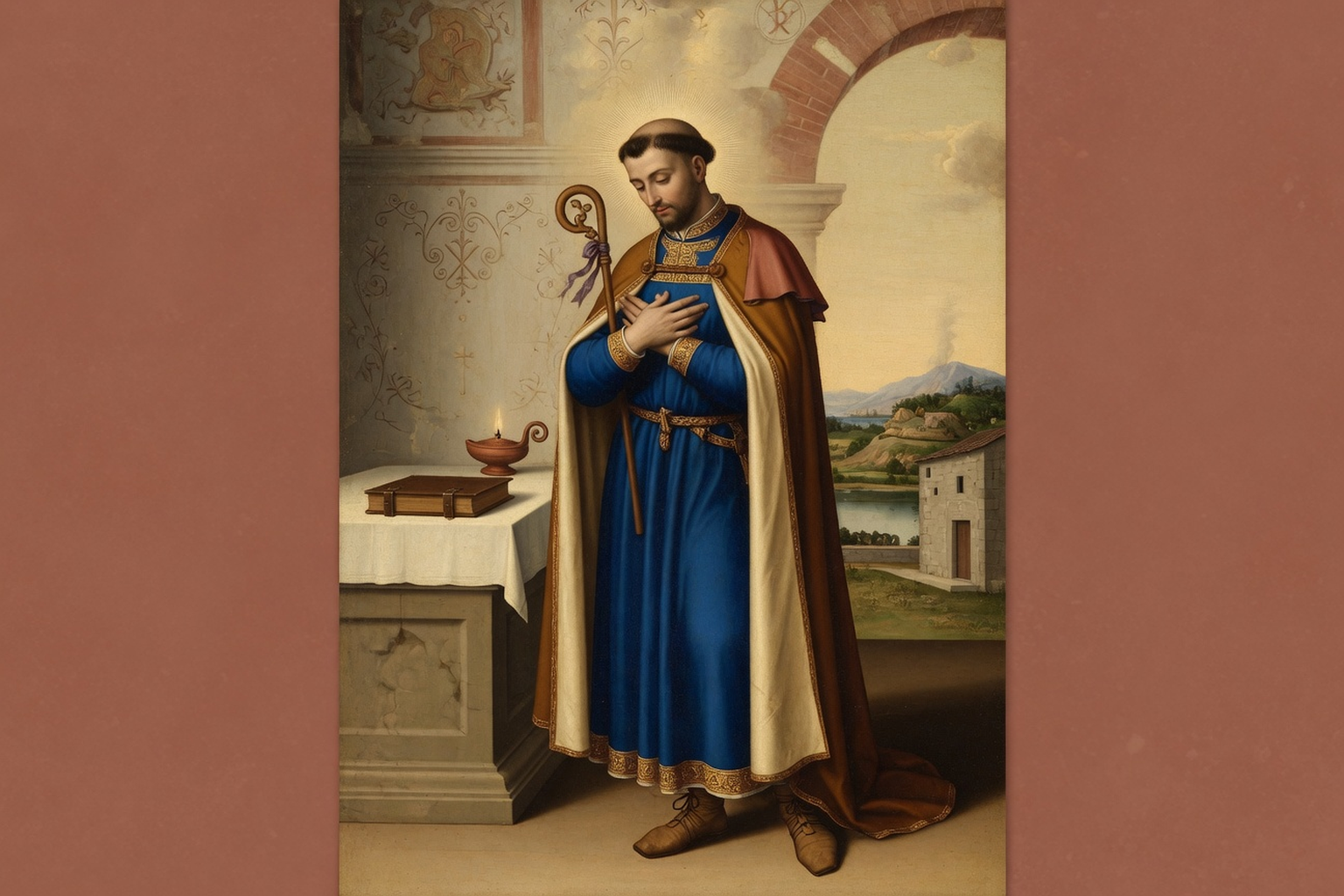
Saint Genou
Genulfe
First Bishop of Cahors
Sent by the Roman pontiff around 260, Genou evangelized Cahors with his father Genit. After surviving the stake and resurrecting the governor's son, he converted the Cadurci people. He ended his days in Berry, where his relics were honored on the banks of the Indre.
Guided reading
6 reading sections
SAINT GENOU, BISHOP OF CAHORS AND SAINT GENIT, HIS FATHER
Mission among the Cadurci
Sent by the Pope around 260, Genulfe arrived in Divona (Cahors) with his father Genitus to evangelize the Celtic people who practiced human sacrifice.
3rd century. G enulfe or Genou, Genulfe ou Genou First bishop of Cahors and evangelizer of the Quercy region. destined for the apostolate of the Cadurci by the Roman pontiff, came, around the year 260, to their capital city, named in the Celtic language Divona and later Cahors; he came there with his fat Genitus Father of Saint Genou and companion in his apostolic mission. her Genitus, such is the tradition. To what senseless religion the Cadurci were then given over, one can judge by what remains of the ruins of their temples, by the fragments of the simulacra of their deities, and by their gigantic stone altars still standing on their mountains, upon which they immolated human victims to the princes of darkness. Genulfe had pity on the deplorable blindness of the people entrusted to his zeal; he conceived the hope of dissipating these deep shadows by the evangelical light; divine help was what he relied upon above all: he implored it first through the abundance of his tears, through continual fasts, and incessant prayers; then, coming to the ministry of the word, in the city first, he proposed to these worshippers of false gods the adoration of one God, sovereign master of all.
Miracles and first conversions
The saint confirms his mission through healings and exorcisms, surviving the pyre and resurrecting the governor's son, which leads to the conversion of the city.
God, through striking miracles, confirmed the mission of the holy apostle. His prayers caused idols to fall, put demons to flight, and restored health to the infirm; it followed that a great part of the inhabitants believed in Jesus Christ. But the Druids and other priests, both of the Gallic race and of the Roman nation, which had subjugated the Cadurci, seeing with spite the fall of their gods, stirred up against Genulfe and his father the portion of the people who had not yet embraced the faith. Therefore, the governor of the city condemned them, as magicians, to be burned alive on the pyre. But the flame having spared them, to the great astonishment of the people, the multitude of believers increased. Then, Genulfe having soon after recalled to life the son of the governor taken by a sudden death, tradition reports that the governor and all the people received the faith of Jesus Christ with baptism.
Episcopacy and legacy in Cahors
The first bishop of Cahors, he Christianized the region by transforming pagan temples into churches before dying after his father.
It was not only the city, but the entire land of the Cadurci, that Genulfe brought to the knowledge of the true God. He burned the woods consecrated to idols, broke the statues, overturned the temples, or else, after having purified them, he consecrated them to the Most High, and after having strengthened in the faith the countless children he had begotten for Jesus Christ, he migrated into the bosom of God, where his father had preceded him. The principal places where God had performed wonders by the hand of Genulfe were held in such great veneration among the Cadurci that they marked them by erecting churches there, perpetual monuments of God's goodness toward them and of their gratitude toward Him. Some churches dedicated under his name have been destroyed by the misfortune of wars and have left hardly any traces except in the monuments of history. Various very ancient images, as well as old inscriptions, make the antiquity of his cult in this city incontestable, as well as the truth of his t itle as the first bishop premier évêque de Cahors First bishop of Cahors and evangelizer of the Quercy region. of Cahors.
Translation of relics in Berry
Initially buried on the banks of the Nahon, his body was transferred by Benedictine monks to the banks of the Indre, where an abbey was dedicated to him.
Saint Genou, wrote to us on August 11, 1871, Father G. de Roaldès, chaplain of the Cahors high school, whom we more readily call Saint Genulphe, is, according to all our traditions, dead in Berry and I believe he is still honored there. In 1867, I was commissioned by the Bishop of Cahors to maintain correspondence with Mr. Damourette, of Châteauroux, who was looking for documents on some saints of Quercy, and in particular on Saint Genulphe. Here is what he wrote to me about this saint: Saint Genou and his father Saint Genit were b uried on th saint Genit Father of Saint Genou and companion in his apostolic mission. e banks of the Nahon, in a small chapel which was recently given by the owner to the parish fabric. The body of Saint Genou was transported (some say stolen) by Benedictine monks who built a church on the banks of the Indre, to pla moines bénédictins Monastic order whose church housed the saint's remains. ce this precious deposit there. This church was p Indre River on which the miraculous mill was built. artially destroyed by the Protestants, but what remains of it is so remarkable that in the archives of the historical monuments of France, it is classified in the first category, that is to say among the sixty oldest and most curious monuments in France. The relics of Saint Genou were the object of great devotion in Berry. There are now only memories left. The abbey church is today a parish church, located in a town of this name that is quite populous (1,200 inhabitants).
Iconography and the legend of the fox
The saint is traditionally depicted with a dead fox at his feet, in memory of a miracle where the animal had to return a stolen prey.
Saint Genou, who is one of the patrons of Cahors, is depicted with a dead fox at his feet: one of these predators, which had come to hunt among the holy man's hens, was forced to bring back its prey, and it is added that it died in front of the church door before having returned to its burrow.
Sources of the saint's life
The account is based on the Proyeu of Cahors, local notes from the Abbé de Roaldès, and the works of Father Cahier.
This biography is drawn from the *Proyeu of Cahors*; we have supplemented it by means of *Local Notes* which the Abbé O. de Rosidès, chaplain of the Cahors lycée, kindly communicated to us; and from the *Characteristics of the Saints*, by the Reverend Father Cahie r, of the Society Compagnie de Jésus Teaching order that educated Josaphat. of Jesus.
Annexes & related entities
Structured data for exploration: events, miracles, quotes, places, attributes, patronages, and important entities cited in the text.