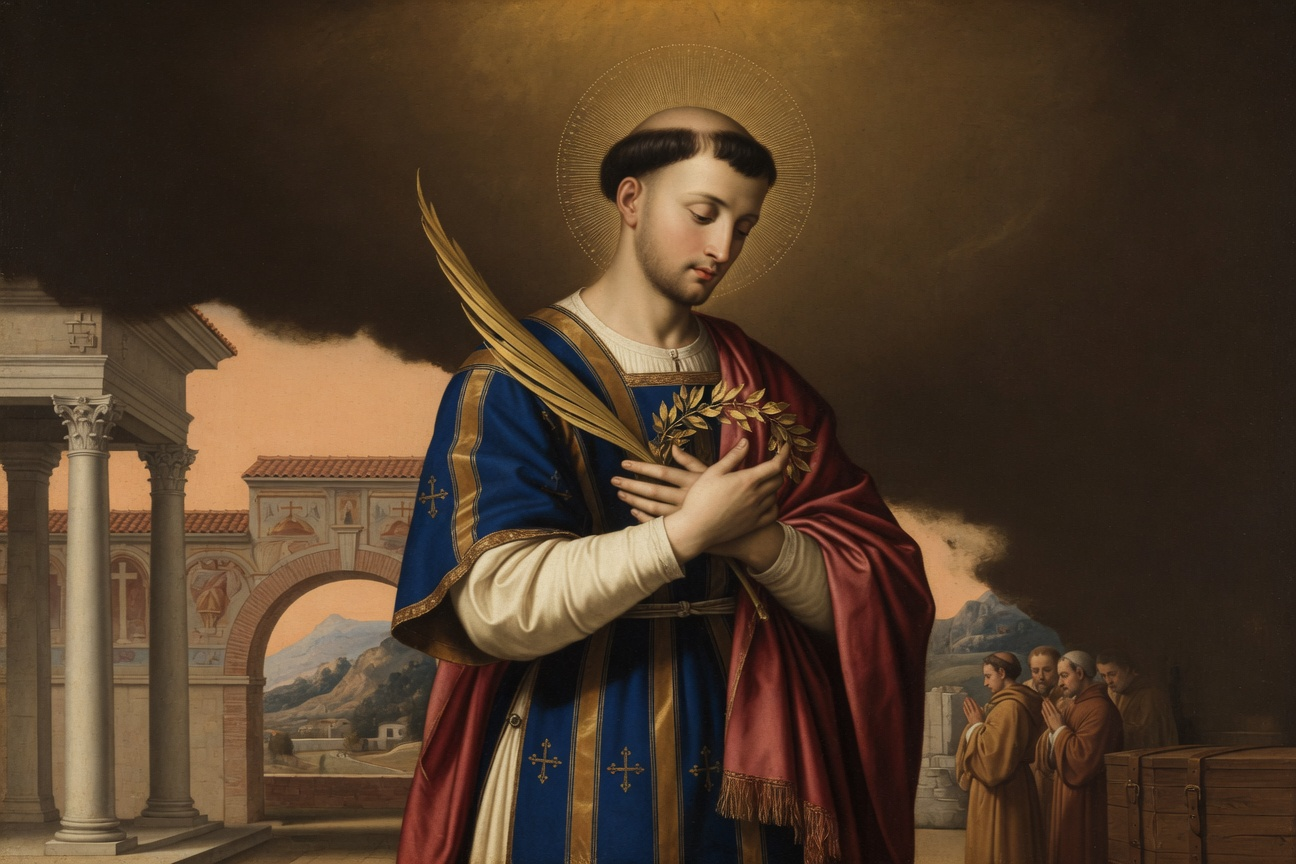
Born in Cimiez and converted to Christianity, Vincent traveled to Spain with his brother Oronce to brave the persecution of Diocletian. Accompanied by the deacon Victor, they were arrested by the proconsul Rufinus and beheaded for their faith. Their relics, miraculously transported to France, came to rest in Embrun, where they became a source of numerous miracles.
Guided reading
7 reading sections
SAINT VINCENT, SAINT ORONCE, AND SAINT VICTOR
MARTYRS, HONORED IN GAP AND EMBRUN
Origins and conversion
Vincent and Orontius, two brothers of noble pagan origin born in Cimiez, convert to Christianity and evangelize their own family.
Towards the end of the third century, in a considerable city of the Maritime Alps at that time, named Cimiez, not far from Nice, two brothers wer e born: Vincent Martyr from Cimiez, main protagonist. Vin cent a Oronce Brother of Saint Vincent and companion in martyrdom. nd Orontius. Their parents, of illustrious origin, were pagans. But God, who had designs of mercy for these two young men, soon called them from the darkness of infidelity to His admirable light.
The Gospel, proclaimed from the very time of the Apostles in the Alps and in Gaul, already counted many disciples. Vincent and Orontius therefore heard the word of life; disillusioned with vain beliefs, they submitted to the truth and asked for baptism.
Scarcely neophytes, they became apostles. Their first conquest was their own family. Heaven granted them the sweetest, most intimate consolation that children can taste on this earth: that of procuring the life of the soul for those from whom they received the life of the body.
This first success only increased their zeal. They resolved to leave the comforts of family, to bid farewell to their homeland, and to go and carry afar the good news they had received.
Mission in Spain
Learning of the persecutions in Spain, the two brothers traveled there to support the faithful and met Bishop Pontius and the levite Victor.
A violent persecution was then staining the northern provinces of Spain with blood. The cruel emperors Diocletian and Maximian had found, in the proconsul Rufinus, a fierce executor of their hatred against the disciples of the Gospel. The account of these violent struggles, having reached the ears of Vincent and Oronce, had inflamed their courage and excited their charity; they formed the heroic plan to go and support their brothers in the faith and to gather for themselves the palms of martyrdom; and, without being deterred by the length, the difficulties, and the perils of this journey, they took, full of ardor, the road that leads to Spain. The persecution had scattered the stones of the sanctuary, piled up ruins, and watered the debris of this desolate Church with blood. Bishop Pontius, followed by a large crowd, was then fleeing before the tyrant and was going to seek, in some deep solitude, a shelter against the sword of the persecutors and a place safe enough for him to set up an altar without fear and to worship his God in complete freedom. With him fled a pious levite named Victor, alre ady fa Victor Roman veteran martyred with the legion. mous for several miracles and well known for his heroic devotion to the Christian cause. It was near Girona that our young apostles, breathing zeal and faith, met Pontius and the multitude that accompanied him in his retreat. After having mingled their tears and joined their sorrows to those of the venerable prelate, they told him the motive of their journey, and how they hoped to soften the sufferings of their brothers by supporting their courage in the midst of these harsh trials. The bishop, full of admiration, blessed them, then they parted ways. But Victor could not see them leave alone; he asked for and obtained permission to assist them in their holy enterprise and their perilous ministry.
Martyrdom of Vincent and Orontius
After a period of preaching, Vincent and Orontius are arrested by the proconsul Rufinus and beheaded for their refusal to sacrifice to idols.
Our three confessors traveled through the towns and cities, bringing to the faithful words full of strength and generous ardor.
After fulfilling this holy mission with all the zeal and self-denial that charity places in the heart of an apostle, and understanding that martyrdom could no longer delay their hopes, they withdrew to Victor's country house to refresh their souls in prayer and prepare for the final struggle. This country house was likely located near Julia Lybica, today Puycerda, the homeland of Victor.
Their ardent aspirations toward heaven were about to be satisfied. Rufinus, informed of their evangelical journeys, had flown into a rage; he had sworn to make them cruelly atone for their audacity and to wash away their disobedience to the emperors' orders in their blood.
The retreat where they had shut themselves away without much precaution was easily discovered. Rufinus, followed by a few soldiers, appeared before Victor's house. But at the insistence of this generous young man, Vincent and Orontius had consented, albeit reluctantly, to withdraw, having first made him promise that he would reveal their asylum if the proconsul demanded it. Rufinus, furious, addressed bitter reproaches to the holy deacon: "How," he said to him in an insulting tone, "how dare you harbor in your home these two seducers who come, even before my eyes, to propagate the superstition that I am enjoined to destroy? I swear by Jupiter, if you do not reveal the retreat of your guests to me, I will unleash the full weight of my anger upon you yourself." — "No," replied Victor, with noble courage and after arming himself with the sign of the cross; "no, they are not seducers, these men whom you seek to make the victims of your impiety; they are the friends of the almighty God and the servants of Jesus Christ; the savior and master of the world, yours and mine... Not far from here, on the neighboring mountain, they are asking, for themselves and for their brothers, for an abundance of heavenly blessings."
Without losing time, Rufinus hurried his steps toward the mountain.
Meanwhile, the servants of God, in expectation of an imminent arrest, were praying.
They were still praying when Rufinus, trying in turn threats and promises, cried out: "Wretches, are you then ignorant of the orders and the power I have received to pursue, until extinction, all who bear the name of Christian? Do not be such enemies to yourselves as to defy my wrath. Sacrifice to the divinities of the empire, and by your submission to the laws, merit my protection, which can raise you to positions and honors."
Insensible to this false pretense of passionate and cruel interest, our saints limited themselves to replying with unalterable calm: "Order what you please; but we remain faithful to the living God, and we trust in Jesus Christ, who has redeemed us by his precious blood." At this response, Rufinus, furious to see his advances disdainfully scorned, summoned the executioners. The heads of Vincent and Orontius fell, and their souls ascended bright and glorious toward the heavens.
Martyrdom of Victor and his parents
Victor is in turn arrested and executed with his parents, Aquilina and her husband, who show great firmness in the faith.
Victor had foreseen this bloody outcome; he wished to go and venerate the mortal remains of the two martyrs, to shield them from profanation, and to render them the honors of burial. He therefore prostrates himself, seized with religious respect, before these precious remains; he kisses them with love, wraps them with care, and carries them secretly to his dwelling to hide them from the sacrilegious profanations of the persecutors.
But the holy relics were not to remain long in the secrecy of the tomb. The holy bishop Pontius had received a revelation from the Lord. Jesus Christ had appeared to him and ordered him to place the bodies of the martyrs on a chariot and have them transported to their homeland. Pontius, having shared the designs of heaven with Victor, charged him with the pious undertaking.
The holy deacon set about executing the orders of his bishop; the chariot was ready, Victor was about to depart; but the cruel proconsul would not let this victim escape him. His emissaries seized the courageous Levite and led him before their master.
The interrogation was not long; the holy confessor had to choose between sacrificing to the gods or dying. To this dishonorable proposition, he replied: "I offer my incense and my homage only to the Lord Jesus, the son of the King of kings; as for your ridiculous divinities, I profess for them only a sovereign contempt."
Irritated by this noble resistance, Rufinus had the generous Victor led to the very place where his two friends had been immolated; then, with a refinement of cruelty common in that time, his arms were first cut off, and then he was beheaded.
His parents, arrested with him, were dragged to the place of execution. At the sight of the blood, the martyr's father was shaken; but Aqu Aquilina Mother of Saint Victor, martyred with her son. ilina, his wife, filled with manly courage, restrained him: "Let us remain firm," she said, "and let us die for Jesus Christ, since for Jesus Christ we have lived." These words communicated an incredible ardor to the old man; his heart was warmed by it, and he saw death approach without fear. Their heads fell beside that of their son; the floods of their blood mingled, and their souls, victorious in the same struggles, shared the same triumph.
Happy are the families whose members all follow thus, with perseverance, the path of heaven, and encourage one another in the practice and heroism of the faith!
Translation of the relics to Embrun
The transport of the bodies toward Cimiez is interrupted at Embrun by a miracle involving oxen, signaling the divine will to leave the relics on site.
However, the orders of Pontius, inspired from above, had to be carried out: the body of Victor was placed on the cart where he himself had placed those of Vincent and Oronce, and a fervent Christian named Hector consented to drive the glorious remains to Italy. The angels of the regions he traversed directed his path.
The convoy had arrived near Embrun when suddenly the oxen yoked to the cart stopped and made the valley resound with their lowing. In vain they were urged, in vain they were prodded with the goad to make them move, the cart remained immobile. Arator, a venerable priest whom Providence had brought to meet the convoy, ran to announce this singular event to Saint Marcellinus, who was then il saint Marcellin First bishop of Embrun in the 4th century. luminating the archiepiscopal see of Embrun with his virtues and miracles. "Lord," he said, "I have just seen a most extraordinary thing." — "What then, my brother?" replied Saint Marcellinus. — "The bodies of three martyrs beheaded in Spain are being carried on a cart, and the one driving it says he wishes to go to Cimiez in Italy. Now, having barely arrived in front of the pavilion of the Jews, where you know that a crypt has just been built, so rich, so well constructed of cut stone and covered in precious marble, the cart suddenly stops. The oxen low; in vain they are tormented; the cart is as immovable as our mountain."
The holy prelate judged, at that very hour, that God alone could be the author of the miracle. Having prostrated himself on the ground, he cried out with emotion: "Eternal God, who presides over all, grant one more favor to this poor city, and permit it to glory in possessing these holy bodies." After which he went to the scene of the event, questioned the driver; then, happy and proud of this new treasure with which Heaven seemed to wish to enrich his church, he sought a tomb worthy of the holy relics.
Conversion and expansion of the cult
The Jewish owner of the crypt converts after the miracle, and the site becomes a pilgrimage center famous for its healings.
Marcellinus proposed to the Jew, master of the crypt of which we have spoken, to buy it from him; he offered him double its value, with a prayer to cede it. But, suddenly, the Jew was touched by an interior grace: he abandoned the monument to the holy archbishop, while refusing the sum offered, and replied with tears: "God declares Himself in favor of the martyrs of your faith. Do not count me any longer among the infidels; for I believe, I and all my family. I ask you for neither gold nor silver; dispose of this tomb and of all my house, but do not refuse me baptism."
The sepulcher of the martyrs soon became famous throughout the region for the countless wonders that never ceased to occur there. The sick and the possessed were brought there in crowds, and all returned healed, delivered, and blessing God.
The report of these wonders soon spread beyond the mountains, and the cult of the three martyrs penetrated into all the Maritime and Cottian Alps. For a long time it was held in great honor there, and we see in contemporary annals that in the sixth century, the monastery of Novalesa in Savoy, or as others say that of Lyons in Switzerland, insistently requested and obtained as a treasure a portion of the glorious relics.
Posthumous history of the relics
The relics, rediscovered in 1435, were finally lost or destroyed during the Wars of Religion in 1585.
During the last incursion of the Saracens into the Alps, at the beginning of the tenth century, the church of Embrun lost the venerated remains of these holy martyrs. The Christians had perhaps hidden them to prevent them from being profaned by the impiety of these barbarians. Later, in 1435, under the episcopate of Mgr Jean Giraud, workers digging in the parish church of Saint-Vincent, built by Saint Pelade and consecrated by Saint Galican II, his successor, discovered these precious relics, which were once again exposed to the veneration of the inhabitants of the city and the diocese.
The feast of the holy martyrs Vincent, Oronce, and Victor is celebrated today throughout the diocese of Gap on the 22nd of January, the day on which it is inscribed in the Roman Martyrology. But that of the invention of the relics of the same holy martyrs has been suppressed, because the misfortune of the times did not allow the cathedral of Embrun to save them from profanation and annihilation during the looting of the metropolis by the Protestants on March pillage de la métropole par les protestants Event that led to the definitive loss of the relics in 1585. 15, 1585.
We have sometimes analyzed, sometimes reproduced the Hagiological History of the diocese of Gap, by Monseigneur Dépery.
Annexes & related entities
Structured data for exploration: events, miracles, quotes, places, attributes, patronages, and important entities cited in the text.