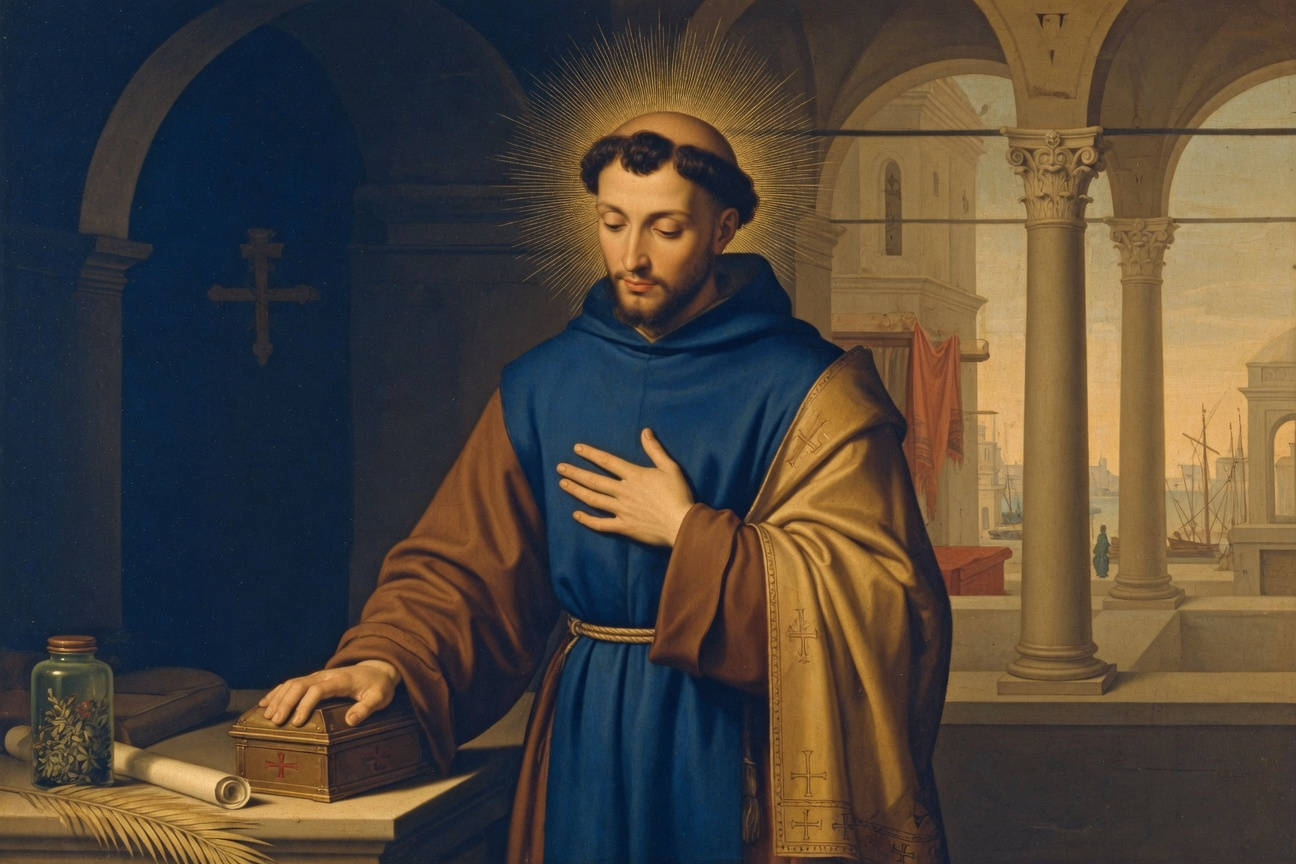
Saint Cyrus
SAINTS ATHANASIA, THEODOSIA, THEOCTISTA, AND EUDOXIA, MARTYRS
Physician, Monk, and Martyr
A physician from Alexandria who became a monk, Saint Cyrus was martyred under Diocletian with his companion John and four women (Athanasia and her three daughters). After enduring various torments for encouraging young virgins to remain steadfast, he was beheaded. His relics, initially in Alexandria, were later transferred to Rome.
Guided reading
6 reading sections
SAINTS CYRUS AND JOHN,
SAINTS ATHANASIA, THEODOSIA, THEOCTISTA, AND EUDOXIA, MARTYRS
Vocation as a physician and monk
Under the reign of Diocletian, Cyrus, a physician in Alexandria, heals bodies and converts souls before retiring to Arabia as a monk to escape persecution.
Reign of Diocletian.
Cyrus was fr Cyr ou Cyrus Young three-year-old martyr, son of Saint Julitta. om Alexan dria itsel Alexandrie Place of refuge and study during the persecution. f; he practiced the profession of physician there, healing souls of the errors of paganism no less than bodies of their diseases. He was denounced to the governor for turning people away from the worship of idols and persuading them to worship Jesus the Crucified. The governor gave orders to arrest him. The Saint took refuge on the borders of Arabia, changed his attire, shaved his head, took the monastic habit, and continued to heal bodies and souls through faith and prayer alone.
The alliance with John
John, a former soldier on a pilgrimage, joins Cyrus in Egypt, drawn by his reputation for holiness and healing.
John Jean Roman martyr beheaded in 363. was of illustrious birth and held a high position in the secular militia. Having gone on a pilgrimage to Jerusalem, he came to Egypt and joined Cyrus, drawn by the report of his miraculous healings. Edifying one another, they made new progress in virtue every day.
Support for the virgins of Canopus
Learning of the arrest of Athanasia and her three young daughters in Canopus, Cyrus and John return to Alexandria to encourage them in their faith in the face of torture.
The persecution having intensified, three Christian virgins of Can Canope Temporary place of residence for Arsenius in Egypt. opus, consecrated to Jesus Christ, were arrested with their mother At Athanasie Mother of the three virgins martyred with Cyrus and John. hanasia and presented to the Syrian governor. Saint Cyrus, having learned of this in his retreat, greatly feared that these children, intimidated by the sight of the tortures, might come to deny their heavenly spouse, especially becau se of thei Théoctiste The eldest of the three virgin martyrs. r great youth. For Theoctiste, the eldest of the three, was only fifteen years old, Theodosia, the second, was thirteen, and Eudoxia, the last, was in her eleventh year.
Saint Cyrus therefore returned to Alexandria, accompanied by John. They entered the prison, they exhorted the young virgins to place their trust in Jesus Christ, to whom they had consecrated themselves, and who would himself be their strength in the midst of the torments; they thus inspired in them a courage beyond their age and their sex.
The collective martyrdom
After refusing to apostatize despite promises and tortures, Cyrus and John witness the execution of Athanasia and her daughters before being beheaded themselves.
The governor, having learned of this, had them both brought before his tribunal, along with the three virgins and their mother. He intended to lead the latter into the apostasy of the two men, or to frighten them with their torment. He first tried to win over Cyrus and John with promises; he offered them money, honors, and positions if they would return to the religion of the prince. Upon their refusal, he made them endure all kinds of torments, lashes, iron, and fire. Seeing these two men insensible, as if they had suffered in a foreign body, he had them set aside and began to torment the young virgins and their mother. As they remained unshakable, he had the mother and the three daughters beheaded. After which he tried again on the two martyrs, Cyrus and John, all kinds of promises and tortures, and finally had them beheaded.
Cult and translation of relics
The bodies were first deposited in the church of Saint Mark, then transferred by Patriarch Cyril before finally being taken to Rome.
The Christians transported the bodies to the church of Saint Mark, and placed them, the three virgins and their mother in one tomb, the two friends Saint Cyrus and Saint John in another. Later, Sain t Cyril, Patriarch of Alexandria, tran saint Cyrille, patriarche d'Alexandrie Patriarch of Alexandria encountered by the saint. sferred Saint Cyrus and Saint John to the church of the Evangelists, on the seashore, where they performed an infinity of miracles.
Their bodies were later transported to Rome. If t Rome Birthplace of Maximian. herefore Rome is cited in the mention of the martyrology, it is as the place where they are honored, and not as that of their martyrdom. There is, says Baronius, on the Via Portuensis, in the region or quarter of the Basilica of Saint Paul, beyond the Tiber, an old church commonly named Saint-Passars, but which ancient manuscripts call Saint Praxedes; one reads these two solemn verses on the marble.
Here shine the holy bodies of Cyrus and John.
Alexandria the Great gave them to Rome.
Ecclesial Recognition
The panegyric of Sophronius of Jerusalem and the mentions at the Council of Nicaea attest to the enduring renown of the two martyrs.
Sophronius, Bishop of Jerusale Sophronie, évêque de Jérusalem Bishop of Jerusalem and author of a panegyric on the martyrs. m, delivered a beautiful panegyric of these Martyrs; it is cited in the second act o f the Council of concile de Nicée Council where the panegyric of the martyrs was cited. Nicaea and by Saint John of Damascus, in his third discourse on images.
Acta Sanctorum.
Annexes & related entities
Structured data for exploration: events, miracles, quotes, places, attributes, patronages, and important entities cited in the text.